












Large companies in many Australian industries today are leveraging an integrated system for business to solidify their position in the market. It is more than adopting new software; it reshapes workflows, data ownership, and how teams collaborate day to day.
This shift is rarely straightforward and demands careful planning, strong project leadership, and clear priorities. Without a structured approach, companies can run into cost blowouts, delays, and avoidable disruption across departments.
When the rollout is handled well, ERP connects previously siloed functions into one operating view. It delivers real-time operational insight and gives the business a stable platform to scale with confidence.
Key Takeaways
ERP implementation is the structured process of deploying an ERP system and aligning it with core functions like finance, HR, operations, and sales to improve efficiency and visibility.
The ERP implementation life cycle runs from discovery and scoping through design, data migration, testing, training, go-live, and post-launch optimisation to ensure stable adoption and measurable business impact.
In Australia, timelines are usually 3–6 months for SMEs and 12 months for complex rollouts, with delays often caused by data issues and scope creep.
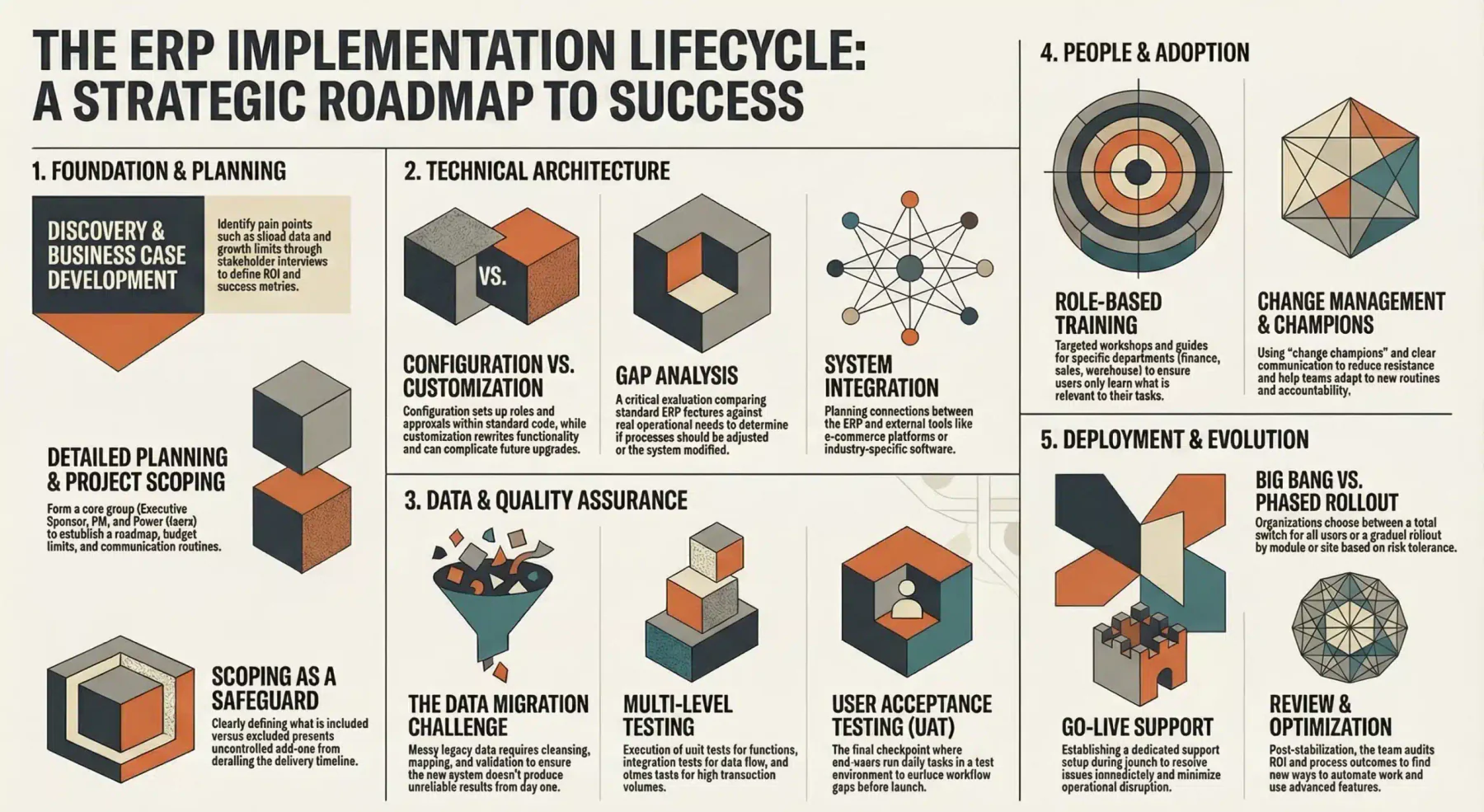
Australian business leaders often ask how long an ERP implementation takes, and the honest answer is that it varies. Timelines depend on company size, operational complexity, user count, and whether its a cloud-based management system or on-premise.
For SMEs adopting a cloud ERP with minimal customisation, projects commonly take around 3 to 6 months. Using prebuilt templates and standard workflows helps teams reach value faster with core modules.
Larger companies with complex supply chains, manufacturing needs, or compliance requirements may need 12 months to several years. These rollouts often include heavy data work, integrations, and phased deployments to reduce risk.
Delays usually come from poor data quality, scope creep, or limited internal capacity. A realistic plan must include time for testing, cleansing data, and supporting teams through the operational change.
Key Principles for a Successful ERP Rollout
Success in ERP projects is rarely a matter of luck. It is the result of adhering to proven strategies that mitigate risk. While every company is unique, the following best practices are universally applicable and can significantly increase the probability of a successful deployment.
- Secure executive sponsorship early: Appoint a visible executive sponsor early to remove roadblocks, approve key decisions, and drive cross-team adoption.
- Invest in change management: Run structured change management with consistent communication and user involvement so employees understand the impact and actually use the system.
- Prioritize data quality before migration: Clean and standardize data from the start to prevent inaccurate reports and lost user trust after go-live.
- Don’t over-customize: Stick to standard ERP features where possible and customize only when it delivers clear competitive value and won’t complicate upgrades.
- Plan for post-go-live support: Prepare strong post-launch support and training to reduce the productivity dip and keep improving the system after deployment.
Common ERP Implementation Challenges (and How to Avoid Them)
"Most ERP failures are not caused by technology, but by underestimated change, poor data readiness, and lack of user buy-in. Companies that acknowledge these risks early are far better positioned to control costs and protect timelines."
Even with the best planning, challenges will arise. Being aware of these common pitfalls allows project teams to develop mitigation strategies proactively.
1. Scope creep: New feature requests can inflate timelines and costs, so enforce strict scope control and park non-critical ideas in a “phase two” list. Evaluate every change request against the business case and schedule before approving it.
2. Insufficient training: Generic or rushed training drives errors and off-system workarounds, so keep it role-based and close to go-live. Give users a sandbox to practise safely.
3. Data integration issues: Integrations can fail due to mismatched data formats or sync gaps, so test integrations thoroughly. Bring technical experts in early to spot compatibility risks before they block progress.
4. Employee resistance: Some staff may fear loss of control or job security, so involve key influencers in design and testing. When their input is used, adoption improves and resistance drops.
How to Choose the Right ERP Implementation Partner in Australia
The right partner acts as a trusted advisor, guiding the business through the technical and cultural complexities of the project.
1. Industry expertise
Choose a partner with proven experience in your sector so they understand operational realities and Australian regulatory requirements. Industry knowledge helps them anticipate risks and deliver practical solutions faster.
2. Local support and presence
A partner with an Australian presence can support critical phases like workshops, UAT, and go-live more effectively. Local knowledge of ATO and employment rules also ensures compliance from day one.
3. Methodology and cultural fit
Evaluate whether their delivery approach, whether agile or structured, aligns with your company’s culture. Strong cultural fit supports smoother collaboration and better project momentum.
4. Vendor agnostic vs specific
Confirm the partner has deep certification and strong access to the chosen ERP vendor’s ecosystem. Always check references from similar Australian businesses before making a final decision.
Conclusion
ERP implementation can be demanding, but it fundamentally upgrades how an Australian business runs day to day. The effort is significant, yet the payoff is clear: tighter operations, better visibility, and a platform built to scale.
Treat the erp implementation life cycle as your guardrails, not a checklist to rush through. When each phase is owned properly, you reduce costly surprises and keep the project tied to real business outcomes.
The real win is not “going live,” but changing how teams work with cleaner data, clearer processes, and stronger accountability. To achieve success in this implementation, you can try out our free consultation services and be the business leaders you can be.

Frequently Asked Questions About ERP Implementation
In Australia, the average ERP implementation cost usually ranges from AUD $20,000 to $150,000 for small to mid-sized businesses. More complex or enterprise-level implementations can exceed AUD $250,000, depending on modules, integrations, and customisation.
Common reasons for failure include poor project management, lack of executive sponsorship, insufficient training, and resistance to change from employees. Additionally, poor data quality and undefined project scope (scope creep) often lead to budget overruns and delays.
Preparation should start with a comprehensive data audit to identify duplicate, obsolete, or incorrect records. Businesses must cleanse their data before migration, map legacy fields to the new system structure, and establish validation rules to ensure only high-quality data enters the new ERP.
Yes, appointing a dedicated project manager is highly recommended. Implementing an ERP is a complex, full-time job that involves coordinating resources, managing timelines, mitigating risks, and communicating with stakeholders. Relying on staff to manage this alongside their regular duties often leads to burnout and project delays.