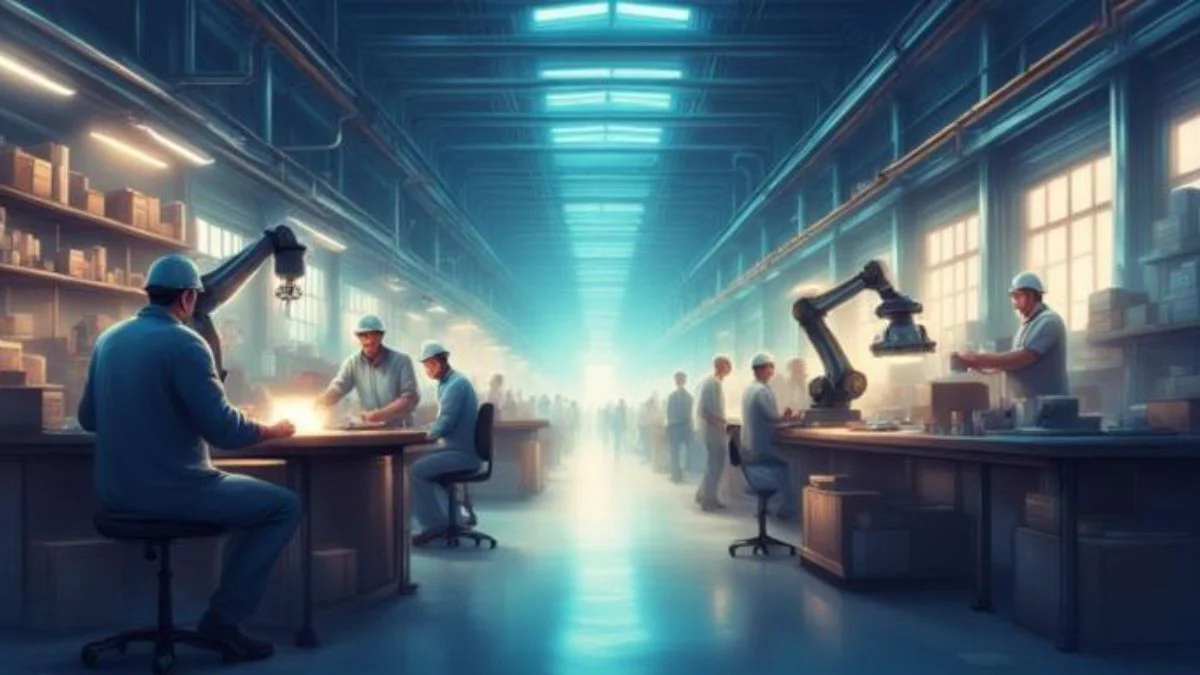






Production inefficiencies often hide in plain sight; missed updates, delayed decisions, and disconnected shop-floor data. A Manufacturing Execution System (MES) addresses this gap by monitoring, tracking, and controlling production in real time, helping factories operate more efficiently while improving productivity, quality, and cost control.
MES software ensures every process runs smoothly with automation and real-time insights. Since its debut in the 1970s and according to Industrieinformatik, it has become essential for manufacturers worldwide, helping many cut production time by up to 40%.
In this article, we’ll cover how MES System works, its key benefits, and top features. Ready to see it in action?
Key Takeaways
Manufacturing execution system (MES) is a software that supports organizations in monitoring and controlling the supervision of their production processes.
There are benefits of MES, such as improved product quality, reduced manufacturing cycle time, and the elimination of paperwork between shifts.
HashMicro MES ERP system is the best manufacturing software that will help companies to maximize the efficiency of their production process.
What is a Manufacturing Execution System?
A practical manufacturing execution system definition is software that monitors, tracks, and controls factory operations in real time. For readers asking what a manufacturing execution system is, MES connects machines, workers, production orders, and enterprise data to provide consistent visibility into shop-floor performance.
It helps manufacturers reduce downtime, maintain product quality, improve traceability, and make faster decisions. Integration with ERP software and factory equipment also enables the system to automate workflows and exchange information across departments.
How an MES System Works
Understanding how a Manufacturing Execution System (MES) works is crucial for better manufacturing. It uses real-time monitoring to closely oversee the factory, ensuring that everything in the production line operates smoothly.
MES and ERP integration are vital for seamless information sharing. Connecting management with the production process enhances decision-making, making it smarter and faster, which, in turn, improves the performance of both machines and personnel.
Additionally, MES software, often paired with production planning software, manages scheduling by using up-to-the-minute data to oversee job orders and track progress precisely. This allows for accurate prediction of job completion times and enables adjustments to meet production goals effectively.
Here’s a table showing how MES makes manufacturing better by combining different tools:
| MES Functionality | Benefits |
| Real-Time Manufacturing Monitoring | Enhanced visibility and instantaneous feedback on production activities. |
| MES and ERP Integration | Streamlined data flow, improved resource planning, and strategic decision-making. |
| Shop Floor Control | Empowers production managers to directly control and adapt manufacturing operations. |
| Production Scheduling | Effective allocation of resources and precise schedule management to meet manufacturing deadlines. |
An MES Systems can make your manufacturing benefit smarter, faster, and more connected. Being able to plan ahead and adjust quickly is key in competitive manufacturing. With a good MES, your operations can become more efficient and effective.
Key Benefits of Using an MES System
Learn how a manufacturing execution system software can greatly better your production. MESA research report explains that around 22% of companies feel that the implementation of MES systems can improve timeliness in the production process.
Below are the benefits of manufacturing execution system software that may help your business grow better:
- Improves product quality: A MES manufacturing execution system checks every product against tough standards. This lowers mistakes and makes customers happier.
- Reduces manufacturing cycle time: MES sytstem makes production faster by automating workflows. With the integration of AI in manufacturing, it optimizes processes, ensuring a smoother workflow from beginning to end.
- Empowers plant operations people: Operators can act quickly with the real-time data MES gives. This makes work more efficient and improves how fast you can respond.
- Reduces lead times: Production steps and resources are better managed with MES System. This cuts down time between steps, making things happen faster.
- Eliminates paperwork between shifts: Moving from one shift to the next is smooth without paper. Manufacturing execution system keeps everything going without the slow of manual documents.
- Improves the planning process: MES lets you plan more accurately. This means making the most of every resource you have.
- Reduces setup costs: Setting up costs less because MES System makes machine setups and work schedules work better together. This saves money.
- More reliable and precise sequence planning: Production steps are managed more carefully with MES. This means each step follows well from the last, cutting down mistakes and stoppages.
All of these benefits of manufacturing software combine to make your manufacturing work better. Choosing a manufacturing execution system prepares your place for growing and keeping high quality and efficiency in production.
Core MES Features
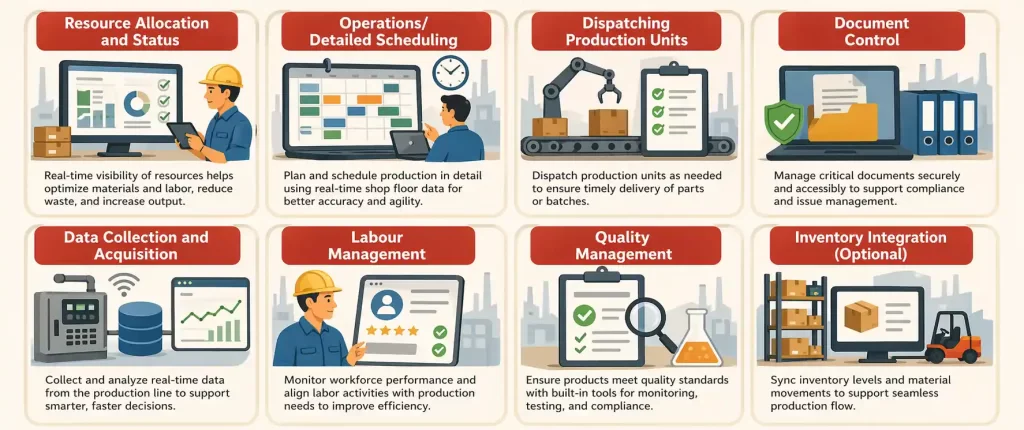
When you look closer at Manufacturing Execution Systems (MES), understanding its key features is important. This can make a big difference in how well your process manufacturing runs.
Below, we provide the core features that should be available in an MES system:
- Resource Allocation and Status: MES systems that give real-time updates on your resources are very helpful. They let you use materials and workers better. It cuts down on time wasted and boosts what you can make.
- Operations/Detailed Scheduling: MES manufacturing execution system has tools, such as an advanced planning system, that let you plan things out down to the detail. You can use up-to-the-minute data from the floor.
- Dispatching Production Units: Being able to send out production units as needed is a key feature. It ensures all parts or batches are on time.
- Document Control: Manufacturing execution system helps handle important docs for rules and how things work. It keeps documents safe and easy to get to. This helps with managing issues.
- Data Collection and Acquisition: MES manufacturing execution system at its heart is about getting and sorting through data from the production line. It gives makers the info they need to make smart choices.
- Labour Management: Manufacturing ERP or MES System makes it easier to watch worker performance. It lines up what workers do with what’s needed in production. It makes things work better and boosts what you can do.
- Quality Management: MES includes tools for making sure products meet standards. This is key for keeping your brand trusted by customers. It’s all about making quality a top priority.
Using these MES System features and implementing other related inventory software can change how well you control production. They use tools like statistical process control to be efficient and adapt to the needs of manufacturing today.
The Evolution of MES Standards

During the late 1990s, the International Society of Automation introduced the ISA-95 framework. ISA-95 establishes a blueprint for defining and synchronizing operations between enterprise systems and control mechanisms. By unifying terminology, ISA-95 facilitates seamless communication among parties such as vendors and producers.
ISA-95 delineates the connection between control systems and enterprise operations by creating hierarchical levels for technological and organizational workflows. A streamlined representation of this hierarchy positions manufacturing execution systems (MES) at tier three:
- Level 4: ERP (enterprise resource planning and logistics).
- Level 3: MES (management of manufacturing operations).
- Level 2: Process control systems for batch operations.
- Level 1: Process control systems for continuous operations.
- Level 0: Process control systems for discrete operations.
MES Trends and Applications Across Industries
Manufacturing execution system technology continues to evolve as factories adopt more connected production methods. A manufacturing execution system example differs by industry. For example, an automotive plant may prioritize equipment performance, while pharmaceutical manufacturers depend more heavily on batch traceability, quality controls, and compliance records. The following trends show how modern MES systems support manufacturing operations across various sectors.
1. Artificial intelligence and machine learning
MES platforms increasingly use AI and machine learning to identify production patterns, detect anomalies, predict equipment issues, and recommend process adjustments. These capabilities help manufacturers reduce disruption and make faster decisions based on current shop-floor conditions.
In the automotive industry, for example, AI-enabled MES software can detect recurring assembly problems and predict maintenance needs before machinery interrupts vehicle production.
2. Compliance and production traceability
MES software can maintain electronic production histories, approval records, batch details, and quality checkpoints. These records help manufacturers verify whether required procedures were completed. Pharmaceutical companies can trace ingredients and processing activities across each medicine batch, supporting investigations and product-quality reviews when deviations occur.
3. Connected planning across business operations
Integrating MES with the right ERP and supply chain platforms allows production orders, inventory quantities, material requirements, and delivery schedules to move between departments. Consumer goods manufacturers can use this connected environment to adjust production when demand changes while coordinating purchasing, warehousing, and distribution activities.
4. Cloud-based MES deployment
Cloud MES solutions allow manufacturers to access production information across different facilities without maintaining all infrastructure locally. They can support easier system expansion, centralized reporting, and collaboration between multiple production sites.
Electronics manufacturers, for example, can use a cloud-based MES to compare output across factories and quickly distribute revised production instructions when product designs or component requirements change.
5. Shop-floor access through handheld devices
MES functions are increasingly available through smartphones and tablets, allowing employees to record activities and review operational information near the production line. Food and beverage manufacturers can use mobile devices to confirm recipe steps, document temperature readings, and report food-safety issues directly from processing areas.
6. Advanced manufacturing analytics
MES platforms collect data from machines, operators, work orders, materials, and quality inspections. Then the aggregated information gets converted with advanced analytics into insights about bottlenecks, cycle times, downtime, defects, and resource usage.
Aerospace and defense manufacturers can analyze production data to identify delays or quality deviations within complex assemblies where every component and process stage requires precise documentation.
7. Enhanced interfaces and visualization
Contemporary MES software presents production conditions through role-based dashboards, interactive displays, and visual alerts. Some platforms also support augmented reality or three-dimensional work instructions. In medical device manufacturing, visual guidance can help operators complete delicate assembly steps while confirming that mandatory inspections and documentation have been recorded.
Challenges of implementing an MES system
Implementing a manufacturing execution system is complicated no matter the industry because it handles shop-floor processes, business data, technology, and people. Beyond understanding what manufacturing execution system software is, companies must align the MES system with existing operations, compliance requirements, security controls, and employee workflows before it can deliver reliable production visibility.
| Challenges | What is it | Common cause |
|---|---|---|
| Data integration | An MES system must exchange production, inventory, engineering, and planning data with ERP, PLM, SCM, and other authoritative platforms without losing accuracy or timing. | Legacy interfaces, inconsistent field formats, duplicate records, weak data governance, and unclear ownership often require extensive mapping, cleansing, customization, and synchronization work. |
| Regulatory compliance | The manufacturing execution system must preserve traceable records, approvals, quality checks, and audit evidence while supporting the rules governing each regulated production environment. | Requirements differ across pharmaceuticals, food production, aerospace, and other sectors. Incomplete validation, outdated procedures, or poorly configured recordkeeping can create compliance gaps. |
| Implementation complexity | MES deployment requires process design, configuration, testing, integration, validation, and a carefully staged operational transition before the platform can support production reliably. | Unclear scope, underestimated customization, limited internal expertise, weak project governance, and unrealistic timelines can cause delays, additional costs, rework, and operational interruptions. |
| Limited operational visibility | MES may connect planned ERP demand with actual shop-floor output, but incomplete system coverage can prevent managers from identifying delays, quality problems, and resource constraints. | Disconnected machines, manual reporting, delayed data capture, inconsistent metrics, and poorly designed dashboards create blind spots even after the platform becomes technically available. |
| Production data security | MES platforms manage sensitive information such as product designs, process settings, quality results, and production volumes, making protection against unauthorized access and cyberthreats essential. | Weak access controls, unencrypted data, outdated infrastructure, unsecured networks, and excessive user permissions increase the risk of information exposure, manipulation, or operational disruption |
| Workforce adoption | Moving to a paperless MES system changes established tasks, responsibilities, approvals, and reporting practices. Employees must understand both the technology and the revised operating procedures. | Limited training, unclear communication, insufficient leadership support, and employee resistance can reduce adoption, encourage manual workarounds, and prevent the system from delivering consistent results. |
How an MES System Integrates with ERP in the Philippines
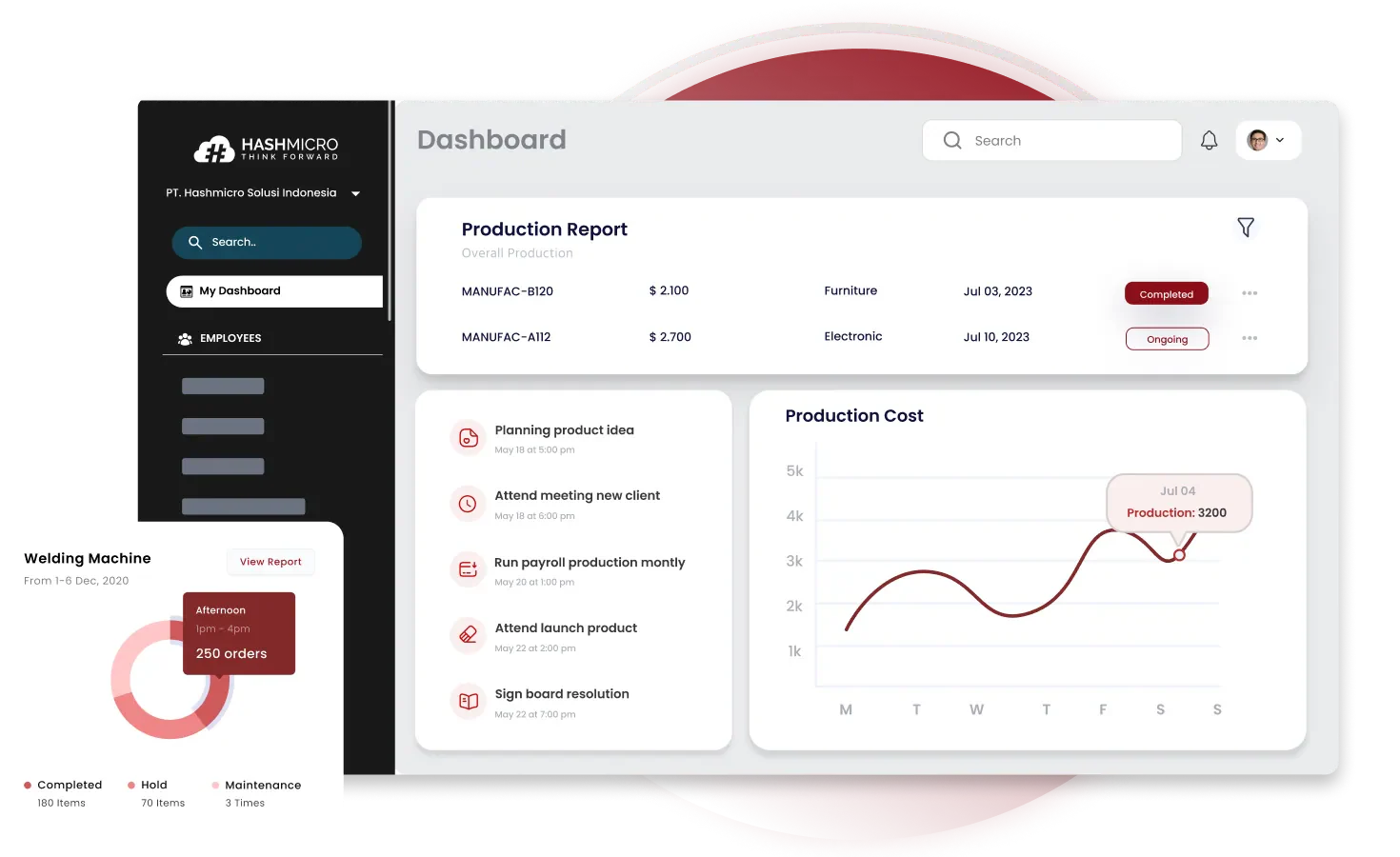
One of the best choice is HashMicro MES system. It is a top choice in the high-tech world of Philippines’ manufacturing as it blends easy use with strong technology. This changes how factories work, giving instant data.
Equipped by complete features and modules, HashMicro MES ERP system is the best manufacturing software that will help companies to maximize the efficiency of their production process.
Below are the benefits of adopting HashMicro MES software for your company:
- Cloud-based MES: HashMicro MES uses cloud tech, meaning it’s easy to grow and doesn’t need big starting costs. This boosts security and keeps updates smooth, always keeping your plant on the edge of tech.
- Big Data Analytics: This MES has big data skills, pulling in and understanding huge amounts of info as things happen. It helps you really know your plant and provides supporting choices to make it work better.
- IoT Integration: With IoT, HashMicro MES talks to your machines and sensors. It sees each step in your manufacturing, helping you move quickly and wisely.
- AI and Machine Learning: Its use of AI and learning helps HashMicro MES act on your needs ahead of time. This smart tech automates and fine-tunes your plant, running it at its best.
- Enhanced User Interfaces and Visualization: The design makes it easy to use, and the view makes tough info simple to understand. Everyone can see what to do next at a glance.
- Integration with Other Modules: It blends well with other systems like manufacturing accounting, making it a hub for all your management needs. It simplifies running different sectors together.
To explore the best solutions for your business, check out HashMicro’s ERP software. Discover our pricing schemes below and find the right package for your needs.

Conclusion
Manufacturing Execution Systems have changed the way factories work. They are key in making manufacturing efficient, which helps companies be more successful. These systems improve the quality and accuracy at every step of making products.
In the Philippines, using these systems can make a company’s factory very productive. HashMicro’s systems are leading this change. They work well with other software, improving manufacturing better than before.
Adding HashMicro MES to your factory helps deal with fast changes and new tech. It’s more than just a tool; it’s a partner in reaching your manufacturing goals. For companies in the Philippines, choosing top MES technology, like HashMicro, means investing in future growth and success. Try a free consultation now!

FAQ about Manufacturing Execution System
Yes. One manufacturing execution system example for a small or mid-sized factory is a phased deployment that first digitizes work orders, material use, quality checks, and output reporting. A modular MES system can reduce manual work and improve real-time production visibility without requiring every facility or function to go live simultaneously.
The manufacturing execution system definition covers production monitoring, traceability, and shop-floor control, not tax filing. An MES system can preserve production histories, approvals, quality checks, and audit records, but BIR reporting usually sits within an integrated Philippine-localized ERP or accounting module. Any configuration should be validated against current regulatory requirements.
A manufacturing execution system implementation typically takes several weeks to several months. The schedule depends on factory size, number of sites, process complexity, data quality, required customization, equipment connectivity, ERP integration, testing, and employee training. A phased MES system rollout can reduce disruption by implementing critical production workflows first.
For readers asking what a manufacturing execution system is in relation to ERP, MES manages shop-floor execution while ERP handles business planning and resources. The systems integrate by synchronizing production orders, material consumption, inventory movements, quality results, and completion data, aligning planned demand with actual output to improve scheduling, costing, traceability, and control.
Three established manufacturing execution system options Philippine manufacturers can evaluate are HashMicro Manufacturing, Siemens Opcenter Execution, and GE Vernova Proficy Smart Factory. HashMicro emphasizes integrated planning and operational visibility; Siemens supports specialized manufacturing environments; and Proficy offers cloud and on-premises MES. Compare industry fit, scalability, integrations, compliance, implementation costs, and local support before choosing.