







Ever discovered that a product was out of stock only after a customer placed an order? Or found shelves packed with items that barely sell? These situations often point to gaps in inventory control. When stock records fail to reflect what is actually available, businesses risk missed sales, wasted storage space, and purchasing decisions that hurt profitability.
An inventory control system can help prevent these problems by giving businesses a clearer picture of their stock, from incoming goods to outgoing orders. But with different control methods and software options available, where should you start? Understanding how these systems work, what they offer, and how they fit different business needs can help you build a more reliable approach to managing inventory.
Key Takeaways
Inventory control systems track stock across purchasing, shipping, receiving, warehousing, and returns while supporting accurate levels and timely reordering.
Types of inventory control systems include perpetual real-time updates and periodic counts at set intervals, suited to different business sizes and stock volumes.
Importance of inventory control systems includes real-time visibility, smoother logistics, lower costs, fewer manual errors, and better customer experiences.
Best inventory control systems combine forecasting, quality control, pick-pack-delivery, barcode and QR integration, returns, RFID, and live dashboards.
What Is an Inventory Control System?
Managing inventory is crucial to running a business, as it helps you maintain appropriate stock levels to meet customer demand. An effective inventory management approach can help increase profitability by reducing the cost of goods sold and improving sales through better stock availability. This approach can be done with an inventory control system.
This system is a technology-based solution that manages and tracks a company’s goods throughout the supply chain, integrating purchasing, shipping, receiving, warehousing, and returns. Businesses comparing Singapore inventory platforms can assess how each option supports these workflows. A good inventory control system automates manual processes, provides an accurate inventory count, and helps businesses maintain optimal stock levels by notifying them when to reorder.
2 Types of Inventory Control System

Nowadays, advancements in technology have led to the integration of machine learning. This is because of the significant changes in the inventory control systems over time. Due to the changes, there are two types of inventory control systems that we use.
Strengths and Weaknesses of Each Inventory Control Methods
Inventory control methods differ in update frequency, automation, labour requirements, and stock visibility. Comparing these factors helps businesses choose a system that matches their operations.
| Inventory control method | Strengths | Weaknesses | Best suited for |
|---|---|---|---|
| Perpetual inventory system | Updates stock records continuously through software and automation. It provides near-real-time visibility, supports reporting and auditing, and helps teams make faster replenishment decisions. | Requires software, equipment, implementation, and staff training. Scanning errors, theft, loss, damage, or missed transactions can still create inaccurate records. | Businesses with high stock volumes, fast-moving products, frequent transactions, multiple locations, or strict stockout-control requirements. |
| Periodic inventory system | Simple to manage and easy to explain to new employees. It can be suitable when inventory quantities are small and a business wants to limit technology costs. | Physical counting takes time and relies on manual labour. Stock records may be inaccurate between counts, while human error can affect ordering and fulfilment decisions. | Small businesses with fewer SKUs, slower-moving products, niche items, larger products, or higher-value goods that can be counted efficiently. |
Source: ASCM, Types of Inventory Control Systems.
Perpetual inventory system
It is a type of inventory control system that updates inventory in real-time. The system operates by scanning the barcode of a product when it is sold, instantly removing it from the global inventory database. Conversely, when a new product is received, it is scanned and added to the database.
All parts of the system have access to the same database, enabling an accurate accounting of inventory levels without the need for manual inventory counts. Other than that, this system also provides a highly detailed view of inventory changes. It is suitable for businesses of all sizes, especially those with high sales volume or multiple locations.
Periodic inventory system
A periodic inventory system involves updating inventory periodically by conducting physical counts of goods on hand at specific intervals. Unlike perpetual inventory systems, where inventory levels are continuously tracked, a periodic system relies on manual counting. This can be time-consuming and labor-intensive.
This manual counting method can cause problems when fulfilling orders since the inventory count may be inaccurate at the time of sale. Therefore, a periodic inventory system is more suitable for small businesses with limited inventory since it would be impractical to manually count every SKU for larger stores.
The Importance of Inventory Control System
It is essential to have products readily available when customers demand them. However, this involves various complicated processes. Therefore, implementing an inventory control system is important to help automate and manage the processes, and here are the reasons why.
Which Inventory Control System Is Right for Your Business?
The right inventory control system depends on your stock volume, transaction frequency, number of locations, product value, required accuracy, available staff, and technology budget.
Choose a perpetual inventory system if:
- Your business processes many sales, purchases, transfers, or returns every day.
- You need up-to-date stock visibility across warehouses, stores, or sales channels.
- Stockouts, overstocks, or inaccurate availability could significantly affect revenue.
- You can invest in inventory software, barcode or QR scanning, equipment, and staff training.
Choose a periodic inventory system if:
- Your business manages a small number of SKUs or relatively low stock volumes.
- Products move slowly and stock levels do not change frequently.
- Your team can schedule accurate physical counts at suitable intervals.
- You need a straightforward approach with limited technology investment.
Some businesses combine both methods. They use perpetual records for daily transactions and periodic physical counts to verify stock accuracy and investigate discrepancies.
Before deciding, compare the cost of the system with the cost of stockouts, excess inventory, manual counting, and inaccurate fulfilment. The best option is the one that supports reliable decisions without creating unnecessary operational complexity.
Real-time inventory management
Real-time inventory management is available through a perpetual inventory system, which continuously updates inventory levels globally in response to sales, purchases, manufacturing, or returns. By maintaining an accurate and up-to-date inventory, businesses can analyze inventory flow to establish effective reorder points.
This ensures that stockouts and overstocks are avoided. Additionally, real-time inventory management can benefit employees. Providing them with an accurate view of inventory status can lead to better decision-making and reduce the risk of stockouts.
Streamline logistic workflow

Streamlining your logistic workflow is crucial for successful supply chain management. Due to the complicated supply chain process involved in delivering products to customers, it is important to have an efficient inventory control system that enables you to track each step of the process. With this system, you can easily identify what slows down your logistic workflow and make necessary improvements to enhance efficiency and increase productivity.
Cost saving
Cost saving can be done with an inventory control system. The system can prevent various costs associated with inaccurate inventory. When inventory levels are not accurately tracked, it can result in backorders and lost sales.
In contrast, overstocking can lead to increased expenses, such as storage costs, insurance costs, and taxes. However, maintaining optimal inventory levels with an inventory control system can help reduce costs and increase profitability. For a detailed pricing scheme of the system, you can download it by clicking the image below.

Reduce manual labor inaccuracy
Inaccuracies are potential risks of manual labor in tracking inventory. Which is why you should use an inventory control system. Utilizing the system helps you monitor the entire process, starting from purchase order to customer delivery. It can eliminate the possibility of human errors along with theft.
Boost customer experiences
In the current times of rapid delivery, customers have high expectations for receiving their orders promptly. Inaccurate inventory records can cause a customer to place an order for an item that is displayed as available but is actually out of stock.
As a result, the customer may experience a delay or cancellation of their order. This will lead to dissatisfaction with the shopping experience. This could hinder the customer from making future purchases from the store. Therefore, ensuring accurate inventory records is crucial to boost customer experiences and enhance their satisfaction.
Also Read: What Is ERP System Inventory Management and Its Benefits
Best Inventory Control System Recommendation
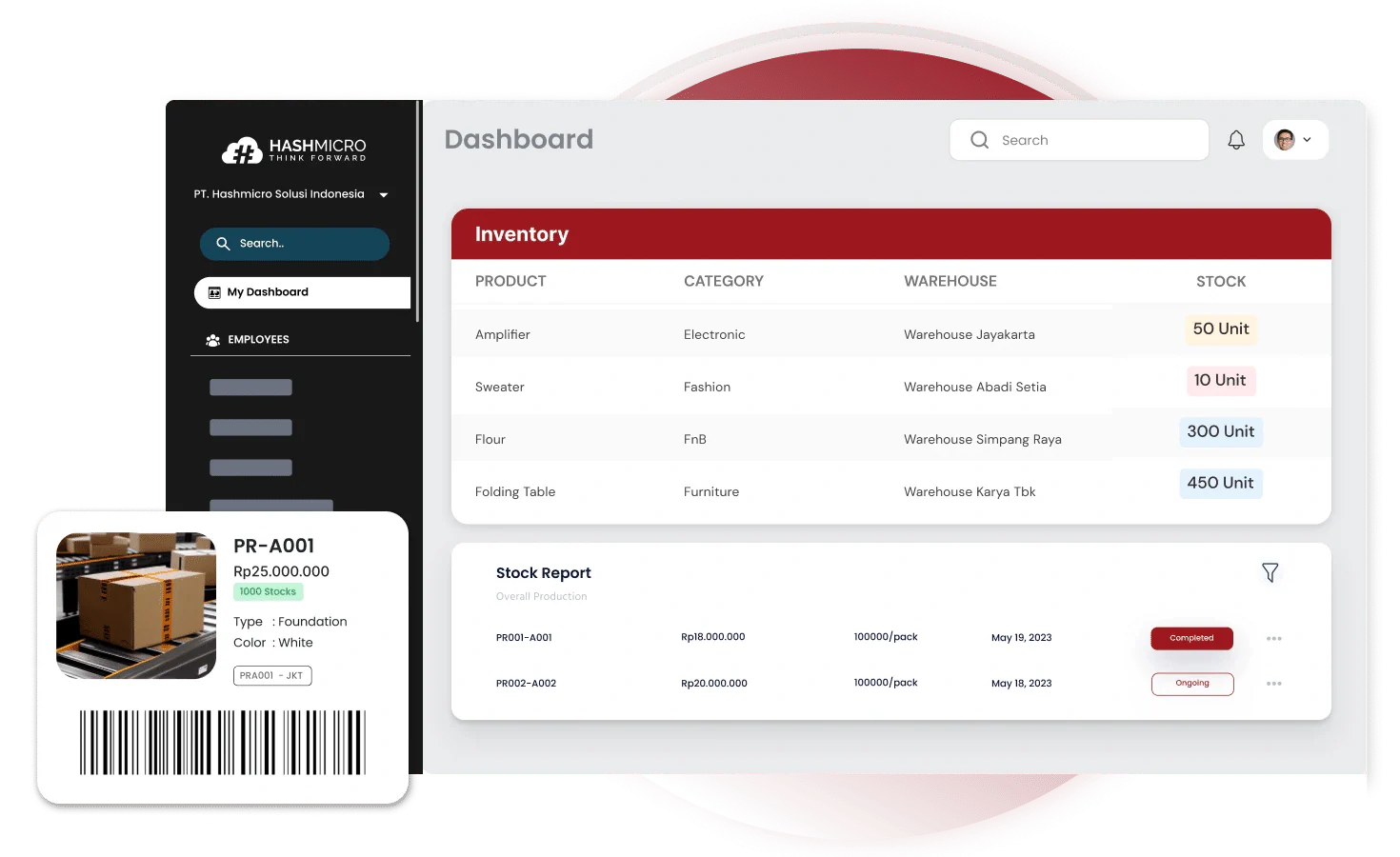
There are many inventory control systems you can use for your business. One of the best recommendations is HashMicro’s inventory management system. With this system, you can seamlessly track inventory, monitor stock, and optimize inventory management through these features:
- Stock Forecasting: Predicts stock requirements based on historical data and trends, aiding in proactive inventory management and avoiding shortages or overstock situations.
- Quality Control Management: Ensures adherence to quality standards throughout inventory processes, safeguarding against defective or substandard stock.
- Pick-Pack-Delivery Warehousing: Streamlines warehousing processes by optimizing picking, packing, and delivery workflows, improving efficiency and order fulfillment speed.
- Integrated Barcode & QR Code: Enables seamless integration with barcode and QR code systems for accurate and efficient inventory tracking and management.
- Return Management: Efficiently manages and processes returns, ensuring smooth handling of product returns and exchanges within the inventory system.
- RFID Warehouse Automation: Automates stock movement within the warehouse using RFID technology, enhancing accuracy and efficiency in inventory tracking and retrieval.
In addition, there is also an operational dashboard. It allows you to keep track of your current inventory, as well as the progress of internal transfers, incoming shipments, and outgoing orders. All this tracking is done in real-time from a single dashboard. When deciding how often records should be updated, compare interval-based stock counting with continuous tracking to match your operating needs.
Conclusion
Inventory management with inventory control system plays a crucial role in the success of a business. An effective inventory control system can simplify the management of inventory by automating manual tasks, optimizing logistics workflows, and providing a real-time view of inventory levels.
You can utilize the system from HashMicro. In addition, you can claim an Enterprise Development Grant up to 50%. For further details, you can click the image below, or you can contact us and apply for a free demo here!

FAQ
An inventory control system is a process or technology that tracks stock quantities, movements, locations, receipts, sales, returns, and replenishment needs.
The two main types are perpetual and periodic inventory systems. Perpetual systems update stock continuously, while periodic systems update records after scheduled physical counts.
Perpetual inventory updates stock continuously through software and automation. Periodic inventory relies on manual counts at set intervals, so stock visibility is limited between counts.
A periodic system may suit small businesses with limited stock and few transactions. A perpetual system is better when real-time visibility is needed or rapid growth is expected.
Inventory may be counted monthly, quarterly, or annually, depending on product movement, stock value, risk, and staff. Faster-moving or higher-value items may need more frequent checks.
Yes. Businesses can use perpetual records for daily stock movements and scheduled physical counts to confirm accuracy and identify discrepancies.
Accurate records show stock availability and movement speed. This helps businesses set reorder points, plan purchases, and replenish products before stock runs out.