






Keeping inventory under control is essential for businesses that want to meet customer demand without tying up too much capital in excess stock. However, inaccurate records, delayed replenishment, and poor stock visibility can lead to shortages, overstocking, and unnecessary operating costs. These issues make it harder to maintain smooth business operations and respond to changing demand.
A stock control system helps businesses monitor inventory movements, maintain accurate stock records, and make informed replenishment decisions. By understanding the right stock control methods and how software supports daily inventory management, businesses can reduce waste, improve efficiency, and keep stock levels aligned with operational needs.
Key Takeaways
A stock control system keeps inventory records accurate so businesses can meet demand without holding excess stock.
Different stock control methods help businesses decide how much stock to hold and when to reorder it.
Poor stock control leads to overstock, stockouts, tied-up capital, and damaged or unsellable goods.
Moving from spreadsheets to an automated system reduces manual work and gives teams more reliable stock data.
What is Stock Control?
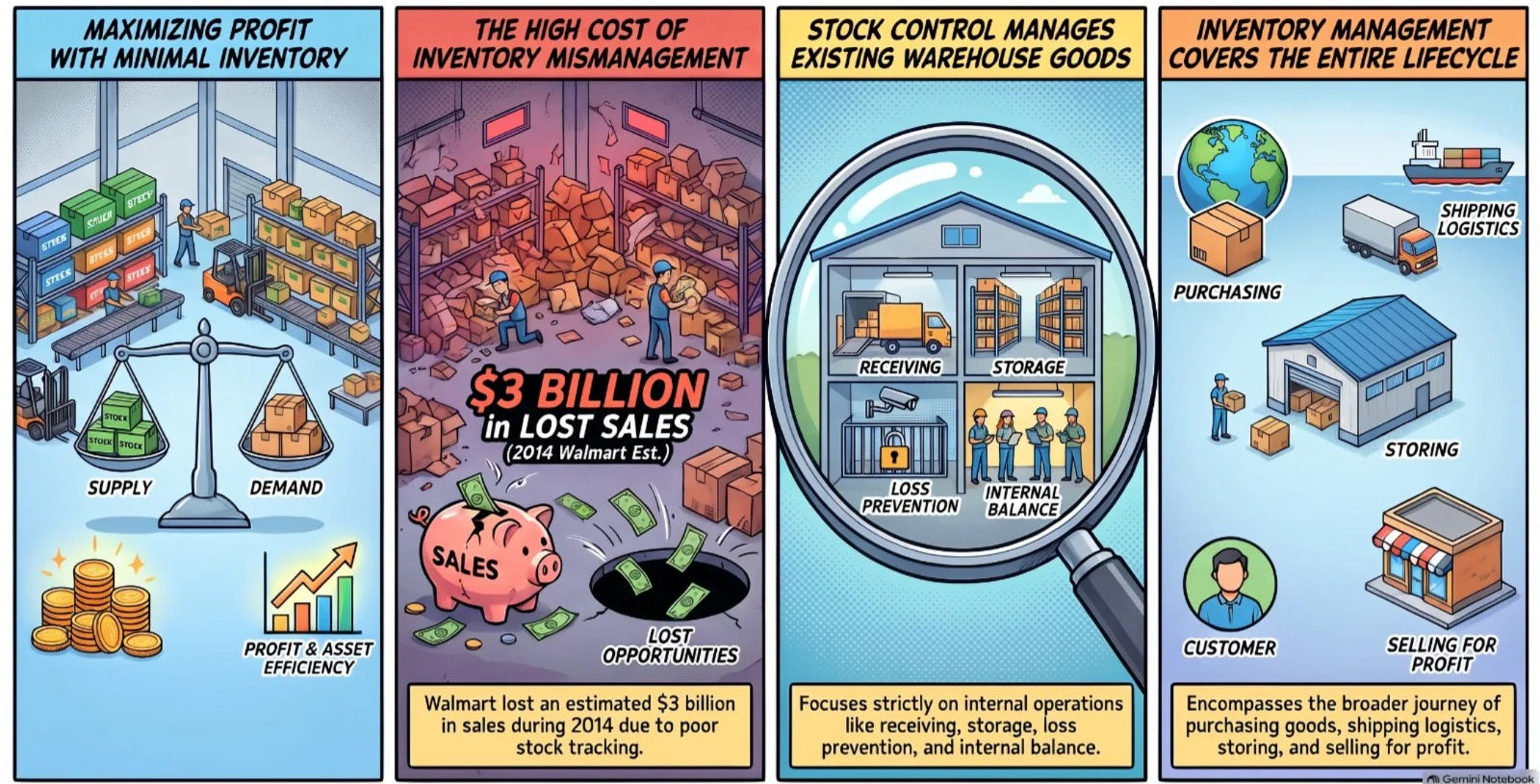
Stock control, often known as inventory control, is the process of ensuring that a company has sufficient supplies. With the proper internal and production controls, the approach ensures that the company can meet client demand. In addition, inventory control depends on data from purchases, reorders, shipping, warehousing, storage, receiving, customer satisfaction, loss prevention, and turnover.
For example, Walmart estimated that it missed $3 billion in sales in 2014 because it didn’t have good enough ways to keep track of its stock. The stock control system maximizes profit from the minimum inventory investment without affecting customer satisfaction. Additionally, if done correctly, it enables businesses to evaluate their existing situation regarding assets, account balances, and financial reports.
Inventory management is a more general term for the whole process of buying goods or services, storing them, and selling them for a profit. Inventory control and management may seem the same, but they are not. In comparison, inventory control manages what is already within a warehouse. Whereas inventory management covers everything from what’s in the warehouse to how a business gets it there and where it goes.
Stock Control System Methods
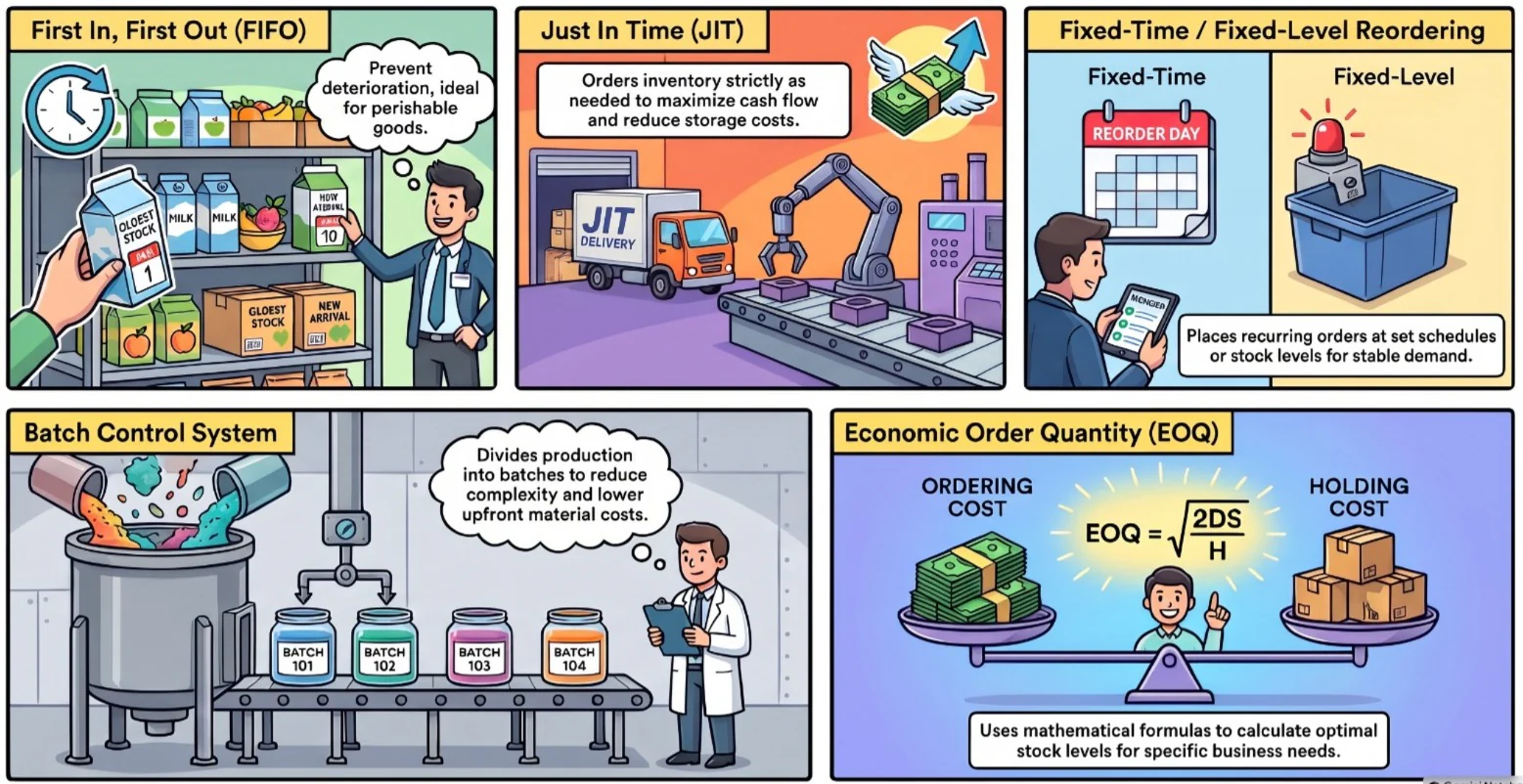
Stock control methods ensure the right amount of inventory is available to fulfill consumer demand. The following is a list of the most often-used techniques for stock control:
First in, first out
This method calculates the cost of goods sold using the oldest products bought or produced. This approach is popular with perishable stock businesses. Its purpose is to keep goods from deteriorating before it is used. Stock is sorted by arrival date and processed before later arrivals. FIFO is mostly used by retailers who offer many different products over long periods.
Batch control with stock control system
Batch control divides stock and production into batches. This minimizes complexity in the manufacturing process and helps in achieving short-term goals. Additionally, batch control can help keep costs low by only requiring companies to buy the raw materials and parts needed for each batch.
Economic order quantity (EOQ)
EOQ is a complex mathematical formula that optimizes stock for each industry and business. EOQ calculations can be time-consuming, so you may want to consult a specialist or use stock management software with built-in EOQ calculators. It can be integrated with other forms of stock management.
Fixed-time/fixed-level reordering
This entails ordering new supplies at specific periods, specific levels, or both. For instance, a company might have a recurring order for 500 units every third Sunday of the month. For Businesses with established contracts, stable demand, and intermittent irregular orders unless they have a long-term delivery date, this stock control is useful.
Just in time (JIT)
This stock control system originated in Japan. To keep costs low and liquidity high, the company orders inventory only when needed. However, there is a cost associated with the higher cash flow. The company must be very well organized to ensure orders are placed at the right time, and suppliers must be reliable to meet needs. There is also the possibility of running out of stock if a large order is placed.

The Risks of Poor Stock Control
Poor stock control costs money in several ways at once. Overstock, stockouts, tied-up capital, and damaged goods each take a share of profit, and they often feed one another over time.
1. Overstock and rising holding costs
Buying more than demand justifies fills shelves with items that sell slowly. Every extra unit needs space and handling, so holding costs keep growing while the stock waits for a buyer.
2. Stockouts and lost sales
Running out of a popular item sends customers to a competitor, and some do not come back. Rushed reorders to fill the gap also tend to cost more in freight or supplier pricing, which narrows the margin.
3. Capital tied up in stock
Stock is cash converted into goods. The more of it sits unsold, the less money is left for payroll, marketing, or new products, even when inventory looks healthy on the balance sheet.
4. Damaged, expired, and unsellable stock
Items left too long can expire, go out of season, or get damaged in a crowded storeroom. Unsellable stock is written off, so the original purchase cost becomes a direct loss for the business.
Manual vs Automated Stock Control System
Manual stock control relies on a stock book, stock cards, or spreadsheets. That setup can work for a new business with few products, but it gets harder to trust as orders, locations, and staff increase.
- Spreadsheet errors: one mistyped quantity or broken formula carries into every report built on it, and nobody notices until a count fails.
- Inaccurate stock data: updates made after the fact leave records behind the shelves, so teams promise stock they do not have or reorder items already on hand.
- Repetitive manual work: counting, typing, and reconciling take hours that could go to purchasing and customer service.
The table below shows how the two approaches differ in daily use.
| Aspect | Manual (stock book or spreadsheet) | Automated system |
|---|---|---|
| Stock updates | Entered by hand after the event | Recorded as stock moves |
| Accuracy | Exposed to typing and formula errors | Fewer entry errors, checked against records |
| Reordering | Staff check levels themselves | Low-stock alerts and reorder suggestions |
| Reporting | Built manually each period | Generated from live data |
| Growth | Harder with more items and sites | Scales with more items, users, and locations |
Automated systems track stock as it moves, flag low levels, and connect purchasing, sales, and accounting data. They still depend on accurate setup and disciplined counts, so item data should be cleaned up first.
Manage Stock Control System With Inventory Software
The Inventory Management System integrates related activities into a central software package to provide you with complete control over stock and supply. It can inform you of important actions as your company operates, such as ordering new products whenever your stock reaches a specific level. This can help you avoid overstocking by letting you make decisions based on data.
A computerized stock control system is a good option for businesses dealing with many types of stock. Other useful features include:
Barcode management in stock control system
This refers to the use of barcode scanning technology to manage inventory and track stock movement across multiple locations. Additionally, this allows businesses to quickly and accurately monitor their inventory levels, reduce the risk of stockouts, and avoid overstocking. By using barcode scanners, businesses can easily track the movement of items in and out of their inventory, as well as identify which products are selling quickly and which are not.
Inventory forecasting
It is the process of predicting the amount of inventory a business will need to provide during a specified future period of time. This involves analyzing historical sales data, current inventory levels, and market trends to estimate the demand for a particular product.
Stock aging analysis
involves analyzing the age of a business’s inventory to evaluate and decide on future stock levels of slow and fast-moving items. Additionally, this involves tracking the length of time that items have been in inventory and using that information to determine which items are selling quickly and which ones are not. By identifying slow-moving items, businesses can make informed decisions about how much stock to order and when to order it, which can help to reduce waste and improve overall inventory management.
Stock request management
Refers to the process of managing stock requests from all outlets or warehouses. In addition, this involves automating the approval workflow for stock requests, allowing businesses to quickly and efficiently respond to requests for additional inventory. Therefore, by automating this process, businesses can reduce the amount of time and resources required to manage stock requests.
With the Inventory Management Software, you can easily carry out any related daily inventory activities. You will also find out that using this approach will result in fewer mistakes made by humans.
Also Read: 7 Best Inventory Control Tips to Improve Efficiency
Conclusion
A stock control system is essential for those businesses that maintain large stock and therefore have high turnover. The more products a business holds, the more time-consuming manual recording becomes. It is with this in mind that an automated stock control system becomes such a valuable investment for your business. Automated stock control is an efficient way to ensure that your business never runs out of stock.
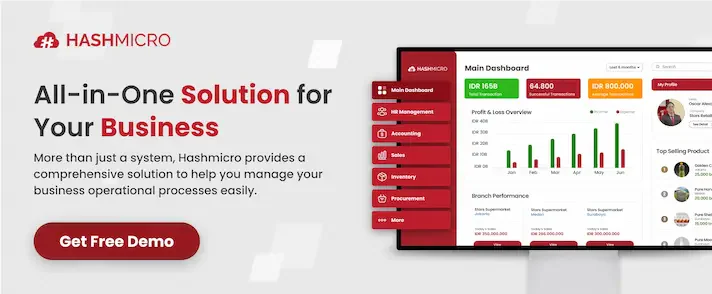
HashMicro’s Complete Inventory Management Software can streamline stock management, monitor stock transfers, and estimate all inventory needs. Get your free demo now! and join 1750+ companies in having a better stock control system.

Frequently Asked Questions About Stock Control Systems
Stock control focuses on keeping the right quantity of each item on hand, using reorder levels, counts, and methods to avoid shortages and excess. Inventory management is broader, covering purchasing, storage, valuation, forecasting, and fulfilment around that stock.
It depends on stock volume, value, and how fast items move. Many businesses run a full stocktake once or twice a year and add regular cycle counts for fast-moving or high-value items in between, then investigate any gap between counted and recorded stock.
A common formula is average daily usage multiplied by supplier lead time in days, plus safety stock. When on-hand stock falls to that level, it is time to place a new order.
Yes. A small business can start with real-time stock levels, low-stock alerts, and simple reports, then add purchasing, warehouse, or integration features as it grows. Choosing a system that scales avoids a second migration later.
Cost depends on the number of users, modules, deployment model, and implementation scope, and many vendors quote on request. Ask for a written breakdown covering licences, setup, training, and support, and check which Singapore grants your business may qualify for.