







Agriculture is still a major economic engine in Malaysia, and it’s not slowing down anytime soon. In 2022 alone, the sector contributed 6.6% (about RM99.1 billion) to national GDP, which shows how much everyday business activity still depends on farms, estates, and plantations.
Palm oil also continues to carry a big share of the load. For example, official statistics have highlighted oil palm as the largest contributor to agriculture value added, at 35.2% in one of DOSM’s agricultural indicator releases.
What’s changing is the operating reality: input costs move faster, weather events disrupt yields and logistics, and planning gets harder across seasons. That’s why more agribusiness teams are turning to agriculture software (custom-built or packaged) to keep field activity, inventory, labour, and post-harvest workflows connected, so decisions aren’t made off scattered spreadsheets and late reports.
Key Takeaways
Agriculture software supports Malaysian farmers in managing costs, improving crop planning, and minimizing waste through digital tools.
Common features include inventory tracking, crop scheduling, financial monitoring, and weather or pest alerts.
Each software option has different strengths. Some are better for small farms, while others suit large, multi-site operations.
HashMicro stands out for its local support, end-to-end automation, and seamless integration across accounting, inventory, and operations.
Managing multiple fields, workers, equipment, and inventories through separate records can lead to delays, errors, and limited operational visibility. Agriculture software brings these activities into one platform, helping agribusinesses monitor resources, coordinate daily work, and make informed decisions.

Top Agriculture Software in Malaysia Shortlisted



Best Because
Help modern farmers, grow more and sell more, all from one easy to use place
Best Because
Comprehensive tools designed to simplify and optimize farm management
Understanding Agriculture Software
Agriculture software refers to digital tools that help farmers manage and automate their daily operations, analyze data, and make informed decisions to improve efficiency and crop yields. These solutions are designed to enhance productivity across agricultural activities.
The software consolidates data from multiple sources, such as satellite imagery, soil sensors, and field devices. By integrating these insights, agriculture software development enables smarter, data-driven farming for better outcomes.
Benefits of Agriculture Software
Farming today requires more than hard work in the field. With unpredictable weather, high input costs, and market pressure, you need better tools to stay profitable. Agriculture management software offers many benefits for farmers and business owners, such as:
- Track Costs per Field or Crop: You can see exactly where your money goes, from fertilizer and seeds to labor and machinery. Breaking down costs by area or crop helps identify which parts of your farm bring in profit and which ones drain resources.
- Plan and Monitor Crop Activities More Easily: The software helps you prepare planting and harvesting schedules, record what you apply to each crop, and monitor progress. When you manage several crops or large areas, it reduces mistakes and avoids missed steps in the growing cycle.
- Store Weather, Soil, and Crop Data in One System: You don’t need to check separate tools or rely on memory. The software gives timely updates like rain forecasts, pest warnings, and plant health reports. That makes it easier to act quickly when conditions change.
- Reduce Wasted Inputs: By knowing how much water, pesticide, or fertilizer each crop actually needs, you avoid overuse..
- Monitor Inventory of Farm Supplies: You can keep track of stock levels for seeds, fertilizers, and equipment. When supplies run low, the system gives you a heads-up, so you can restock.
Some agriculture companies also use ERP software to manage their farm and store data more accurately.
Types of Agriculture Software
Modern farmers rely on a variety of digital tools to manage and optimize their operations efficiently. Below are the key types of agriculture software commonly used in today’s farming industry:
- Farm Management Software: Comprehensive platforms that centralize all farming activities, from crop planning and field mapping to monitoring performance, helping farmers make smarter, data-driven decisions.
- Farm Mapping and Design Software: Used to plan and design field layouts for optimal land use and improved efficiency in planting and irrigation.
- Farm Equipment Management Software: Helps track equipment usage, maintenance schedules, and performance to minimize downtime and extend machinery lifespan.
- Farm Inventory Software: Manages stock levels for seeds, fertilizers, produce, and supplies, ensuring timely replenishment and reducing waste.
- Farm Record Keeping Software: Maintains compliance records and operational data, keeping farmers organized and audit-ready.
- Accounting Software for Agriculture: Simplifies bookkeeping, expense tracking, and financial reporting for better budgeting and profit analysis.
- CSA Farm Software: Designed for Community Supported Agriculture (CSA) programs to manage member subscriptions, orders, and deliveries.
- Farm E-commerce Software: Enables farmers to sell products online directly to consumers or vendors, streamlining sales, payments, and customer relationships.
By integrating HashMicro Agriculture Software, farmers can streamline all these processes in one platform, from inventory management and equipment tracking to financial reporting, ensuring higher efficiency, reduced waste, and smarter decision-making across the farm.
"Types of agriculture software, from farm management and mapping to equipment, inventory, and accounting tools, help farmers streamline operations, reduce waste, and make smarter, data-driven decisions."
Quick Comparison of Best Agriculture Software in Malaysia
| Software | Best for | Strength | Malaysia Support | Key Features | Pricing |
|---|---|---|---|---|---|
| HashMicro | Medium to large agribusinesses managing multiple sites | Integrated agriculture ERP with BI and AI capabilities | Local Malaysia office and implementation support | Land preparation, maintenance scheduling, inventory, workforce, and financial reporting | Custom quotation |
| FarmBrite | Mixed crop and livestock farms | Accessible cloud platform covering operational and financial records | Global remote support; no dedicated Malaysia office listed | Crop and livestock records, tasks, inventory, and accounting | Approx. RM241 to RM445/month |
| FarmLogs, now Bushel Farm | Row-crop farms requiring field and profitability records | Connects agronomic records with financial and market information | US-based support; no Malaysia-specific coverage listed | Field mapping, rainfall, work orders, P&L, and satellite imagery | Approx. RM306 to RM2,446/year |
| Agrimap | Farms requiring field mapping and task coordination | Centralised field records that support remote collaboration | Malaysia relevance stated; confirm local service coverage | Field mapping, crop planning, irrigation, pest tracking, and yield monitoring | Contact vendor |
| SPL Tech | Agribusinesses needing detailed field and crop monitoring | Combines crop, soil, weather, and irrigation information | Malaysia-focused offering; confirm implementation coverage | Crop monitoring, soil analysis, weather forecasts, irrigation, and pest alerts | Contact vendor |
| Produce Inventory Control System (PICS) | Fresh-produce growers, packers, and distributors | Strong produce inventory control and lot traceability | Canada-based vendor with remote support | Lot tracking, barcode scanning, quality checks, cold storage, and dispatch | Approx. RM1,176/month for one user; implementation costs extra |
| Trimble Agriculture | Crop farms using precision agriculture and connected machinery | Strong GIS, GPS, field mapping, and machine-data capabilities | Regional dealer support; confirm Malaysian availability | Farm mapping, task records, work orders, and yield analysis | Contact vendor or authorised dealer |
| EasyFarm | Farms prioritising accounting and financial management | Farm-specific accounting with a one-time purchase model | US-based support; no Malaysia-specific coverage listed | Chart of accounts, cost centres, inventory, payroll, and production records | Approx. RM3,267 to RM6,534 one-time |
| CropTracker | Fruit and vegetable growers requiring traceability | Detailed harvest, labour, spray, and food-safety records | Canada-based vendor with remote support | Labour tracking, spray records, packing, storage, and quality control | Approx. RM112/user/month, minimum 10 users |
| SmartFarm by Cropin | Large agribusinesses and value-chain operators | Enterprise field intelligence and crop-risk monitoring | Global support; no dedicated Malaysia office stated | Field scheduling, crop monitoring, pest alerts, inventory, and forecasting | Custom quotation |
| Folio3 AgTech | Medium to large farms requiring tailored digital systems | Custom agriculture ERP, AI, IoT, and supply-chain capabilities | Global delivery team; no Malaysia office listed | ERP, CRM, livestock, inventory, analytics, and supply chain | Custom quotation |
| Agrivi | Commercial growers and agriculture enterprises | Field-to-finance management with traceability and compliance tools | Global support across 50+ markets; confirm Malaysia coverage | Crop planning, weather data, compliance, analytics, and workforce tracking | Custom quotation |
| Heirloom | Small organic, regenerative, and diversified farms | Simple crop planning designed for market gardeners | Online support; no Malaysia-specific coverage listed | Planting plans, field layouts, labour tasks, and predictive guidance | Contact vendor; free trial available |
| FarmKeep | Small farms, ranches, homesteads, and livestock operators | Affordable mobile record keeping for mixed farm activities | Global app access; pricing may vary outside the US | Livestock, breeding, tasks, finances, production, and land mapping | Free plan; Premium approx. RM33/month with annual billing |
14 Best Agriculture Software in Malaysia for 2026
Here are the list of the best agriculture software in Malaysia in 2026 with their main features, pros, and cons:
1. HashMicro
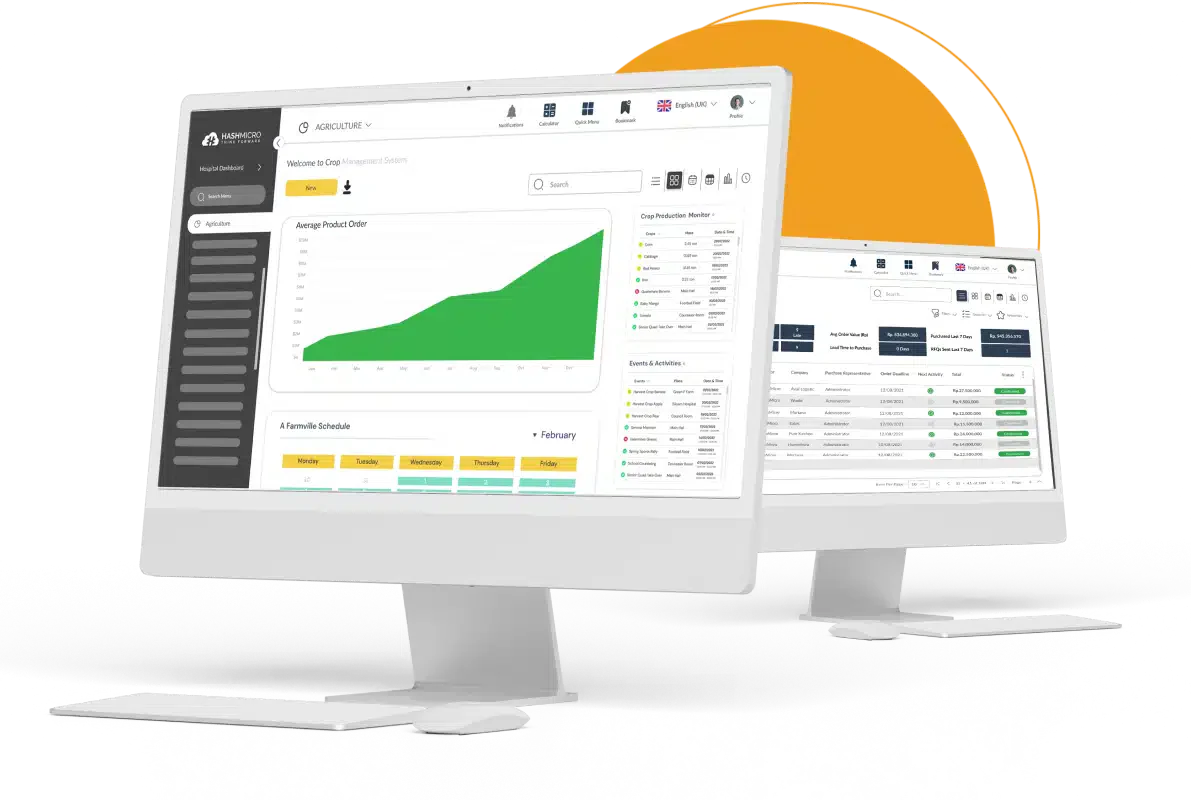
HashMicro’s Agriculture Management Software is built for Malaysian farms and agribusinesses that want to modernize operations. It’s also backed with ISO certification and a responsive local support team to assist.
From managing estate land in Sabah to coordinating harvest and distribution across multiple sites in Selangor or Johor, the system helps you track every process with better accuracy and less manual work.
You can monitor crop performance, automate equipment maintenance, and manage warehouse stock levels in real-time from one platform. The software also provides clear data on asset value and condition.
Features:
- Land Preparation Tracking
- Automated Maintenance Scheduling
- Agribusiness Operations Monitoring
- End-to-End Business Automation
- Plant Care and Task Coordination
- Fertilizer Timing Alerts
- Workforce Oversight Tools
- On-Site Real-Time Updates
Medium to large agricultural enterprises seeking to centralize farm operations that have BI and AI integration.
| Pros | Cons |
|
|
Want to know how much your farm might invest? Use our pricing calculator to get a personalized estimate. Click the banner below to receive a customized quote that meets your agricultural business needs.
2. FarmBrite
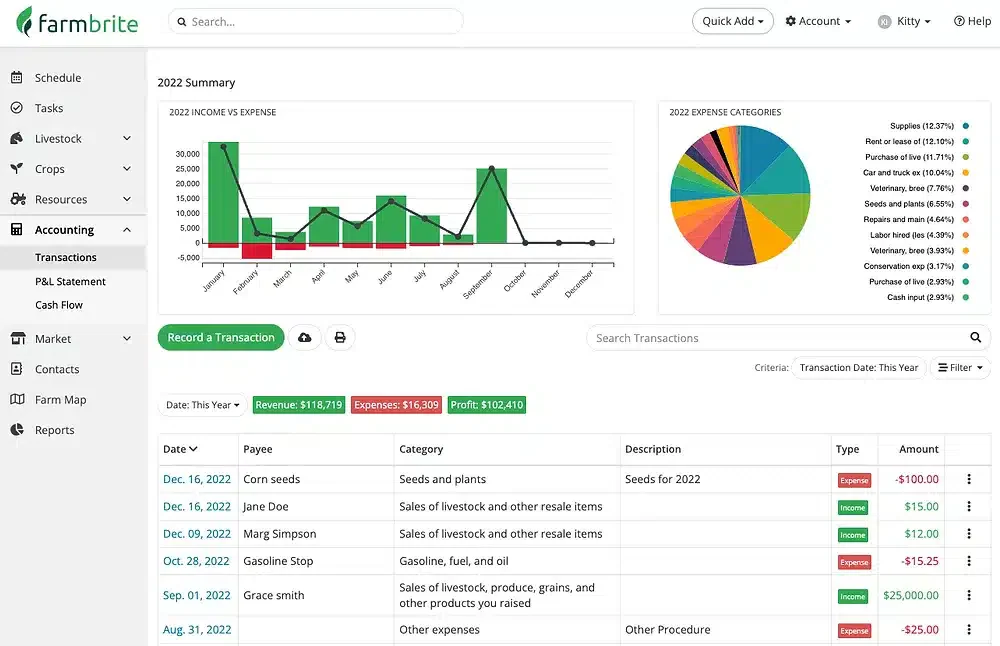
Farmbrite is a complete farm management software designed for modern farmers who want to simplify operations and improve productivity. Whether you manage crops, livestock, or both, Farmbrite brings all essential tools into one connected system with ERP software integration.
Farmbrite is an agriculture software company for small to mid-sized farms looking to transition to digital management without overcomplicating their processes. It’s especially useful for agribusiness owners who want more control and visibility.
Features:
- Crop and livestock management for health, cycles, and yields
- Task management for organizing, assigning, and tracking farm activities
- Inventory management for monitoring inputs, supplies, and equipment
- Financial tracking for reviewing income, expenses, and farm profitability
Medium to large agricultural enterprises looking for an all-in-one agriculture software to manage crops, livestock, finances, and field activities efficiently.
| Pros | Cons |
|
|
3. FarmLogs
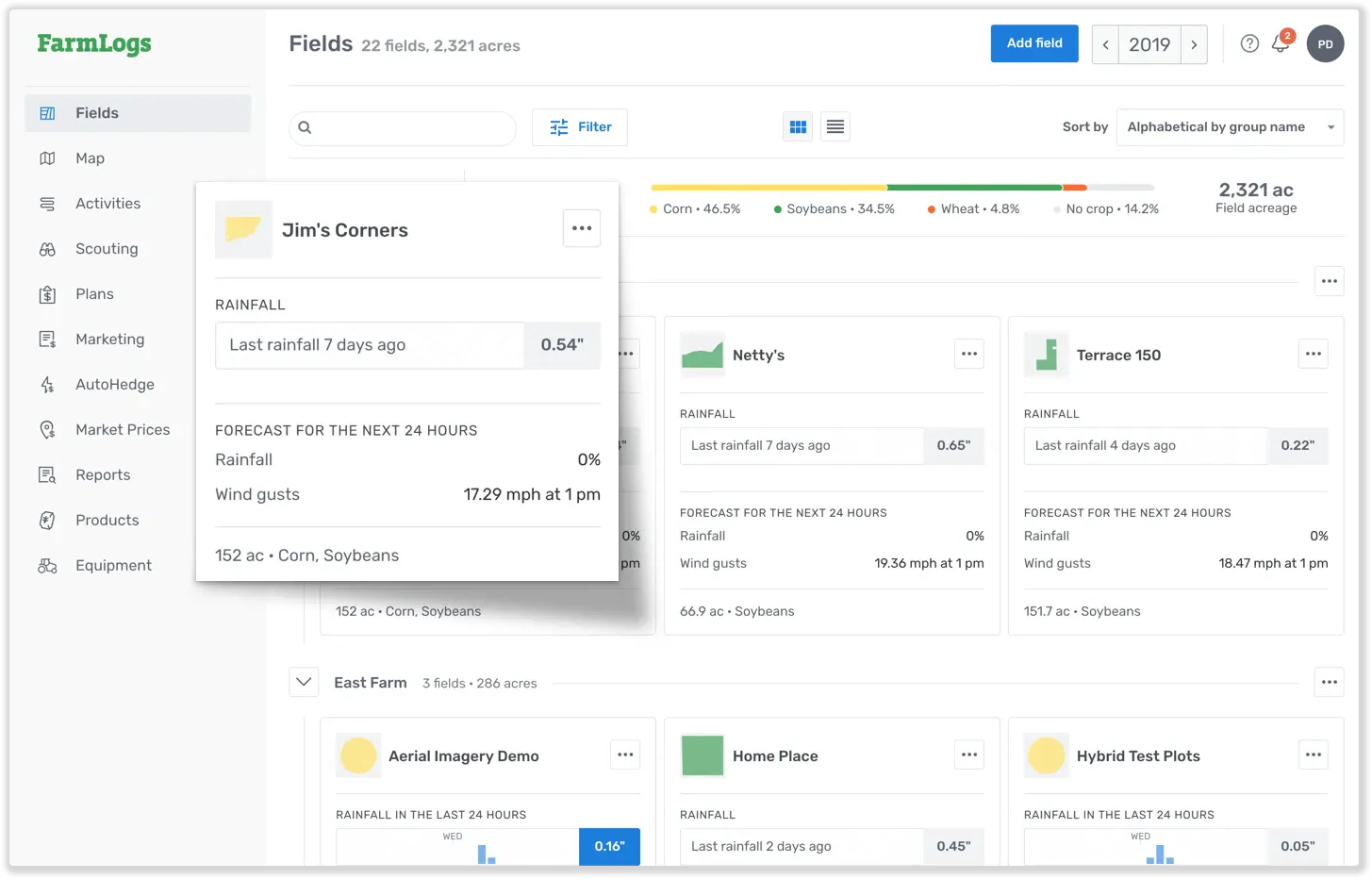
FarmLogs is an agriculture software development that helps farmers maintain accurate records, make informed decisions, and improve profitability. It includes tools such as contract entry automation, field mapping, and financial analysis to manage their operations effectively.
Features:
- Field mapping for visualizing and organizing farm plots
- Crop planning for scheduling planting and harvesting activities
- Irrigation management for optimizing water usage across fields
- Pest and disease tracking for monitoring and addressing crop health issues
- Yield monitoring for analyzing production outputs over time
This agriculture software is ideal for agricultural operations seeking a centralized, cloud-based solution to track field activities.
| Pros | Cons |
|
|
4. Agrimap
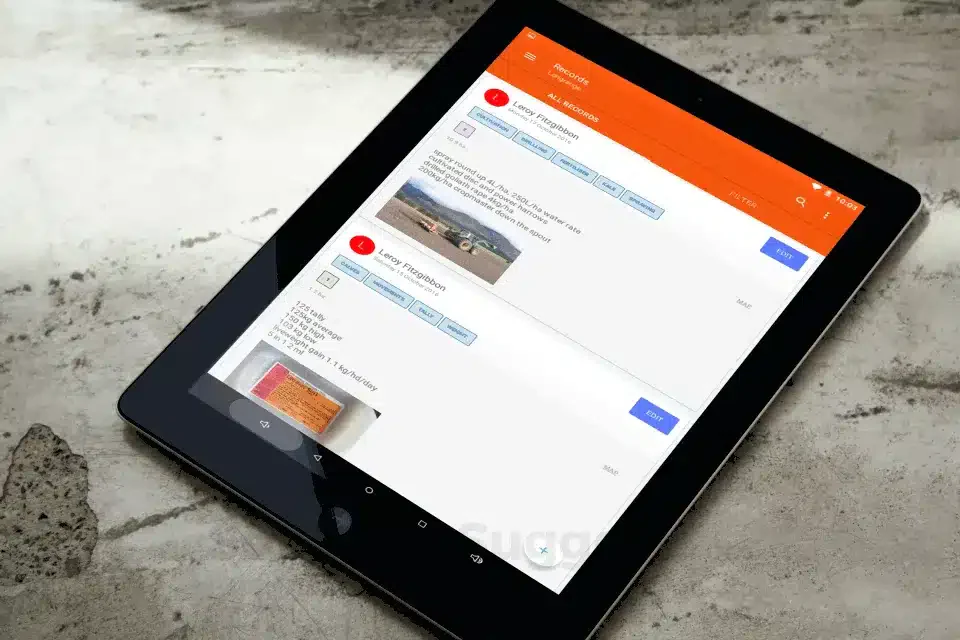
Agrimap is an agriculture software development designed to assist Malaysian farmers in organizing and sharing farm data efficiently. It enables users to record and access information from any location, fostering better collaboration and decision-making.
Features:
- Field mapping for organizing plots, pastures, and infrastructure
- Crop planning for planting schedules, harvest timing, and rotation cycles
- Irrigation control for efficient water use and reduced waste
- Pest and disease tracking for timely detection and treatment
- Yield monitoring for reviewing output trends and improving future planning
This agriculture software is suitable for agricultural operations that need robust field-mapping and task management capabilities.
| Pros | Cons |
|
|
5. SPL Tech
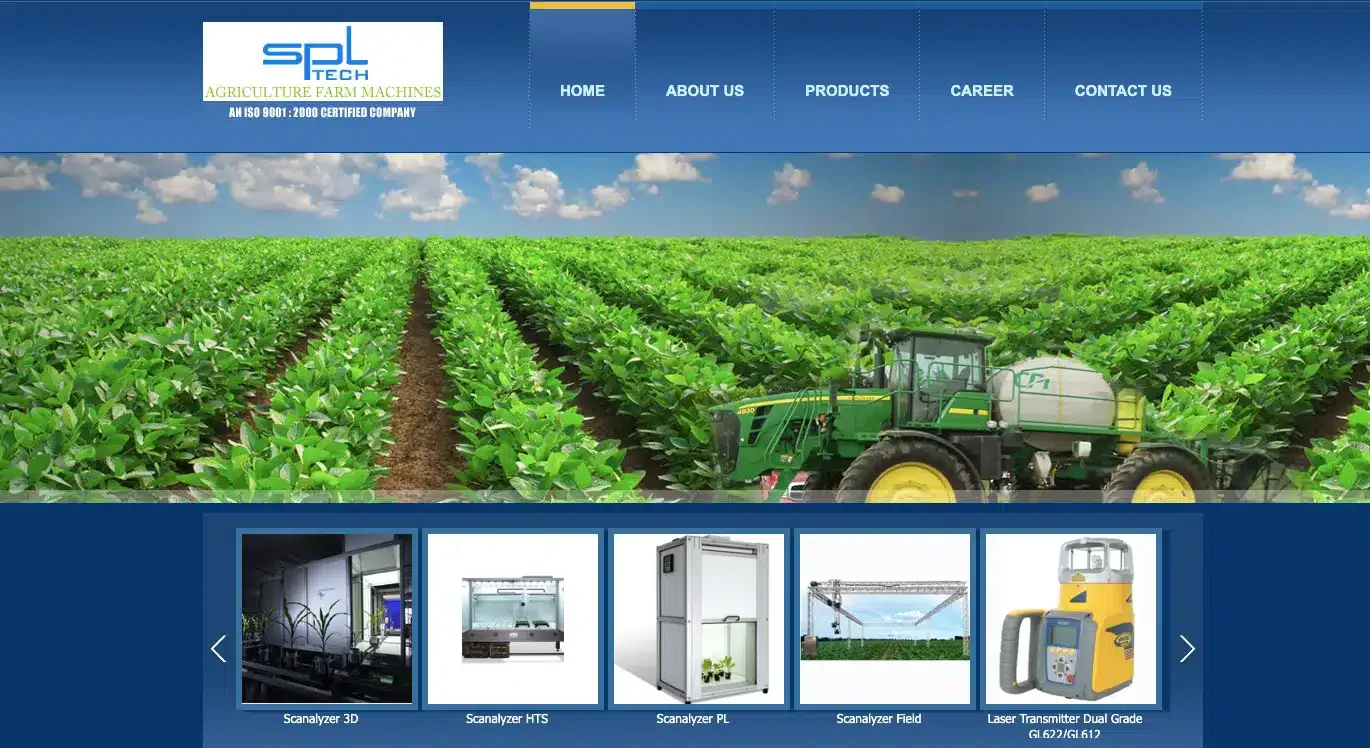
SPL Tech offers a comprehensive suite of agricultural tools aimed at increasing productivity and sustainability for Malaysian farmers. It combines advanced technologies to manage various aspects of farming operations effectively.
Features:
- Crop monitoring for health, growth stages, and yield projections
- Soil analysis for nutrient levels, structure, and moisture content
- Weather forecasting for real-time updates to guide daily planning
- Irrigation scheduling for timely and efficient water usage
- Pest and disease control for early detection and effective treatment
This agriculture software company is suitable for agribusinesses seeking an advanced all-in-one platform that covers field-to-bank operations.
| Pros | Cons |
|
|
6. Produce Inventory Control System (PICS)
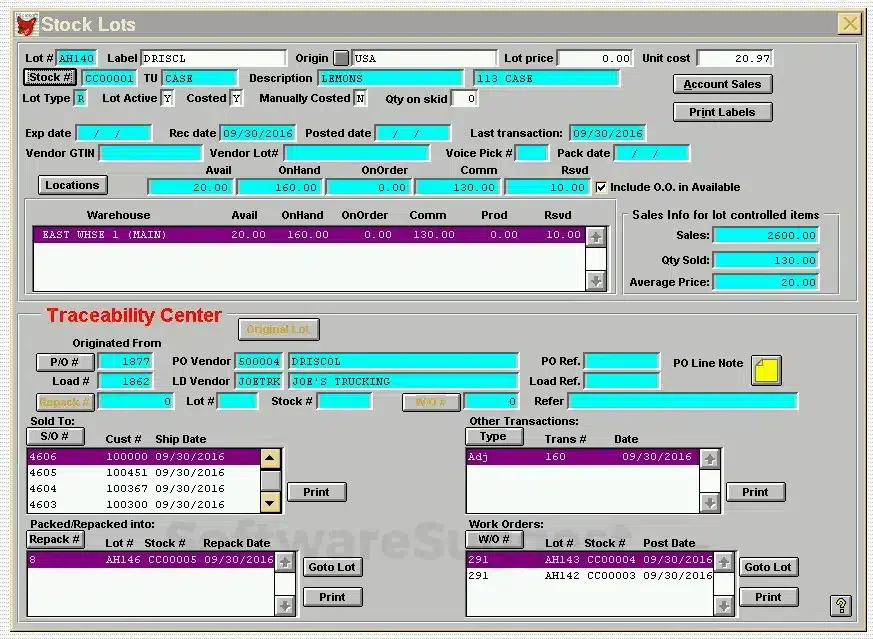
Produce Inventory Control System (PICS) is an agriculture management software that helps fruit and vegetable businesses manage their stock and trace each item from farm to sale. It keeps records accurate, supports food safety compliance, and connects smoothly with other systems to reduce manual work.
Features:
- Produce inventory tracking for monitoring quantity, location, and movement of harvests
- Lot-based traceability for identifying produce origin, handling, and delivery status
- Quality checks for recording grade, condition, and rejection data per batch
- Barcode scanning for fast product intake, packing, and dispatch
- Warehouse organization for managing cold storage and packing facility logistics
This agriculture software development is suitable for fresh-produce distributors, wholesalers, and growers who need an integrated system for inventory management and full traceability across buying, production, and sales in the perishable goods supply chain.
| Pros | Cons |
|
|
7. Trimble Agriculture
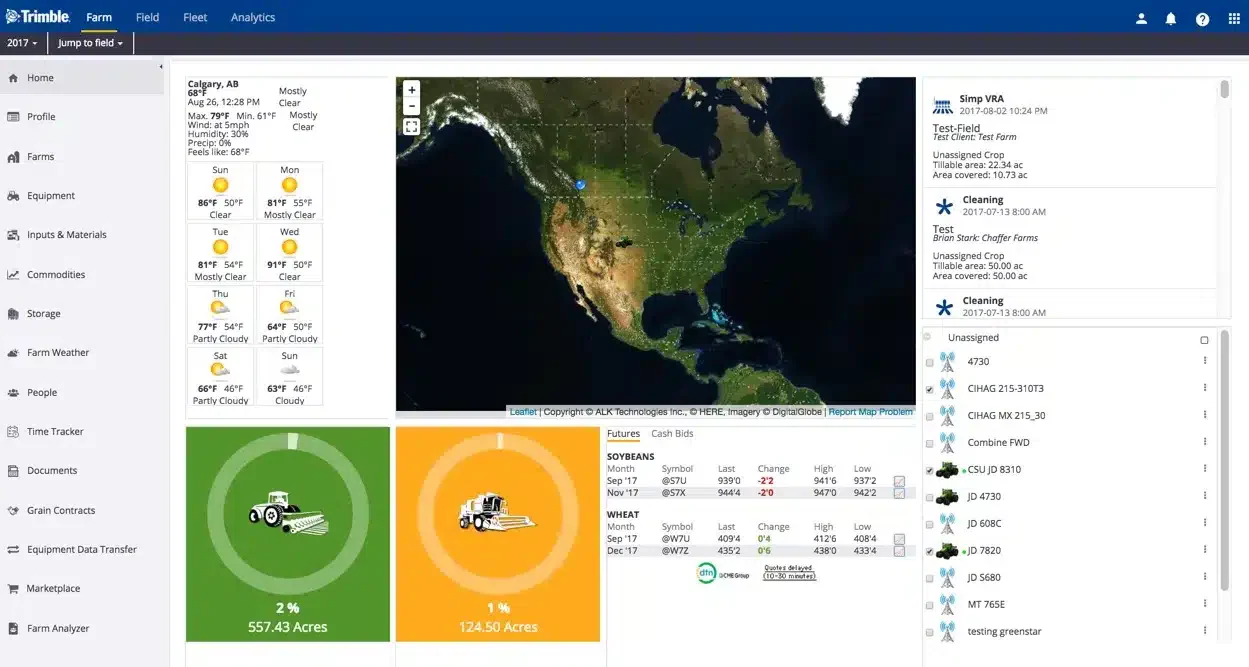
Trimble Agriculture provides precision farming software for agribusinesses in Malaysia, helping farmers manage operations with greater accuracy.
By connecting land data, fieldwork, and machine operations in one system, Trimble supports faster decision-making through real-time updates. Tools like Geographic Information System (GIS) improve land planning, simplify work processes, and support higher productivity with less waste.
Features:
- Farm management for organizing land, crops, and resources in one system
- Task documentation for recording field activities and completed work
- Work order management for assigning tasks and tracking completion
- Yield analysis for measuring harvest results and field performance
Fresh-produce distributors, wholesalers, and growers who need an integrated system for inventory management and full traceability across buying, production, and sales in the perishable goods supply chain.
| Pros | Cons |
|
|
8. EasyFarm
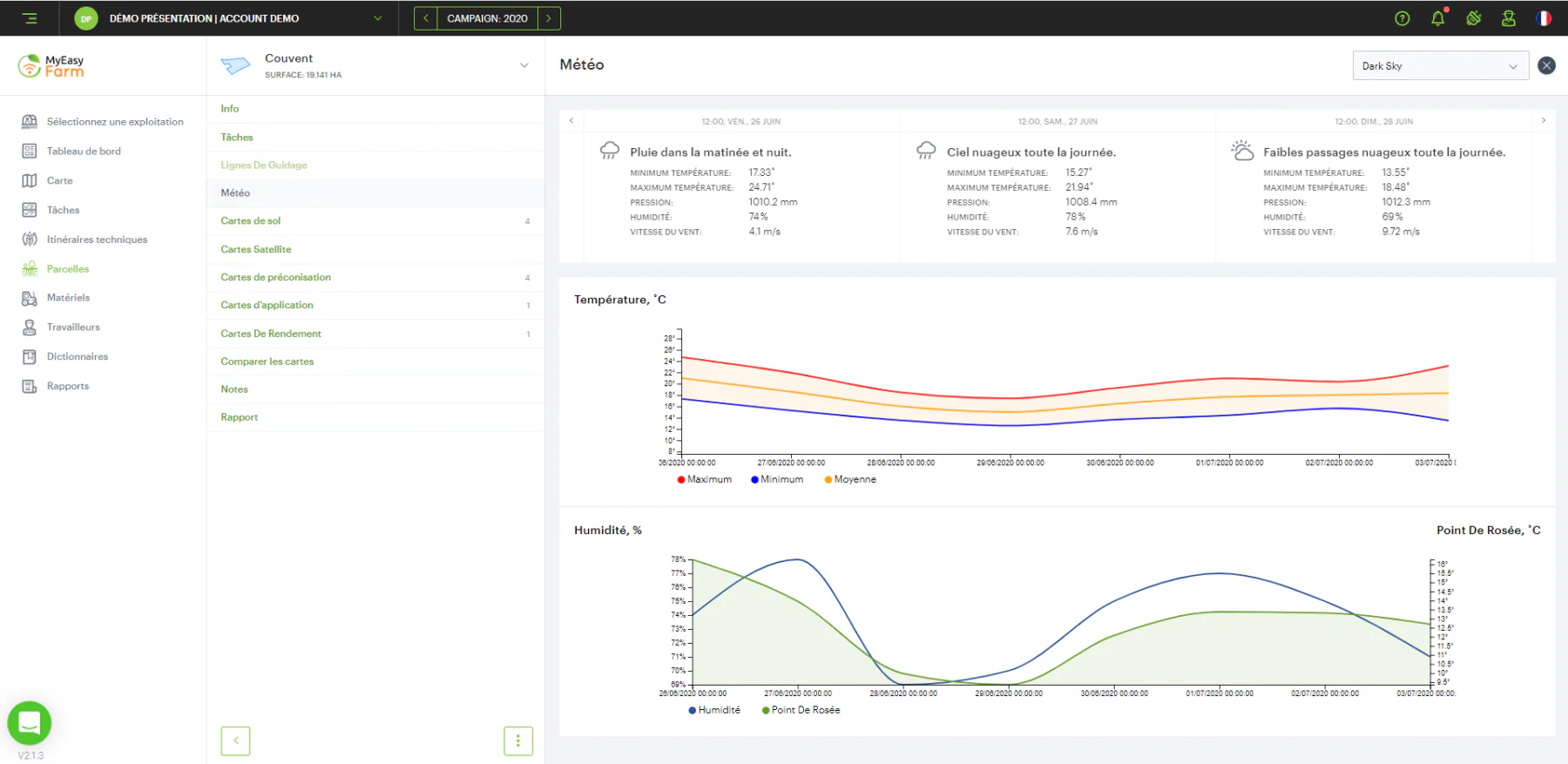
EasyFarm is a farm management software designed to help farmers and ranchers efficiently manage finances, track inventory, and oversee crop and livestock operations.
It offers tools tailored for agricultural needs, such as customizable charts of accounts, cost centers, and integrated inventory tracking, facilitating better decision-making and streamlined farm management.
Features:
- Customizable chart of accounts for organizing farm-specific income and expenses
- Cost centers to monitor profitability by field, crop, or livestock group
- Bank account integration for streamlined financial transactions
- Inventory tracking for managing quantities and values of crops, livestock, and supplies
- Production records to document crop yields and livestock performance
This agriculture software development is suitable for agricultural operations that want a farm-centric accounting and management solution tailored to both crops and livestock.
| Pros | Cons |
|
|
9. CropTracker
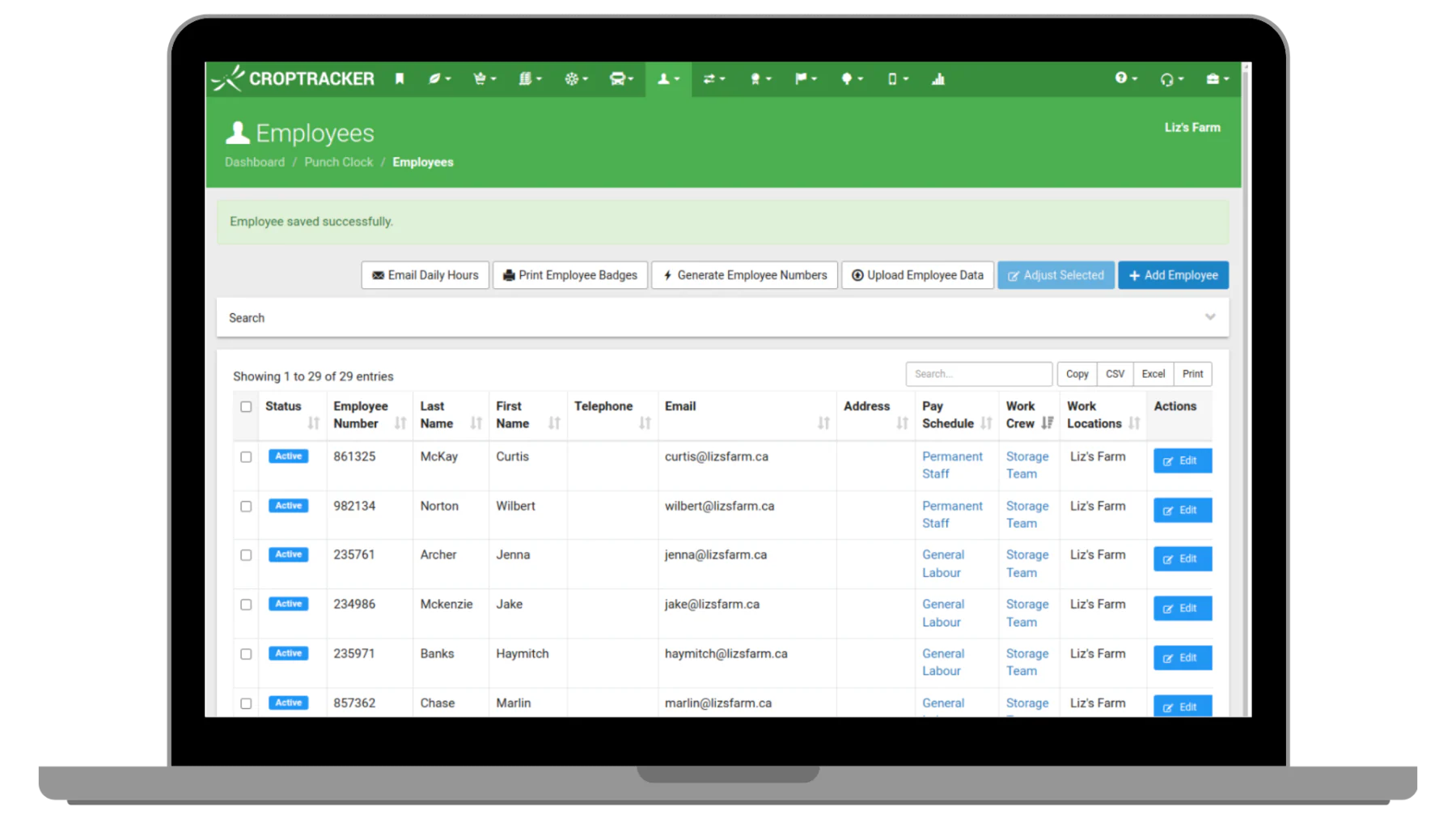
CropTracker is a farm management software designed for fruit and vegetable producers, offering tools to enhance productivity, ensure traceability, and improve accessibility.
Developed by Dragonfly IT, CropTracker enables farmers to create customized schedules, monitor work crew activities, and generate detailed analytics and reports to streamline operations.
Features:
- Labor tracking for monitoring work crew activities and performance
- Storage records for managing inventory levels and storage conditions
- Quality control for conducting inspections and maintaining product standards
- Harvest packing and recording for documenting harvest details and packaging processes
- Spray record keeping for logging pesticide applications and compliance
Growers of fruits and vegetables who need a robust, cloud-based system to manage everything from spray records and harvest tracking through to workforce management, full traceability and audit-ready reports.
| Pros | Cons |
|
|
10. SmartFarm by Cropin
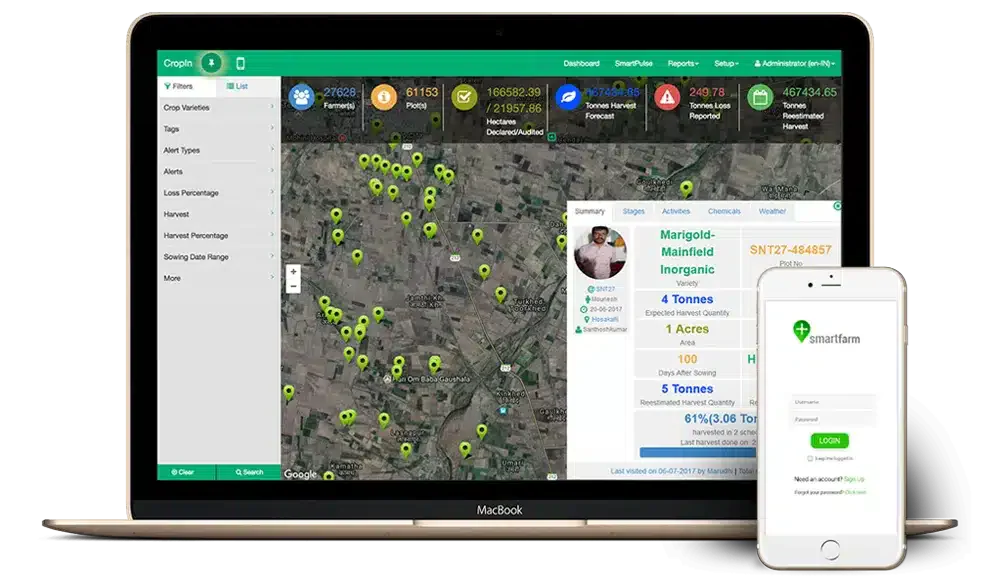
SmartFarm is a complete farm management system that helps farmers keep digital records, improve crop performance, and run operations more efficiently. It provides real-time data and useful forecasts to support better planning and decision-making in the field.
Features:
- Farm activity scheduling for organizing planting, irrigation, and harvesting tasks
- Real-time field monitoring to track crop health and growth stages
- Pest and disease alerts for early detection and management of potential threats
- Inventory management to monitor stock levels of seeds, fertilizers, and pesticides
- Financial tracking for managing expenses, revenues, and profitability
This agriculture software company is suitable for large-scale agricultural enterprises, agribusinesses and institutional value-chain players that need to digitise operations end-to-end.
| Pros | Cons |
|
|
11. Folio3 AgTech
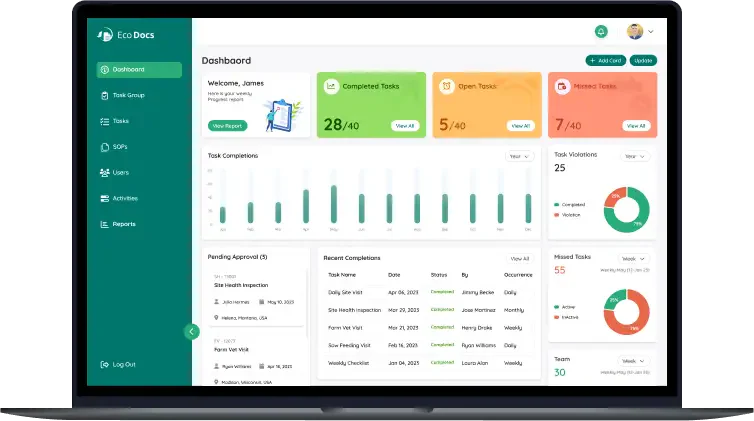
Folio3 AgTech is a leading provider of advanced agriculture software. Its innovative platform supports everything from crop management to livestock monitoring, leveraging AI, IoT, and cloud technologies for scalable and efficient farm operations.
Features:
- AI-powered insights for smarter decision-making
- Real-time monitoring with IoT and cloud integration
- ERP and CRM systems designed for agricultural operations
- Automated inventory and supply chain management
- Data analytics for yield optimization and resource planning
Medium to large-scale farms looking to integrate technology across all operations for higher efficiency and profitability.
| Pros | Cons |
|
|
12. Agrivi
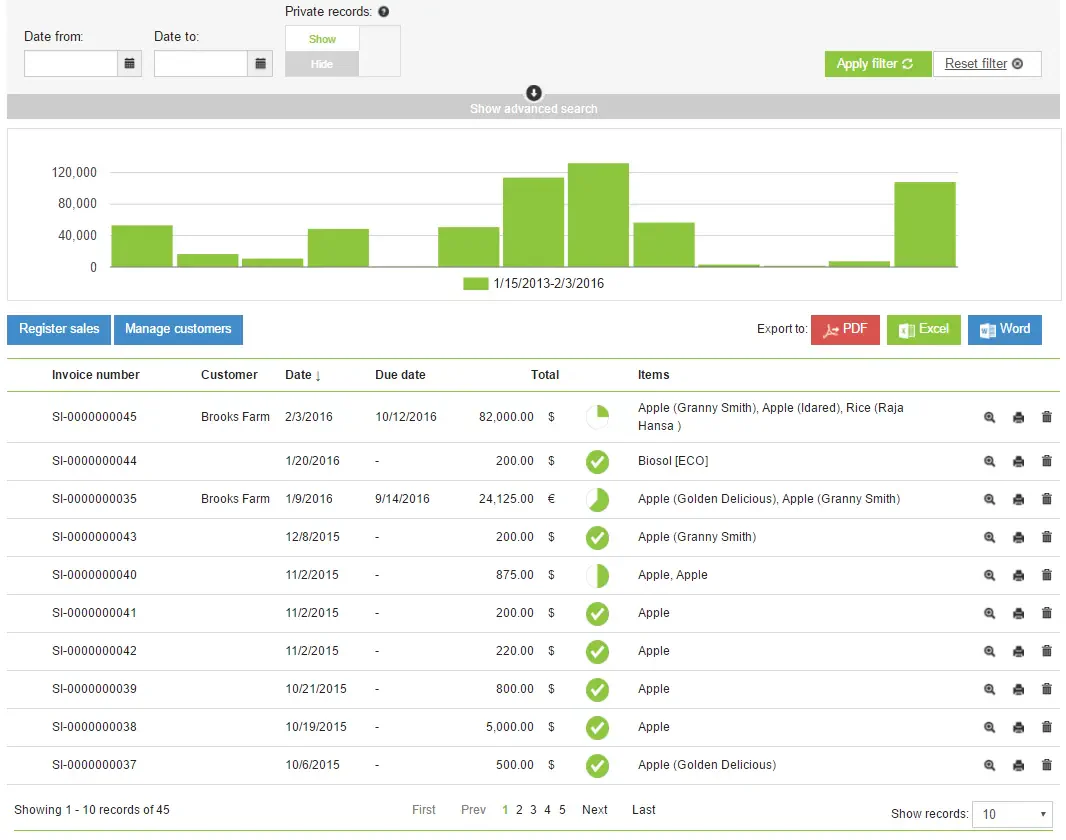
Agrivi is an agriculture software company designed to optimize modern farming operations. It supports everything from crop planning and field operations to inventory, finances, and compliance, helping farmers improve efficiency and productivity.
Features:
- Centralized farm management by crop planning
- Real-time insights for weather tracking
- Supports food safety standards and production records
- Analytics & workforce/equipment management
This agriculture software is suitable for farms or agribusinesses seeking an all-in-one digital solution to streamline operations, improve efficiency, and scale.
| Pros | Cons |
|
|
13. Heirloom
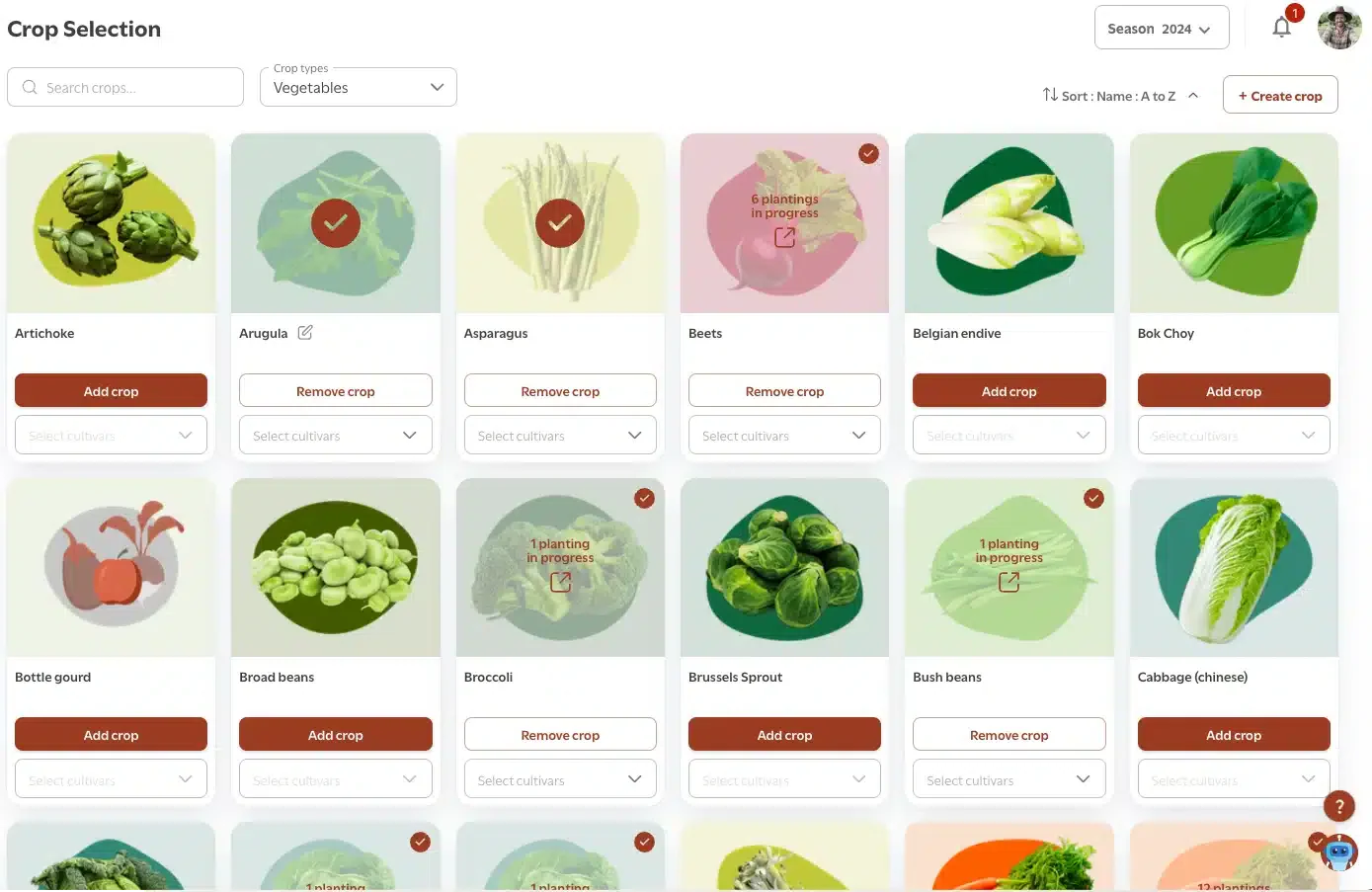
Heirloom Agriculture Management Software is a cloud-based platform for small to medium organic or regenerative farms, simplifying crop planning, field mapping, and farm management while enabling data-driven decisions.
Features:
- Design planting schedules and field layouts efficiently
- Track weekly tasks and labor requirements
- Get predictive guidance for better crop decisions
- Inventory Tracking to reduce waste
This agriculture software company is suitable for small to medium organic or regenerative farms seeking an easy-to-use, cloud-based solution.
| Pros | Cons |
|
|
14. FarmKeep
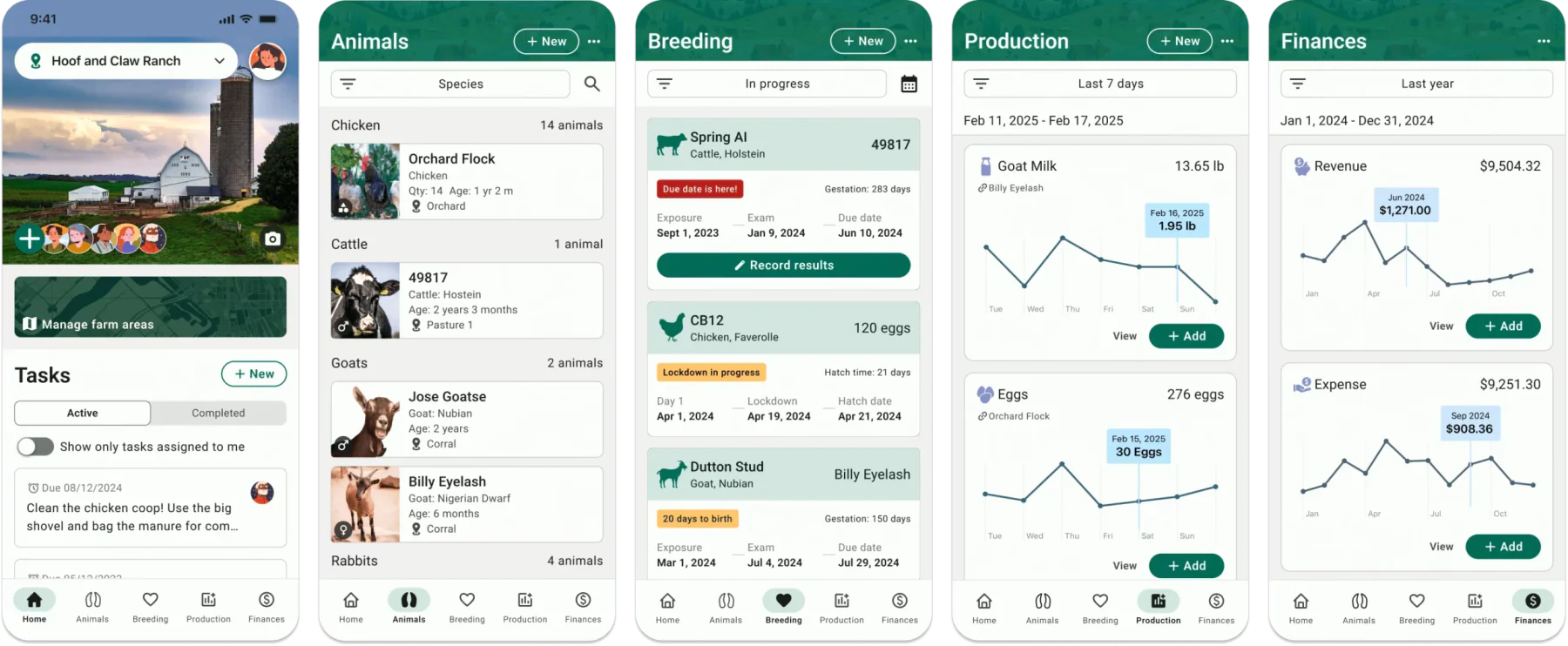
FarmKeep is a software for agriculture app designed primarily for small to mid‑sized farms, homesteads and ranches. It supports livestock tracking, production monitoring, finances, tasks and even land/pasture mapping, all in a unified platform.
Features:
- Livestock and breeding management
- Monitor daily and weekly output
- Financial and accounting tools
- Assigning chores, creating tasks, and monitoring team progress
- Mapping and spatial planning
Small to mid‑sized livestock or mixed‑use farms, hobby farms or homesteads that want to move from spreadsheets/paper‑logs to an organized digital system.
| Pros | Cons |
|
|
Top Agriculture Software Rates for Malaysian Businesses
| Provider | best for | core strength | agriculture function | malaysian support |
|---|---|---|---|---|
| HashMicro | ||||
| FarmBrite | ||||
| CropTracker | ||||
| EasyFarm |
Key Features in Agriculture ERP Software
When choosing agriculture ERP software, business owners need to understand the key features that can improve efficiency and control in the field, warehouse, and supply chain through agriculture inventory software.
1. Smart farm scheduling & planning
A good ERP system organizes agricultural activities from planting to harvest. For example, it assigns labor, equipment, and land usage automatically. As a result, resources, Land, labor, and time usage efficiency become more efficient.
2. End-to-end inventory & supply chain control
The system should monitor stock from procurement until distribution to the market. As an agriculture inventory software solution, this system should support for agriculture warehouse management with alerts and batch tracking. Prevents stock shortages and waste.
3. Integrated financial insights
Financial module should provides real-time financial reports, including cash flow, costs, and margins. Data is available in an easy-to-analyze format. Facilitates financial decision-making based on verified figures.
4. Live analytics & interactive dashboard
Displays real-time agricultural operational data for quick response to field conditions. Intuitive dashboards provide summaries of performance and critical activities. Helps managers respond proactively to challenges.
5. Regulatory compliance & traceability module
Regulatory tracking ensures all standards are documented from the initial stage to distribution. As a result, audits become easier and product origins remain tranparant. Enhances transparency and trust among business partners.
Key Areas of Agriculture Software Development
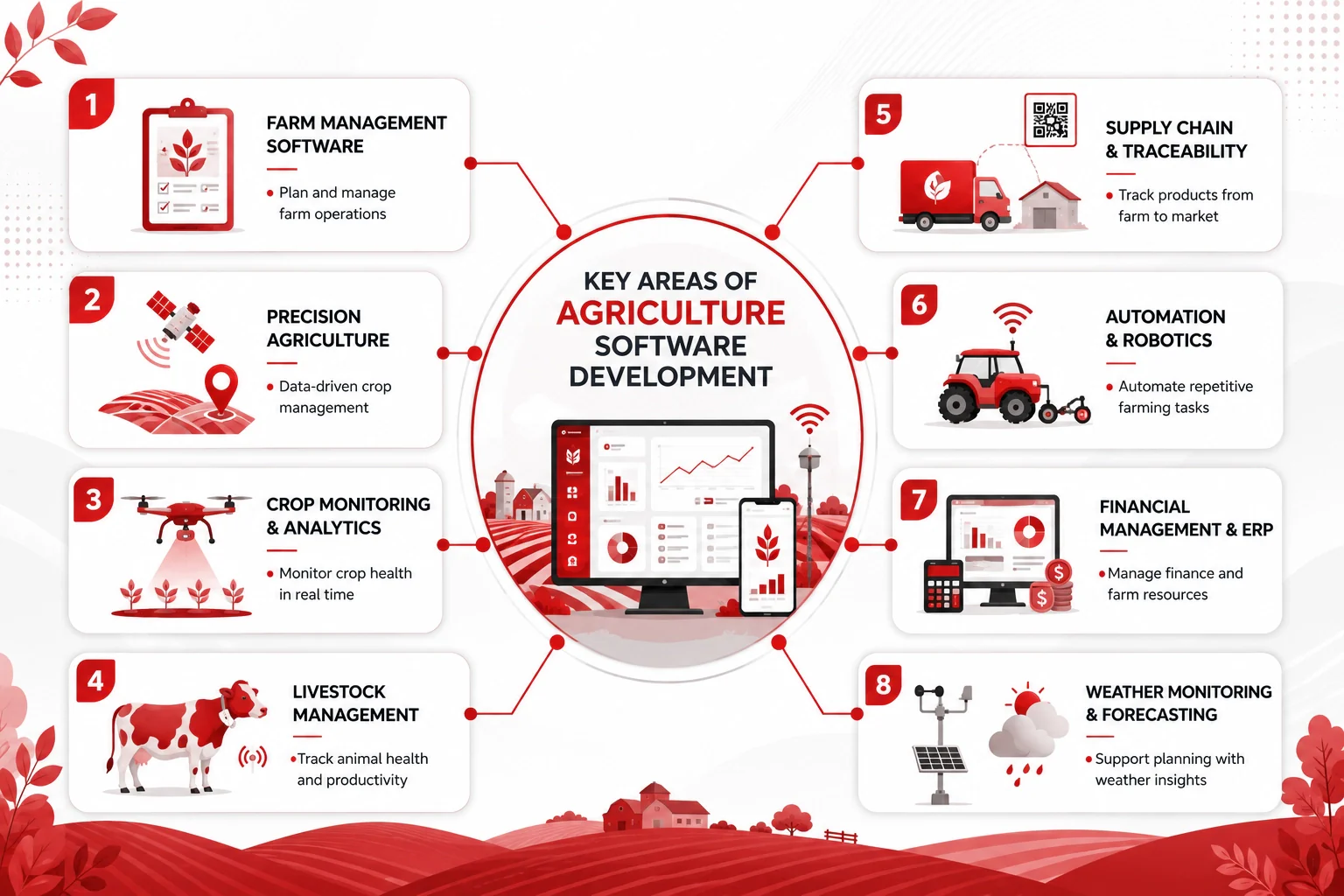
Agriculture software development focuses on transforming traditional farming practices into data-driven and automated systems. Aside from technologies like IoT, AI, and cloud computing, below are the key areas of the development of agricultural software:
- Farm Management Software (FMS)
Farm Management Software enables farmers to plan, monitor, and analyze all farming activities from a single, intuitive dashboard. It works by integrating data from various sources such as sensors, machinery, and financial records to optimize resource use and improve farm productivity. - Precision agriculture solutions
Precision Agriculture Solutions use GPS, IoT sensors, and satellite imagery to deliver data-driven insights for targeted crop management. They work by collecting real-time data on soil, moisture, and crop health, allowing farmers to make accurate decisions about irrigation, fertilization, and pest control. - Crop monitoring & analytics
Crop monitoring and analytics systems analyze vegetation health using drones, remote sensing, and AI algorithms. These tools work by processing real-time images and environmental data to detect issues such as disease or nutrient deficiency early, enabling farmers to take timely action. - Livestock management software
Livestock Management Software tracks the health, breeding, and productivity of animals in real time. It works by using sensors and RFID tags to record data, such as feeding schedules, medical treatments, and movement patterns, for improved herd management. - Supply chain management & traceability
This system ensures transparency and efficiency from farm to consumer by tracking every step of agricultural production. It works by recording and sharing data across all supply chain participants, enabling stakeholders to verify the origin, quality, and safety of products. - Automation and robotics
Automation and Robotics bring efficiency to farming through automated machinery like drones, harvesters, and robotic weeders. They work by executing repetitive or labor-intensive tasks autonomously, reducing human error and operational costs. - Financial management & ERP
Financial Management & ERP software centralizes farm accounting, budgeting, and inventory management. It works by integrating financial data with operational metrics, giving farmers clear visibility into profitability and cost control. - Weather monitoring & forecasting
Weather monitoring and forecasting systems utilize satellites and IoT sensors to collect real-time climate data. They work by analyzing patterns to provide accurate predictions, helping farmers plan planting, harvesting, and irrigation activities effectively.
How to Choose the Best Agriculture Software?

Choosing the right agriculture management software can feel confusing, especially when each option offers different features. These systems aim to improve how you run your farm or agribusiness, but not all of them work the same way.
Here are some practical tips when selecting software for agriculture operations:
- Look into local options: Focus on software that works well for farms in Malaysia. Check if it’s easy to use, covers the tools you need, and runs smoothly on your devices. Reading real user reviews can help you spot common problems or strong points.
- Check if the software fits your farm’s size and setup: Pick a system that adjusts as your operations expand. Custom settings help match the software to how you actually run things, whether you manage crops, livestock, or both.
- Make sure it works with your current tools: Choose a digital farming solution that can connect with your existing systems like accounting tools, mobile apps, or inventory trackers. That way, you don’t need to start from scratch.
- Protect your farm’s data: Go for software for agriculture that keeps your records safe. Secure logins, regular backups, and clear access controls matter, especially if you handle financial or employee information.
- Check the support and training options: A user-friendly agriculture ERP system should come with easy-to-follow guides or help from the support team. Quick answers and proper training reduce downtime when you start using it.
- Think beyond the price tag: Don’t just go for the cheapest option. Weigh the long-term value like better crop planning, less waste, or improved reporting, against what you pay upfront.
Why HashMicro Agriculture Software is The Best Choice?
Agriculture software is used to support daily farming operations, improve data management, and monitor activities more efficiently. HashMicro Agriculture Software includes features for managing various agricultural processes within a single system. The following are some of its key features and capabilities.
Here’s a tailored explanation for each USP in the context of the agriculture sector:
- Built-in Business Intelligence (BI): Enables farmers and agribusiness managers to analyze crop yield trends, cost efficiency, and resource usage through real-time data visualization for smarter planning and profitability.
- AI integration: Uses artificial intelligence to predict crop diseases, optimize planting schedules, and enhance decision-making with data-driven insights across every farming stage.
- Weather forecast integration: Provides accurate, location-based weather insights to help plan irrigation, fertilization, and harvesting schedules, reducing risks caused by unpredictable climate conditions.
- Mobile apps: Allow field workers and managers to record data, monitor activities, and track equipment usage directly from mobile devices, ensuring complete visibility even in remote areas.
- Flexible Hosting (On-Premise/Cloud): Offers deployment options that suit both traditional farms and modern agritech enterprises, enabling secure data storage and seamless, anytime, anywhere access to operations.
Which Agriculture Software Suit your Business?
Different agricultural businesses require different software capabilities based on their farm size, production type, and operational priorities. The table below matches common business scenarios with recommended agriculture software solutions to help buyers identify the most suitable option.
| Business Scenario | Recommended Agriculture Software | Why It Fits |
|---|---|---|
| Medium to large agribusiness with multiple estates, warehouses, and business units | HashMicro | Centralises land preparation, crop activities, equipment maintenance, inventory, workforce, finance, and BI or AI insights. It also provides local support in Malaysia. |
| Small to mid-sized farm managing both crops and livestock | FarmBrite | Combines crop records, livestock monitoring, task management, inventory, and basic financial tracking in one cloud platform. |
| Row-crop farm focused on field performance and profitability | FarmLogs by Bushel Farm | Provides field mapping, rainfall monitoring, work orders, satellite imagery, production records, and profitability analysis. |
| Farm that prioritises field mapping and task coordination | Agrimap | Helps teams organise farm plots, schedule activities, monitor irrigation, record pest treatments, and review yield performance. |
| Agribusiness requiring soil, weather, and crop intelligence | SPL Tech | Supports crop monitoring, soil analysis, weather forecasting, irrigation scheduling, and pest management. |
| Fresh-produce grower, packer, wholesaler, or distributor | PICS | Offers lot-based traceability, barcode scanning, quality checks, cold-storage management, and inventory control from farm to buyer. |
| Large farm using GPS-enabled machinery and precision agriculture | Trimble Agriculture | Connects GIS, field data, work orders, machine activities, and yield analysis for more precise resource planning. |
| Farm that mainly needs agriculture-specific accounting | EasyFarm | Provides farm-focused accounts, cost centres, inventory valuation, payroll, and production records through a one-time purchase model. |
| Fruit or vegetable producer with strict traceability requirements | CropTracker | Covers spray records, harvest tracking, packing, storage, labour management, quality control, and audit-ready reports. |
| Large agricultural enterprise or institutional value-chain operator | SmartFarm by Cropin | Supports large-scale field monitoring, crop-risk alerts, activity scheduling, inventory management, forecasting, and compliance reporting. |
| Agribusiness requiring a customised AI, IoT, or ERP solution | Folio3 AgTech | Builds tailored systems that connect farm operations, ERP, CRM, livestock, inventory, analytics, and supply-chain processes. |
| Commercial crop producer needing field-to-finance control | Agrivi | Combines crop planning, weather data, production records, inventory, workforce, equipment, finance, and compliance management. |
| Small organic or regenerative crop farm | Heirloom | Provides accessible tools for planting schedules, field layouts, weekly labour planning, task management, and crop inventory. |
| Small livestock farm, ranch, homestead, or mixed-use farm | FarmKeep | Offers affordable livestock records, breeding management, production tracking, financial tools, tasks, and pasture mapping. |
Conclusion
Agriculture software helps farmers work smarter by pulling crop, inventory, and finance tracking into one place with real-time updates. It cuts down on guesswork, saves time, and supports clearer decisions from planting through post-harvest.
Whether you’re managing land in Sabah or coordinating harvests across multiple sites in Selangor, the right system should fit how your team already works day to day. If you’re considering HashMicro, place it on your shortlist and assess it based on the workflows that matter most to you, like crop monitoring, warehouse stock control, and field team coordination.
Instead of chasing “the most features,” focus on what will remove friction fastest in your operation, such as fewer manual reports, fewer stock surprises, and cleaner handovers between field and warehouse. A short product walkthrough or consultation can help you validate fit before committing time, budget, and change management effort.
FAQ about Agriculture Software
In Malaysia, agriculture software pricing varies based on features, scalability, and customization. Some solutions offer a one-time purchase starting at approximately RM900. Others operate on a subscription model, beginning at USD 27.50 (around RM130) per user per month, requiring a minimum of users.
Yes, many modern agriculture software solutions are designed to integrate seamlessly with existing farm equipment. This integration allows for real-time data collection from machinery, enabling features like automated field records and equipment monitoring.
Look for features that boost efficiency, such as precision farming tools, real-time monitoring, and IoT integration. Strong farm and financial management capabilities help track operations, expenses, and resources, making your farm more productive and data-driven.
Artifical intelligence (AI) and machine learning (ML) for predictive analytics and automation, Internet of Things (IoT) to connect sensors for real-time data collection, drones for automated monitoring, computer vision for detailed tracking, big data and analytics to process insights, and cloud computing to store date safely.
Yes, several agriculture software applications offer offline functionality, allowing farmers to input and access data without an active internet connection. These offline capabilities are particularly beneficial in remote areas with limited connectivity. Data entered offline is typically synced to the cloud once an internet connection is re-established, ensuring that records remain up-to-date.
Yes. Most agriculture ERP systems include farm management features that monitor planting schedules, crop cycles, and harvest results.