







Leads constantly arrive from multiple channels, causing crucial follow-ups to slip and meeting notes to remain scattered. Consequently, managers often struggle to identify which opportunities need immediate attention first.
AI solves this by automating routine research and prioritising your most valuable leads. In fact, recent news coverage of the Malaysian e-commerce market reveals that 77% of sellers report significant productivity boosts from these tools. Crucially, AI simply handles the administrative heavy lifting, ensuring your representatives retain full control over the authentic relationships that actually close deals.
Beyond the industry hype, AI only works when it fits naturally into daily operations. Connecting sales-focused AI agents to an ERP system can bring practical benefits, although there are realistic limitations to consider. Let’s explore how to balance both and upgrade your workflows safely.
Key Takeaways
AI for sales is an advanced tool that uses data patterns to predict outcomes and generate content, requiring human oversight for final decisions.
AI accelerates the sales process by automating tasks like research, scoring, and outreach, while strictly requiring human oversight to ensure accuracy and strategic execution.
While AI accelerates sales workflows, it is susceptible to errors and biases, making strict human oversight non-negotiable for safe implementation.
A centralised ERP system provides this foundation by unifying your business data and operations.

What Is AI for Sales?
AI for sales is technology that analyses data, predicts outcomes, and generates content to give teams better context. While traditional automated sales force systems strictly follow predefined rules, AI learns from patterns to create original outputs. However, human review remains essential for final decisions.
In practice, this means moving away from rigid workflows that simply log daily activities, toward a system that actively guides your representatives. Instead of merely recording that a client was contacted, this technology can highlight which accounts are most likely to convert and suggest the most effective timing for the next pitch. Ultimately, it transforms your CRM from a static storage unit into an active driver of revenue.
Why AI for Sales Actually Matters in Practice
When sales data is scattered across CRM records, WhatsApp, and meeting notes, manual updates inevitably cause critical follow-up delays and unreliable pipeline visibility. This is exactly where AI proves its strategic value. It eliminates the administrative bottlenecks that steal valuable time away from active client conversations and optimising your B2B lead generation campaigns.
However, technology alone cannot fix poor process discipline or act as a sweeping replacement for your team. AI is most effective when applied to solve specific operational friction points. By taking this targeted approach, managers can restore reliable data visibility and efficiency without disrupting the workflows that already work.
What Types of AI Are Used in Sales?

Predictive AI
Predictive AI focuses on finding patterns and estimating likely outcomes from historical data, such as generating sales leads, lead propensity scores, or identifying pipeline risks. Because it relies heavily on past trends, sales leaders must actively validate data quality, adjust scoring thresholds, and apply the real-world business context that the mathematical model cannot see.Generative AI
Generative AI accelerates administrative work by creating or transforming content, enabling teams to quickly draft follow-ups, summarise discovery calls, or prepare account briefs. Despite this speed, sales representatives must meticulously review all outputs to ensure factual accuracy, verify appropriate tone, and protect sensitive customer information before any message is sent.Conversational AI
This technology interprets user intent and responds through natural dialogue, making it ideal for handling basic website inquiries from prospects or assisting salespeople with internal CRM queries. To maintain a high-quality brand experience, organisations must continuously monitor these interactions and define clear escalation paths so that a human representative can seamlessly take over when needed.AI Agents
AI agents autonomously execute multi-step tasks, such as gathering account context or triggering automated CRM workflows. Despite their efficiency, teams must enforce strict system checkpoints and keep human professionals in the loop to resolve complex exceptions, ensure data privacy, and manage the authentic relationships that actually close deals.What Are the Key Ways AI Is Used in Sales?
The main uses of AI in sales are prospecting and lead prioritization, conversation intelligence, sales forecasting, and outreach automation. AI agents can connect several of these steps into a controlled workflow, but human professionals must still approve important messages, exceptions, and final customer decisions.
1. Prospecting and Lead Prioritization
Using approved market sources and internal records as input, AI enriches account context and surfaces priority signals based on historical data. However, the salesperson must validate this relevance and interpret the broader business context, ultimately producing a realistic target list rather than a guaranteed best lead.
2. Conversation Intelligence
When fed call recordings or meeting transcripts, the AI transcribes conversations, generates summaries, and identifies potential next actions. Representatives remain responsible for confirming factual accuracy, reading human nuances the system missed, and choosing the right strategic response, resulting in a structured and actionable follow-up plan.3. Sales Forecasting
By analyzing raw CRM and pipeline data, including customer interactions handled by AI agent customer service tools, AI detects historical patterns, uncovers anomalies, and highlights potential revenue gaps. Because the mathematical model lacks external market awareness, human sales leaders must assess the commercial context and own the final forecast decision, outputting a risk-adjusted pipeline view.4. Outreach Automation
Provided with approved prospect data and messaging frameworks, AI prepares personalized email drafts and triggers defined outreach sequences. To protect brand integrity, salespeople must review and approve sensitive communications before sending, ensuring the final output is a highly relevant, relationship-building message.5. AI Agent Workflow
Rather than acting as a separate benefit, AI agents function as an orchestration layer. Understanding what an AI agent is helps explain how these systems use defined objectives and connected tools to coordinate multistep tasks across the sales cycle. Operations teams retain control through strict permissions and checkpoints, while final decisions remain subject to human approval.
Why Do Sales Teams Use AI?
For Malaysian sales teams handling enquiries across website forms and WhatsApp, the main challenge isn't generating more messages, but consistently capturing context, assigning ownership, and tracking next actions across disjointed channels.
Instead of chasing unrealistic revenue promises, strategic teams adopt AI to solve these exact fundamental workflow problems. By transforming chaotic inputs into organized execution, AI enables faster triage, cleaner records, and better pipeline visibility, turning common bottlenecks into the practical outcomes outlined below:
| Sales Problem | How AI May Support | Practical Outcome |
|---|---|---|
| High enquiry volume | Classify and summarize incoming messages. | Faster initial triage and clearer ownership. |
| Inconsistent lead qualification | Apply documented criteria and surface relevant context. | More consistent prioritization for salesperson review. |
| Incomplete CRM notes | Prepare structured summaries from approved sources. | Cleaner records and easier handovers. |
| Missed or uneven follow-up | Flag inactivity and prepare a draft next step. | More timely follow-up without removing human approval. |
| Weak pipeline visibility | Identify changes, anomalies, and missing activity. | Earlier review of possible risk and data gaps. |
Limitations of AI in Sales

Data Dependency: AI does not fix bad data; it amplifies it. Poor, duplicated, or incomplete CRM records will directly result in weak recommendations and unreliable summaries. Maintaining strict data hygiene is the non-negotiable prerequisite for any AI initiative.
Content Accuracy: AI models prioritize fluency over factual accuracy, meaning generated content can confidently present mistakes or unsupported statements (often called hallucinations). Furthermore, AI lacks situational awareness and often misses the subtle tone required for specific, high-stakes customer relationships.
Historical Bias: Because AI trains on historical data, it naturally reproduces past biases and behaviors. It cannot instinctively recognize unprecedented market shifts, sudden economic changes, or fresh nuances within a specific account's context.
Privacy and Consent: Feeding sensitive customer data into AI systems creates immediate compliance risks. Customer information requires strict access controls, clear consent for AI processing, and regular review to ensure adherence to data protection laws (such as the PDPA in Malaysia).
Human Judgment: AI is a powerful operational assistant, not a closer. It cannot reliably navigate complex negotiations, read emotional nuances, or take legal accountability for business decisions. Critical thinking and relationship-building must remain strictly human responsibilities.
How to Start Using AI in Sales
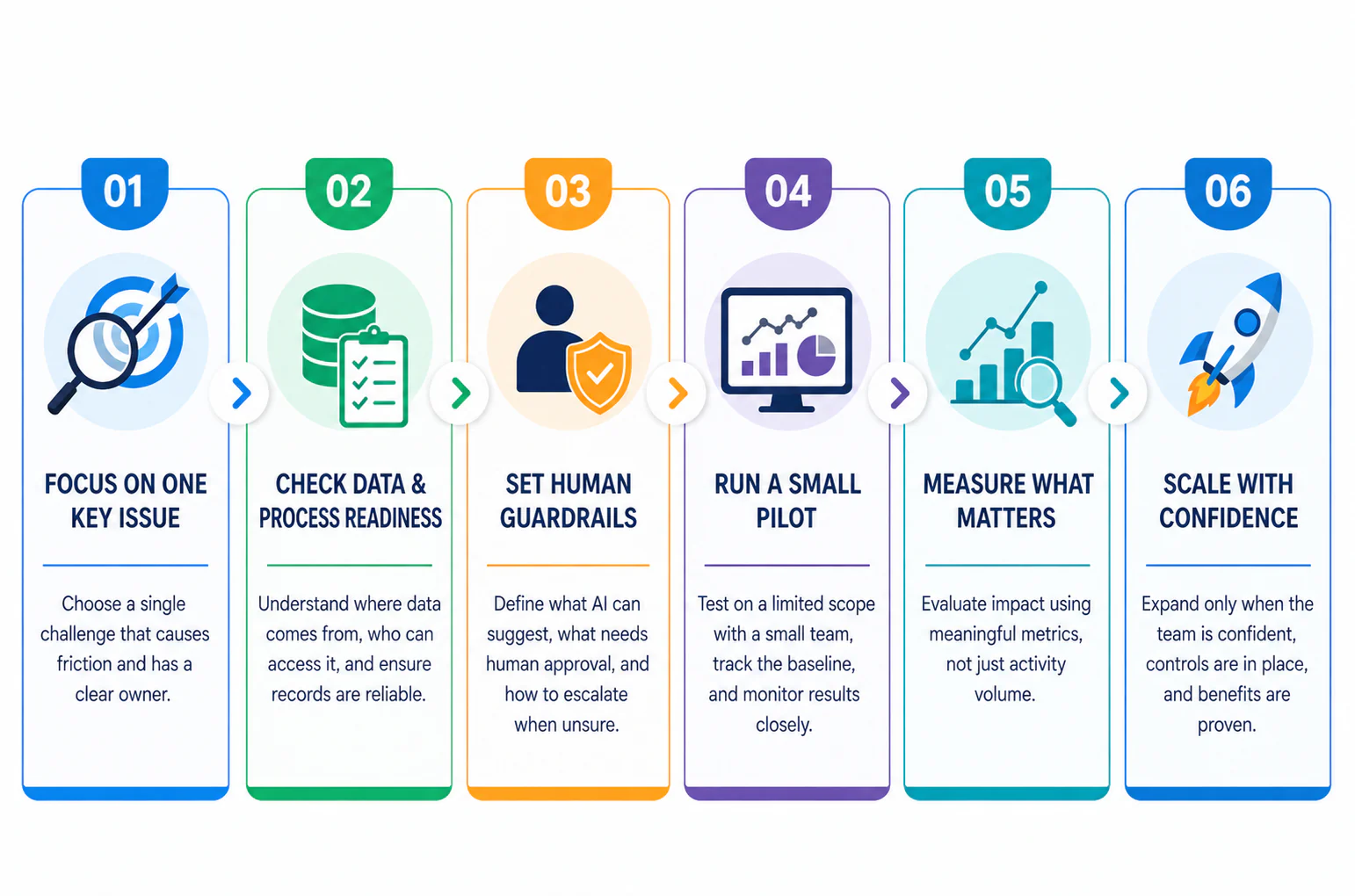
Identify one specific bottleneck: Begin by isolating a single friction point rather than attempting a broad transformation. Select a specific task with a visible owner, such as meeting-note capture, initial lead triage, or routine follow-up drafting.
Review data and workflow readiness: Carefully map out where your data originates, who holds access rights, and whether existing records are complete. If you are currently evaluating reliable software for sales management, clearly identify which systems need integration before moving forward.
Define human approval and escalation: Establish strict operational guidelines. Specify exactly which AI outputs act as suggestions and which actions require explicit human sign-off. Outline clear procedures for what happens when the system lacks sufficient context or confidence.
Run a limited pilot: Launch a tightly restricted test before considering any company-wide rollout. Choose a small team or single workflow, document the baseline performance, train the users, and meticulously monitor for both useful outputs and unexpected errors.
Measure relevant outcomes: Evaluate success by comparing tangible metrics like follow-up response time, record completeness, user adoption, exception rates, or forecast stability. Crucially, do not fall into the trap of substituting pure activity volume for genuine business quality.
Scale only when ready: Finally, expand the implementation only after the initial team can confidently explain the workflow, consistently apply human controls, demonstrate observed benefits, and safely manage any remaining risks.
Conclusion
Integrating AI into sales elevates representatives from mere data managers to strategic advisors. By offloading routine research and lead routing, your team can focus entirely on complex negotiations and building authentic trust.
Furthermore, adopting these tools is an ongoing evolution rather than a one-time setup. Long-term success requires a culture of continuous tuning, where salespeople actively provide feedback to keep the system aligned with real-world customer expectations.
Ultimately, intelligent workflows only thrive on a highly organised foundation. To see how unifying fragmented channels can create seamless handoffs for your team, you can explore a free demo of a dedicated sales leads management solution.






Frequently Asked Questions
No. While AI can efficiently support representatives by automating specific administrative tasks, it cannot replace the human element of selling. Crucial responsibilities like exercising strategic judgement, building authentic relationships, handling nuanced negotiations, managing exceptions, and holding ultimate accountability remain strictly human duties.
Yes, but technological readiness is not determined by company size alone. Its actual suitability depends much more on identifying a clear operational bottleneck, possessing clean and usable data, ensuring a proper workflow fit, managing implementation costs, and maintaining consistent human oversight.
Traditional sales automation strictly follows predefined rules and triggers to execute repetitive tasks. In contrast, AI systems can process unstructured information to identify hidden patterns, dynamically generate original outputs, or recommend strategic next actions based on historical data.
Not every AI application strictly requires a CRM to function on its own. However, having structured customer and activity data centralised within a CRM often significantly improves overall workflow integration. It ensures better data governance and maintains crucial context continuity across your sales pipeline.