







Imagine sitting in a performance review where months of your team’s hard work are erased by one minor mistake made last week. For many HR leaders in Malaysia, this is a daily reality where short term memory dictates career paths and destroys employee morale.
Memory based reviews often lack credibility, with Gallup reporting only 26% of employees find them accurate and 29% fair. SHRM notes these traditional methods encourage recency bias, causing you to favor recent events over an employee’s full year contribution.
You cannot let objective data be erased by a mental shortcut that threatens your organizational integrity. By mastering strategies to eliminate recency bias, you will ensure fairness and build a team that trusts your leadership. Read on to discover how to transform your decision making into a data driven powerhouse.
Key Takeaways
Recency bias forces your brain to prioritize the last few weeks of performance, causing you to overlook critical long term achievements from earlier in the year.
Hiring top tier talent becomes difficult when interview fatigue causes you to favor the last candidate interviewed simply because they are the freshest in your mind.
Auditing your HR data for sudden Q4 productivity spikes or unbalanced feedback language is essential to diagnosing and curing systemic bias in your workplace.
Stop letting flawed memory dictate your team’s future. To ensure every evaluation is backed by objective, real time data throughout the year, you need a system that captures every milestone as it happens.

What is Recency Bias? The Psychology Behind the Phenomenon

Recency bias is the tendency to focus more on recent events or information while overlooking older data. It leads people to judge situations based on what happened most recently instead of considering the full picture. Your brain naturally prioritizes recent events while overlooking past achievements, even when those older milestones are more critical for your business growth.
This phenomenon is part of the Serial Position Effect, first studied by German psychologist Hermann Ebbinghaus in the late 1800s, who discovered that where information falls in a sequence heavily impacts how well you remember it.
Here is how this cognitive shortcut affects your professional judgment:
- Primacy Bias: You tend to remember information at the very beginning of a sequence, which is why first impressions hold such a powerful grip on your evaluation.
- Recency Bias: You easily recall events from the end of a period because they remain fresh in your short term memory, causing you to give them disproportionate weight.
- The Middle Gap: Critical performance data that occurs in the middle of a project often gets lost, leaving a massive hole in your overall assessment.
Why does this become a major problem at work? Because as a manager or HR professional, you are already overwhelmed every day with emails, meetings, tough decisions, and team issues . When your brain is overloaded like that, it naturally takes shortcuts by defaulting to whatever is easiest to recall, which is whatever happened most recently.
As a result, your brain convinces you that what happened in the last few weeks is the most accurate picture of someone’s overall performance . But that is often far from the truth and can lead to biased evaluations that harm your team’s long term morale.
How Recency Bias Quietly Shows Up at Work
Recency bias is difficult to notice because it operates quietly in day-to-day decisions. It influences how teams collaborate, how tasks are assigned, and how performance is perceived, often without clear awareness. Even experienced managers can fall into this pattern when decisions rely more on memory or instinct rather than documented data.
- It starts in everyday moments
Think about your weekly team meeting. When asked about recent wins, you likely highlight what happened in the last few days while foundational work from earlier in the month gets overlooked. Over time, this creates a culture where your employees feel that steady consistency is ignored while last minute heroics get all your attention. - It also affects who gets the best opportunities
A strong recent performance, such as delivering a successful presentation, can quickly change how an employee is perceived. This may lead to more visibility and new opportunities, while others with proven track records are unintentionally overlooked. On the other hand, a single recent mistake can unfairly impact how a reliable employee is judged.- The bigger picture?
When your team’s reputation shifts based on what happened last week, it creates an unstable environment. Your employees feel their standing is only as secure as their most recent project, which breeds anxiety and kills creativity. People stop taking smart risks because they are too busy making sure their latest work looks good for you, leading to a loss for everyone.
- The bigger picture?
The Devastating Impact on Performance Management
Recency bias does the most damage during your annual performance reviews. You are expected to fairly evaluate twelve full months of work, but without detailed documentation, your brain is simply not built for that. Consequently, your evaluations often end up being based mostly on the last four to six weeks of an employee’s performance.
This leads to two unfair scenarios that can compromise your leadership:
Scenario 1: The Late Stage Slacker
Imagine an employee who underperforms from January through October but suddenly flips a switch as December reviews approach. If you are influenced by recency bias, you might give them a glowing review or a bonus based only on this recent burst of effort. In this case, their ten months of mediocrity are completely forgotten, rewarding behavior that does not reflect true consistency.
Scenario 2: The Fallen Star
Now imagine a dedicated employee who has crushed their targets for eleven straight months but makes a visible mistake right before their review. If you fixate on that recent stumble, you may deliver a harsh evaluation that overshadows nearly a year of outstanding work. This unfair judgment happens simply because the mistake occurred at the worst possible time for your memory.
Both scenarios destroy the integrity of your evaluation process. When your employees realize that long term effort is irrelevant compared to end of year visibility, they will adopt cynical behaviors. To combat this, your organization must shift toward modern approaches to performance management that emphasize continuous tracking and objective data rather than relying on flawed human memory.
Recency Bias in the Hiring and Recruitment Process
Recency bias often wreaks havoc during recruitment, especially when interview fatigue sets in after meeting numerous candidates. Your brain becomes susceptible to mental shortcuts as you struggle to maintain focus over several days or weeks of evaluations.
When making a final decision, candidates you interviewed early or in the middle often blur together as their specific skills fade from your memory. In contrast, the very last candidate remains vivid, leading you to falsely equate this ease of recall with higher quality. This trap causes you to reject superior talent simply because of their interview timing.
This bias also affects how you screen resumes. You might overvalue a candidate’s most recent job title while ignoring a rich history of relevant experience in previous roles. This narrow focus prevents you from seeing their full potential, leading to costly hiring mistakes that drain your company’s resources.
The Ripple Effect on Employee Engagement and Retention
Recency bias damages your culture by signaling that evaluations depend on your fleeting memory rather than total contributions. When your team perceives this injustice, their motivation plummets. Your top performers will quickly feel betrayed if a year of hard work is ignored due to one recent mistake, leading them to seek out fairer, data driven organizations.
If you continue to judge based on recent events, you risk retaining only those who have learned to game the system by performing well just before reviews. This creates a toxic, low productivity environment. To prevent this, you must prioritize objective fairness as a core strategy for maintaining high levels of employee engagement. When your workforce trusts that you value their consistent efforts, they remain loyal and invested in your long term success.
Recognizing the Signs of Recency Bias in Your Organization
Before you can cure recency bias, you must diagnose its symptoms. Since these biases are unconscious, you must act as an organizational auditor to identify systemic patterns and data anomalies that suggest your managers are being unfairly influenced by recent events.
One glaring sign is a sudden shift in performance ratings that aligns with your review cycle. If your data shows vastly different ratings in Q4 compared to Q1 and Q2, or a massive spike in productivity just before annual reviews, your team is likely reacting to a memory based evaluation culture. You should also watch for feedback language that relies heavily on phrases like just last week while ignoring earlier initiatives.
High turnover among your consistent performers is another major red flag. If exit interviews reveal that talented employees feel unseen or unappreciated for their long term work, you must investigate the managers involved. Tracking these metrics provides the empirical evidence you need to prove that cognitive biases are actively harming your company’s bottom line.
10 Strategic Ways to Prevent Recency Bias in Performance Appraisals
Eradicating recency bias requires a proactive approach. You cannot simply tell your managers to remember better; you must build systems that make relying on flawed memory impossible. Here are ten effective strategies to ensure objective and fair performance appraisals.
1. Implement Continuous Feedback Loops
You should transition to a continuous performance management model by holding weekly or bi-weekly check-ins. By documenting feedback in real time, your final annual review becomes a simple summary of these conversations, eliminating the need to recall distant memories.
2. Require Managerial Journaling
You must encourage your managers to keep a digital performance journal for every direct report. By logging milestones and errors as they happen, your team can base evaluations on a year long ledger rather than immediate recollection.
3. Utilize Standardized Evaluation Rubrics
You should replace subjective questions with standardized rubrics tied to measurable KPIs. When your evaluations focus on concrete data, such as specific sales targets or resolved tickets, you remove the influence of memory loss from the process.
4. Implement 360 Degree Feedback
By gathering evaluations from peers, subordinates, and clients, you dilute the bias of any single individual. Aggregating these diverse viewpoints throughout the year ensures a more balanced picture of your employee’s performance.
5. Conduct Calibration Meetings
You should facilitate sessions where multiple managers review proposed ratings together. This allows your HR team to challenge low ratings based on recent failures by pointing to an employee’s strong performance earlier in the year.
6. Separate Compensation from Development Reviews
You can reduce high stakes anxiety by separating developmental feedback from salary discussions. This prevents recent actions from being over scrutinized during critical financial reward conversations.
7. Set Clear SMART Goals
When you set Specific, Measurable, Achievable, Relevant, and Time bound goals, evaluation becomes a matter of fact. Using goal tracking software ensures that achievements from early in the year remain visible during December reviews.
8. Emphasize the How as Much as the What
You must evaluate long term behavioral patterns, such as teamwork and values, rather than just recent major successes or failures. This forces your managers to think holistically about an employee’s conduct throughout the entire year.
9. Pre Review Self Assessments
You should allow employees to complete self assessments to serve as memory joggers for their managers. This empowers your team to remind leadership of their great work from the beginning of the year that might otherwise be forgotten.
10. Regular HR Audits of Appraisal Data
Your HR team must actively audit reviews to ensure they align with continuous feedback logs. If a final evaluation contradicts the documented reality of the first three quarters, you must intervene to ensure objective fairness.
"These strategies effectively shift evaluation from flawed memory to objective systems by integrating real time documentation and cross team calibration. This data driven approach ensures your appraisals remain fair and consistent throughout the entire year."
Overcoming Cognitive Biases in Talent Acquisition
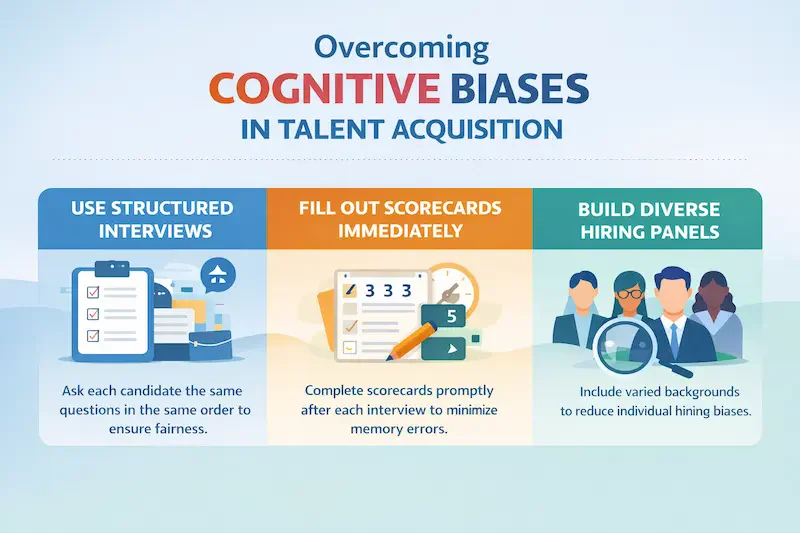
Just like performance reviews, your hiring process needs proper structure to keep bias out. Unstructured interviews where you just chat to see if someone is a good fit are where recency bias, affinity bias, and the halo effect thrive the most.
Here is how you can build a fairer hiring process:
1. Use Structured Interviews
You should ask every candidate for the same role the exact same questions in the same order. By avoiding casual tangents and standardizing the input, you can compare candidates fairly based on what actually matters which is their answers.
2. Fill Out Scorecards Immediately After Each Interview
Your memory of a conversation starts fading within minutes, so you must fill out a standardized scorecard right after each interview ends. This ensures that your final decision is driven by documented data and numerical scores rather than who you happen to remember best at the end of the week.
3. Build Diverse Hiring Panels
By bringing in interviewers from different backgrounds and departments, you ensure that your team pays attention to a variety of skills and perspectives. This diversity makes it far less likely that one impressive or disappointing moment will sway your entire group’s decision, leading to a more balanced evaluation of every candidate.
The Role of Technology in Eliminating Human Bias
Human error is inevitable, but modern HR technology acts as an indispensable ally. By automating performance and recruitment data, you create objective paper trails that bypass memory flaws entirely. This digital infrastructure ensures your decisions are always backed by facts rather than fleeting impressions.
In performance management, utilizing the best performance management tools allows you to centralize goals, feedback, and check ins into one dashboard. The software aggregates twelve months of data, presenting a clear timeline of achievements. This evidence based approach highlights any discrepancies caused by recent events, allowing you to maintain absolute fairness.
For recruitment, an Advanced ATS anonymizes resumes and mandates scorecards for every candidate. This compiles aggregate data to show who scored highest across objective criteria, regardless of their interview order. Technology serves as your ultimate referee, keeping psychological flaws in check and ensuring you hire the best talent based on merit.
Building a Culture of Objective Evaluation
Human error is inevitable, but modern HR technology acts as an indispensable ally. By automating performance and recruitment data, you create objective paper trails that bypass memory flaws entirely. This digital infrastructure ensures your decisions are always backed by facts rather than fleeting impressions.
In performance management, utilizing the best performance management tools allows you to centralize goals, feedback, and check ins into one dashboard. The software aggregates twelve months of data, presenting a clear timeline of achievements. This evidence based approach highlights any discrepancies caused by recent events, allowing you to maintain absolute fairness.
For recruitment, an Advanced ATS anonymizes resumes and mandates scorecards for every candidate. This compiles aggregate data to show who scored highest across objective criteria, regardless of their interview order. Technology serves as your ultimate referee, keeping psychological flaws in check and ensuring you hire the best talent based on merit.
Recognizing bias is only the first step. To truly eradicate its influence, you must implement structural changes to your evaluation and hiring processes. Here is a practical roadmap for you and your leadership team.
Step by Step Implementation: Building a Bias Resistant Framework
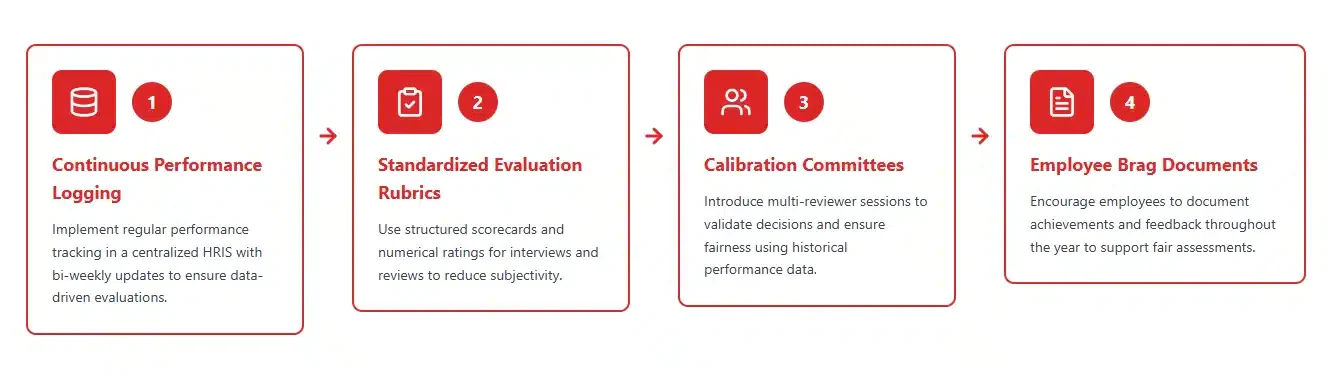
Recognizing bias is only the first step. To truly eradicate its influence, you must implement structural changes to your evaluation and hiring processes. Here is a practical roadmap for you and your leadership team.
Step 1: Transition to Continuous Performance Logging
You should shift to a continuous feedback model by requiring your managers to log performance notes and project outcomes in a centralized HRIS bi weekly. When review season arrives, you will have a data rich timeline to draw from instead of relying on what happened last week.
Step 2: Standardize Evaluation Rubrics
You must develop specific standardized rubrics for both reviews and interviews to counter subjective biases. By using scorecards that rank competencies on a numerical scale immediately after an interaction, you prevent the last candidate from winning simply because they are the freshest in your mind.
Step 3: Institute Calibration Committees
You should never leave a promotion or termination decision to a single manager. By implementing calibration sessions where multiple leaders review proposed ratings together, you can force managers to justify their decisions with historical data and easily identify evaluations skewed by recent events.
Step 4: Empower Employees with Brag Documents
You should encourage your employees to maintain a running list of their accomplishments and positive feedback received throughout the year. When employees submit these brag documents before a formal review, they ensure their early year successes are brought back to the forefront of your working memory.
Conclusion
Eradicating recency bias is about changing the systems your brain relies on. By embracing continuous documentation, you protect your team from unfair judgments and build a workplace rooted in trust. When every employee knows their consistent effort is valued, you create a high performing culture that thrives on merit rather than fleeting memories.
Implementing these structural changes secures your organizational integrity and keeps your top talent engaged. As you standardize rubrics and facilitate calibration meetings, you ensure that every year long contribution remains the foundation for future growth. This proactive approach prevents memory gaps from undermining your leadership and team morale.
You cannot let manual processes continue to threaten your business success. To see how automated tracking and evidence based data can transform your management style, you should book a free demo of our Smart HRIS today. Taking this step will empower you to make fairer decisions and lead your organization with absolute confidence.

FAQ About Recency Bias
You should look for the frequency and consistency of the behavior over a minimum of six months rather than a single event. A genuine performance trend shows a clear trajectory of improvement or decline across multiple projects, whereas recency bias fixates on an isolated incident that contradicts the employee’s established historical data.
While it might provide a temporary boost for an employee who performs well just before a review, you will find that the long term impact is overwhelmingly negative. It creates a “sprint and rest” culture where your team only works hard when they know they are being watched, ultimately destroying the year long productivity and steady reliability your business needs.
You must respond by presenting the documented evidence gathered from your continuous feedback logs and standardized rubrics throughout the entire year. By showing a transparent timeline of both early year successes and late year challenges, you can move the conversation from subjective opinions to an objective discussion based on a complete data set.
Recency bias is when people give more importance to recent events or information and overlook older data. In simple terms, it means you tend to judge a situation based on what happened lately rather than considering the full history. This can lead to decisions that feel right in the moment but are not always accurate overall.
You should understand that recency bias is driven by the timing of the interaction, where you favor the last candidate simply because they are the freshest in your mind. In contrast, the halo effect occurs when one specific positive trait, such as a prestigious previous employer, causes you to overlook all other weaknesses regardless of when the interview took place.