






For businesses in Malaysia in 2026, the distinction between the mandatory MyInvois system and the optional Peppol network is often confusing. Many struggle to separate legal tax obligations from operational choices, leading to uncertainty in managing digital workflows while ensuring full compliance.
According to industry guidance industry guidance, Peppol enables secure, standardized invoice exchange between ERP systems. Alongside MyInvois, it reduces manual work, improves visibility, and streamlines transactions between trading partners.
This article provides an objective breakdown of how these systems interact, the roles of MDEC and LHDN, and the practical steps to integrate them through advanced invoicing software platforms. Read on to gain the clarity needed to streamline your tax compliance and optimize your company’s digital connectivity.
Key Takeaways
Peppol is a global standard for automated document exchange, serving as an optional tool for operational efficiency in Malaysia rather than a mandatory tax system.
Peppol’s 4-corner model and digital directories enable automated, direct document exchange between businesses, eliminating the need for custom integrations.
Peppol drives operational efficiency by accelerating payment cycles, reducing manual costs, and enabling seamless cross-border trade through a scalable digital infrastructure.
Standardized e-invoicing is essential for maintaining operational accuracy and achieving seamless financial connectivity as your digital landscape evolves.

What Is Peppol E-Invoicing?
Peppol is a standardized global network that enables the secure and automated exchange of electronic documents, such as e-invoices, between different business systems. At its core, the system utilizes Access Points, which act as secure gateways to ensure that data is transmitted in a consistent format that is instantly readable by the recipient system without requiring manual intervention.
Peppol vs MyInvois: What’s the Difference?

| Feature | MyInvois (LHDN) | Peppol Network |
|---|---|---|
| Primary Purpose | Mandatory Tax Compliance | Operational Efficiency & Automation |
| Legal Status | Required by LHDN | Voluntary Infrastructure |
| Main Function | Validates & archives tax invoices | Facilitates secure document exchange |
| Scope | Domestic Malaysian Tax Reporting | Global Business-to-Business (B2B) Trade |
| System Interaction | Connects to LHDN portal | Connects through Access Points |
| Strategic Focus | Regulatory adherence | Streamlining digital supply chains |
How the Peppol Network Works
The Peppol network operates on a simple 4-corner model designed to make document exchange as seamless as sending an email. Instead of connecting your system directly to every business partner, you connect to a certified Access Point, which then handles the secure delivery to your partner Access Point. The model consists of four key components:Sender: You, the business issuing the invoice.
Sender Access Point: Your service provider, which validates and encrypts your invoice for transport.
Receiver Access Point: The service provider of your customer, which receives and decrypts the data.
Receiver: Your customer, who receives the invoice directly into their ERP system.
The network uses two directories: the Service Metadata Locator finds partners, while the Service Metadata Publisher stores delivery details. This standardizes exchanges, eliminating the need for custom integrations with every client.
MY-PINT and EIF Identifiers in Malaysia
Malaysia adopts the PINT MY specification to align the global Peppol standard with local LHDN regulations. Businesses use the Electronic Address Scheme and EIF identifiers to ensure instant and accurate document routing. The following table outlines the essential identifiers required for this digital infrastructure:
These standardized identifiers enable your ERP to automate routing, ensuring invoices reach the correct destination instantly while eliminating risks of human error.
| Identifier Type | Purpose | Example Format |
|---|---|---|
| EIF (National E-Invoicing) | Main business identification in Malaysia | 0230:[Your Business Registration No] |
| GLN (Global Location Number) | Identifying specific branches or departments | 0088:[13-digit GS1 Code] |
| DUNS Number | Globally recognized corporate ID | 0060:[9-digit DUNS Code] |
MDEC’s Role as Malaysia’s Peppol Authority
To clarify Malaysia’s digital landscape, note that LHDN manages mandatory tax compliance via MyInvois, while MDEC acts as the official Peppol Authority overseeing the local framework. As the Peppol Authority, MDEC's primary duties include:
Accreditation: MDEC vets and certifies Peppol Service Providers (SPs) and Peppol-Ready Solution Providers (PRSPs) to ensure they meet strict security and technical standards.
Localization: MDEC localizes global Peppol standards (such as PINT-MY) to ensure they align with Malaysian business practices and regulatory requirements.
Ecosystem Promotion: MDEC drives the national agenda for digital transformation, encouraging businesses to adopt interoperable e-invoicing to increase efficiency beyond mere tax compliance.
While LHDN ensures tax compliance, MDEC fosters operational growth and digital connectivity. They work together to build an integrated environment, which you can explore further in this comprehensive guide to Malaysia e-invoicing standards for businesses navigating both systems.
E-Invoice Implementation Timeline in Malaysia
This timeline applies only to the mandatory LHDN MyInvois system, not the optional Peppol network. Malaysia is implementing a phased rollout based on annual turnover to ensure businesses have sufficient time to transition.
For businesses with an annual turnover up to RM5 million, the government has extended an interim relaxation period until 31 December 2027. During this time, you may continue using consolidated e-invoices for smaller transactions while working toward full compliance.
| Taxpayer Category (Turnover) | Implementation Date |
|---|---|
| Above RM100 Million | 1 August 2024 |
| Above RM25 Million to RM100 Million | 1 January 2025 |
| Above RM5 Million to RM25 Million | 1 July 2025 |
| Up to RM5 Million | 1 January 2026 |
| New Businesses (Commenced 2023–2025 with RM1M+) | 1 July 2026 |
Benefits of Peppol for Malaysian Businesses
While MyInvois handles mandatory tax compliance, the Peppol network provides strategic advantages to transform your daily operations. For Malaysian businesses in B2B or international trade, Peppol acts as an efficiency engine beyond regulatory requirements. Key benefits include:
Accelerated Payment Cycles: Automating invoice delivery directly into customer ERP systems eliminates manual delays, speeding up reconciliation and improving cash flow.
Reduced Operational Costs: Digital exchange minimizes human intervention, cutting costs related to printing, mailing, and correcting data entry errors.
Seamless Cross-Border Exchange: As a global standard in over 70 countries, Peppol ensures your invoices are delivered in a format that international partners can immediately process.
Scalable B2B/B2G Connectivity: Beyond invoices, you can exchange various procurement documents to build a reliable digital supply chain, which is often optimized by using top-tier manufacturing engineering software to ensure your production data remains integrated and accurate.
Enhanced Data Accuracy: Standardized formats help you meet LHDN requirements, particularly when applying the correct e-invoice classification codes the correct e-invoice classification codes to lower rejection risks, minimize disputes, and foster stronger partner relationships.
For Malaysian SMEs, integrating Peppol through an MDEC-accredited provider transforms your accounting system into a strategic asset, moving your business well beyond simple compliance.
How to Get Started with Peppol in Malaysia
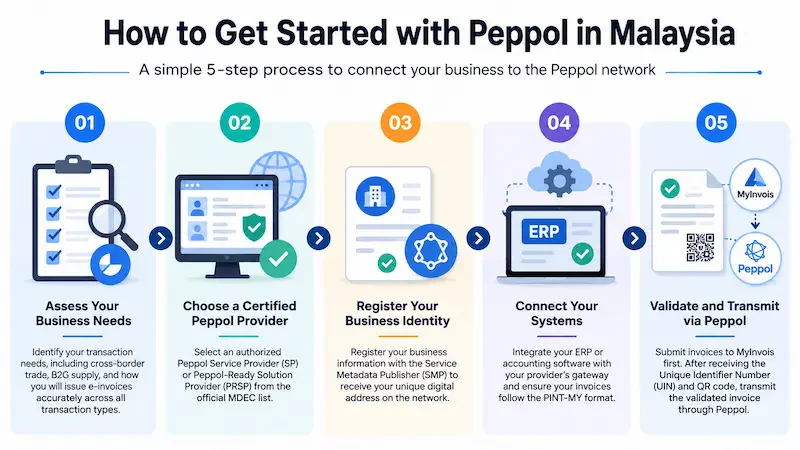
Peppol is a transmission layer rather than a replacement for LHDN compliance, so you must first master the essential e-invoice implementation steps for Malaysia e-invoice implementation steps for Malaysia before transitioning. To begin your journey toward greater operational efficiency, follow these objective steps:
1. Evaluate Operational Needs: Determine if you require automated exchange for cross-border trade or B2G supply, while also reviewing the specific requirements for generating a consolidated e-invoice to ensure all transaction types are appropriately accounted for.
2. Verify Accredited Providers: Consult the official MDEC portal to select an authorized Peppol Service Provider (SP) or Peppol-Ready Solution Provider (PRSP) that meets the required technical standards.
3. Register Your Identifier: Work with your provider to register your business in the Service Metadata Publisher (SMP) using your registration details to establish a unique digital network address.
4. Integrate Systems: Connect your ERP or accounting software to your provider’s gateway to ensure all generated invoices conform to the required PINT-MY format.
5. Establish Validation Sequences: Configure your workflow to submit invoices to the MyInvois platform first. Once LHDN issues a Unique Identifier Number (UIN) and QR code, your system can automatically transmit the validated invoice via Peppol.
How ERP Software Supports Peppol Compliance
Integrating LHDN compliance with Peppol transmission is best achieved through a centralized ERP system. This approach eliminates manual data entry and minimizes errors throughout your document lifecycle. Modern ERP solutions support this workflow by:
Automated Invoice Creation: Generate accurate invoices directly from sales or procurement data to ensure consistency from the start.
Integrated Validation: The system acts as a bridge, automatically routing data to the MyInvois platform to secure LHDN compliance before further action.
Peppol Transmission: Once validated, the system instantly transmits the invoice through the Peppol network, delivering it directly into your partner’s system.
Streamlined Reconciliation: Centralizing invoicing, validation, and delivery allows for real-time updates to your general ledger, making cash flow tracking and bank reconciliation significantly faster.
Leveraging specialized accounting software turns compliance into an operational advantage. By automating e-invoicing and data transmission, your team can shift their focus toward core business goals and quality control.
Conclusion
The distinction between MyInvois and Peppol is vital for businesses in Malaysia. MyInvois serves as the mandatory foundation for LHDN tax compliance, while Peppol acts as a strategic digital network for efficient B2B document exchange. Recognizing that these tools work in tandem rather than as alternatives allows companies to move beyond basic regulatory compliance and optimize their entire invoicing lifecycle.
The true advantage lies in integration. By synchronizing tax validation with automated Peppol delivery, you eliminate redundant manual workflows and ensure seamless accuracy. This unified approach transforms e-invoicing from a regulatory requirement into a catalyst for operational growth and long-term efficiency.
Understanding how to align these digital tools is the first step toward building a more resilient financial infrastructure. You can explore how these integrated workflows function in practice by requesting a free demo free demo of our accounting software.
FAQ
MyInvois focuses on tax reporting to LHDN while Peppol facilitates real-time business data exchange such as purchase orders and delivery notes between systems. Adopting Peppol allows companies to automate the entire trade cycle rather than just fulfilling tax document validation requirements.
No because Peppol is not a substitute for LHDN tax obligations. To remain compliant documents must be validated in MyInvois to receive a Unique Identifier Number before transmission via the Peppol network ensuring that all exchanged data is legally recognized.
LHDN is responsible for ensuring each transaction is accurately reported for tax purposes. MDEC acts as the Peppol Authority in Malaysia setting the technical and security standards required to ensure that data exchange between companies remains globally interoperable and operationally efficient.
PINT MY is a localized version of the Peppol standard tailored to Malaysian tax requirements and local business practices. By utilizing PINT MY companies ensure their electronic documents satisfy LHDN compliance criteria while remaining compatible with trading partners in over 70 countries.
The Electronic Address Scheme serves as a unique digital address for companies connected directly to the recipient ERP system. This eliminates the risk of manual email input errors or delivery failures common in traditional methods ensuring invoices reach the correct accounting system immediately.
Although a relaxation period is provided early ERP integration is highly recommended to avoid administrative backlogs when the transition phase concludes. Using the relaxation period to test systems is a strategic move to ensure full readiness when enforcement becomes mandatory.