










 Limited to 100 registrants

Construction projects often face delays, costly rework, and system failures when building components are not properly tested before handover. Construction commissioning helps prevent these issues by verifying that all systems perform according to project requirements before the building becomes operational.
In Malaysia, commissioning is increasingly recognized as an important quality assurance practice for building projects. Based on industry commissioning guidelines, the process helps verify that building systems operate as intended, reducing operational risks while supporting compliance, performance, and a smoother handover process.
Commissioning is a key component of construction management, ensuring that building systems are verified and operating as intended. The following sections cover its purpose, process, and benefits in construction projects.
Key Takeaways
Effective construction commissioning requires clear documentation, coordinated workflows, and consistent oversight throughout the project lifecycle.
Each stage of construction commissioning plays a critical role in ensuring building systems are properly verified before handover and occupancy.
Many commissioning challenges stem from poor coordination and fragmented information, making effective project management essential for a successful handover.
Building systems that are not properly verified before handover can create unexpected challenges after project completion. Professional commissioning services help ensure everything operates according to project requirements before the building enters service.

What is Construction Commissioning?
Construction commissioning (Cx) is a structured process that verifies whether building systems perform according to project requirements and design intent. By validating system performance at different project stages (design inspection, pre-commissioning tests, and performance validation procedures), commissioning helps reduce the risk of operational issues after completion.
Commissioning supports quality assurance, regulatory compliance, and building performance by identifying issues before they impact operations. Industry frameworks such as ASHRAE Guideline 0, along with references from Construction Industry Development Board (CIDB) Malaysia and the Green Building Index (GBI), provide guidance for effective commissioning practices.
Common Types of Construction Commissioning
Not every commissioning engagement looks the same. The right type depends on the age of the building, the systems involved, and what the owner wants to achieve. Four types dominate practice.
New Construction Commissioning
Applied during the design and build of a new facility. The Commissioning Agent (CxA) is engaged from the early design stages and stays involved through handover. This is the most common type for Malaysian developers building from scratch, particularly on commercial towers, hospitals, and large mixed-use developments.
Re-commissioning
A periodic check on a building that was already commissioned. The goal is to verify that systems still perform to the original benchmarks. Most facility managers in Malaysia schedule re-commissioning every three to five years, or when major tenants change.
Retro-commissioning
Applied to older buildings that were never commissioned in the first place. The focus is usually on energy efficiency, since older HVAC and lighting systems tend to drift far from their nameplate performance. Owners pursuing GBI re-certification on existing assets rely heavily on retro-commissioning.
Monitor-Based Commissioning
Continuous Commissioning uses building management systems and IoT sensors to monitor performance in real time. Unlike periodic inspections, this approach continuously tracks system operation and allows issues to be identified and addressed as they occur. As a result, building systems can maintain their intended performance throughout the asset lifecycle.
Stages of Construction Commissioning
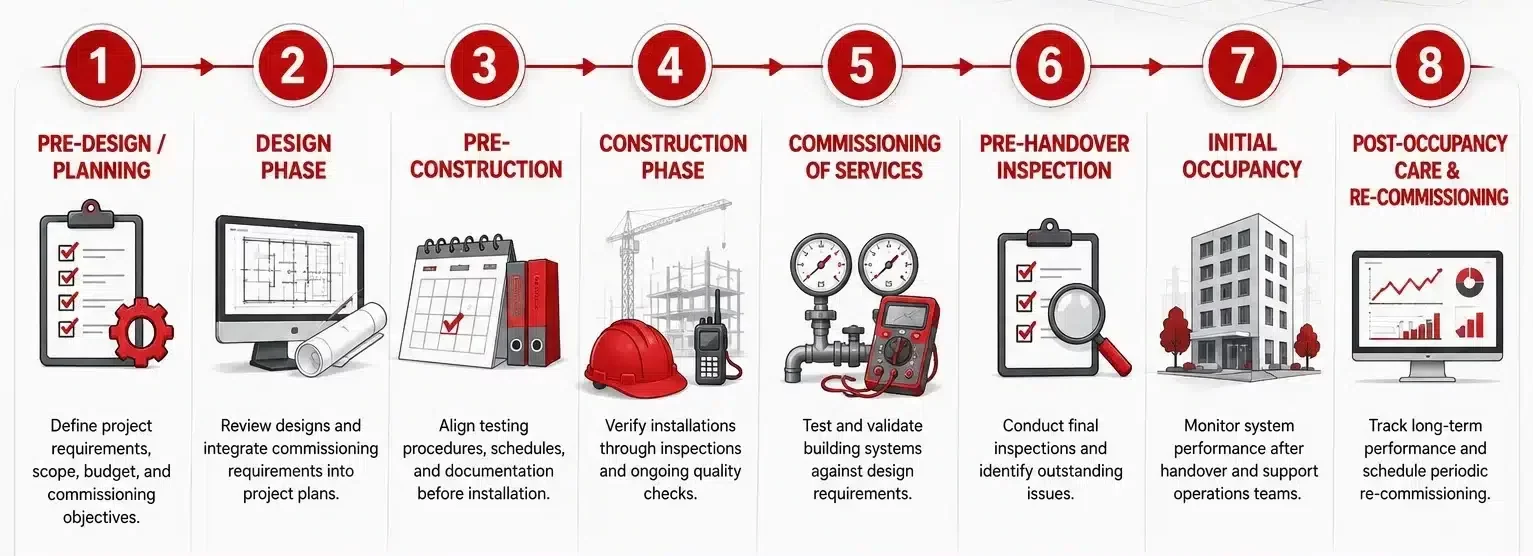
Commissioning runs across eight stages, each with its own stakeholders, documentation, and deliverables. Treating them in order is what separates a smooth handover from a fire drill at completion.
1. Pre-Design / Planning
This stage establishes the foundation for the entire commissioning process by defining project objectives, performance expectations, and stakeholder responsibilities from the outset. Owner, project manager, and Commissioning Agent define the Owner’s Project Requirements (OPR).
Documents: OPR, commissioning scope outline.
Output: agreed scope, budget allocation, and Cx team appointment.
2. Design Phase
During the design phase, commissioning requirements are incorporated into project plans to ensure building systems can achieve the intended performance once installed and operational. CxA, design consultants, and MEP engineers review drawings against the OPR.
Documents: Basis of Design (BoD), design review reports, draft Cx Plan.
Output: validated design with commissioning requirements embedded in tender documents.
3. Pre-Construction
Before construction begins, project teams coordinate commissioning activities, testing procedures, and documentation requirements to avoid delays during later project stages. Main contractor, subcontractors, and CxA align on testing protocols before installation begins.
Documents: finalised Cx Plan, pre-functional checklists, submittal log.
Output: testing schedule integrated into the construction monitor program.
4. Construction Phase
As building systems are installed, commissioning activities focus on verifying that construction project work follows approved designs, specifications, and project requirements. Contractors install systems while CxA performs site inspections and witness tests.
Documents: installation verification checklists, non-conformance reports, equipment data sheets.
Output: confirmation that installed systems match approved submittals.
5. Commissioning of Services
This stage involves comprehensive testing and verification to confirm that all building systems operate according to the approved design and performance criteria. All systems are tested, balanced, and verified against design intent.
Documents: functional performance test scripts, balancing reports, integrated systems test results.
Output: signed-off test records for every commissioned system.
6. Pre-Handover Inspection
Before the building is officially handed over, stakeholders conduct final inspections to identify outstanding issues and confirm readiness for occupancy. Owner’s representative, CxA, and contractors conduct a final walkthrough.
Documents: snag list, training records, operation and maintenance manuals.
Output: defects captured and assigned for rectification before handover.
7. Initial Occupancy
Following handover, attention shifts to monitoring building performance under actual operating conditions and ensuring systems continue functioning as expected. Building is handed over, operations team takes control, and seasonal performance testing begins.
Documents: handover certificate, final Cx Report, warranty documentation.
Output: occupant feedback loop and seasonal test results.
8. Post-Occupancy Care & Re-commissioning
Commissioning does not end after occupancy, as ongoing monitoring and periodic reviews help maintain system performance throughout the building’s operational life. Facility manager monitors performance and schedules periodic re-commissioning.
Documents: ongoing performance reports, energy consumption logs, re-commissioning plan.
Output: sustained performance through the operational life of the asset.
Building Commissioning Checklist
A practical commissioning checklist forces the team to verify systems one component at a time. Below is a working checklist grouped by system. Use it as a starting template and adapt to the project scope.
HVAC
- Air handling units tested for design airflow rates
- Ventilation system verified against indoor air quality requirements
- Temperature control loops calibrated and response times measured
Electrical
- Main switchboard and distribution boards energized and tested under load
- Lighting circuits verified for switching logic and lux levels
- Earthing and bonding measured against IEEE and Suruhanjaya Tenaga requirements
Plumbing
- Cold and hot water supply pressure tested across all floors
- Drainage system flow tested and slope verified
- Hot water systems checked for temperature stability and storage capacity
Fire Safety
- Sprinkler heads pressure tested and water flow verified
- Fire alarm panel integrated with smoke detectors and manual call points
- Evacuation routes inspected for unobstructed access and signage
Building Envelope
- Waterproofing checked for leakage at roof, basement, and wet areas
- Insulation continuity verified across walls and ceilings
- Windows and curtain walls tested for air and water tightness
Building Commissioning Certification

Several certification schemes recognize commissioning as a mandatory or rewarded practice. For Malaysian projects, five matter most.
- LEED Fundamental Commissioning
Mandatory prerequisite for any project pursuing LEED certification, issued by the U.S. Green Building Council. It establishes baseline commissioning requirements that every LEED-rated project must meet, regardless of tier. - LEED Enhanced Commissioning
An optional LEED credit that earns up to six additional points. It requires deeper involvement from the Commissioning Agent across design review, ongoing commissioning, and monitoring-based verification. - ASHRAE Guideline 0
The international reference standard for the commissioning process, issued by the American Society of Heating, Refrigerating and Air-Conditioning Engineers. Most Malaysian consultants align their Cx Plans to this guideline because it is recognized across jurisdictions. - Green Building Index (GBI) Malaysia
Green Building Index (GBI) is Malaysia’s national green building rating system that promotes sustainable building performance. Developed by Pertubuhan Arkitek Malaysia and the Association of Consulting Engineers Malaysia, it includes commissioning as a scored criterion under the Energy Efficiency category and encourages proper system verification throughout project delivery. - CIDB Green Card
Issued by the Construction Industry Development Board, the Green Card is required for all personnel working on Malaysian construction sites. While not a commissioning certification on its own, it ensures that the workers carrying out commissioning tasks have completed mandatory safety and induction training.
Common Commissioning Challenges and How Software Helps
Most commissioning problems are not technical. They are coordination problems that compound across the project. Five recurring challenges show up on Malaysian sites.
- Commissioning planned too late
Many projects treat commissioning as a final-stage activity rather than a process that begins during planning and design. When commissioning is introduced too close to handover, important issues are often discovered at the last minute, leaving teams with limited time to make corrections before project completion.Solution: Appoint the CxA during the design phase and embed Cx milestones into the master programme from day one. - Poor coordination between subcontractors
Commissioning activities rely on multiple contractors and trades working according to the same schedule. When coordination is lacking, testing can be delayed while teams wait for prerequisites to be completed, creating unnecessary disruptions during critical project stages.
Solution: A single coordination calendar with locked testing windows and clear handoff criteria between trades. - Incomplete documentation at handover
Even when building systems are functioning properly, missing records can slow down the handover process. Project teams may spend additional time locating documents and verifying information that should have been collected throughout the commissioning process.
Solution: Enforce digital document control from the start, with every commissioning record linked to the system it certifies. - Late design changes not reflected in the Cx Plan
Changes made during construction do not always make their way into commissioning documentation. As a result, testing procedures may no longer align with the final installation, increasing the likelihood of discrepancies during verification.
Solution: route every variation through the CxA for Cx Plan revision before approval. - Shortage of qualified Commissioning Agents
The growing demand for commissioning services can make it difficult to secure experienced professionals when projects need them most. This challenge becomes more noticeable during periods of high construction activity, where multiple developments compete for the same expertise.
Solution: secure CxA appointment early, and complement scarce specialist time with in-house engineers trained to perform pre-functional checks.
Construction ERP software can help streamline commissioning activities by keeping project information organized and accessible. With greater visibility into schedules, documentation, and project progress, teams can reduce delays and maintain better control throughout the commissioning process.
Conclusion
Construction commissioning has become an essential part of modern construction projects in Malaysia. By verifying that building systems perform according to project requirements, commissioning helps reduce operational issues and supports a smoother transition from construction to occupancy.
Beyond system testing, commissioning also plays an important role in meeting project standards and ensuring that documentation, inspections, and performance requirements are properly managed throughout the project lifecycle. When integrated early, it helps teams identify potential issues before they affect handover.
Organizations looking to improve commissioning efficiency can benefit from digital tools that centralize project information and support better coordination. Book a free demo to see commissioning help planning through post-occupancy operations.

FAQ about Construction Commissioning
Commissioning in construction is the structured process of verifying that every building system performs to design intent and regulatory requirements. It covers HVAC, electrical, plumbing, fire safety, and building envelope, and runs from pre-design through post-occupancy to confirm quality before and after handover.
Building commissioning runs across the full project lifecycle rather than a fixed window. Active testing usually takes three to six months for a mid-sized commercial building. Re-commissioning and monitor-based commissioning continue throughout the operational life of the asset, often on an annual cycle.
Testing checks whether a single component works in isolation. Commissioning verifies that all components work together as an integrated system across the building, against the original design intent and the owner’s project requirements. Testing feeds into commissioning, not the other way around.
Commissioning of life-safety systems such as fire protection is mandatory under the Uniform Building By-Laws and Bomba requirements. Full-building commissioning is not universally compulsory, but it is required for GBI certification, encouraged by CIDB, and increasingly demanded by institutional clients.
The Commissioning Agent (CxA) leads the process, working alongside the developer, design consultants, main contractor, and MEP subcontractors. On regulated projects, CIDB-registered personnel must perform site work, while GBI-rated projects also require accredited Cx professionals to sign off on energy-related systems.