









 Limited to 100 registrants

Malaysian enterprises face intense pressure to align employee capabilities with rapid technological shifts and new business demands. Operations leaders often watch their teams struggle with updated workflows, resulting in frustrating delays and widening skill gaps. Without a strategic continuous learning framework to address these daily deficits, companies risk losing key talent and severely compromising overall business continuity.
The impact of this capability gap on talent retention is particularly severe. The Randstad Malaysia 2025 Workmonitor report reveals that 57 percent of professionals would leave roles lacking development support. With 41 percent actively seeking technology training, establishing a structured framework for skills building is essential for modern enterprises.
For Malaysian enterprises, this system of learning management is relevant when teams adopt new systems, standardise processes across locations, expand operations, or adjust to changing customer expectations. Employees need more than an initial briefing; they need structured opportunities to practise, receive feedback, and apply new knowledge in their daily work.
Key Takeaways
Continuous learning is an ongoing workplace approach that builds employee knowledge, skills, and capability over time.
Unlike event-based training, continuous learning connects development with employees’ roles, business priorities, and future responsibilities.
An enterprise LMS can help teams manage learning paths, track progress, and maintain consistency across departments and locations.
The following overview illustrates how these learning elements align with broader enterprise operations.
What Is Continuous Learning?
Continuous learning is an ongoing approach to developing employees’ knowledge, skills, and behaviours throughout their employment lifecycle. It combines formal training with coaching, peer knowledge sharing, on-the-job practice, feedback, and opportunities to build capability over time.
In an enterprise setting, continuous learning is not limited to attending courses. It gives employees a clear path to improve in their current roles while preparing for new processes, technologies, and broader responsibilities. For employers, integrating this approach into a human capital strategy makes learning a long term capability building practice rather than a reaction to an immediate skills gap.
How Is Continuous Learning Different From Traditional Employee Training?
Traditional employee training often focuses on a specific event, such as onboarding, compliance updates, or a system launch. Continuous learning takes a broader view by making development relevant before, during, and after workplace changes occur.
| Area | Traditional Employee Training | Continuous Learning |
|---|---|---|
| Timing | Delivered as a scheduled event or when an issue arises. | Ongoing and adapted as roles, processes, and priorities change. |
| Focus | Often centred on course completion or immediate knowledge transfer. | Centred on applying knowledge, building competence, and improving performance. |
| Relevance | May provide the same content to broad groups of employees. | Uses role-based pathways and development priorities for different teams. |
| Measurement | Usually tracks attendance or completion. | Reviews progress, practical application, capability development, and business outcomes. |
Both approaches can work together. Mandatory training may still be necessary, especially for new policies or regulatory obligations. The difference is that continuous learning ensures these events contribute to a wider development journey rather than becoming isolated activities.
Why Is Continuous Learning Important for Enterprises?

Continuous learning helps enterprises maintain workforce readiness as processes, technologies, and customer expectations evolve. Its main benefits include supporting business transformation, strengthening employee development, performance evaluation, improving compliance, and operational consistency.
Supporting Business Transformation
New ERP systems, workflow standardisation, automation initiatives, and organisational changes all require employees to work differently. A continuous learning approach helps teams understand not only what has changed, but also how the change affects their responsibilities and decisions.
For example, an employee may need initial system training during implementation, followed by practical guidance, manager feedback, and refresher learning once the new process is live. This reduces the risk of employees reverting to old workarounds after the launch period.
Strengthening Employee Development and Leadership Readiness
Enterprises can use continuous learning to connect development with competency frameworks, career pathways, and succession strategy. Employees gain clearer visibility into the knowledge and skills needed to take on more complex work or move into adjacent roles.
This also supports managers in having more meaningful development conversations. Instead of discussing training as a general benefit, they can identify the capabilities an employee needs for the next stage of their role.
Improving Compliance and Operational Consistency
When operations span departments, branches, or sites, consistent learning helps employees follow updated standard operating procedures, policies, safety practices, and approval requirements. It also makes it easier to document who has completed required learning and who may need further support.
What Are the Core Elements of a Continuous Learning Culture?
A continuous learning culture is built through management practices, clear priorities, and accessible development opportunities. It does not depend on a course catalogue alone.
1. Leadership Support and Clear Learning Priorities
Leaders need to define which capabilities matter to the business and explain why they matter. When learning is visibly connected to transformation, service quality, operational excellence, or career development, employees are more likely to see it as meaningful work rather than an extra task.
2. Role-Based Learning Paths and Competency Frameworks
Employees in sales, operations, finance, HR, and management do not need the same development path. Role-based learning helps organisations provide relevant content and practical milestones without overwhelming employees with material that does not apply to their work.
3. Learning Embedded in Day-to-Day Work
Learning becomes more effective when employees can apply it directly. Job aids, peer discussions, manager coaching, process reviews, and short refresher modules can reinforce learning at the point where employees need it.
4. Feedback, Coaching, and Knowledge Sharing
Managers and subject-matter experts play an important role in helping employees connect formal learning with real work. Feedback and knowledge sharing reveal where employees need clarification, practice, or more advanced support.
5. Measurement and Continuous Improvement
Completion rates are useful, but they are not enough on their own. Enterprises should also review whether employees can apply new knowledge, whether managers observe improvements in work quality, and whether learning priorities still match business needs.
How Can Enterprises Implement Continuous Learning Effectively?
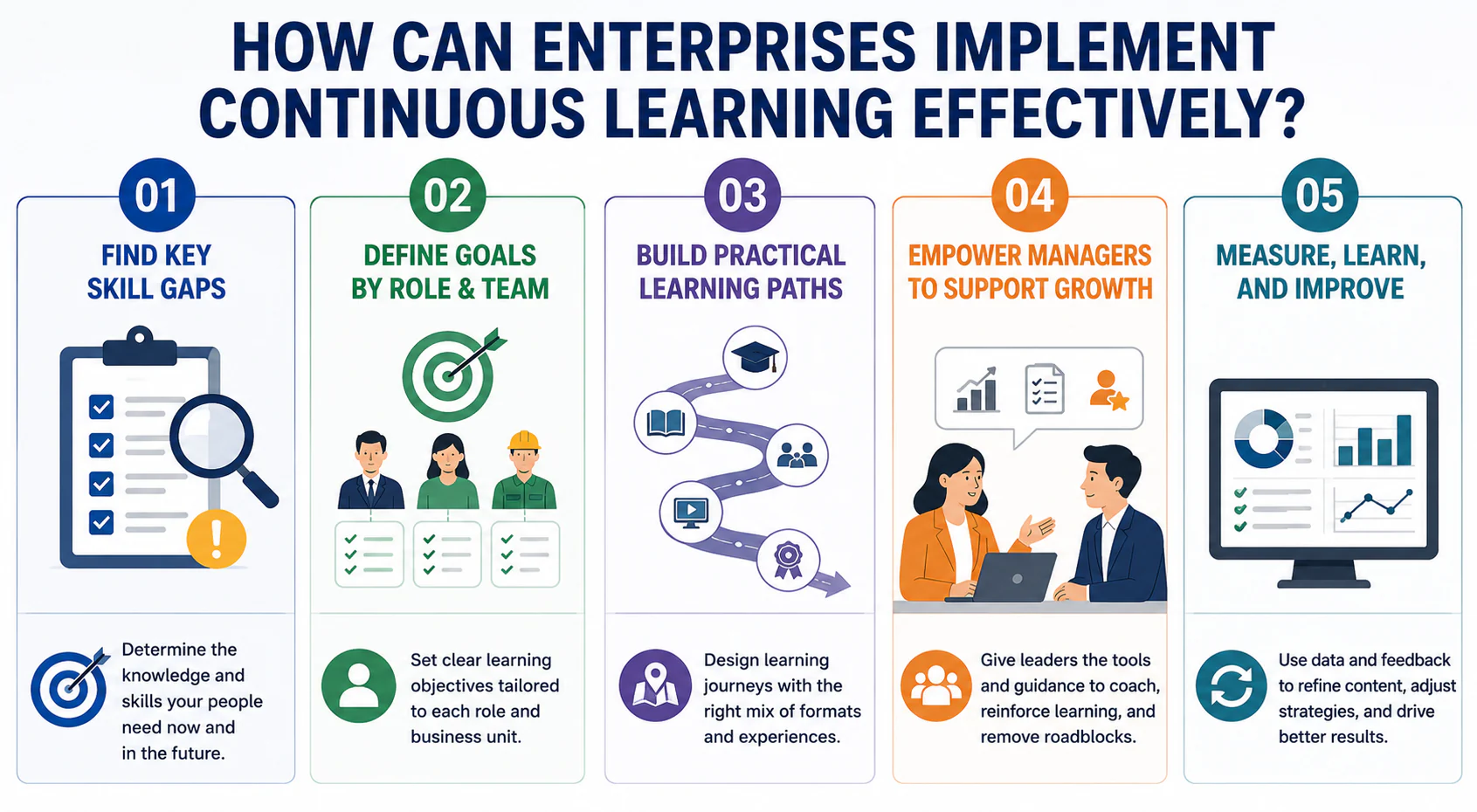
Implementing continuous learning starts with business priorities, not software selection. Enterprises should define the capabilities that matter most, build relevant pathways, and create a practical process for improving the programme over time.
1. Identify Critical Capability Gaps
Start by identifying which knowledge and skills are required to support current operations, as well as planned business changes. Evaluating these workforce upskilling needs may involve discussions with department heads, process owners, managers, and employees who work directly with customers or operational systems.
2. Set Learning Goals by Role and Business Unit
Translate capability gaps into specific learning goals for each role or team. A manager may need coaching and performance-management skills, while an operations team may need more consistent process knowledge or system proficiency.
3. Create Structured Learning Paths
Organise learning into a logical path that moves from essential knowledge to practical application and further development. Include appropriate formats such as short modules, workshops, peer sessions, supervised practice, and reference materials.
4. Equip Managers to Coach and Develop Employees
Managers need enough visibility to discuss progress, reinforce new behaviours, and remove barriers that prevent employees from learning. Give them simple guidance on how to turn development goals into regular conversations with their teams.
5. Track Progress and Improve the Programme
Review participation, assessment results, employee feedback, manager observations, and operational outcomes. Use these findings to improve content, adjust learning paths, or provide more support where a particular team is struggling.
What Challenges Can Prevent Continuous Learning From Succeeding?
Continuous learning can lose momentum when it is treated as an HR initiative without operational ownership. Recognising common barriers early helps enterprises design a programme that fits real work conditions.
- Lack of time and competing operational priorities: Employees may postpone learning if workload planning does not allow time for it. Leaders should define realistic learning expectations and protect time for priority development activities.
- Content that does not match employees’ roles: Generic content can reduce engagement. Role-relevant material and practical examples help employees understand how learning applies to their work.
- Limited visibility across departments and locations: Without a central view, it is difficult to identify who has completed learning, where capability gaps remain, or whether teams receive consistent guidance.
- Measuring completion instead of capability growth: Completion data should be supported by manager feedback, assessments, practical application, and evidence that employees can perform required tasks.
Addressing Capability Gaps Through Continuous Learning
Continuous learning is critical as Malaysian enterprises face pressure to align employee capabilities with rapid technological shifts. The Randstad Malaysia 2025 Workmonitor report reveals that 57 percent of professionals would leave roles lacking development support. Addressing this capability gap through structured skills building is now essential to retain talent and avoid a shortage of skilled manpower.
Navigating Digital Transformation Challenges
A prominent manufacturing enterprise in Penang experienced this exact challenge during a major digital transformation. Seasoned technicians struggled with automated interfaces, while younger recruits felt frustrated by unclear progression pathways. This environment created unstable operations and directly threatened their overall production targets.
The Strategic Shift to Continuous Learning
Management realised their annual training workshops were insufficient for the rapid pace of technological change. They urgently needed to shift towards continuous learning to deliver technical knowledge directly to the factory floor. The goal was to provide practical guidance without disrupting daily operational schedules.
Driving Results with Learning Management Software
By deploying targeted learning management software, the enterprise successfully established a continuous learning culture. Workers accessed digestible technical modules on their personal devices to troubleshoot issues quickly. This ongoing capability building initiative retained crucial young talent while empowering senior staff.
How Can an Enterprise LMS Enable Continuous Learning at Scale?
An enterprise learning management system, or LMS, can provide the operational structure needed to manage continuous learning across teams, locations, and job levels. It should support workplace development, not simply act as a repository for online courses.
For organisations evaluating a learning management software, the key consideration is whether the platform can support role-based pathways, learning assignments, progress tracking, reporting, and the changing needs of the workforce.
| LMS Capability | How It Supports Continuous Learning |
|---|---|
| Role-based learning paths | Delivers relevant development content based on job roles, competency needs, or business units. |
| Progress tracking and reporting | Provides leaders with visibility into participation, completion, and areas requiring support. |
| Centralised learning management | Helps maintain consistent learning standards across departments, branches, or locations. |
| Content updates and assignments | Allows teams to distribute updated process, policy, or system learning when needed. |
An LMS does not replace leadership support, manager involvement, or a well-defined development strategy. However, it can make a continuous learning programme easier to organise, govern, and improve as the enterprise grows.
Conclusion
Continuous learning gives Malaysian enterprises a practical way to build workforce capability over time. It moves employee development beyond isolated training sessions by connecting learning with roles, operational needs, business transformation, and future career opportunities.
The strongest programmes combine clear priorities, relevant learning paths, manager support, feedback, and measurement. When these foundations are in place, an enterprise LMS can help organisations manage learning consistently across their workforce.
If your organisation is planning a structured workplace-learning programme, request a free product demo to assess how an enterprise system could support learning paths, progress visibility, and cross-team coordination.
FAQ About Continuous Learning
Continuous learning is an ongoing approach to developing employees’ knowledge, skills, and behaviours. It combines formal training with coaching, practice, feedback, and knowledge sharing throughout an employee’s career.
It helps enterprises maintain workforce readiness as systems, processes, and business needs change. It can also support transformation, internal mobility, operational consistency, and employee development.
Traditional training is often delivered as a one-off event and measured by completion. Continuous learning is ongoing, role-relevant, and focused on helping employees apply knowledge and build capability over time.
Managers help employees connect learning with real work. They can set development expectations, provide feedback, coach employees, and identify where further support or practice is needed.
Yes. An enterprise LMS can support continuous learning by organising role-based learning paths, assigning content, tracking progress, and giving leaders visibility across teams and locations.