







HR teams often spend considerable time on repetitive administrative tasks such as screening applications, coordinating onboarding, answering employee queries, and preparing workforce reports. As these responsibilities increase, they leave less time for strategic initiatives and employee engagement. AI in HR helps automate routine processes, allowing HR teams to improve efficiency while keeping critical decisions under human oversight.
The need for AI adoption is also growing in Malaysia as organizations balance operational efficiency with compliance. Employee data used in AI systems falls under the Personal Data Protection Act 2010, amended in 2024 to add breach notification and data protection officer obligations. MOSTI's National Guidelines on AI Governance and Ethics add principles of fairness, transparency, and human oversight.
Understanding how AI in HR is the first step toward responsible adoption. This guide explores the key concepts, applications, and considerations, while businesses can also explore an integrated HR software solution to support AI-powered workflows.
Key Takeaways
AI in HR helps automate routine HR tasks and provides data-driven insights while keeping critical workforce decisions under human oversight.
Each of the different types of AI offers unique capabilities that support specific HR functions and workflows.
The use of AI across the employee lifecycle helps HR teams improve efficiency while preserving human judgment for critical decisions.
As organizations adopt AI, disconnected data and manual workflows can limit its effectiveness. An integrated AI-powered HR system helps connect employee data, automate routine processes, and support more accurate HR decisions.
What Is AI in HR?
AI in HR is the application of artificial intelligence to help HR teams streamline administrative tasks, improve workforce management, and support better people-related decisions. It uses technologies such as machine learning, natural language processing (NLP), generative AI, predictive analytics, and automation to screen applications, answer employee queries, generate content, analyze workforce data, and recommend actions more efficiently.
Rather than replacing HR professionals, AI serves as a decision-support tool within human capital management. It helps organizations manage, develop, and retain employees more effectively, while HR teams remain responsible for data quality, fairness, communication, and final hiring or workforce decisions.
What Types of AI Are Used in HR?
AI is an umbrella term that covers several different technologies, each suited to a different type of HR work. Understanding the distinction between them helps HR teams set accurate expectations for what each tool can and cannot do.
1. Generative AI
Generative AI helps HR teams create job descriptions, onboarding documents, training materials, policy drafts, and other HR content. It can also summarize reports or employee feedback to reduce manual work. However, all outputs should be reviewed for accuracy, privacy, and potential bias before use.
2. Conversational AI and Natural-Language Processing (NLP)
Conversational AI and NLP support employee self-service by answering HR policy questions, handling routine enquiries, classifying tickets, and analyzing feedback. These tools improve response times while allowing more complex or sensitive cases to be escalated to HR professionals.
3. Machine Learning and Analytics
Machine learning analyzes workforce data to identify patterns and generate predictions for candidate matching, workforce planning, skills-gap analysis, and turnover risk. Its recommendations should support, not replace, professional judgment and business context.
4. Intelligent Workflow Automation
AI-powered workflow automation automates repetitive HR tasks such as approval routing, document validation, reminders, and employee record updates. Unlike rule-based automation, AI-powered workflows can recommend actions based on data, making regular monitoring and human oversight important.
How Is AI Used Across the Employee Lifecycle?

AI delivers the greatest value when integrated into each stage of the employee lifecycle rather than used as a standalone tool. It is best suited for repetitive and data-driven tasks, while decisions involving employment, compensation, performance, or employee wellbeing should continue to involve human oversight.
Recruitment and Candidate Screening
AI helps HR teams create job descriptions, screen resumes, match candidates with job requirements, schedule interviews, and communicate with applicants. It support recruitment software to identify suitable candidates from talent pools more quickly. However, recruiters should always validate AI recommendations to reduce bias and ensure fair hiring decisions.
Onboarding and Employee Administration
AI supports employee onboarding by collecting documents, generating onboarding checklists, providing policy information, and answering common employee questions. It can also route requests to the appropriate HR staff when additional assistance is needed. Accurate employee records remain essential for reliable AI recommendations.
Learning and Skills Development
AI recommends training programs based on employees' roles, skills, and learning needs while helping generate learning materials and assessments. These recommendations can support career development discussions, but managers should remain responsible for approving learning plans and development opportunities.
Performance and Employee Experience
AI can summarize employee feedback, identify trends in surveys, send reminders for performance goals, and prepare insights for review discussions. These capabilities reduce administrative workloads, while performance reviews, disciplinary decisions, and discussions about employee wellbeing should continue to be handled by people.
Workforce Planning and Retention
AI enhance workforce analytics by analyzing employee data to improve headcount planning, skills-gap analysis, succession planning, and retention strategies. It helps identify workforce patterns and potential attrition risks, but these insights should be used to support decisions rather than replace human judgment.
Offboarding and Knowledge Transfer
AI helps manage offboarding by organizing exit workflows, revoking system access, tracking company assets, and analyzing exit survey responses. It can also capture organizational knowledge before employees leave, while HR professionals continue to handle termination decisions and sensitive exit discussions.
What Are the Benefits of AI in HR?
AI offers several potential benefits for HR, from improving operational efficiency to supporting better decision-making. When integrated with an HR module, AI can access connected employee data and workflows to provide more practical and reliable support. However, the results still depend on the quality of implementation and ongoing human oversight.
- Less Repetitive Administration
AI reduces time spent on routine HR activities such as document processing, request classification, approval routing, and answering common employee enquiries. This allows HR professionals to dedicate more time to employee engagement, talent development, and strategic initiatives. - Faster Information Access
AI helps HR teams retrieve policies, employee records, and workforce reports more quickly by analyzing connected data sources. Faster access to relevant information also supports quicker responses to employee requests and management enquiries. - More Consistent Service
AI provides standardized responses and follows predefined workflows, helping employees receive consistent information across HR processes. With proper governance and escalation rules, it also ensures more reliable service while directing complex cases to HR professionals. - Better-Supported Workforce Analytics and Planning
AI strengthens workforce analytics by identifying trends in hiring, employee skills, capacity, and retention. These insights help HR teams make more informed workforce planning decisions, while final judgments continue to rely on business context and human expertise.
What Risks Should HR Teams Manage?
As AI becomes more widely used in HR, organizations should also consider the risks that come with handling employee data and supporting people-related decisions. Managing these risks requires clear governance, responsible data practices, and ongoing human oversight to ensure AI is used fairly and transparently.
1. Privacy and Personal Data Protection
HR teams should protect employee and candidate data by applying appropriate access controls, collecting only necessary information, and complying with regulations such as Malaysia's Personal Data Protection Act (PDPA). Organizations should also be transparent about how personal data is collected, processed, and used by AI systems.
2. Bias and Unequal Treatment
AI models trained on historical data can reproduce past patterns of unequal treatment. Proxy variables, incomplete datasets, and untested models can produce discriminatory outputs even without intent. Representative validation, bias testing, periodic review, and accessible appeal channels help manage this risk.
3. Inaccurate or Unexplainable Output
Generative AI can produce incorrect facts with apparent confidence. Scoring or ranking models may produce results that are difficult to explain to the person affected. Outputs must be traceable to source data, and HR teams must be able to explain decisions in terms that affected individuals can understand.
4. Security and Unapproved AI Use
Employee records, salary information, health data, identity documents, credentials, and confidential case notes must not be entered into unapproved public tools. Clear policies should specify which tools are approved for which types of HR work.
"AI delivers the greatest value in HR when it reduces administrative work without replacing human judgment. Organizations should use AI to support routine processes and insights, while keeping hiring, performance, and employee relations decisions under qualified HR oversight."
Which HR Decisions Need Human Approval?
Human oversight should reflect the potential impact of an AI-generated recommendation. AI can support day-to-day HR activities, but final decisions should remain the responsibility of HR professionals.
| Decision or Task | Appropriate AI Role | Required Human Control |
|---|---|---|
| Scheduling, reminders, and routine ticket routing | Automate within approved rules | Periodic monitoring and exception handling |
| Drafts of job descriptions, policies, or communications | Generate or summarize | HR review before publication or use |
| Candidate matching and CV prioritization | Recommend or rank | Recruiter validates criteria, fairness, and progression |
| Learning, mobility, or career-path recommendations | Suggest available options | Employee and manager validate context and interest |
| Attrition, absence, or performance-risk signals | Flag patterns for investigation | No adverse action based on a score alone |
| Pay, promotion, performance, or succession decisions | Provide supporting analysis | Authorized manager and HR decide, document, and explain |
| Discipline, grievance, investigation, or termination | Organize relevant information only | Qualified humans retain full decision and communication responsibility |
Example Scenario: Human Oversight in AI-Assisted HR
A company with 1,000 employees struggles to manage high volumes of recruitment, employee inquiries, onboarding, and attendance records. As administrative work increases, HR teams spend less time on strategic priorities such as talent development and employee engagement.
The company adopts AI to automate routine tasks, including application screening and employee support. This reduces administrative workload, accelerates HR processes, and allows HR professionals to focus on talent development and workforce planning. However, HR professionals review all AI recommendations before making decisions. Hiring, promotions, compensation, and disciplinary actions remain under human oversight to ensure fairness, compliance, and accurate judgment.
How Can Malaysian Businesses Implement AI in HR Responsibly?
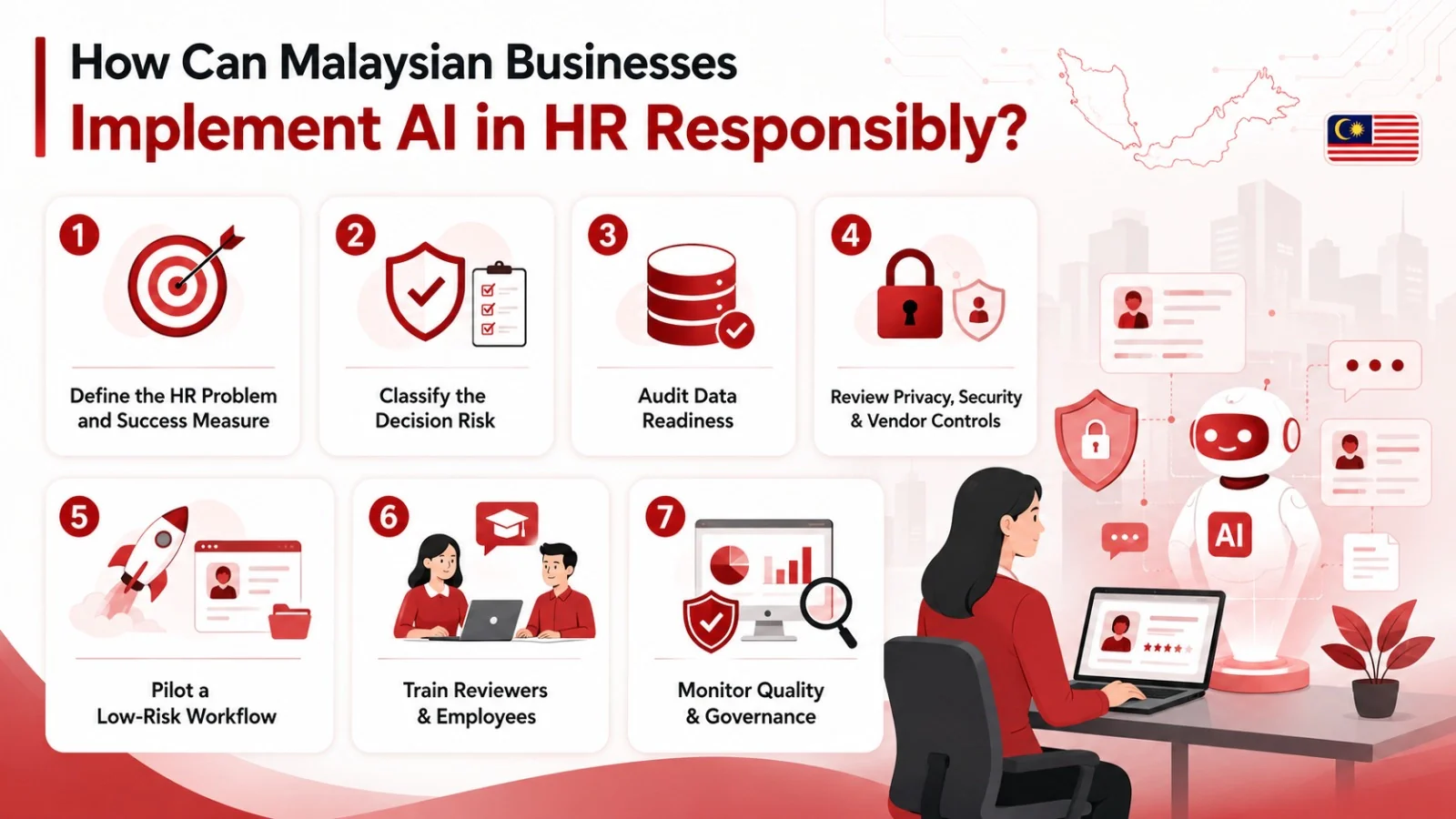
Implementing AI as an assistant requires a structured approach to ensure it delivers practical value while supporting responsible decision-making. Successful adoption depends not only on the technology itself but also on how it is planned, implemented, and managed over time. The following practices provide a practical starting point for Malaysian businesses adopting AI in HR.
1. Define the HR Problem and Success Measure
Start by identifying a specific HR challenge instead of adopting AI for every process. Set clear goals, such as reducing administrative time, improving response speed, or increasing service quality, so implementation can be measured against meaningful outcomes.
2. Classify the Decision Risk
Separate routine administrative tasks from decisions that have a direct impact on employees. AI can support low-risk activities, while important decisions should include defined review and approval steps by HR professionals.
3. Audit Data Readiness
Review whether employee data is accurate, complete, and up to date before connecting it to an AI system. Good data quality helps improve the reliability of AI recommendations and reduces the risk of inaccurate outputs.
4. Review Privacy, Security, and Vendor Controls
Evaluate how employee data is stored, accessed, shared, and protected throughout the AI system. Businesses should also ensure their AI solution complies with Malaysia's Personal Data Protection Act (PDPA) and follows appropriate security practices.
5. Pilot a Low-Risk Workflow
Begin with routine processes such as answering HR FAQs, document classification, scheduling, or preparing draft documents. Starting with lower-risk use cases allows organizations to evaluate AI performance before expanding to more complex workflows.
6. Train Reviewers and Employees
Provide training so HR teams and employees understand how to use AI responsibly, validate AI-generated outputs, and protect confidential information. Clear guidance also helps build trust and encourages consistent adoption across the organization.
7. Monitor Quality and Governance
Regularly review AI performance by monitoring output quality, user feedback, and governance practices. Integrating AI with an HR management system or ERP also makes it easier to maintain accurate records, approvals, and workflow visibility over time.
Conclusion
AI is transforming how HR teams manage recruitment, employee services, workforce planning, and everyday operations. When supported by reliable data, clear governance, and human oversight, AI can reduce administrative workloads, improve decision-making, and allow HR professionals to focus on more strategic priorities throughout the employee lifecycle.
However, effective AI adoption requires more than implementing new technology. Organizations need to define clear objectives, protect employee data, monitor AI performance, and keep high-impact decisions under human oversight. A structured approach helps businesses gain the benefits of AI while maintaining responsible and accountable HR practices.
For businesses looking to explore the potential of AI in HR, understanding how it can fit into existing processes is a practical first step. Book a free demo to see how AI can support everyday HR operations.

FAQ about AI in HR
AI can reduce the time HR teams spend on routine administration, document handling, and data retrieval. However, it cannot replace the judgment, empathy, and accountability that HR work requires, particularly in areas involving employment decisions, employee wellbeing, conflict resolution, and cultural development. The more realistic outcome is that HR professionals spend less time on repeatable tasks and more time on the work that needs human involvement.
Using AI in HR is not prohibited in Malaysia, but organisations must apply it in ways that comply with the Personal Data Protection Act (PDPA) and any sector-specific requirements. This means collecting only the data needed, obtaining appropriate consent, protecting data from unauthorised access, and being transparent about how employee and candidate data is processed. Organisations should seek qualified legal and privacy advice when designing AI-supported HR systems.
AI can assist with parts of the recruitment process, including job description drafting, CV screening, and candidate matching. It should not make the final hiring decision. Recruiter review, bias validation, and criteria verification are required before any candidate is progressed or declined. A system that automatically accepts or rejects candidates without human review creates significant fairness and legal risk.
Low-risk, process-driven tasks with predictable inputs and limited employment impact are the safest starting point. Examples include policy search tools, FAQ triage, document checklist generation, interview scheduling, and standard communication drafts. These use cases allow teams to test AI accuracy, measure output quality, and build user confidence before moving to more complex or higher-stakes applications.
Employee records, salary information, health or medical data, identity documents, home addresses, immigration status, performance case notes, grievance or investigation details, and any information classified as sensitive under Malaysia's PDPA must not be entered into unapproved public tools. Organisations should maintain a clear approved-tools list and train employees on what constitutes sensitive HR data before deploying any AI application.