









 Limited to 100 registrants

How you move goods from production to the buyer determines your profit and market standing. The core choice is between push and pull supply chains. Since customers now expect custom options and fast delivery, understanding these models is a requirement for anyone building a competitive business.
Global disruptions have proven that old, rigid systems are high-risk. Aligning with Malaysia’s NIMP 2030’s is a must for businesses to protect their operations in Malaysia. This guide explains push and pull mechanics and shows how digital tech helps companies merge both into effective hybrid strategies.
Key Takeaways
Push Supply Chain A forecast-driven model where products are manufactured and distributed in anticipation of future customer demand. While Pull Supply Chain is A demand-driven model where production and movement are triggered only by actual, real-time customer orders.
Discover the Advantages and Disadvantages of Push & Pull Supply Chain
Hybrid Strategy is An optimized approach that utilizes a decoupling point to balance manufacturing efficiency with customer-specific requirements.
What is a Push Strategy in Supply Chain?
A push strategy (Make-to-Stock) operates entirely on demand forecasting. Manufacturers produce, store, and distribute goods based on historical sales data and projected market trends before any actual customer orders are placed.
This model relies on demand planning to predict market needs. By studying sales history and trends, companies set their schedules and material levels. It is a strategy designed for stability and high-volume consistency.
What is a Pull Strategy in Supply Chain?
A pull strategy (Make-to-Order) operates on actual, confirmed customer demand. Production and inventory movement are triggered strictly by incoming sales rather than theoretical forecasts.
This model is rooted in Lean and the Toyota Production System to cut waste. It uses JIT inventory and Kanban signals to keep stock levels minimal. This setup makes a business responsive to real market shifts instead of theoretical guesses.
Push vs Pull Supply Chain: Key Differences
To make informed strategic decisions, organizations must understand how these models diverge across several critical operational dimensions that impact the entire value chain:
Inventory Management
- In a push system, inventory is treated as a strategic asset used to guarantee high service levels and immediate availability.
- In a pull system, inventory is often viewed as a liability or waste, kept to the absolute minimum necessary to fulfill active orders.
Production Scheduling
- Push systems prioritize capacity utilization, high machine uptime, and economies of scale with stable, long-term schedules.
- Pull systems prioritize responsiveness and flexibility, with dynamic schedules that change daily based on incoming orders.
Information Flow
- In a push model, information flows primarily downstream (from management forecasts to factory operations).
- In a pull model, information must flow upstream with zero latency (from customer orders back to raw material suppliers).
Risk Management
- The primary risk in push is demand volatility, which leads to excess stock and markdowns.
- The primary risk in pull is supply volatility, where a single broken link in the supply chain can lead to immediate production halts and lost sales.
The Advantages and Disadvantages of Push & Pull Supply Chain
Deciding between push and pull models requires a look at their specific trade-offs. While one strategy relies on bulk efficiency, the other focuses on market reaction. This comparison helps clarify which approach suits your operational needs by highlighting the strengths and risks of each.
| Aspect | Push Supply Chain (Forecast-Driven) | Pull Supply Chain (Demand-Driven) |
| Key Advantages | Optimized through economies of scale, immediate product availability on shelves, and high operational stability for labor and machinery. | Dramatic reduction in inventory costs, support for mass customization, and superior quality control through small-batch production. |
| Strategic Risks | High risk of obsolescence and dead stock if forecasts are wrong; highly susceptible to the bullwhip effect. | Extreme susceptibility to supply chain disruptions; any single failure in the network can halt the entire fulfillment process. |
| Cost Implications | Lower per-unit cost (COGS) through bulk manufacturing but carries high warehouse and capital expenses. | Higher per-unit manufacturing costs and loss of shipping discounts, but minimal working capital is tied up in stock. |
| Lead Times | Near-zero lead times for customers as finished goods are pre-positioned in distribution centers or retail stores. | Extended lead times; customers must wait for the manufacturing and shipping window after the order is placed. |
| Ideal Industry | Standardized products with predictable demand and high-volume, low-variety requirements. | High-variability markets, personalized/luxury goods, and industries with short product lifecycles. |
Push vs Pull Supply Chain Examples in Real Business
The optimal choice is often dictated by product characteristics. For example, the Push Model remains the gold standard in the Consumer Packaged Goods (CPG) industry. Products like bottled water, detergents, or basic groceries have stable, predictable demand patterns, requiring massive, continuous production to drive down costs and ensure 100% shelf availability.
Conversely, the Pull Model thrives in high-tech, luxury, and custom automotive sectors. For instance, a high-end computer manufacturer like Dell famously pioneered a pull model where the actual assembly of a laptop only begins once the customer selects their specifications online. This eliminates the risk of holding expensive, rapidly depreciating components in a warehouse.
What is a Hybrid Push-Pull Supply Chain Strategy?
Top companies rarely stick to just one method. Instead, they mix push and pull strategies. The switch happens at the Decoupling Point (or Order Penetration Point). This is the specific stage where forecast-driven work ends and real customer orders start. Postponement Strategy is a common way to manage this balance:
- The Push Phase: In this stage, operations rely on long-term forecasts to manufacture or procure generic sub-assemblies in bulk. By producing these uncustomized core components ahead of time, companies secure economies of scale and significantly lower their baseline manufacturing costs without committing to a final product variant.
- The Pull Phase: Operations shift to a demand-driven model at the Decoupling Point. Final assembly, localized packaging, or specific feature configurations are strictly delayed until a confirmed customer order arrives. This ensures capital is only spent on finishing goods that are already sold, effectively eliminating the risk of obsolete inventory.
This method gives you the cost savings of mass production without the risk of making thousands of items that no one wants to buy. It keeps your inventory lean and your response times fast.
How to Choose Between Push, Pull, or Hybrid Strategy
When evaluating which strategy to implement, organizations should weigh these three primary factors:
- Demand Predictability: High predictability and low product variety favor a push system. High volatility and high variety strongly suggest a pull model.
- Lead Time Tolerance: If your customers require immediate delivery (e.g., fast-moving consumer goods), push is essential. If they are willing to wait for a tailored product (e.g., custom furniture or PCs), pull is ideal.
- Product Value and Margin: High-value products with high margins are best managed through pull or hybrid models to avoid massive stockout or overstock situations that could devastate cash flow.
How Supply Chain Software Helps Manage Push and Pull Strategies
The theoretical concepts of these strategies are made operational through modern technological infrastructure. AI and predictive analytics have revolutionized the push components of hybrid strategies by generating hyper-accurate demand models that account for weather, social media trends, and local events. Meanwhile, IoT devices and real-time tracking provide the end-to-end visibility required for pull systems to function without the need for traditional safety stocks.
Digital twins also allow companies to simulate various “what-if” scenarios, stress-testing their push and pull boundaries in a risk-free virtual environment. This allows managers to find the perfect decoupling point for their specific market conditions, ensuring they are neither over-prepared nor caught off guard.
Build a More Connected Supply Chain Strategy
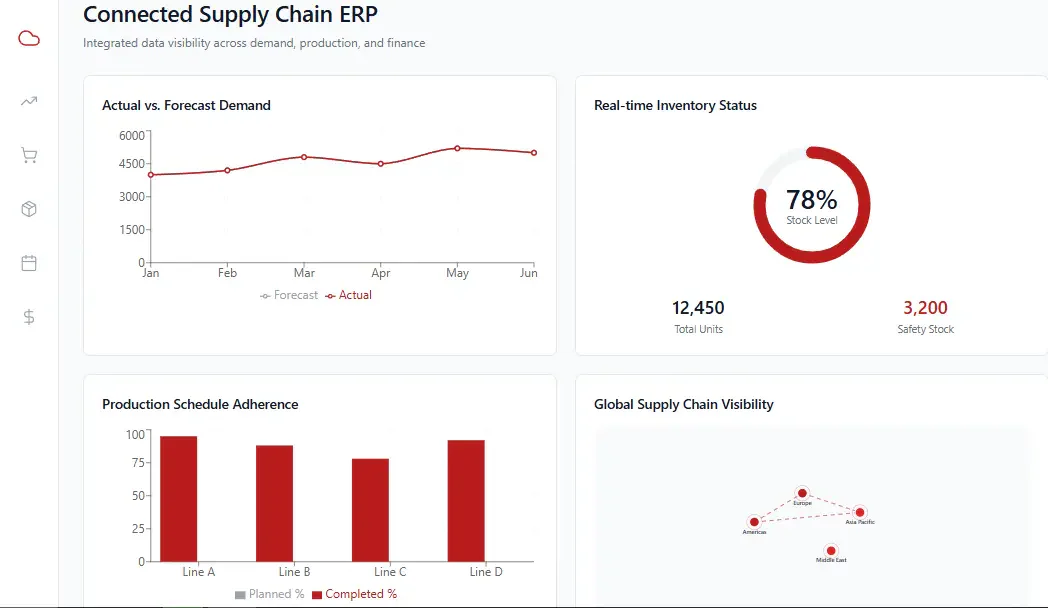
A strong supply chain strategy depends on accurate data, clear coordination, and visibility across every operational area. When demand planning, procurement, inventory, production, and finance run on separate systems, teams often make decisions based on incomplete or outdated information.
An ERP system helps connect these processes in one platform, so businesses can track inventory levels, monitor purchasing needs, manage production schedules, and compare actual demand with forecasts more easily. This gives teams a clearer view of what is happening across the supply chain and helps reduce delays, overstocking, stockouts, and miscommunication.
With better data visibility, companies can respond faster to demand changes, supplier issues, and operational risks. This makes supply chain planning more reliable and supports better decisions across the entire value chain.
Conclusion
The push vs pull choice is about finding the right fit for your specific market and product lifecycle. Neither is better; they simply serve different needs. Push models use high-volume efficiency for stable markets, while pull models provide the speed needed for custom or unpredictable demand.
Relying on a single, rigid model is a risk as global disruptions become more common. Resilient companies are moving toward hybrid systems. By using a clear decoupling point, you can keep the low costs of mass production while staying flexible enough to meet real-time customer needs.
Moving to a hybrid model requires getting rid of manual data and messy spreadsheets. You need full visibility across your entire operation. A capable ERP or Supply Chain system provides the data and automation needed to balance these strategies, turning your supply chain into a clear competitive advantage.
FAQ About Push & Pull Supply Chain
The main difference is the trigger: push systems initiate production based on demand forecasts, while pull systems are triggered by actual customer orders.
Yes, this is known as a hybrid strategy. It involves pushing raw materials or components to a certain stage and then pulling the final assembly based on specific customer demand.
The pull strategy is generally better for high-value items to minimize the amount of capital tied up in inventory and reduce the risk of product obsolescence.
Managers should focus on the Inventory Turnover Ratio to monitor the efficiency of the initial push phase, ensuring core components do not become dead stock. For the pull phase, tracking Order Cycle Time is critical to guarantee that the final customization step meets customer delivery expectations without delay.