







Many finance teams struggle to track invoices, payments, and credit notes stored in different records, especially when managing staggered payments and e-Invoice records through Malaysia’s LHDN MyInvois system. A statement of account brings all transactions together in one document. This article provides an overview of its purpose, contents, preparation, and differences from other financial documents.
A statement of account brings all transactions together in one document. This article provides an overview of its purpose, contents, preparation, and differences from other financial documents.
A statement of account brings all transactions together in one document. This article provides an overview of its purpose, contents, preparation, and differences from other financial documents.
Key Takeaways
A statement of account summarises invoices, payments, credit notes, and the outstanding balance between a business and one customer or vendor for a set period.
A complete statement shows business and customer details, the statement period, opening balance, transaction lines, ageing summary, and the closing balance due.
A statement of account is not an invoice, a receipt, proof of payment, a balance sheet, or a bank statement, because each document answers a different question.
Tracking invoices, payments, and credit notes across separate records can make reconciliation time-consuming and prone to errors. A statement of account making it easier to track balances and follow up on outstanding payments.

What Is a Statement of Account?
A statement of account is a summary document that lists all transactions between a business and one customer or vendor over a defined period, including invoices issued, payments received, credit notes, and the outstanding balance. Rather than focusing on a single transaction, it provides a consolidated view of the account activity within a specific period.
This document helps both parties track what has been billed, what has already been paid, and what remains outstanding. Finance teams commonly use it to reconcile records, identify discrepancies, and follow up on overdue balances, making it a useful reference for maintaining accurate and transparent business accounts.
How a Statement of Account Works?
A statement of account works by pulling every posted transaction for one customer or supplier within a chosen date range, then arranging them in date order to arrive at a closing balance. It summarizes what is already recorded in the ledger, which is why the document works differently depending on whether you are tracking receivables or reconciling with a supplier.
Statement of Account in Accounting Context
A statement of account summarizes the financial activity between a buyer and seller over a specific period. Its key components include:
- Opening balance: The amount carried forward from the previous accounting period.
- Invoices, payments, and credits: Invoices increase the balance owed, while payments and credit notes reduce it.
- Closing balance: The running balance shows the total amount the customer still owes at the statement date.
- Record checking: Customers can compare the statement with their own records, while buyers can use vendor statements to verify accounts payable.
How a Statement of Account Connects to Your Ledger
Behind each statement of account is a series of accounting entries recorded in the relevant subledger. This connection helps ensure that the statement reflects accurate financial records:
- Posted transactions: Each statement entry comes from a posted document in the accounts receivable or accounts payable subledger.
- Control account: The closing balance should match the corresponding customer or supplier control account.
- Possible discrepancies: Differences may result from unposted payments, missing credit notes, duplicated invoices, or other posting errors.
- Reconciliation: Comparing the statement with the control account helps identify errors before they affect the financial statements.
Why Is a Statement of Account Important?
A statement of account matters because it turns scattered transaction records into one verifiable position that both parties can review before money moves or a dispute escalates.
Cash flow visibility
Finance teams can quickly identify which customer balances are current, overdue, or approaching their payment due dates. This helps prioritize collection efforts and gives the business a clearer view of expected incoming cash.Receivable and payable reconciliation
Buyers and sellers can compare transactions for the same period to confirm that invoices, payments, and credit notes are recorded consistently. Differences such as unrecorded payments or missing invoices can then be identified and resolved more quickly.Structured payment follow-up
A statement provides a clear basis for following up on outstanding balances without referring to individual invoices one by one. It shows the amount due, transaction history, and relevant adjustments in one place, making payment reminders easier to support.Dispute reduction
By presenting invoices, credit notes, adjustments, and partial payments in chronological order, a statement makes it easier to trace how the closing balance was calculated. This helps narrow disputes to specific transactions instead of requiring both parties to review the entire account.Audit trail
Period statements provide a documented link between subledger balances and supporting records such as invoices, receipts, and credit notes. This gives finance teams and auditors a clearer transaction trail when reviewing account movements or investigating discrepancies.
What Is Included in a Statement of Account?
A statement of account should include business details, customer or vendor details, the statement period, opening balance, invoice list, payments received, credit notes, outstanding balance, payment due date, and contact notes.
Each field exists to remove a question the recipient would otherwise raise. Fields that nobody maintains should be removed, because an incomplete column is more confusing than a shorter statement.
1. Customer and Business Details
The header identifies the issuing business, its registration number, address, and finance contact. The customer or vendor block carries the account code, company name, billing address, and payment terms.
Account codes matter more than company names in group structures. One customer may hold several accounts across branches, and a statement without a code is difficult to reconcile.
2. Statement Period and Opening Balance
The statement period sets the start and end date of the transactions listed. Anything outside that window belongs to a different statement, which keeps comparisons between two parties clean.
The opening balance carries forward the closing balance of the previous period. If the opening figure is wrong, every line below it inherits the error, so this value is checked first.
3. Invoices, Payments, Credit Notes, and Closing Balance
The transaction body lists each invoice as a debit, each payment as a credit, and each credit note or adjustment as a separate credit line with its own reference number.
The closing balance is the opening balance plus invoices, less payments and credit notes. Adding a due date and a short remittance note tells the recipient exactly what to settle next.
Statement of Account Format and Template
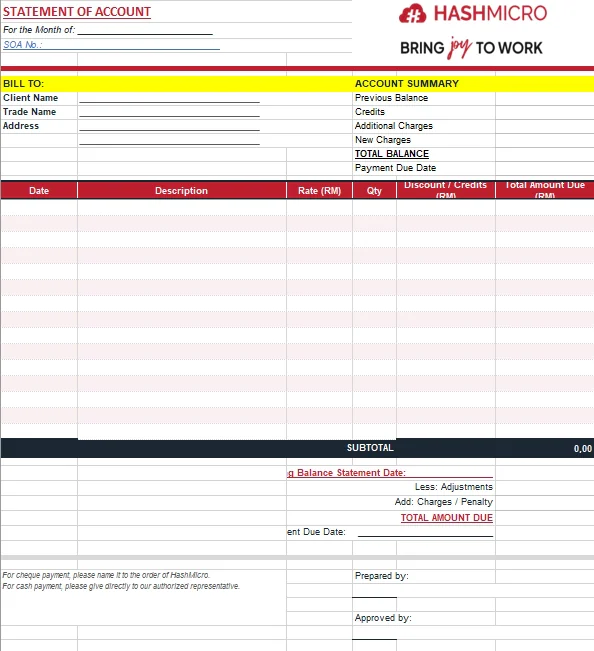
A standard statement of account format uses a header block, a transaction table with date, reference, description, debit, credit, and running balance columns, followed by an ageing summary and a closing balance.
Sample statement of account format
The layout below is the common structure used by Malaysian suppliers. Keep one line per document so every figure can be traced to an invoice, receipt, or credit note reference.
- Header: issuing business, registration number, address, and finance contact.
- Account block: customer name, account code, billing address, and payment terms.
- Period: statement start date, end date, and statement issue date.
- Transaction table: date, reference, description, debit, credit, and running balance.
- Ageing summary: current, 31 to 60 days, 61 to 90 days, and over 90 days.
- Footer: closing balance, due date, bank details, and dispute contact.
RM/MYR Example for a Malaysian Business
The following statement covers 1 August 2026 to 31 August 2026 for a fictional customer, Sri Damai Trading Sdn Bhd, holding account code CUS-1042 on 30 day terms.
| Date | Reference | Description | Debit (RM) | Credit (RM) | Balance (RM) |
|---|---|---|---|---|---|
| 1 August 2026 | - | Opening balance | - | - | 12,400.00 |
| 6 August 2026 | INV-2026-0812 | Invoice issued | 5,250.00 | - | 17,650.00 |
| 12 August 2026 | RCP-2026-0455 | Payment received for INV-2026-0731 | - | 3,800.00 | 13,850.00 |
| 20 August 2026 | CN-2026-0091 | Credit note for returned goods | - | 750.00 | 13,100.00 |
| 31 August 2026 | - | Closing balance due 30 September 2026 | - | - | 13,100.00 |
Ageing Summary and Outstanding Balance
The ageing summary splits the closing balance by how long each amount has been outstanding. It tells the recipient which portion is still within terms and which portion is already overdue.
| Current (0 to 30 Days) | 31 to 60 Days | 61 to 90 Days | Over 90 Days | Total Outstanding |
|---|---|---|---|---|
| RM 4,500.00 | RM 8,600.00 | RM 0.00 | RM 0.00 | RM 13,100.00 |
Download Free Template
How to Prepare a Statement of Account
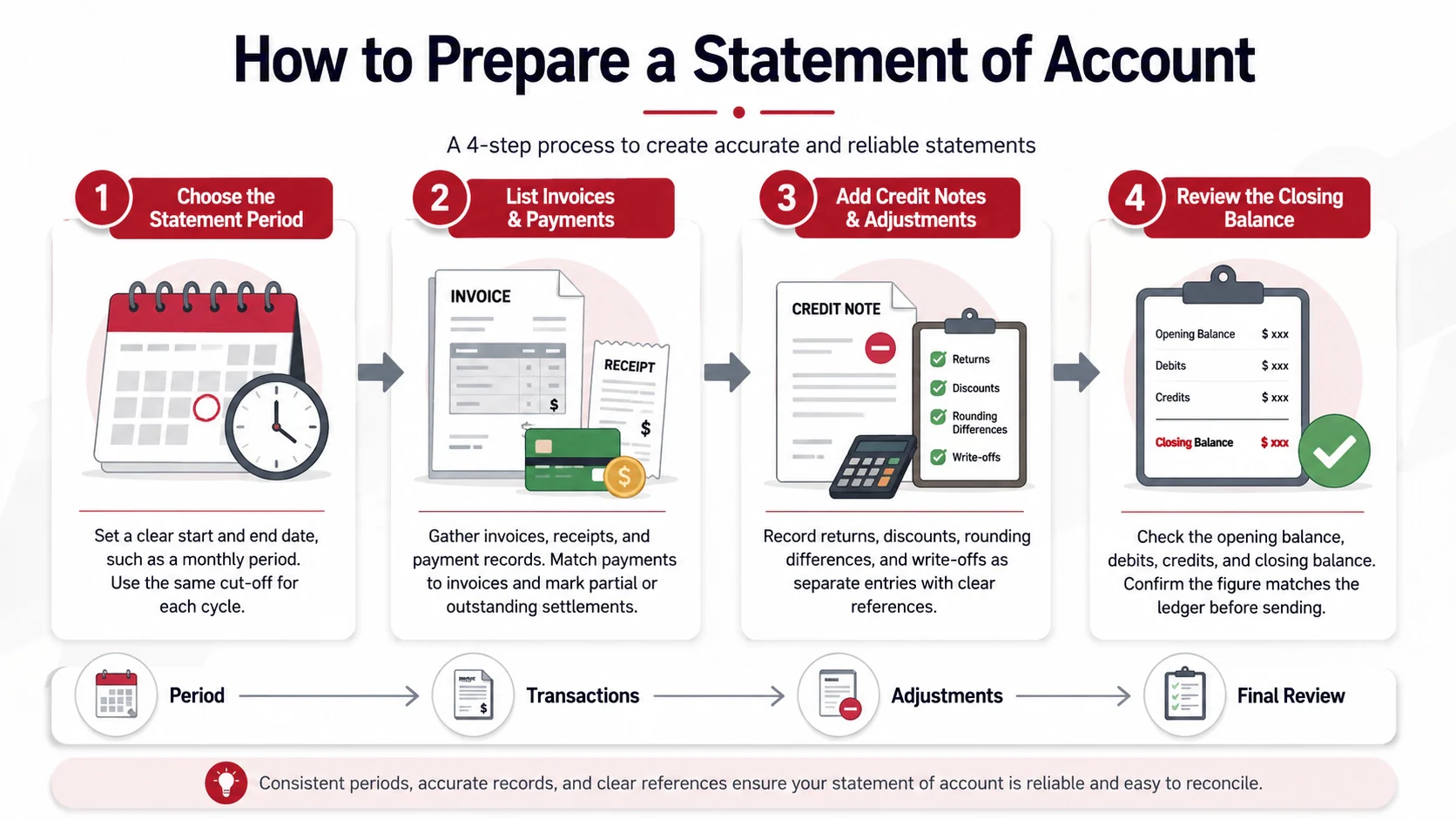
To prepare a statement of account, choose the period, collect the transactions, match invoices against payments, apply credit notes, calculate the closing balance, then review the document before sending it.
Step 1: Choose the Statement Period
Set a specific start and end date for the statement, such as a monthly period ending on the last working day. Using the same cut-off for each cycle makes statements easier to compare and helps ensure that no transactions are unintentionally left out.
Step 2: List Invoices and Payments
Gather all invoices, receipts, and payment records related to the account during the selected period. Arrange them by transaction date and match each payment to the relevant invoice, clearly identifying any partial or outstanding settlements. For basic document definitions before this step, see how an invoice differs from a bill in a standard billing cycle.
Step 3: Add Credit Notes or Adjustments
Record credit notes and other adjustments, such as returns, discounts, rounding differences, or approved write-offs, as separate entries. Include the relevant reference for each adjustment so the reason for the change remains clear and can be checked later if needed.
Step 4: Review the Closing Balance Before Sending
Recalculate the statement to confirm that the opening balance, debits, credits, and closing balance are consistent. Compare the final figure with the receivable or payable ledger, then check the recipient details, statement period, and due date before sending.
When Should Businesses Send a Statement of Account?
Businesses usually send a statement of account at month end, during overdue follow-up, on customer request, for vendor reconciliation, during audit preparation, and before a formal payment reminder.
Month end cycle
A routine statement issued on a fixed date gives both parties a consistent record of account activity for the period. It also makes it easier to compare balances from one month to the next and identify transactions that may need follow-up.Overdue follow-up
A statement provides a complete view of outstanding transactions when a customer has overdue balances. Instead of referring to one invoice at a time, finance teams can use the statement to show all open items and the total amount currently due.Customer request
Customers may request a statement before processing a payment batch or closing their accounting period. Providing the latest statement allows them to compare the supplier's records with their own and resolve any differences before payment is made.Vendor reconciliation
Accounts payable teams can compare a supplier's statement against their internal records to check whether all invoices, payments, and credit notes have been recorded. This helps identify missing invoices or unallocated payments before they affect the payable balance.Audit preparation
Statements can support audit preparation by providing a consolidated record of transactions and the resulting account balance for a specific period. Finance teams can use them alongside invoices, receipts, and other supporting documents when confirming account movements.Before formal reminders
Sending a statement before issuing a formal payment reminder gives the customer an opportunity to review the balance and raise any discrepancies. This can help resolve simple record issues before the matter requires further collection action.
Statement of Account vs Invoice, Receipt, and Proof of Payment
A statement of account summarizes many transactions, an invoice requests payment for one sale, a receipt confirms one payment received, and proof of payment shows that the payer has transferred funds.
| Document | Main purpose | Scope | Usually issued by | Typical timing |
|---|---|---|---|---|
| Statement of account | Summarise transactions and the outstanding balance for one account | Many invoices, payments, credit notes | Supplier or seller | Period end or during payment follow-up |
| Invoice | Request payment for a specific sale | One transaction | Supplier or seller | When goods or services are delivered |
| Receipt | Confirm that a specific payment has been received | One payment | Supplier or seller | After payment is received |
| Proof of payment | Show that funds have been transferred by the payer | One payment instruction | Buyer or the bank | After payment is initiated |
1. Statement of Account vs Invoice
An invoice is a demand for payment tied to one delivery of goods or services. A statement lists those invoices together and reports what remains unpaid at the end of the period.
An invoice can be settled on its own, while a statement is not a payable document. For the underlying document rules, review this explanation of invoice and receipt differences.
2. Statement of Account vs Receipt
A receipt confirms one payment on one date for one amount. It closes a single transaction and is normally issued immediately after funds are confirmed.
A statement shows that same payment as one credit line among many. It reports position, while the receipt is the evidence supporting a single line in that position.
3. Statement of Account vs Proof of Payment
Proof of payment comes from the payer side, such as a bank transfer slip or transaction reference. It evidences that money left the buyer account on a stated date.
A statement of account is not proof of payment, because the supplier prepares it from its own records. See this explanation of what qualifies as proof of payment before accepting a statement as settlement evidence.
Statement of Account vs Balance Sheet and Bank Statement
A statement of account covers one customer or vendor relationship, a balance sheet reports the financial position of the whole business, and a bank statement is issued by a bank for one bank account.
| Document | Covers | Prepared by | Main use |
|---|---|---|---|
| Statement of account | One customer or vendor account for a period | The business issuing it | Reconciliation and payment follow-up |
| Balance sheet | Assets, liabilities, and equity of the whole business | Finance or accounting team | Financial reporting at a point in time |
| Bank statement | Cash movement in one bank account | The bank | Bank reconciliation and cash verification |
Statement of Account vs Balance Sheet
A balance sheet is a financial statement covering total assets, liabilities, and equity. It does not name individual customers or list their invoices and payments.
The receivable total on a balance sheet is the sum of many customer positions, and each statement of account explains one component of that total.
Statement of Account vs Bank Statement
A bank statement is issued by a bank and records deposits, withdrawals, and charges in one account. It shows cash movement, not who still owes the business money.
A statement of account can show an outstanding balance even when no cash has moved. The two documents meet during reconciliation, when receipts recorded internally are matched against bank credits.
Conclusion
A statement of account is more than a record of transactions. It serves as a practical reconciliation and payment follow-up document by bringing invoices, payments, credit notes, adjustments, and the outstanding balance for one customer or vendor into a single period view. This gives both parties a clearer basis for checking account activity and resolving discrepancies.
To keep statements reliable, use a consistent format, trace every transaction to its source document, and issue statements on a fixed cycle. Accurate and up-to-date records make the closing balance and ageing information easier to verify, helping finance teams make informed collection and reconciliation decisions.
Businesses that still reconcile statements manually across spreadsheets can review how connected accounting records handle this cycle in a free demo.

FAQ About Statement of Account
It is a summary of what a customer has been invoiced, what has been paid, and what is still outstanding for a set period. It reports the position of one trading account rather than requesting payment for a single sale.
No. An invoice requests payment for one specific transaction, while a statement of account lists many invoices, payments, and credit notes together and reports the remaining balance at the end of the period.
A receipt confirms that one payment has been received on one date. A statement of account shows that payment as a single credit line alongside every other transaction in the period, ending with the outstanding balance.
No. Proof of payment comes from the payer side, such as a bank transfer slip or transaction reference. A statement of account is prepared by the issuing business from its own records, so it supports reconciliation rather than settlement evidence.
Yes. An ageing summary splits the closing balance into current, 31 to 60 days, 61 to 90 days, and over 90 days, so the recipient can see which portion is already past the agreed payment terms.
Common moments are month end, overdue payment follow-up, customer request, vendor reconciliation, audit preparation, and before issuing a formal payment reminder. A fixed monthly cycle keeps both sets of records aligned.
No. A bank statement is issued by a bank and records cash movement in one bank account. A statement of account is issued by a business and covers invoices, payments, and balances for one customer or vendor.
- Point one
- Point two
- Point one
- Point two
- Point one
- Point two