










 Limited to 100 registrants

Warehouse operations in Malaysia are under growing pressure to move faster while controlling cost and protecting accuracy. In logistics hubs such as Klang Valley, Penang, and Johor, warehouse leaders must contend with expensive space, fluctuating order volumes, seasonal peaks such as 11.11, 12.12, and Hari Raya, and the operational impact of picking fatigue or incorrect dispatches.
Artificial intelligence (AI) offers a practical response but not necessarily through costly robotics. For many enterprises, the immediate opportunity is software-level intelligence that improves decisions within existing warehouse systems. AI can help teams anticipate demand, prioritise stock movements, optimise picking paths, and identify exceptions before they become expensive problems.
Moving from reactive troubleshooting to predictive operations begins with a simple integration: treating AI as an intelligence layer over your Warehouse Management System. Unpacking its role across daily warehouse workflows highlights clear opportunities for Malaysian facilities to eliminate bottlenecks, optimize human labor, and build a high-ROI business case for modern automation.
Key Takeaways
Modern WMS tracks accurate transaction data into actionable insights, helping supply chain teams determine what is likely to happen next and which operational tasks to prioritize.
There are 4 core practical applications of AI in Daily Warehouse Workflows, including Demand Forecasting, Dynamic Optimisation, Intelligent Route Picking, and Quality Control.
AI adoption should begin with operational readiness, not a rushed technology purchase. Implementation must be tailored to available resources and well-thought-out steps.
Translating these core AI workflows into daily floor operations requires a platform built for real-time execution. Explore how an enterprise-grade WMS unifies forecasting, slotting, and route optimization in a single environment
What Is AI in Warehouse Management?
AI in warehouse management is an intelligence layer that analyzes operational data including sales history, stock movements, and picking times to predict trends and automate real-time decisions.
Unlike a traditional WMS that merely records past events (what has happened), AI integrates with your existing WMS and ERP to create a predictive, Modern WMS. By transforming raw transaction data into actionable foresight, it helps supply chain teams anticipate what is likely to happen next and automatically prioritize daily operational tasks.
Traditional WMS vs. AI-Powered WMS
A traditional WMS is still the backbone of warehouse control. It supports receiving, put-away, stock visibility, order allocation, and dispatch documentation. AI-powered capabilities strengthen these functions by making them more adaptive.
| Feature/Capability | Traditional WMS | AI-Powered WMS |
|---|---|---|
| Inventory Tracking | Records stock quantities and locations after transactions occur. | Detects unusual movement patterns, predicts replenishment needs, and highlights inventory risks. |
| Picking Routes | Uses fixed zones, static rules, or manual supervisor direction. | Generates dynamic routes based on order priority, picker location, congestion, and SKU proximity. |
| Demand Planning | Relies on historical reports and planned reorder points. | Analyses trends, campaigns, seasonality, and demand signals to improve forecast accuracy. |
| Error Handling | Flags errors after a mismatch, missed scan, or customer complaint. | Identifies abnormal patterns early and recommends corrective actions before dispatch. |
| Equipment Maintenance | Uses scheduled inspections or reacts after equipment issues occur. | Uses usage and condition data to identify potential maintenance needs earlier. |
The distinction is not that a traditional WMS is outdated or ineffective. Rather, it is designed primarily to enforce processes and maintain accurate records. An AI-enhanced WMS helps teams make better choices within those processes.
For Malaysian enterprises managing multiple sites, high-SKU inventories, or mixed fulfilment channels, this intelligence layer can be especially useful. It helps managers respond to changes without relying solely on institutional knowledge, manual reports, or last-minute overtime.
Core Practical Applications of AI in Daily Warehouse Workflows
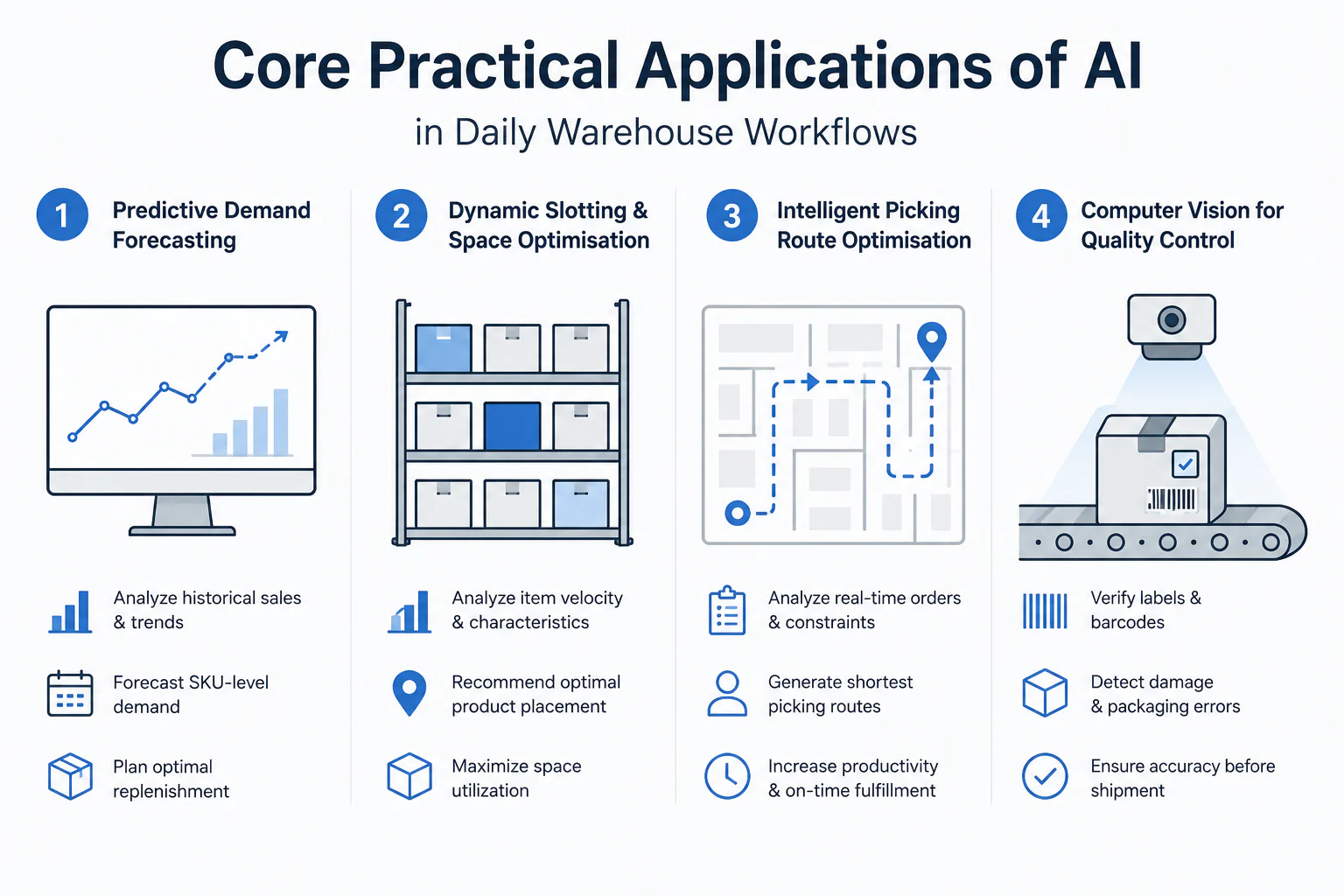
While high-level AI concepts sound impressive, its true value lies in execution on the warehouse floor. By embedding machine learning into daily operations, businesses can transform passive inventory data into active, real-time workflow improvements.
Predictive Demand Forecasting
Demand volatility from seasonal marketplace campaigns, product launches, or festive peaks often leads to either stockouts or costly overstock. AI evaluates historical sales patterns, order frequency, and lead times alongside current inventory to forecast accurate demand for each SKU.
Rather than relying on manual guesses, planners gain early visibility into replenishment needs. This allows supply chain teams to maintain optimal safety stock without tying up excess capital after promotional campaigns end.
Dynamic Slotting and Space Optimisation
According to industrial growth data reported by The Star, the rapid expansion of mega logistics hubs across Klang Valley, Penang, and Johor reflects a sharp rise in regional supply chain demand, subsequently pushing up facility rental and storage costs. When fast-moving inventory is poorly positioned in these high-cost facilities, staff waste up to 50% of their shift time traveling across storage zones, creating severe congestion.
Dynamic slotting automatically analyzes item velocity, physical dimensions, and co-picking relationships to recommend optimal product placement. Fast-moving SKUs are placed closer to dispatch zones, continuously maximizing rack space without requiring periodic manual layout overhauls.
Intelligent Picking Route Optimisation
Order picking is typically the most labor-intensive warehouse activity. During order spikes, inefficient travel paths create severe fulfillment backlogs and unsustainable overtime pressure on warehouse staff.
AI route optimization analyzes real-time order queues, picker locations, and delivery cut-off times to generate the shortest, most efficient task sequence. For busy facilities in Klang Valley, this increases shift output safely without forcing pickers to rush in an unsustainable way.
Computer Vision for Quality Control
Packaging errors, damaged cartons, and mislabeling lead to expensive customer returns and time-consuming investigations. Computer vision uses AI-powered cameras to inspect packages automatically during receiving, packing, and dispatch.
The system verifies labels, detects physical damage, and checks barcode accuracy against the expected order profile. Catching discrepancies on-site allows warehouse teams to intervene and fix errors before shipments leave the facility.
Key Benefits of AI in Warehouse Management
Implementing artificial intelligence in warehouse operations goes beyond technological novelty, it delivers concrete operational improvements that directly strengthen supply chain resilience.
1. Enhanced Operational Throughput and Speed
AI automates complex decision-making processes, enabling warehouses to process, pick, and dispatch orders significantly faster. By streamlining daily workflows, facilities can increase order fulfillment capacity without expanding physical space.
2. Drastic Reduction in Pick and Pack Errors
Through computer vision verification and guided picking routes, AI minimizes human errors in item selection, packing, and labeling. Achieving picking accuracy rates near 99.9% drastically reduces costly customer returns and manual rework.
3. Lower Inventory Carrying Costs
Predictive forecasting and dynamic slotting prevent overstocking and reduce deadstock risks. By keeping safety stock at optimal, data-backed levels, enterprises free up working capital previously tied up in excess inventory.
4. Greater Scalability During Seasonal Spikes
During peak shopping periods or festive sales in Malaysia, AI systems dynamically adjust picking routes and batching rules. This allows facilities to absorb massive order surges without requiring proportional increases in temporary headcount.
5. Improved Ergonomics and Staff Safety
By optimizing travel routes and cutting unnecessary walking distance by up to 50%, AI minimizes physical fatigue for warehouse pickers. This results in a safer floor environment and better staff retention.
6. Real-Time Operational Visibility
AI transforms raw transactional data into actionable dashboard insights. Supply chain leaders gain immediate visibility into facility bottlenecks, equipment health, and labor allocation, transitioning from reactive troubleshooting to proactive management.
Practical Case Studies of AI in Warehouse Management
The following scenarios are illustrative examples of how AI-enabled workflows can support enterprise warehouse operations.
Case Study 1: E-Commerce Dispatch Backlogs During a Sales Spike
Problem: An e-commerce fulfilment operation experiences a sharp increase in orders during a 12.12 campaign. Static picking waves create congestion, popular SKUs run low at pick faces, and dispatch teams begin accumulating a backlog close to carrier cut-off times.
AI Intervention: The AI layer analyses real-time order volume, SKU demand, picker locations, and carrier deadlines. It prioritises urgent orders, recommends replenishment for high-velocity pick faces, and dynamically groups orders to reduce duplicate travel.
Measurable Outcome: At peak the operation handles about 8,000 orders a day against a normal baseline of 2,500. With dynamic order grouping, average picking travel time per order falls from 4.2 minutes to 3.1 minutes, and orders missing the carrier cut-off drop from 9 per cent to 2 per cent. Campaign week overtime falls from roughly 620 hours to 390 hours. The important metric is not the number of tasks completed, but the ability to hold agreed dispatch service levels under peak conditions.
Case Study 2: Cold-Chain F&B and Expiry Risk
Problem: A cold-chain F&B distributor manages inventory with varying shelf lives across multiple customers. Relying solely on standard First-In, First-Out (FIFO) rotation or manual reviews causes severe stock spoilage during order spikes, as arrival sequence does not always align with actual batch expiration dates.
AI Intervention: The AI layer evaluates batch-level expiry data, demand patterns, product movement, and customer allocation rules. It automatically upgrades basic inventory rotation to dynamic First-Expired, First-Out (FEFO) logic flagging stock at risk of expiry, prioritizing eligible batches for dispatch, and alerting planners to take promotional or redistribution action.
Measurable Outcome: The distributor holds about 1,800 pallets across 40 SKUs with shelf lives ranging from 14 to 90 days. FEFO compliance rises from 74 per cent to 98 per cent once batch expiry drives allocation, and stock expiring before dispatch falls from 3.6 per cent of volume to 1.2 per cent. Monthly write-offs fall from about RM85,000 to RM34,000. Near-expiry batches are flagged 21 days ahead instead of surfacing in a weekly manual review, which leaves enough time for promotional or redistribution action.
Case Study 3: Shared Space Utilisation for a 3PL Provider
Problem: A third-party logistics (3PL) provider operates a multi-tenant warehouse in Klang Valley. Customer inventories change frequently, but rack allocation is reviewed manually and may not reflect actual storage velocity or capacity requirements.
AI Intervention: The system analyses pallet movement, SKU dimensions, turnover rate, client demand profiles, and available rack capacity. It recommends slotting adjustments and identifies underused areas that can be reassigned without disrupting active operations.
Measurable Outcome: The site operates 12,000 pallet positions across nine client accounts. Rack utilization improves from 68 per cent to 83 per cent, freeing about 1,800 pallet positions, while internal relocation moves fall from around 1,400 to 900 a month. That released capacity is enough to onboard two additional client accounts without expanding the physical footprint, which turns space efficiency into a revenue outcome rather than a housekeeping metric.
The Financial and Operational Business Case for AI WMS
The strongest business case for AI in warehouse management is built on measurable operational outcomes. Rather than positioning AI as a technology trend, enterprise leaders should connect it to specific cost and service metrics.
- Labour productivity: reduced walking time, better task allocation, and lower overtime requirements.
- Inventory efficiency: improved forecasting, fewer stockouts, and less excess or ageing stock.
- Picking and packing accuracy: fewer mis-picks, returns, claims, and rework activities.
- Space utilisation: better slotting and rack allocation before considering additional warehouse capacity.
- Scalability: a more controlled response to seasonal demand without relying entirely on manual coordination.
A practical ROI assessment should include implementation costs, integration work, training, process changes, and any ongoing software fees. It should also avoid counting theoretical benefits that cannot be measured operationally.
Illustrative ROI Simulation for a Klang Valley Enterprise Warehouse
Consider a mid-sized enterprise warehouse in Klang Valley with 60 staff across two shifts, about 1,200 order lines picked per day over 300 working days, and RM5 million in average inventory. After AI-enabled forecasting, slotting, and picking optimisation, picking accuracy moves from 98.5 to 99.4 per cent, and overtime drops from 15 to 6 hours per person per month for 40 staff at RM18 an hour.
Those baselines produce the figures in the table. The accuracy gain removes about 3,240 mispicks a year at RM17 each, forecasting trims inventory by 6 per cent at an 18 per cent carrying cost, and 30 pickers save roughly 45 minutes a shift at RM12 an hour. The RM220,000 cost covers licensing, integration, scanners, and training in year one.
| Item | Illustrative annual value |
|---|---|
| Reduced overtime and temporary labour | RM90,000 |
| Fewer picking errors, returns, and rework | RM55,000 |
| Lower carrying and obsolescence costs | RM75,000 |
| Productivity value from improved picking efficiency | RM80,000 |
| Total estimated financial gain | RM300,000 |
| AI WMS implementation and first-year cost | RM220,000 |
| Net financial gain | RM80,000 |
Breakdown & Calculation:
- Reduced Overtime and Temporary Labour: RM 90,000
- Fewer Picking Errors, Returns, and Rework: RM 55,000
- Lower Carrying and Obsolescence Costs: RM 75,000
- Productivity Value from Improved Picking Efficiency: RM 80,000
- Total Estimated Financial Gain: RM 90,000 + RM 55,000 + RM 75,000 + RM 80,000 = RM 300,000
- AI WMS Implementation and First-Year Cost: RM 220,000
Calculation Steps:
- Net Financial Gain: RM 300,000 − RM 220,000 = RM 80,000
- ROI (%): (RM 80,000 / RM 220,000) × 100 = 36.4%
Using the formula above, the illustrative ROI is 36.4%. In this illustration, payback occurs within the first year. Actual results will depend on baseline process performance, warehouse scale, data quality, integration scope, and the organisation’s ability to act on AI recommendations.
The key is to establish baseline measurements before deployment. Track picking accuracy, overtime, travel time, inventory ageing, and order cycle time so the organisation can distinguish real performance improvement from normal demand variation.
Challenges in Implementing AI in Warehouse Management
While the operational benefits of artificial intelligence are significant, transitioning to a smart warehouse environment presents specific hurdles. Understanding these challenges allows supply chain leaders to proactively mitigate risks and ensure a smoother deployment.
Legacy System Compatibility and Data Silos
Many enterprise facilities rely on older ERPs or legacy WMS platforms that lack modern API-first architecture. Integrating advanced AI models into these rigid systems often creates data connectivity bottlenecks, requiring data cleaning and middleware integration before AI can deliver real-time insights.
High Initial Investment and ROI Justification
Securing executive buy-in can be difficult when upfront costs for software licensing, cloud infrastructure, and system integration appear high. Decision-makers often hesitate to commit capital without a clear, localized ROI projection that demonstrates payback within 6 to 12 months.
Workforce Resistance and Change Management
Warehouse staff may perceive AI automation as a threat to job security or feel overwhelmed by new digital tools. Overcoming this requires structured upskilling and change management, positioning AI as an assistant that reduces physical strain and repetitive manual errors rather than a human replacement.
Data Quality and Infrastructure Demands
AI algorithms depend on accurate, continuous streams of operational data to function effectively. If a facility lacks reliable barcode scanning, IoT sensors, or stable network coverage, poor data inputs will lead to inaccurate demand forecasts and flawed picking route recommendations.
Strategic Implementation and Change Management
AI adoption should begin with operational readiness, not a rushed technology purchase. A simple implementation roadmap can reduce risk and help teams gain confidence.
1. Data Audit
Review inventory accuracy, SKU master data, location data, order history, expiry information, and process definitions. AI is only as useful as the underlying operational data.
2. System Integration
Connect the AI capability with the existing WMS, ERP, and relevant order or transport systems. Maintain clear ownership of master data, approval rules, and exception handling.
3. Pilot Testing
Start with one workflow, site, customer segment, or product category. For example, pilot picking-route optimisation in a high-volume zone before expanding across the warehouse.
4. Full Rollout
Scale based on validated results, staff feedback, and refined operating procedures. Keep supervisors involved in reviewing recommendations and handling exceptions.
Change management matters as much as technology. Warehouse employees should understand that AI is intended to reduce repetitive friction and support safer, more accurate work, not simply to monitor or replace them. Training should focus on interpreting recommendations, escalating exceptions, and using the system as a practical operational assistant.
Conclusion
AI in warehouse management is not a replacement for a dependable WMS or experienced warehouse teams. It is an intelligence layer that helps Malaysian enterprises turn operational data into better daily decisions.
By improving forecasting, space use, picking efficiency, and quality control, AI can create measurable value without requiring a robotics-first transformation. Enterprises that start with a focused use case, clean data, and clear KPIs will be better positioned to build resilient, scalable warehouse operations for the next demand surge.
Assess your warehouse’s current bottlenecks picking accuracy, overtime, inventory ageing, or space utilisation and identify one AI-enabled workflow to pilot through a free product demonstration with your WMS and ERP stakeholders.
FAQ About AI in Warehouse Management
AI helps warehouses make faster, more informed decisions. It can analyse operational data to improve forecasting, slotting, picking routes, quality checks, and exception management.
No. Most enterprise use cases focus on supporting people with better information and more efficient workflows. Warehouse staff, planners, and supervisors remain essential for execution, safety, customer requirements, and exceptions.
The timeframe depends on the use case, data readiness, integration complexity, and baseline inefficiencies. Enterprises should assess ROI through measurable KPIs; targeted deployments may show operational improvements within months, while broader transformation takes longer.
Yes, many AI-enabled warehouse solutions are designed to work with existing WMS and ERP environments. Integration planning should confirm data quality, API capability, process ownership, and security requirements before implementation.