






Leads may come from ads, referrals, website forms, or social media, but not every lead turns into a paying customer. Without a clear sales funnel, the sales team can stay busy with follow-ups while prospects quietly drop off before reaching the buying stage.
This matters as Malaysian buyers spend more time researching, comparing, and interacting with businesses online. Data from DataReportal Malaysia shows that the country had 33.59 million internet users in early 2024, making it more important for businesses to manage customer interest clearly across digital touchpoints.
This guide walks through the sales funnel stages, how the process works, what strategy to use at each layer, and how CRM helps sales teams see which prospects need attention next.
Key Takeaways
A sales funnel maps how prospects move from first contact to purchase, while showing where leads drop off.
Each sales funnel stage needs a different approach, from awareness content to fast follow-up and customer retention.
Building a strong funnel starts with clear audience targeting, stage-based content, and CRM tracking for each conversion goal.
| Merek | Ideal untuk | Fitur | Kelebihan | Harga |
|---|---|---|---|---|
| HashMicro | Perusahaan menengah hingga besar yang membutuhkan HR terintegrasi ERP | Payroll otomatis, cuti, absensi, PPh 21, BPJS, dan rekrutmen | Terintegrasi dengan modul ERP lain dan mendukung regulasi lokal | Harga custom sesuai kebutuhan |
What is a Sales Funnel?
A sales funnel is a simple map of how potential customers move from first contact to purchase. It is called a funnel because many leads enter at the top, but fewer people continue through each step until they become customers.
This applies to both B2B and B2C businesses. A marketing funnel usually focuses on awareness and interest, while a sales pipeline tracks active deals from the seller’s side. The sales funnel sits between both ideas because it shows where prospects drop off and what the team needs to fix before more leads turn into customers.
Why Sales Funnels Matter for Malaysian Businesses

Malaysian SMEs and B2B companies may get leads from ads, referrals, WhatsApp, trade shows, website forms, and sales calls. The issue starts when every lead is followed up in a different way. A sales funnel Malaysia approach helps teams see where prospects come in, where they stop responding, and which follow-up should happen before the deal goes cold.
This matters because digital touchpoints are becoming a bigger part of how customers discover and evaluate businesses. DOSM reported that Malaysia’s e-commerce income reached RM918.2 billion in the first nine months of 2024, showing how important online buying and digital interactions have become for local businesses.
Cost of Not Having a Funnel
Without a funnel, sales teams often lose track of where leads drop off. One rep may follow up quickly, another may wait too long, and some prospects may never hear back at all. This becomes more obvious when a company grows from a small team to 50 or more staff, because lead ownership, response time, and deal status become harder to track manually.
B2B vs B2C Sales Funnels
For B2B businesses, the funnel is usually longer because deals involve multiple decision-makers, higher budgets, and more approval steps. A prospect may need product demos, proposal reviews, pricing discussions, and management approval before buying.
B2C funnels are usually shorter because one person can often decide faster, especially when price, timing, or promotion feels right. For Malaysian B2C brands, a clear funnel helps guide customers from product discovery to checkout without adding unnecessary steps.
The 6 Stages of a Sales Funnel Explained and Examples
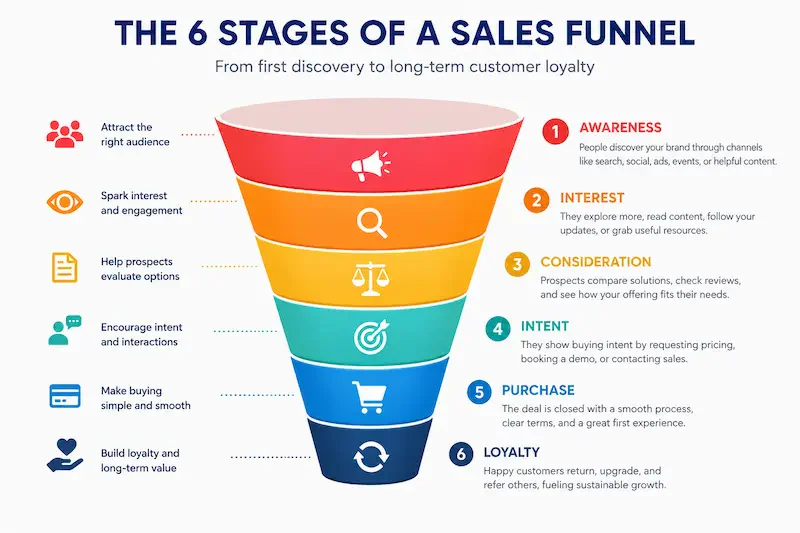
A sales funnel typically has six sales funnel stages, from first discovery to repeat purchase. Each stage needs a different approach because someone who has just found your brand will not respond the same way as someone already asking for pricing.
Stage 1: Awareness
At the awareness stage, prospects may find your brand through search, social media, referrals, ads, events, or educational content. They are usually not ready to buy yet. The content should answer early questions, explain common problems, and make the brand easy to find without pushing for a sale too soon.
Example: The reseller uses B2B lead generation tactics, such as LinkedIn ads targeting procurement managers in Malaysian manufacturing companies. The ads bring them to a blog article about approval delays, a problem many manufacturing teams already recognise.
Stage 2: Interest
At this stage, prospects are no longer just passing by. They may browse your website, read a few blog articles, follow your social content, subscribe to emails, or download a guide. The next step is to keep the conversation useful through email sequences, lead magnets, and simple explanations that help them understand the problem better.
Example: Visitors download a guide about common workflow bottlenecks in manufacturing. After the download, they receive a short email nurture sequence with practical tips, product education, and examples of problems the software can help solve.
Stage 3: Consideration
In the consideration stage, prospects start comparing products, vendors, or ways to solve the problem. They may check pricing pages, read testimonials, compare features, or ask colleagues for input. Case studies, product demos, customer reviews, and clear comparison content help them decide whether the solution fits their situation.
Example: Leads who engage with the emails receive a local case study and an invitation to book a demo. The case study helps them compare the solution with their current manual process.
Stage 4: Intent
Intent appears when prospects request pricing, book a demo, fill out a sales form, or ask about implementation. Speed matters here because a slow reply can push the prospect to compare other vendors. The next step should be clear, fast, and tailored to what they asked for.
Example: Prospects who attend the demo receive a pricing proposal based on user count, required modules, and implementation scope. The sales team follows up quickly to answer budget, timeline, and integration questions.
Stage 5: Purchase
The purchase stage happens when the prospect signs a contract, makes payment, or confirms the order. This part should feel simple, with clear terms, onboarding steps, payment details, and service expectations. A messy handover can reduce trust even after the deal is closed.
Example: The buyer signs the contract and begins onboarding with training, data preparation, and setup support.
Stage 6: Loyalty
The funnel does not end after purchase. Loyal customers may buy again, upgrade, renew, or recommend the business to others. Good onboarding, regular check-ins, helpful support, and customer experience management efforts can turn one-time buyers into long-term relationships.
Example: After six months, the reseller reviews product usage with the customer. If the team is getting value, the reseller may suggest a relevant add-on or ask whether the customer is comfortable referring another manufacturer.
"A strong sales funnel should not treat every lead the same. Each stage needs a different action, from educational content at awareness, useful follow-ups at interest, proof at consideration, fast response at intent, smooth onboarding at purchase, and retention efforts after the first sale."
How to Build a Sales Funnel Step by Step
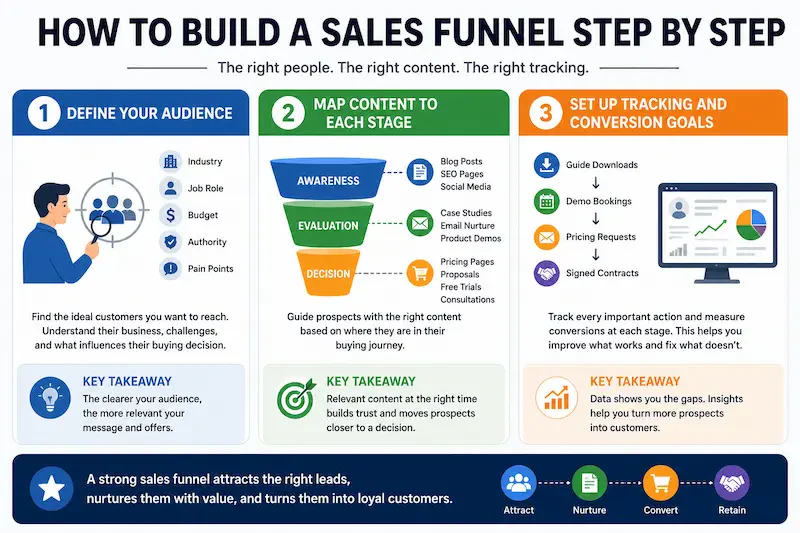
Building an effective sales funnel process starts with three things: knowing who you want to reach, matching the right content to each stage, and tracking whether prospects actually move forward.
Step 1: Define Your Audience
Start by identifying the customers your business wants to attract, including their industry, role, budget, authority, and main pain points. For example, a Malaysian B2B software seller may target operations managers in mid-sized manufacturers that still rely on manual reporting. This is where customer segmentation helps tailor messages for different buyer groups.
Step 2: Map Content to Each Funnel Stage
Once the audience is clear, match content to the prospect’s buying stage. Use blogs, SEO pages, and social posts for awareness, then case studies, email nurture, and demos for evaluation. For prospects closer to buying, use pricing pages, proposals, free trials, or consultation offers.
Step 3: Set Up Tracking and Conversion Goals
A funnel only works if the team can see where prospects move and where they drop off. Define progress points such as guide downloads, demo bookings, pricing requests, or signed contracts. Then, use CRM tracking to record each activity and measure conversion goals at every stage.
Sales Funnel Strategy: TOFU, MOFU & BOFU
A strong sales funnel strategy is built around three layers: TOFU (Top of Funnel), MOFU (Middle of Funnel), and BOFU (Bottom of Funnel). Each layer needs a different tactic because someone who has just discovered your brand should not receive the same message as someone already asking for pricing.
TOFU (Top of Funnel): Attract
TOFU focuses on people who do not know the business yet. SEO blogs, social ads, webinars, and LinkedIn posts work well here because they answer early questions before prospects are ready to speak with sales. For Malaysian B2B companies, LinkedIn ads can help reach procurement managers, founders, or operations leads early. Track website traffic, new leads, and form submissions.
MOFU (Middle of Funnel): Nurture
MOFU is for prospects who already understand the problem but still need confidence before buying. Email nurture, case studies, demos, retargeting, and WhatsApp follow-ups can keep the conversation moving. In Malaysia, WhatsApp often helps when email replies are slow, especially for B2B follow-ups. Track email opens, replies, demo bookings, and content engagement.
BOFU (Bottom of Funnel): Convert
BOFU is where prospects are close to making a decision. Personalised proposals, ROI calculators, testimonials, pricing discussions, and implementation plans help them justify the purchase internally. For Malaysian B2B buyers, this often means giving finance or management enough clarity to approve the deal. Track conversion rate, proposal acceptance, and deal close rate.
Key Sales Funnel Metrics to Track
Sales funnel metrics show where leads slow down, which deals drop off, and whether the team is spending too much to win customers. Start with a few numbers that explain lead quality, sales speed, and cost.
| Metric | What It Measures | Why It Matters |
|---|---|---|
| Stage conversion rate | Percentage of leads moving from one funnel stage to the next | Shows where the funnel is leaking |
| Lead-to-customer rate | Percentage of leads that become paying customers | Measures overall funnel quality |
| Average deal size | Average revenue from each closed deal | Helps forecast sales value more accurately |
| Sales cycle length | Average time from first contact to closed deal | Shows whether prospects are moving too slowly |
| Cost per lead | Marketing cost needed to generate one lead | Helps evaluate campaign efficiency |
| Customer acquisition cost | Total cost to acquire one customer | Shows whether sales and marketing spend is sustainable |
Conversion Rate by Stage
Conversion rate by stage shows how many leads move from one step to the next. The formula is: leads at next stage ÷ leads at current stage × 100. If many leads disappear after the demo, the issue may be slow follow-up, unclear pricing, or leads that were never qualified properly.
Average Deal Value and Cycle Length
Average deal value comes from total revenue divided by the number of closed deals. Sales cycle length shows how many days it takes from first contact to purchase. For Malaysian B2B software deals, 30 to 90 days is common, so longer delays may point to budget concerns, approval bottlenecks, or follow-ups that are not happening fast enough.
How CRM Software Supports Your Sales Funnel
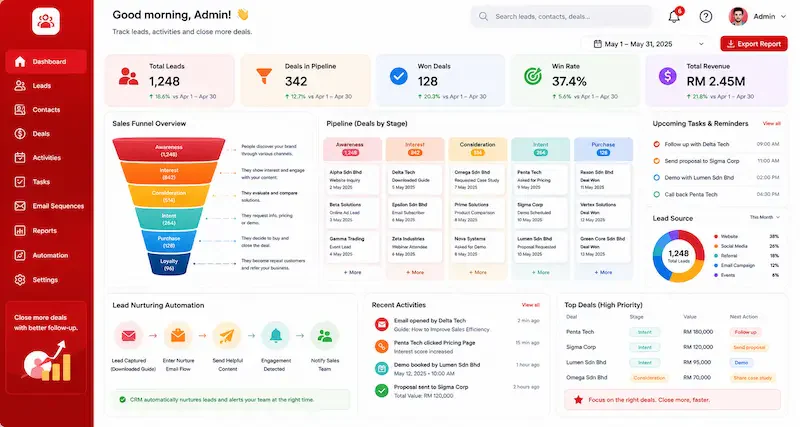
A CRM sales funnel helps teams track each lead from first inquiry until the deal is won or lost. Without CRM, lead details can scatter across WhatsApp chats, emails, spreadsheets, and personal notes, making follow-up easy to miss.
CRM software keeps lead data in one place, including prospect stage, previous questions, last activity, and next action. It can also remind sales teams to follow up, send simple email sequences, tag warm leads, and highlight prospects who are closer to buying.
For managers, CRM gives clearer pipeline visibility. With CRM automation and sales force automation, teams can track sales activities, monitor proposals, forecast deals, and focus on prospects that need attention first.
Automating Lead Nurturing
Lead nurturing is about staying in touch with prospects who are interested but not ready to buy yet. A CRM can send reminders, trigger follow-up emails, and show sales reps which leads should be contacted first.
For example, a Malaysian B2B buyer who downloads a guide may not want a sales call right away. The CRM can place that lead into a nurture flow first, then alert the sales team when the lead books a demo, replies to an email, or requests pricing.
CRM for Malaysian Businesses
For Malaysian businesses, an integrated sales CRM platform should make sales follow-up easier, not add another layer of admin work. Useful features include a clear pipeline view, automated reminders, lead scoring, and integration with quotation, order, finance, or inventory tools.
In practice, CRM should answer three daily questions for the sales team: who needs a follow-up, which deal is stuck, and which prospect is ready for the next conversation.
Conclusion
A sales funnel is useful because it shows where sales opportunities are actually getting stuck. Maybe leads come in, but no one follows up fast enough. Maybe demos happen, but proposals take too long. Once each stage is clear, the sales team can stop guessing and start fixing the part that slows deals down.
For Malaysian businesses, this matters even more when leads come from many places, such as WhatsApp, website forms, referrals, LinkedIn, or sales calls. A good funnel helps the team track who needs attention, which prospects are ready to move forward, and which follow-ups should not be missed.
To see how this works in a real sales workflow, a free demo can show how CRM helps organise leads, reminders, and pipeline activity in one place without making the process harder for the team.

FAQ About Sales Funnel
A sales funnel shows the buyer’s journey from first awareness to purchase. A sales pipeline shows the seller’s view of active deals, follow-ups, deal value, and close probability. In practice, the funnel explains where prospects drop off, while the pipeline helps sales teams manage which deals need action.
A sales funnel commonly has six stages: awareness, interest, consideration, intent, purchase, and loyalty. Some businesses simplify it into fewer stages, but six stages give a clearer view of how leads move from first contact to repeat buying. The right structure depends on how complex the buying process is.
A CRM helps manage a sales funnel by storing lead details, tracking follow-ups, and showing where each prospect sits in the buying journey. It also helps sales teams avoid missed follow-ups by using reminders, lead status updates, and activity records. For managers, CRM gives better visibility into deal progress and sales forecasting.
An ideal B2B sales funnel strategy should match content and follow-up to the buyer’s stage. Use educational content to attract early leads, case studies and demos to build trust, then proposals and ROI discussions for high-intent prospects. Since B2B deals often involve several decision-makers, the funnel should also support longer follow-up cycles.
A sales funnel is working when leads move steadily from one stage to the next and the team can see where deals slow down. Key signs include healthy stage conversion rates, shorter follow-up delays, better lead-to-customer rate, and clearer sales cycle length. If many leads drop at the same point, that stage needs review.
TOFU, MOFU, and BOFU are different stages in a sales funnel. TOFU (Top of Funnel) attracts new prospects who are just discovering the business, MOFU (Middle of Funnel) nurtures prospects who are comparing options, and BOFU (Bottom of Funnel) focuses on converting prospects who are ready to buy.