







When severe flash floods struck the Klang Valley, hundreds of logistics hubs and manufacturing facilities along the Shah Alam and Port Klang corridors faced sudden operational shutdowns. Companies without emergency response protocols suffered prolonged downtime, inventory damage, and breached customer contracts. For Malaysian business leaders, unexpected severe weather and infrastructure failures demonstrate why operational readiness is non-negotiable.
At its core, business continuity refers to an organization's capability to maintain critical operations during and after a disruptive event. According to global standards published by The Business Continuity Institute (BCI), building this resilience requires systematic risk assessment, clear recovery protocols, and continuous testing to protect organizational value.
From supply chain bottlenecks to cybersecurity threats, Malaysian companies face constant disruptions. An ERP system supports business continuity by centralizing data and processes, helping maintain operations, compliance, and revenue during unexpected crises.
Key Takeaways
Business continuity ensures critical operations remain functional during unexpected disruptions.
Monsoon flooding, logistics delays, and cyber incidents represent major operational threats in Malaysia.
A Business Impact Analysis identifies critical processes, RTOs, RPOs, and system dependencies.
Manual tracking and scattered operational records can make crisis recovery slow and disorganized. Integrated business systems help organizations maintain visibility over inventory, finance, and supply chain dependencies when disruptions occur.

What Is Business Continuity and Why Organizations Need It
Business continuity is an organization’s ability to maintain products or services at acceptable predefined levels after a disruption, as defined by ISO 22301:2019. It goes beyond IT recovery by covering people, physical assets, business processes, and vendor networks that support ongoing operations.
This capability is essential because disruptions such as power failures, floods, cyber incidents, supplier delays, and system outages can quickly affect revenue, contractual commitments, and customer trust. A clear continuity approach defines what each team should do, when to act, and within what timeframe, while distinguishing operational readiness from the management structures that support it.
Business Continuity VS Business Continuity Management
While the terms are often used interchangeably, they represent two distinct concepts within risk governance:
| Aspect | Business Continuity (BC) | Business Continuity Management (BCM) |
|---|---|---|
| Nature | An operational capability or end state that the organization achieves. | A management process and governance framework that produces the capability. |
| Core question | Can we keep delivering products and services during a disruption? | How do we identify threats, prepare responses, and keep the plan current? |
| Scope | Focused on critical processes and the resources needed to sustain them. | Covers policy, risk assessment, BIA, strategy, testing, review, and improvement. |
| Ownership | Process owners, department heads, and operational teams. | BCM coordinator, risk or compliance function, and executive committee. |
| Timing | Demonstrated during and immediately after a disruptive incident. | Runs continuously before, during, and after an incident. |
| Main output | Sustained delivery of critical products and services at agreed levels. | Policy, BIA results, recovery strategies, plans, test records, and review reports. |
| How it is measured | Actual recovery time, service levels maintained, and downtime cost avoided. | Plan coverage, exercise frequency, corrective actions closed, and audit findings. |
| Standard reference | Defined in ISO 22301:2019 as the capability to continue delivery. | Implemented as a Business Continuity Management System (BCMS) under ISO 22301. |
| Practical example | A distribution centre keeps fulfilling orders from a backup site after a flood. | The company runs an annual BIA, updates recovery targets, and tests the failover. |
| Risk if missing | Operations stop, revenue is lost, and service commitments are missed. | Plans become outdated, untested, and unusable during a real incident. |
What a Business Continuity Plan Contains
A Business Continuity Plan (BCP) outlines the key actions and responsibilities needed to keep critical operations running during a disruption. It typically includes:
- Governance Roles: Defines who is responsible for making decisions and coordinating the response during a crisis.
- Incident Activation Thresholds: Establishes the conditions that trigger the BCP and initiate the response process.
- Emergency Contact Directory: Lists key internal and external contacts needed during an incident.
- Alternative Work Locations: Identifies backup sites or remote work arrangements for maintaining essential operations.
- Restoration Procedures: Provides step-by-step instructions for recovering critical business functions and returning to normal operations.
Integrating these protocols into a broader enterprise risk management strategy helps leadership assess physical, digital, and financial risks within a coordinated framework.
What Disrupts Business Continuity in Malaysia

Operational risk management requires a realistic understanding of local environmental and economic factors. Malaysian businesses face specific operational vulnerabilities that can disrupt daily activity:
- Monsoon Flooding: Annual severe weather frequently impacts industrial parks across Selangor, Johor, and Pahang, causing physical asset damage and workforce displacement.
- Infrastructure and Grid Outages: Regional power disruptions and water supply cuts across the Klang Valley disrupt manufacturing operations and service facilities.
- Port Congestion and Customs Clearance: High vessel traffic at Port Klang or Johor ports can lead to major logistics delays in Malaysia, creating inventory bottlenecks for trading firms.
- Supply Chain Vulnerabilities: Dependencies on single-source raw material vendors leave production lines vulnerable to sudden supply chain disruption when overseas suppliers face delays.
- Cybersecurity and Ransomware: Industrial facilities and financial services increasingly face malware incidents that paralyze local servers and operational databases.
- Inter-Regional Logistics: Managing multi-site fulfillment between Peninsular Malaysia and East Malaysia (Sabah and Sarawak) presents transit delays during sea freight disruptions.
How a Business Impact Analysis Supports Business Continuity
A Business Impact Analysis (BIA) helps organizations identify critical functions, understand the effects of disruptions, and determine recovery priorities. Its findings provide a basis for strengthening business continuity and preparing for potential disruptions.
1. Scope Definition
Determine which departments, business units, processes, and locations will be assessed. This sets clear boundaries for the BIA and ensures critical areas are not overlooked.
2. Data Collection
Gather information from department heads and process owners about how each process works, what resources it needs, and which other processes depend on it. This helps reveal operational dependencies and potential bottlenecks.
3. Impact Evaluation
Assess what would happen if a process were unavailable for a certain period. Consider financial losses, regulatory or legal consequences, operational disruption, and effects on customers or business reputation.
4. Determine Target Metrics
Set recovery targets based on the impact assessment. Maximum Tolerable Downtime (MTD) defines the longest period a process can remain disrupted before causing unacceptable harm, Recovery Time Objectives (RTO) specifies how quickly the process should be restored, and Downtime (MTD), Recovery Time Objectives (RTO), and defines how much data loss is acceptable after an incident.
Set recovery targets for each critical process. The main measures are the Recovery Time Objective (RTO), which defines how fast a process must be restored, and the RPO, which defines how much data loss is acceptable. These targets should be agreed with process owners and approved by management.
5. Resource Dependency Mapping
Identify everything required to keep or restore critical processes, including employees, facilities, software, IT systems, equipment, raw materials, and third-party suppliers. Mapping these connections often reveals single points of failure, such as one supplier serving several production lines.
6. Gap Analysis
Compare the required recovery targets with the organization’s current capabilities. This shows where weaknesses exist, such as insufficient backup systems, limited staff, outdated recovery procedures, or overreliance on a single supplier.
7. Executive Reporting
Summarize the BIA findings for senior management, highlighting the most critical processes, major risks, recovery requirements, and identified gaps. These findings help leadership prioritize investments and approve appropriate business continuity measures.
Accurate BIA results depend on reliable operational data, including order volumes, inventory costs, production schedules, and supplier lead times. By centralizing this information, an ERP system provides the visibility and data accuracy needed to establish realistic recovery targets and calculate potential downtime costs.
How to Set RTO and RPO for Business Continuity
Setting precise metrics ensures that IT recovery budgets align with business urgency. The three core metrics used in continuity planning include Recovery Time Objective (RTO), Recovery Point Objective (RPO), and Maximum Tolerable Downtime (MTD).
Recovery Time Objective (RTO)
RTO is the target duration for restoring a business process after an outage. It measures how much operational downtime is acceptable before the disruption starts to damage the business, and it is normally set by the business process owner who understands the daily impact.
For a Malaysian wholesaler, customer order processing may need to be back online within four hours to prevent shipment backlogs from building up across the week.
Recovery Point Objective (RPO)
RPO is the maximum acceptable age of unbacked-up data at the point an incident occurs. It measures how much transactional data the business can afford to lose and re-enter, so it directly determines how often systems must be backed up or replicated. The IT and data operations lead usually owns this target. A distributor may set the RPO so that sales transaction records never lose more than 15 minutes of data entry.
Maximum Tolerable Downtime (MTD)
MTD is the upper limit of downtime before business survival is threatened. It sits above the RTO and marks the point where losses become irrecoverable, which is why the executive board is the one to approve it. For a wholesaler, distribution centre downtime beyond 48 hours may lead to contractual breaches that cannot be repaired even after operations resume.
Aligning data backup frequencies with operational targets depends heavily on system deployment models. Comparing cloud ERP and on-premise ERP infrastructure helps technology teams implement automated data replication that meets tight RPO thresholds.
How to Build a Business Continuity Plan
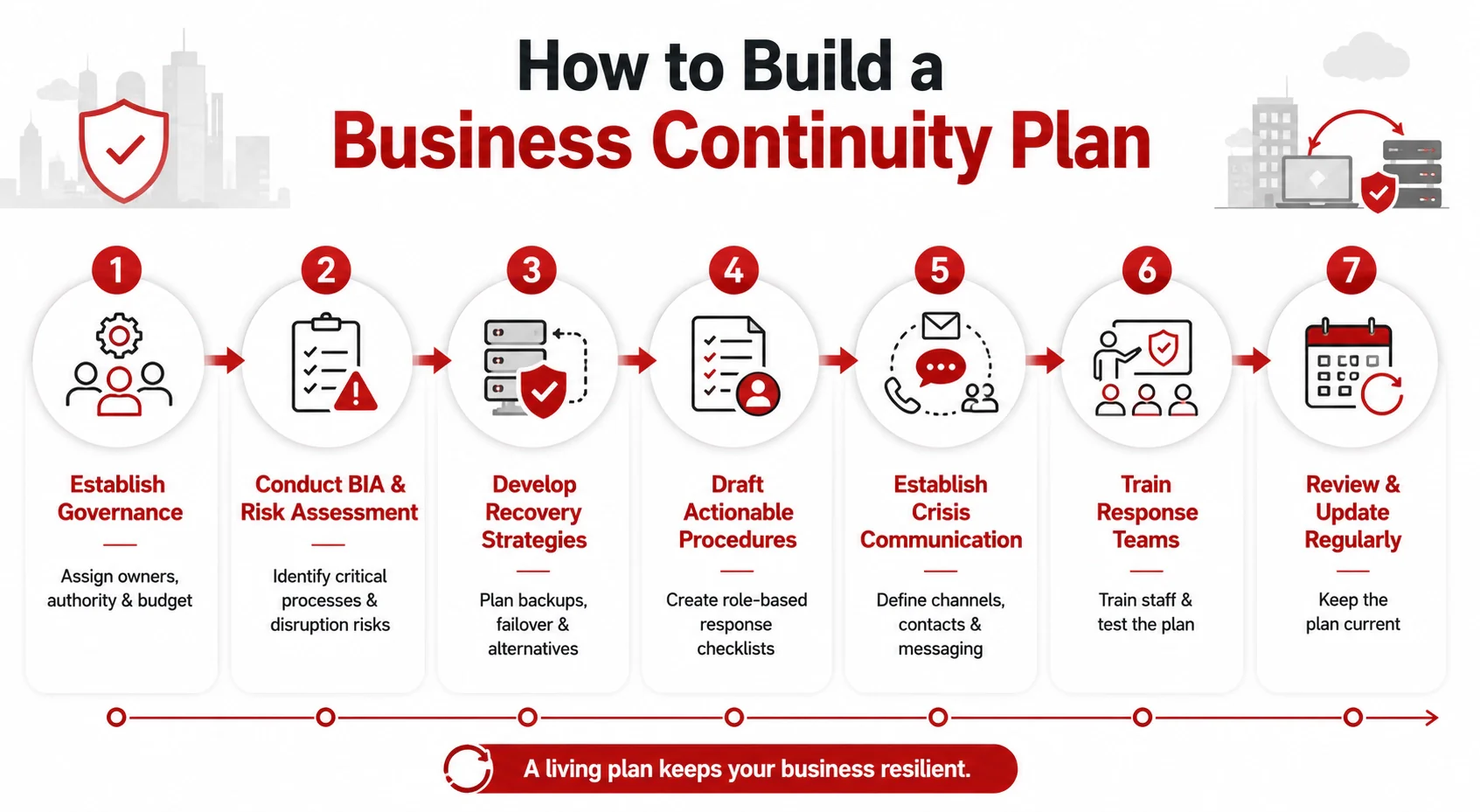
Building a business continuity plan means defining how operations will continue during disruptions. The following seven steps provide a structured approach from planning and impact analysis to testing and regular review.
1. Establish Governance
Appoint a BCM coordinator to own the plan and an executive committee to approve decisions and release budget. Without a named owner, continuity work stalls between departments. Define who has authority to declare a disruption and activate the plan.
2. Conduct BIA and Risk Assessment
The BIA identifies which processes cannot stop and how quickly each must resume, expressed as recovery time and recovery point objectives. The risk assessment identifies what could cause the stoppage, such as power failure, flooding, cyber incidents, or supplier default. Together they show which processes deserve investment first.
3. Develop Recovery Strategies
For each critical process, decide the alternative that keeps it running. This covers staffing backups and cross-training, alternate work sites or remote arrangements, system failover and data backup, and second-source suppliers. Every strategy should be matched to the recovery time target set in the BIA.
4. Draft Actionable Procedures
Turn the strategies into role-specific checklists that a person can follow under pressure. Each checklist states the trigger, the actions in order, the person responsible, and the escalation point. Avoid long narrative documents, because staff will not read them during an incident.
5. Establish Crisis Communication Protocols
Define who speaks to employees, customers, suppliers, media, and regulators, and through which channels. Prepare message templates and a backup contact method in case the primary system is down. Consistent messaging limits confusion and protects reputation.
6. Train Response Teams
Brief staff on their duties and run exercises such as tabletop simulations or full failover tests. Testing reveals gaps that a written plan will not show, including outdated contact lists and dependencies nobody documented. Record the findings and correct them.
7. Review and Update Regularly
Schedule a formal review at least once a year, and update the plan whenever processes, systems, locations, suppliers, or key personnel change. An outdated plan gives false confidence, which is often worse than having no plan at all.
How to Test a Business Continuity Plan
An untested plan offers false security. Organizations validate their emergency preparedness through three main exercise types used across Malaysian industries:
- Notification Tree Test: Validates emergency contact details by testing automated messaging and call chains to verify staff reachability.
- Desktop Walkthrough: Uses a simulated disruption for teams to review their roles, responsibilities, and response procedures. It helps identify unclear instructions or coordination issues without interrupting actual operations.
- Crisis Simulation: Replicates a realistic disruption to test recovery procedures in practice, such as switching to backup facilities, restoring systems from backups, and coordinating with critical vendors.
Plans that are drafted, filed, and never exercised often fail during real emergencies. Conducting regular testing ensures the organization satisfies internal compliance audit standards and risk management obligations.
How Business Continuity Differs From Disaster Recovery and Resilience
Organizations often confuse emergency response terms, leading to gaps in response planning. A comprehensive defense framework separates immediate safety actions from long-term recovery efforts.
The table below summarizes how emergency disciplines differ across operational boundaries.
| Discipline | Scope | Trigger Event | Primary Owner | Time Horizon | What Success Looks Like |
|---|---|---|---|---|---|
| Incident Response | Immediate physical safety and asset protection | Accident, fire, or localized emergency | EHS & Facility Managers | Minutes to hours | Lives secured, site contained, and emergency services notified |
| Crisis Management | Executive communication and brand protection | Severe operational, legal, or PR threat | C-Suite & Board of Directors | Hours to days | Brand reputation maintained and stakeholder confidence preserved |
| Business Continuity | Sustaining critical operations and service delivery | Process outage or facility loss | Business Unit Leads & Operations | Days to weeks | Predefined service levels maintained during disruption |
| Disaster Recovery | Restoring IT infrastructure, databases, and networks | System crash, cyberattack, or server room failure | IT & Infrastructure Directors | Hours to days | Applications and digital data fully restored from backups |
Organizational resilience acts as the umbrella discipline. It combines crisis management, IT disaster recovery, business continuity, and risk governance into an adaptive operational culture.
Business Continuity Requirements and Regulatory Standards in Malaysia
Regulated entities in Malaysia operate under clear statutory expectations governing operational resilience and crisis readiness.
Bank Negara Malaysia BCM policy framework
The BNM BCM Policy Document sets mandatory continuity requirements for licensed financial institutions. Key provisions require financial institutions to establish an enterprise BCMS, conduct annual disaster recovery exercises, and report critical system disruptions to BNM within one hour of occurrence.
Adhering to these requirements helps mitigate the operational challenges facing Malaysian banks during financial or technical shocks.
Securities Commission Malaysia SC-GP/1-2019 guidelines
The Securities Commission Malaysia enforces the Guidelines on Business Continuity Management for Capital Market Entities (SC-GP/1-2019). This framework outlines six guiding principles requiring board oversight, comprehensive BIA exercises, alternate site readiness, and formal notification to the SC within three business days of BCP activation.
Risk management in technology compliance
Bank Negara Malaysia’s Risk Management in Technology (RMiT) framework enforces strict standards for technology resilience. Financial institutions must maintain high availability for critical customer-facing applications, enforce cyber incident response protocols, and establish alternate data centers capable of meeting strict recovery metrics.
ISO 22301 certification via SIRIM QAS
Malaysian companies seeking accredited certification can obtain ISO 22301:2019 certification through SIRIM QAS International. The process involves a Stage 1 documentation review, a Stage 2 implementation audit, and annual surveillance audits to verify continuous improvement.
Business continuity expectations for non-regulated Malaysian SMEs
SMEs operating outside financial services may not face direct statutory BCM mandates. However, commercial pressure from multinational clients, insurance underwriters, and enterprise buyers increasingly requires smaller suppliers to demonstrate formal business continuity capabilities before securing vendor contracts.
Conclusion
Business continuity is an ongoing operational commitment rather than a one-time project. As business operations expand, maintaining clear visibility over inventory, finance, suppliers, employees, and critical processes helps ensure that recovery strategies remain accurate and executable.
Regular BIA reviews, plan testing, and updates are also essential to keep continuity measures aligned with changing business needs. Connecting operational workflows through a central ERP system provides the data visibility needed to assess business impacts, identify dependencies, prioritize recovery efforts, and strengthen overall supply chain resilience.
To learn how an integrated ERP system can support your operational data visibility and risk management planning, schedule a free demo today!

FAQ About Business Continuity
Business Continuity Management (BCM) is the overarching management framework used to identify risks and build organizational readiness. A Business Continuity Plan (BCP) is the specific document containing actionable steps to recover operations during a crisis.
Plans should be reviewed annually at minimum. Additional updates are required whenever there are significant changes to business operations, core software systems, office facilities, or key regulatory guidelines.
No. ISO 22301 certification is optional for most commercial organizations. However, adhering to its framework helps companies meet Bank Negara Malaysia and Securities Commission regulatory expectations.
Cloud-based systems allow employees to access operational data, process orders, and manage approvals securely from any location with an internet connection, reducing reliance on physical offices.
For small to mid-sized enterprises, a thorough BIA typically takes two to four weeks, depending on process complexity and stakeholder availability.
Exceeding the MTD leads to severe financial losses, irreparable reputational damage, breach of customer contracts, or statutory penalties that threaten the ongoing viability of the business.