







When a finance controller, plant manager, or warehouse lead leaves unexpectedly, the vacancy can expose unclear authority, undocumented knowledge, and limited leadership cover. For Malaysian enterprises operating across several subsidiaries, sites, or business units, these gaps can delay approvals and disrupt daily operations.
Succession planning addresses this risk through a structured process for identifying critical roles, assessing potential successors, assigning development actions, and reviewing readiness regularly. The CIPD succession planning factsheet also describes succession planning as a way to identify and develop talent for future critical positions.
Effective succession planning begins with identifying roles that carry the greatest continuity risk, assessing potential successors, closing development gaps, and establishing clear governance and review measures. A human resource management system can help organise workforce data, competency records, development progress, and review history.
Key Takeaways
Succession planning prepares credible options for critical roles before a vacancy disrupts operations.
Critical roles should be prioritised according to operational dependency, scarce skills, control risk, and replacement lead time.
Common succession planning mistakes include relying on preferred names, confusing performance with readiness, and neglecting development follow-through.
As succession planning becomes more structured, enterprises need consistent workforce data, competency records, development progress, and review history. Keeping this information connected helps authorised leaders assess readiness and maintain continuity across critical roles.

What Is Succession Planning in an Enterprise Context?
Succession planning helps companies prepare the right people for roles that cannot be left vacant for long. It brings together role priorities, successor readiness, performance evidence, development plans, and regular reviews so leadership can respond before a key position becomes a business risk.
A strong succession plan is more than a list of backup names. It should explain why the role matters, what skills are required, which employees are close to being ready, and what gaps still need to be addressed
the role matters, what skills are required, which employees are close to being ready, what gaps still need to be addressed
Centralised workforce records make it easier to compare successor readiness, skills, and development gaps across teams. If there are not enough internal candidates, insights from recruitment software can help HR teams understand the external talent pool before leaders make the final decision.
Why Does Succession Planning Matter for Business Continuity?
Succession planning reduces dependence on individual employees and gives the organisation a clearer continuity path. When a critical person leaves, the impact may include delayed approvals, lost operational knowledge, incomplete reporting, and uncertainty over who has decision-making authority.
For example, a finance controller may be the only person who fully understands intercompany routines and month-end exceptions. A plant manager may hold concentrated knowledge about maintenance priorities, production constraints, and customer commitments. Without prepared cover, several teams may be affected simultaneously.
A practical succession plan helps an enterprise:
- designate temporary accountability before a vacancy occurs;
- preserve knowledge that would otherwise remain with one individual;
- prepare internal candidates through relevant experience rather than title-based assumptions;
- shorten the time needed to organise a leadership transition;
- strengthen the wider talent pipeline instead of solving each vacancy separately; and
- clarify who can approve decisions during planned or unexpected leadership gaps.
This is especially relevant to enterprises operating multiple factories, plantations, warehouses, outlets, or legal entities. Succession planning should therefore be treated as an operational risk control, not solely as an HR programme.
Which Roles and Talent Pools Should You Prioritise First?
Prioritise roles where a vacancy could disrupt operations, controls, revenue, customer commitments, or strategic execution. Evaluate operational dependency, skill scarcity, strategic impact, vacancy probability, control risk, and replacement lead time before discussing candidates.
Common priority groups include executives, operational heads, finance and control positions, technical specialists, commercial leaders, and transformation roles. Once critical roles are identified, build talent pools across departments, subsidiaries, and locations rather than considering only direct deputies.
How Do You Build a Succession Plan in 6 Steps?
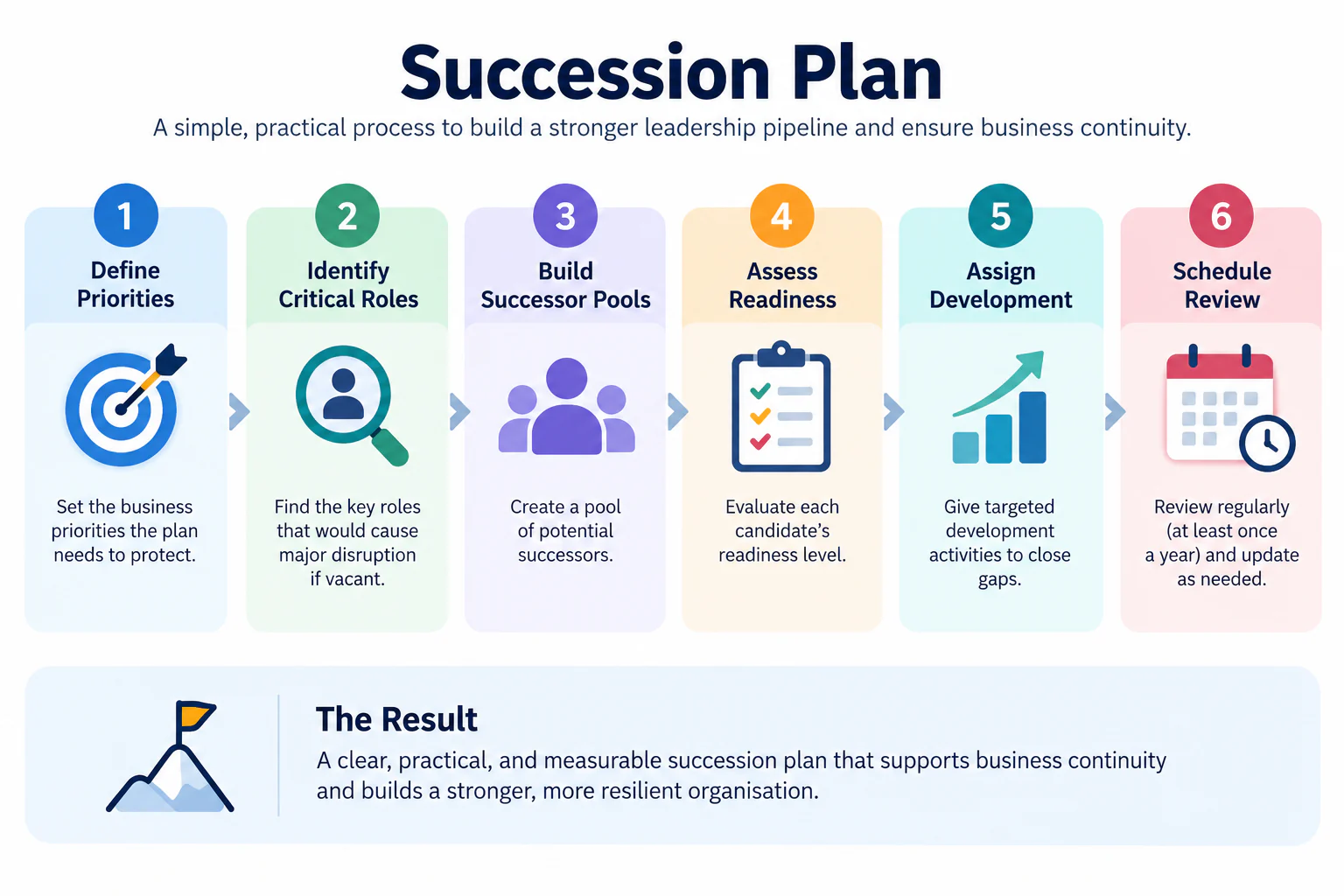
A succession plan is built by connecting business priorities with critical roles, evidence-based successor pools, targeted development, and scheduled review. Each step needs a named owner, clear input, practical output, and control so that the process does not become an HR spreadsheet that managers revisit only after a resignation.
Use this numbered checklist to move from intent to implementation:
1. Define Priorities:
Start by clarifying which business priorities the succession plan needs to protect. These priorities may include operational continuity, leadership transition, regulatory control, branch expansion, or the retention of specialist knowledge. By defining the purpose first, the organisation can focus on roles that truly affect business performance instead of trying to create a succession plan for every position at the same level of detail.
2. Identify Critical Roles:
After the priorities are clear, identify the roles that would create serious disruption if left vacant. These may include roles with approval authority, direct revenue impact, compliance responsibility, scarce technical knowledge, or strong dependency from other departments. For each role, the organisation should understand what decisions, processes, systems, and people depend on that position.
3. Build Successor Pools:
Next, build a pool of potential successors instead of depending on only one person. A successor pool may include employees from the same department, related functions, branches, or subsidiaries. This gives the enterprise more flexibility, especially when one candidate is not ready, not interested, or needed in another critical role. The pool should be based on capability, performance, career interest, and alignment with future role requirements.
4. Assess Readiness:
Assess each potential successor using clear and consistent criteria. Readiness should consider current performance, role-specific skills, leadership behaviour, business knowledge, decision-making ability, and development gaps. The organisation can classify candidates as ready now, ready within one year, ready within two to three years, or not ready yet. This helps leaders make decisions based on evidence rather than personal preference.
5. Assign Development:
Once readiness gaps are identified, assign development actions that prepare each candidate for the role. These actions may include mentoring, job shadowing, leadership training, cross-functional projects, temporary assignments, or exposure to strategic decisions. Each action should have a clear owner, expected outcome, and timeline so progress can be reviewed properly.
6. Schedule Review:
A succession plan should be reviewed regularly because business priorities, role requirements, and employee availability can change. Enterprises should schedule formal reviews at least once a year and update the plan whenever there is a major organisational change.
A complete succession plan should clearly show the organisation's priorities, critical roles, successor pools, readiness levels, development actions, and review schedule. With this structure, enterprises can make succession planning more practical, measurable, and useful for business continuity.
How Should Successors Be Assessed and Developed?
Successors should be assessed using role requirements, performance evidence, competency gaps, leadership behaviour, career interest, mobility, and development progress. The assessment should consider several sources and more than one stakeholder, especially when a decision could shape an employee's career or access to sensitive opportunities.
A practical readiness model uses three categories:
| Readiness category | Meaning | Appropriate action |
|---|---|---|
| Ready now | Evidence indicates that the employee could assume the role with normal transition support | Maintain exposure, confirm interest, and prepare transition cover |
| Ready after targeted development | The employee has credible potential but must close specific gaps | Assign mentoring, stretch work, cross-functional projects, or technical development |
| Long-term potential | The employee shows relevant capability but needs broader experience and time | Build a multi-stage development path and review progress periodically |
These labels are not permanent rankings. A candidate's readiness may change when the role expands, the strategy shifts, personal mobility changes, or new evidence becomes available.
Development actions should correspond to identified gaps. Useful options include:
- mentoring by an experienced leader;
- temporary responsibility for meetings, approvals, or reporting cycles;
- a stretch assignment at another site or subsidiary;
- leadership exposure through steering committees or transformation projects;
- technical training linked to future role requirements; and
- job rotation across operations, finance, commercial, or support functions.
Each action needs an expected outcome. Instead of recording complete leadership training, specify the behaviour or responsibility that should be demonstrated afterwards. Managers should then review evidence from the assignment, not merely whether an activity was attended.
Confidentiality remains important. Employees can participate in career-development conversations without being promised a particular appointment or shown every nomination. Leadership should communicate honestly that succession planning prepares options and does not guarantee promotion.
How Do Succession Planning and Replacement Planning Differ?
Replacement planning provides short-term cover for a role, whereas succession planning develops credible candidates for future responsibility. Both are useful, but they answer different questions: who can take control immediately, and who can become fully ready over time?
| Approach | Main purpose | Time horizon | Typical data | Ownership | Output |
|---|---|---|---|---|---|
| Succession planning | Build capability for critical future roles | Medium to long term | Role requirements, performance, competencies, interests, development progress | Leadership, HR, and business functions | Successor pool and development plan |
| Replacement planning | Identify near-term cover for a vacancy | Short term | Availability, current experience, authority | Role owner and leadership | Primary and secondary replacement names |
| Emergency cover | Maintain essential decisions during sudden absence | Immediate | Delegation limits, contacts, procedures | Operational management | Temporary accountability arrangement |
| Career development | Help an employee build broader capability | Ongoing | Aspirations, strengths, gaps, learning progress | Employee and manager | Individual development plan |
A replacement list may be enough to authorise payments or run a shift during a brief absence. It is not enough to build the judgement, relationships, and experience required for permanent leadership. Enterprises should maintain emergency cover alongside a longer-term succession process, particularly for roles with financial authority or high operational dependency.
Common Succession Planning Mistakes to Avoid
Most weak plans fail because the process becomes too narrow, too subjective, or too difficult to maintain. Common mistakes include:
- Planning Only for Senior Executives:
Focusing only on the executive team can leave operational and specialist positions unprotected. Enterprises should identify critical roles based on business dependency and replacement difficulty, not hierarchy alone. - Naming Only One Successor:
Depending on one candidate creates another point of failure. The employee may leave, decline the opportunity, or no longer meet future requirements. A successor pool gives the organisation more options and supports fairer comparison. - Confusing Performance With Readiness:
An employee can perform well in a current position without being ready for a role that requires different judgement, leadership, or technical capabilities. Readiness should be assessed against the responsibilities of the target role. - Creating Vague Development Plans:
General recommendations such as “improve leadership skills” are difficult to implement and measure. Development actions should identify the capability gap, the required experience, the responsible owner, the expected result, and the review date. - Ignoring Employee Career Interests:
A manager may consider someone a strong successor even when the employee does not want the role or cannot relocate. Career interests and availability should be discussed confidentially before the organisation relies on that person in its plan. - Failing to Update the Plan:
A plan quickly becomes outdated when candidates change roles, leave the organisation, or develop new capabilities. Reviews should occur regularly and whenever significant organisational or workforce changes affect critical positions.
Conclusion
Succession planning helps enterprises prepare for changes in critical roles before those changes disrupt operations. A useful plan identifies business priorities, critical positions, credible successor pools, readiness levels, development actions, and a regular review schedule.
The process should remain evidence-based, confidential, and connected to actual business needs. By combining leadership judgement with organised workforce information, Malaysian enterprises can reduce dependency on key individuals and build a more sustainable pipeline of future leaders and specialists.
An HR system can help organise employee profiles, competencies, and development records used in succession planning. If your organisation is reviewing this process, a free consultation can help you explore the available options.

Frequently Asked Questions
A Malaysian enterprise should conduct a formal succession plan review at least once a year. Additional reviews are advisable after restructuring, senior departures, acquisitions, new site openings, major strategy changes, or changes to a critical role. Fast-moving operational positions may require more frequent readiness checks.
No. Roles do not require the same depth of succession planning. Prioritise positions with high operational dependency, scarce skills, long replacement lead times, strategic impact, significant approval authority, or control risk. Less critical roles may be covered through broader talent pools, recruitment plans, or standard operating procedures.
Use documented role requirements, performance history, competency gaps, leadership behaviours, development progress, career interests, and evidence from relevant assignments. Readiness should be calibrated by more than one stakeholder, with confidential records, consistent criteria, and a documented rationale for material decisions.
Replacement planning focuses on immediate or short-term cover when a role becomes vacant. Succession planning is a longer-term process for developing credible candidates for critical roles. Both can coexist: the organisation may need emergency cover today while building a stronger leadership pipeline for the future.
An HR system can centralise employee profiles, reporting lines, competency records, performance history, career interests, development actions, and review workflows. This gives authorised leaders a more consistent evidence base and clearer process visibility, but leadership must still make confidential judgements and final appointment decisions.