







From the past few years, procurement focused on low costs and lean operations, leading companies to rely on a few large partners. Recent global shocks including pandemics and geopolitical tensions have exposed the dangerous fragility of this concentrated approach.
A research by The Institute of Strategic & International Studies (ISIS) Malaysia underscores this urgency, warning that a major disruption to the semiconductor supply chain alone could set the global economy back at least 20 years. As a result, the concept of ‘supplier diversification’ has transitioned from a secondary consideration to a primary strategic imperative for executive leadership.
Supplier diversification involves sourcing from multiple vendors instead of a single source. This builds redundancy, letting a business switch to alternatives if a partner fails due to financial or logistical issues. In this article you will understand the concepts, the risk, and how to find the right solution for it.
Key Takeaways
Exploring the fundamental concepts and the shift from single-sourcing to multi-sourcing.
Analyzing the risk of supply chain concentration and why is this approach creates serious risks when disruptions occur.
The Benefits of Supplier Diversification including ; tap into a broader pool of intellectual property, optimize cost, and reducing delivery lead times.
Managing several vendors at once is difficult to do manually. To handle the extra data and keep your operations organized, using a dedicated supply chain system is the most practical way to stay in control.
What Is Supplier Diversification?
Supplier diversification is a procurement strategy where a business works with multiple suppliers instead of depending on only one vendor. The goal is to reduce supply chain risk and keep operations running when disruptions happen. A company can diversify suppliers by sourcing from different countries, regions, or vendor types.
For example, it may use one global supplier for large orders and one local supplier for urgent backup needs. This strategy helps businesses build a more resilient supply chain, reduce delays, improve negotiation power, and avoid overdependence on a single supplier. It also encourages vendors to maintain better quality, pricing, and delivery performance.
The Hidden Risks of Supply Chain Concentration
Supply chain concentration happens when a business depends on one supplier or one region for critical materials. While it may seem efficient, this approach creates serious risks when disruptions occur.
High disruption risk
If the main supplier fails, production can stop, orders get delayed, and revenue is lost. The COVID-19 pandemic proved this when companies relying on a single source faced months-long shutdowns with no backup. Even brief disruptions of 2–3 weeks can cascade into missed deliveries, contract penalties, and customer churn.
Financial vulnerability
When a supplier faces financial issues, businesses may struggle to find replacements quickly, leading to major losses. Emergency sourcing from alternative vendors often costs 20–40% above contracted rates since the buyer has no pre-negotiated terms. In severe cases, product lines may halt entirely while a new vendor is qualified, a process that can take weeks depending on industry regulations.
Geographic risk exposure
Relying on one region increases exposure to trade policy changes, tariffs, or political instability. Sudden import tariffs or export bans can overnight make a key component unaffordable or completely unavailable. Natural disasters or port congestion in that single geography can also sever the entire supply line with no alternative route.
Limited innovation
A single supplier has less incentive to improve, which can slow down product development and modernisation. Without competitive pressure, the supplier may keep delivering the same specifications while the market shifts toward newer materials or sustainable practices. This puts the buyer at a disadvantage as competitors working with multiple suppliers gain access to better components sooner.
Lack of flexibility
Businesses may become locked into outdated systems or processes due to supplier dependency. Over time, production workflows and software integrations become tightly coupled to that supplier’s standards, making switching costs prohibitively high. This weakens the company’s negotiating power since the supplier knows the buyer cannot easily walk away.
Diversification breaks this cycle by introducing fresh perspectives and new technologies into the supply chain. To mitigate these issues, companies must proactively identify building a resilient supply chain as a core business objective.
Several Benefits of Supplier Diversification
Diversification offers more than risk protection; it increases agility. Having multiple suppliers lets a company scale production up or down. Local vendors provide quick results for small orders, while large international ones handle mass production. This balance helps businesses stay responsive to market changes.
Protection Against Supply Disruptions
When one supplier fails, others keep your operations running. Businesses with diversified supplier networks recover from disruptions faster, avoiding cascading delays that impact sales, contracts, and customer trust. For companies operating on tight production schedules, this protection alone justifies the effort of managing multiple vendors.
Flexibility to Scale With Demand
One supplier has a fixed capacity limit. When demands spike, whether from a seasonal rush, a promotional campaign, or unexpected market growth they often can’t keep up. Having multiple partners lets you shift work to whoever has the space. This allows you to scale fast and win sales while your rivals hit a wall.
Enhanced Innovation and Collaboration
Each vendor brings unique skills and perspectives. Working with various suppliers lets companies access a broader pool of intellectual property and discover better materials or methods from different regions. This exchange of ideas improves products and creates a competitive edge.
Cost Optimization through Competition
Managing multiple vendors increases admin work but cuts unit costs through competition. Suppliers offer better prices and terms to win business. This prevents price gouging during shortages because you can move orders to more affordable partners.
Reducing Delivery Lead Times
Logistics is often the bottleneck of global trade. By sourcing from suppliers in different locations, companies can significantly optimize their shipping routes. For instance, having a domestic supplier for urgent orders and an overseas supplier for bulk replenishment is a classic way of reducing delivery lead time. This dual-sourcing strategy ensures that the “time-to-market” remains consistent even if global shipping lanes are congested.
A Comprehensive Step for Supplier Diversification
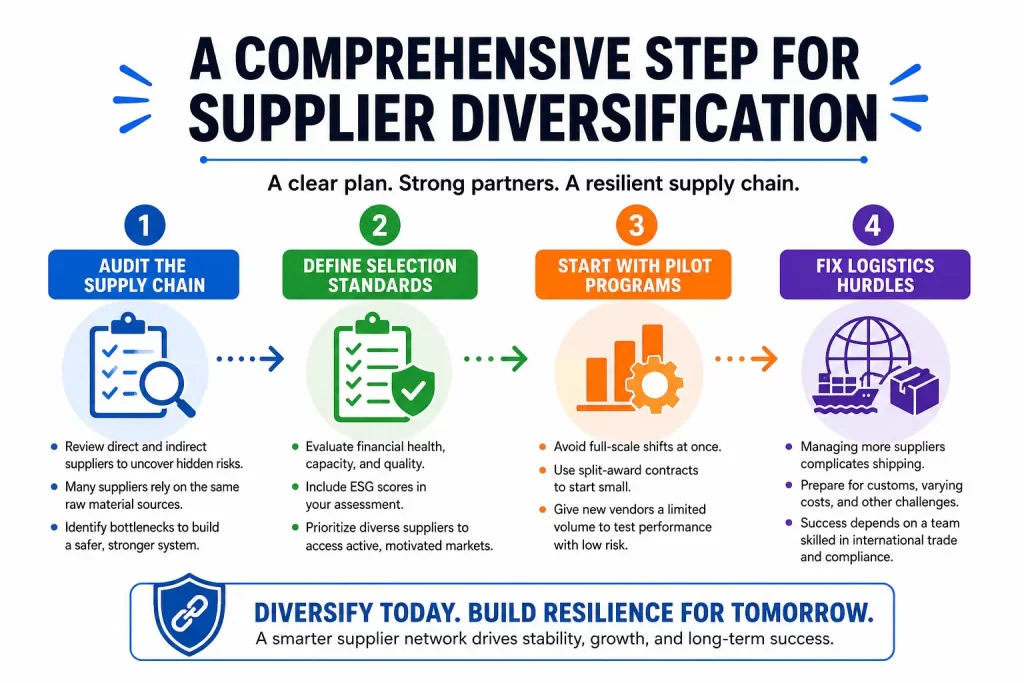
Expanding your supply chain requires a clear plan. It is more than just signing papers. It involves a deep look at your current partners and long-term goals. Here is an effective way to implement this change.
Step 1: Audit the Supply Chain
Look at your direct and indirect partners to find hidden risks. Often, different suppliers use the same source for raw materials. Finding these bottlenecks is the first move toward a safer system.
Step 2: Define Selection Standards
Define what a good partner looks like. Focus on financial health, capacity, and quality. Including ESG scores and buying from diverse businesses helps you reach active, motivated markets.
Step 3: Start with Pilot Programs
Shifting all work at once is risky. Use split-award contracts to start slow. Give a new vendor a small share of the volume to test their work without risking the whole production line.
Step 4: Fix Logistics Hurdles
Managing more suppliers makes shipping harder. Be ready for common logistics challenges such as customs and varying costs. Success depends on a team that understands international trade and compliance.
Spreading Your Supply Chain Across Regions
Geographic hedging is a way to split risks between different parts of the world. The “China Plus One” model is a top example. Companies keep their main setup in China but build extra capacity in places like India, Mexico, or Southeast Asia. This keeps the supply chain moving if one region hits a trade or local crisis.
A clear example of this shift is visible in Southeast Asia, where Malaysia has emerged as a primary beneficiary for the China Plus One strategy. By offering corporate tax incentives in special economic zones and utilizing its strong power capacity, Malaysia is actively attracting global companies that are expanding their technology and supply chain operations beyond single-hub locations.
- Nearshoring means moving production closer to where people actually buy the products. For US companies, this often involves moving work to Mexico. For those in Europe, it might mean sourcing from Turkey or Eastern Europe. This cuts down on long shipping waits and high costs. It also makes it easier to work together since teams are in similar time zones and share similar business habits.
- Friendshoring is a recent strategy where businesses buy from nations with similar political and economic views. It is a direct response to global tension. By working within a network of allied countries, firms reduce the chance of getting caught in trade wars or sudden sanctions that could cut off access to vital parts.
Overcoming the Challenges of a Diversified Supply Chain

A diversified supply chain can reduce risk, but businesses still need to manage cost, quality, and complexity carefully.
Higher purchasing costs
Spreading orders across multiple partners often eliminates bulk pricing tiers. To counter this, procurement teams should evaluate the total cost of ownership, including landed costs and administrative overhead, to ensure the safety of diversification is worth the price.
Quality inconsistency
Varied manufacturing standards can lead to product defects. You must establish unified technical specifications and implement a standardized audit schedule to ensure every vendor meets your brand requirements regardless of their location.
More complex vendor management
Monitoring a larger supplier base increases the burden on administrative staff. You can manage this by centralizing all contracts and using specific performance metrics to track vendor health without doubling your manual workload.
Logistics challenges
Sourcing from diverse regions introduces unpredictable shipping delays and customs issues. Map out your entire transportation network and maintain strategic safety stock at key hubs to prevent localized transit failures from halting your production.
Need for better digital visibility
Fragmented data makes it difficult to see where your inventory sits. Using an integrated procurement system allows you to track order progress and stock levels in real time, giving you the clarity needed to make fast adjustments when a supply link fails.
The Future of Supplier Diversification
Looking ahead to 2026 and beyond, supplier diversification will likely become even more dynamic. We are moving toward a world of “micro-supply chains” where production is hyper-localized and highly automated. In this environment, the ability to rapidly onboard and offboard suppliers based on real-time market conditions will be a key differentiator.
Artificial Intelligence (AI) will play a massive role in this evolution. AI-driven predictive analytics can scan global news, weather patterns, and financial reports to predict disruptions before they happen, suggesting alternative suppliers in real-time. The goal is a “self-healing” supply chain that can automatically reroute procurement orders to the most stable and cost-effective source at any given moment.
The Role of Digital Transformation in Supplier Diversification
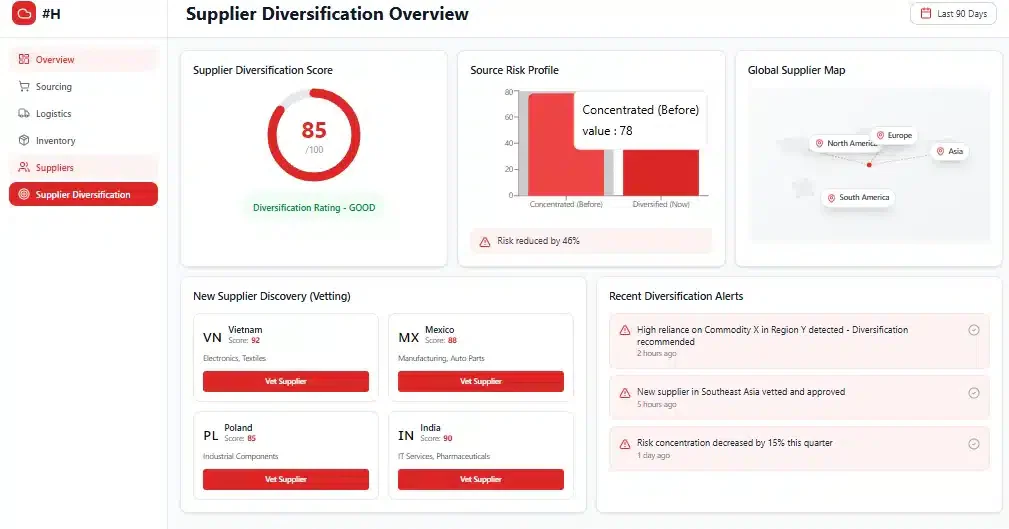
As the number of suppliers grows, manual management via spreadsheets becomes impossible. This is where technology becomes the linchpin of the strategy. Modern procurement and supply chain management systems provide the “single source of truth” needed to monitor dozens or even hundreds of vendors simultaneously.
The advanced systems allow for real-time tracking of supplier performance. These platforms can aggregate data on quality, delivery times, and pricing across the entire vendor base, providing procurement managers with the insights they need to make data-driven decisions. For example, if the system detects a trend of late deliveries from a specific region, it can automatically trigger an alert to shift orders to a supplier in a different territory.
Furthermore, cloud-based collaboration tools enable seamless communication with international partners. Automated onboarding portals can handle the collection of certifications and compliance documents, reducing the administrative burden on the procurement team. By leveraging supply chain management software, businesses can scale their diversification efforts without a linear increase in headcount, maintaining efficiency while gaining the security of a redundant supply base.
Conclusion
Supplier diversification is a key part of business continuity during geopolitical shifts. Single-sourcing for low costs is too risky for modern markets. Stability now depends on agility and a competitive vendor environment that leads to innovation.
Moving to multiple vendors is hard due to administrative work and quality risks. Manual management and spreadsheets cannot handle this workload. To get the benefits of this strategy, companies need digital tools to handle the complexity.
Modern supply chain systems with AI provide one clear data source to track performance and predict issues. Combining diversification with digital tech turns a weak supply chain into a competitive advantage that helps companies thrive with the right solution. Click the free demo here, to get to know further.
FAQ About Supplier Diversification
China Plus One is one of the most widely applied forms of supplier diversification today. It refers to the practice of maintaining operations or sourcing in China while simultaneously developing at least one alternative supplier base in another country, commonly Vietnam, Malaysia, Thailand, or India. This approach reduces overdependence on any single country’s production ecosystem. For businesses in Malaysia, this trend is particularly relevant, as the country has become a top destination for companies actively executing China Plus One strategies due to its established manufacturing clusters, free trade agreements, and proximity to Singapore.
Common warning signs include: placing more than 70% of a critical component’s orders with one supplier, having no pre-qualified backup vendor for any Tier 1 material, experiencing repeated delays with no alternative to fall back on, or realising your supplier’s country is under active trade sanctions or political tension. If your procurement team cannot answer “who is our backup if this supplier stops tomorrow?” for even one key input, concentration risk is already present.
Multi-sourcing is the act of using several suppliers for the same part. Diversification is a broader strategy that includes multi-sourcing but also considers geographic location, vendor size, and different types of technologies to ensure total supply chain health.
Yes, even small businesses can diversify by identifying secondary local vendors or using digital marketplaces to find alternative sources for critical components, ensuring they aren’t vulnerable to a single partner’s failure.