





As Malaysia’s digital economy grows, peak shopping periods such as 11.11 and payday promotions can push enterprise systems beyond their limits. High transaction volumes may cause latency, database bottlenecks, and inventory errors, especially for multi-channel businesses. Asynchronous processing addresses these issues by allowing business events to run independently without blocking user transactions.
This approach is particularly relevant for Malaysian businesses handling high-volume transactions across e-commerce, retail, and digital payments such as DuitNow QR. By decoupling system components, businesses can process more transactions concurrently and maintain more stable operations during demand spikes.
This discussion provides a general overview of asynchronous processing, its benefits for enterprise and ERP systems, and how organizations can leverage it to improve performance and reliability during high-demand periods.
Key Takeaways
Event-Driven Architecture (EDA) decouples software components by using events to trigger asynchronous background workflows.
EDA eliminates system bottlenecks by replacing synchronous blocking calls with event-based message distribution.
Malaysian enterprises utilize EDA to handle real-time payment routing, logistics dispatch, and omnichannel inventory updates.
Legacy monolithic applications often struggle under heavy concurrency. Transitioning to Event-Driven Architecture enables enterprises to build resilient, scalable systems capable of processing high-volume transactions in real time.
What is Event-Driven Architecture (EDA)?
Event-Driven Architecture (EDA) is a software design approach where system processes are triggered by events, such as a completed payment, inventory update, or shipment status change. Instead of requiring each system component to wait for another to finish, events are published asynchronously through a message broker, allowing different services to operate independently.
For example, after an online purchase, the checkout system can record an “Order Placed” event and immediately process the next transaction. Other tasks, such as updating inventory, arranging delivery, generating SST-compliant invoices, and calculating loyalty rewards, can then run in the background through separate services that respond to the event.
Request-Response vs. Event-Driven: The Fundamental Difference
Understanding the difference between traditional request-response and event-driven architectures is key to modernizing systems. While synchronous models make clients wait for processing to finish, EDA uses asynchronous events to let components operate independently.
| Architecture Aspect | Request-Response Model (REST/RPC) | Event-Driven Architecture (EDA) |
|---|---|---|
| Communication Style | Synchronous (Client waits for server response) | Asynchronous (Producer emits event and resumes execution) |
| System Coupling | Tightly coupled (Sender must know receiver endpoint) | Loosely coupled (Producer and consumer operate independently) |
| Failure Impact | Cascading failures (Unresponsive dependency blocks thread) | Isolated degradation (Broker buffers events until consumer recovers) |
| Resource Utilization | High thread locking during network latency | Efficient non-blocking thread execution |
| Primary Use Case | Instant CRUD operations and direct data queries | Complex workflows, real-time analytics, and high-concurrency tasks |
The 4 Main Pillars of an Event-Driven Architecture (EDA)
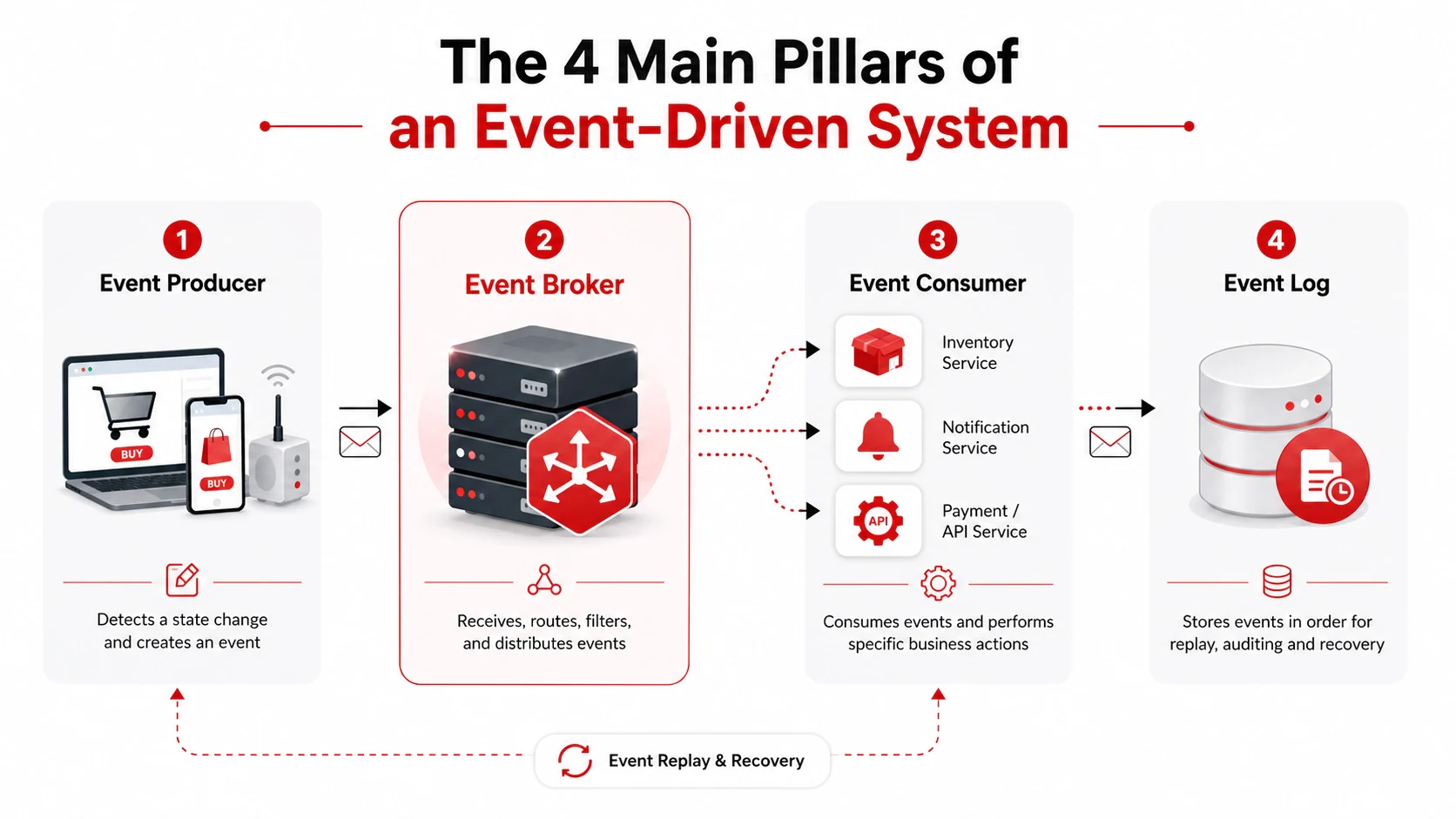
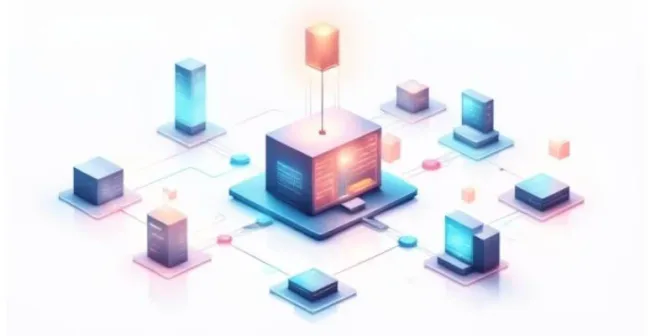
An event-driven architecture relies on four foundational structural components to handle the creation, transmission, storage, and processing of messages across distributed environments. Each component operates independently to maintain operational throughput.
- Event Producer
The producer is the system, application, or IoT device that detects a state change and formulates an event payload. The producer does not execute downstream processing logic, nor does it wait for downstream acknowledgment. Its sole responsibility is to capture data regarding the state change and transmit it to the broker. - Event Broker
The event broker serves as the central message routing engine. It receives events from producers, applies filtering or routing rules, and ensures reliable distribution to registered consumers. Advanced event brokers also manage channel subscriptions, message queue persistence, and dead-letter queues for failed messages. - Event Consumer
The consumer is a microservice or background application that subscribes to specific event channels. When an event is delivered, the consumer extracts the payload and executes its specific business logic, such as updating a localized database, firing a push notification, or triggering a third-party API call. - Event Log
The event log acts as an immutable, append-only ledger that stores events in the exact sequence they occurred. This persistent historical record allows system developers to replay past events for auditing, disaster recovery, data analytics, or rebuilding application state after a system failure.
How Event-Driven Architecture (EDA) Works?
Event-Driven Architecture (EDA) is a software architecture model that enables applications to communicate through events. When a significant change occurs in one system, an event is generated and shared with other applications or services that can respond accordingly.
The following shows how Event-Driven Architecture works, step by step:
- An event occurs: A meaningful change happens in a system, such as a customer placing an order, a payment being completed, or inventory levels changing.
- The event is produced: The application where the change occurs generates an event and sends it to an event broker or messaging system.
- The event is routed: The event broker receives and distributes the event to the applications or services subscribed to that event.
- Event consumers respond: The receiving applications process the event and perform the required action, such as updating inventory, sending a notification, or triggering another workflow.
EDA allows systems to communicate asynchronously, applications can respond to events without waiting for direct responses from other systems. This decoupled approach can improve scalability, flexibility, and responsiveness, making EDA particularly useful for microservices, real-time applications, and distributed systems.
How EDA Powers Daily Life in Malaysia
While Event-Driven Architecture is an internal technical pattern, its practical implementation directly impacts modern digital services across Malaysia. By eliminating processing bottlenecks, EDA enables high-speed digital transactions, real-time tracking, and automated fulfillment across major commercial sectors.
E-Wallets and Instant Interbank Payments
Malaysian financial applications handle millions of micro-transactions daily across platforms like DuitNow, Touch 'n Go eWallet, and commercial banking portals. Synchronous processing during peak hours would cause severe ledger locking and checkout delays.
Mini Case Study:
When a shopper scans a DuitNow QR code at a busy bazaar in Bukit Bintang, the payment gateway captures the primary event "Transaction Authorized". The core application immediately returns a success screen to the customer in under a second. Simultaneously, the event broker broadcasts the event payload to three independent consumer services: the core banking ledger updates account balances, a messaging service sends an instant SMS push notification to the merchant, and a fraud detection service analyzes transaction patterns in the background. None of these sub-tasks delay the merchant's instant checkout receipt.
On-Demand Super-Apps and Logistics Dispatch
Super-apps like Grab and Foodpanda manage complex real-world workflows involving three simultaneous actors: the buyer, the merchant, and the delivery driver. Coordinating these parties requires continuous real-time data flow.
Mini Case Study:
During a rainy Friday lunch rush in Bangsar, thousands of food orders are submitted simultaneously. As a customer confirms an order, the application emits an "Order Placed" event. This single event triggers three parallel workflows: the restaurant's kitchen display system receives an automated prep ticket, the nearest available delivery driver receives a dispatch ping based on real-time GPS telemetry, and the pricing engine recalculates dynamic delivery surcharges for surrounding zones. Because these actions run asynchronously, database lockups are avoided, keeping the mobile interface fully responsive.
Omnichannel Retail and Inventory Synchronization
Modern retail enterprises in Malaysia operate physical stores in shopping centers alongside digital storefronts on Shopee, Lazada, and brand websites. Maintaining unified stock levels without overselling requires instant cross-channel communication.
Mini Case Study:
During a midnight 12.12 campaign, a customer in Kuala Lumpur purchases the final unit of a high-demand laptop online. The e-commerce gateway publishes a "Stock Allocated" event. Within milliseconds, background event consumers update the central warehouse ledger, send cancellation signals to active marketplace listings across external platforms, and refresh the Point-of-Sale (POS) inventory displays in physical retail outlets across Penang and Johor Bahru. This prevents physical store clerks from selling an item that was already claimed online seconds prior.
Why Businesses Are Moving to Event-Driven Systems
Enterprise organizations are increasingly transitioning from legacy monolithic architectures to event-driven frameworks to improve application scalability, fault resilience, and speed of business feature deployment.
System Elasticity and Independent Scaling
In a monolithic application, scaling up to handle a sudden traffic spike requires duplicating the entire application stack across additional servers. With EDA, microservices scale independently based on specific event throughput demands. If order placements spike while invoice generation remains constant, engineers can scale up only the order processing consumers without wasting computing resources on secondary tasks.
Operational Fault Tolerance
Synchronous architectures suffer from cascading failures: if an external email notification service experiences an outage, an entire e-commerce checkout flow might crash because the application cannot complete its final API call. In an event-driven system, the checkout service publishes the "Order Placed" event successfully regardless of downstream system health. The event broker queues the notification event safely until the email service recovers, isolating system failures and preserving core revenue-generating operations.
Business Agility and Extensibility
Adding new capabilities to a traditional codebase requires modifying existing enterprise software modules, creating risks of unexpected regression bugs. In an event-driven environment, teams can add new features simply by deploying new event consumers. For instance, if a business wants to launch an automated AI customer analytics pipeline, engineers can attach a new consumer to the existing "Order Placed" event broker stream without touching or risking the stability of the core transactional codebase.
Real-World Engineering Challenges
While Event-Driven Architecture provides substantial operational advantages, it introduces architectural complexities that software engineering teams must carefully manage.
Eventual Consistency vs. Strong Consistency
Because event-driven systems process secondary tasks asynchronously, different database stores across an enterprise may experience temporary data discrepancies. For example, a customer's payment may succeed immediately, but their updated loyalty points balance might take several seconds to reflect on their profile screen. Engineering teams must design workflows that account for eventual consistency, reserving strict synchronous database transactions only for critical operations like primary ledger balances.
Idempotency and Duplicate Handling
Network hiccups or consumer restarts can occasionally cause an event broker to deliver the same event notification twice (at-least-once delivery semantics). To prevent severe errors event consumers must be designed to be idempotent. An idempotent consumer checks unique event IDs or transaction hashes before processing, ensuring that receiving an identical message multiple times produces the exact same execution result as receiving it once.
Distributed Observability and Tracing
Debugging traditional applications is straightforward because execution follows a single linear call stack. In contrast, tracing an event as it bounces asynchronously across dozens of independent microservices, message queues, and cloud databases requires specialized observability tools. Development teams must implement standardized correlation IDs and distributed tracing frameworks (such as OpenTelemetry) to monitor message health and diagnose latency bottlenecks across distributed environments.
Popular Tools in the Event-Driven World
Building a modern event-driven infrastructure requires selecting the right software tools based on message throughput, persistence requirements, and system complexity.
- Apache Kafka: A distributed event streaming platform built for high-throughput, log-based event retention. Kafka excels at handling massive real-time data pipelines, telemetry collection, and complex stream processing.
- RabbitMQ: A traditional, highly flexible message broker designed for complex routing patterns, task queuing, and point-to-point delivery using protocols like AMQP.
- Cloud-Native Brokers: Cloud providers offer fully managed event routing services such as AWS EventBridge, Amazon Kinesis, and Google Cloud Pub/Sub, simplifying infrastructure management for cloud-first enterprises.
For modern enterprises, connecting these event brokers with an integrated distribution software suite helps ensure that core operational workflows remain synchronized across every business department.
Conclusion
Event-Driven Architecture changes how modern software systems handle data and operational demands. By replacing synchronous processes with asynchronous event distribution, EDA can reduce bottlenecks, improve fault tolerance, and support high traffic volumes.
However, EDA also introduces challenges such as eventual consistency and more complex system monitoring. Despite these trade-offs, its ability to support high concurrency makes it a valuable architecture for growing digital businesses.
Every enterprise operates under unique workflow constraints and scalability goals. Schedule a free demo to explore how modern enterprise platforms can optimize your business workflows with real-time data visibility and automated control.

FAQ about Event-Driven Architecture
No. EDA does not entirely replace REST APIs. REST APIs remain ideal for synchronous, point-to-point operations where immediate data retrieval is required (such as fetching a user profile or querying current stock levels). EDA is used alongside REST to handle background processing, complex multi-system workflows, and high-concurrency event handling asynchronously.
A traditional message queue (like RabbitMQ) primarily handles task distribution, where messages are deleted from the queue once processed by a single consumer. An event streaming platform (like Apache Kafka) maintains an append-only, immutable log of events that can be retained over time, allowing multiple independent consumers to read and replay the exact same stream of events at their own pace.
Instead of using traditional two-phase commit (2PC) database transactions—which lock database tables across services—EDA typically utilizes the Saga Pattern or Transactional Outbox Pattern. A Saga breaks down a business transaction into a series of local transactions. Each local transaction updates its own database and emits an event to trigger the next step. If a step fails, compensating events are published to reverse the preceding actions.
Yes, but adoption should be driven by operational requirements. For SMEs managing straightforward workflows on a single database, a full EDA setup can introduce unnecessary engineering complexity. However, as an SME expands to manage multi-channel sales, multiple warehouse locations, or high-volume online orders, adopting event-driven principles helps prevent performance bottlenecks and simplifies future system integrations.
When an event consumer fails to process a message due to a database error or network issue, the broker typically retries delivery based on a preconfigured retry policy. If processing continues to fail, the broker moves the message to a Dead-Letter Queue (DLQ). The DLQ isolates problematic messages so developers can inspect, fix, and reprocess them without stopping the main event processing pipeline.
During mega-sale events, application traffic spikes rapidly. In a traditional architecture, every component must process requests immediately, leading to server crashes and database locks. In an EDA framework, the core application handles the checkout event and offloads background tasks (like invoice generation, analytics logging, and notification emails) to background queues. This keeps the user-facing checkout app fast and stable regardless of downstream system loads.