







Ad costs in Malaysia are skyrocketing making customer acquisition a heavy financial burden for your business. Relying on one off sales will quickly drain your profit margins in today’s hyper competitive local market. You need a smarter way to grow without constantly overspending on expensive new leads.
Focusing on your existing customers is the most effective way to build stable recurring revenue for your brand. Based on leaderonomics.com, by maximizing their long term value you ensure steady cash flow and higher profitability even during market shifts. This strategy turns your current database into a predictable engine for sustainable business growth.
Stop the exhausting cycle of burning cash and start unlocking the true customer lifetime value of your loyal customers. Ready to dominate the Malaysian market by mastering the math behind long term buyer success? Let’s dive into the exact steps to measure and boost your customer value right now.
Key Takeaways
A holistic view of your buyer relationship evaluates their financial weight from the first purchase until they stop engaging.
The LTV to CAC ratio acts as the ultimate indicator of business viability and your overall financial health.
Accurate value calculation must factor in foundational variables like purchase frequency and local taxes like SST compliance.
Stop the exhausting cycle of manual data tracking and start dominating the local market with a centralized system. Discover how the right sales infrastructure handles the heavy lifting to maximize your buyer value and secure predictable revenue right now.
What is Customer Lifetime Value?

Customer lifetime value (CLV) represents the total net profit a business can earn from a customer over the entire relationship. Instead of focusing on one-time sales, this metric highlights long-term profitability and helps businesses in Malaysia understand the real value of customer retention beyond acquisition.
CLV also reflects customer satisfaction and loyalty. Repeat purchases, renewals, and upgrades increase value, while high churn signals issues in your product or service. For accurate results, businesses should calculate CLV based on net profit, including operational costs and SST, to see each customer’s true impact on revenue.
Why Customer Lifetime Value is the Ultimate Business Metric?
Many businesses in Malaysia fall into the trap of obsessing over acquisition costs while neglecting the long term horizon. While finding new buyers is important for market expansion your financial health actually depends on how well you retain and monetize your existing base. Prioritizing this metric is critical for sustainable success in a hyper competitive local economy.
1. The Economics of Retention vs. Acquisition
Retaining a customer is much cheaper than acquiring a new one which often costs five to twenty five times more. Focusing on lifetime value allows you to step off the expensive marketing treadmill and generate revenue from people who already trust your brand. You can leverage effective customer retention strategies to generate more revenue and significantly improve your overall profit margins.
2. The LTV to CAC Ratio
In the world of business strategy and venture capital, the ratio between Lifetime Value and Customer Acquisition Cost (LTV:CAC) is the ultimate indicator of business viability. This ratio answers a simple question: For every dollar spent on acquiring a buyer, how many dollars of profit will that buyer generate over time?
- 1:1 Ratio: Your business is losing money because every dollar spent on acquisition only generates one dollar in return leaving no room for operational costs or SST obligations.
- 3:1 Ratio: This is the gold standard for a healthy growing company in Malaysia as it shows you are extracting substantial value while still fueling growth.
- 5:1 or Higher: While profitable this might indicate you are under investing in marketing and could grow much faster by spending more on acquisition.
3. Predictable Revenue and Business Valuation
Businesses with high lifetime values enjoy predictable recurring revenue which is essential for long term strategic planning. Proving a stable lifetime value also commands higher market multiples when you are securing loans or attracting investors in the Malaysian financial sector. This predictability transforms your company from a volatile operation into a stable enterprise capable of dominating the market.
How to Calculate Customer Lifetime Value
Calculating this metric can range from a simple equation to a complex algorithmic model depending on your business nature and data depth. To build a robust understanding you must look at these foundational variables and formulas.
1. The Core Variables
Before you can calculate the final number, you must determine several key data points across your entire buyer base or within specific segments:
- Average Order Value (AOV): The average amount of money spent every time a transaction occurs which is calculated by dividing total revenue by total number of orders.
- Purchase Frequency (PF): How often the average buyer makes a purchase within a year by dividing total orders by total unique buyers.
- Customer Value (CV): The average financial value a buyer brings in a year calculated as AOV multiplied by PF.
- Average Customer Lifespan (ACL): The average number of years a buyer continues to purchase from your business before churning.
- Gross Margin (GM): The percentage of sales revenue your company retains after accounting for direct costs and local taxes like SST compliance.
2. The Simple Historical Formula
For businesses looking for a quick baseline the simple historical formula calculates the gross revenue you can expect from a customer.
Formula: Customer Value (CV) x Average Customer Lifespan (ACL)
For example if a coffee shop patron in Malaysia spends an average of RM10 per visit and visits 100 times a year their customer value is RM1,000 annually. If that patron remains loyal for 5 years the simple lifetime value is RM5,000.
3. The Profitable Custom Formula
To make this metric truly actionable for financial planning you must factor in profitability because revenue is vanity but profit is sanity.
Formula: (Customer Value x Average Customer Lifespan) x Gross Margin
Using the previous example if your gross margin after operational costs is 60% the true profitable lifetime value is RM5,000 multiplied by 0.60 which equals RM3,000. This tells you exactly how much profit you can expect which helps you decide how much to spend on local advertising or loyalty perks to keep that patron.
Traditional vs. Predictive CLV Models
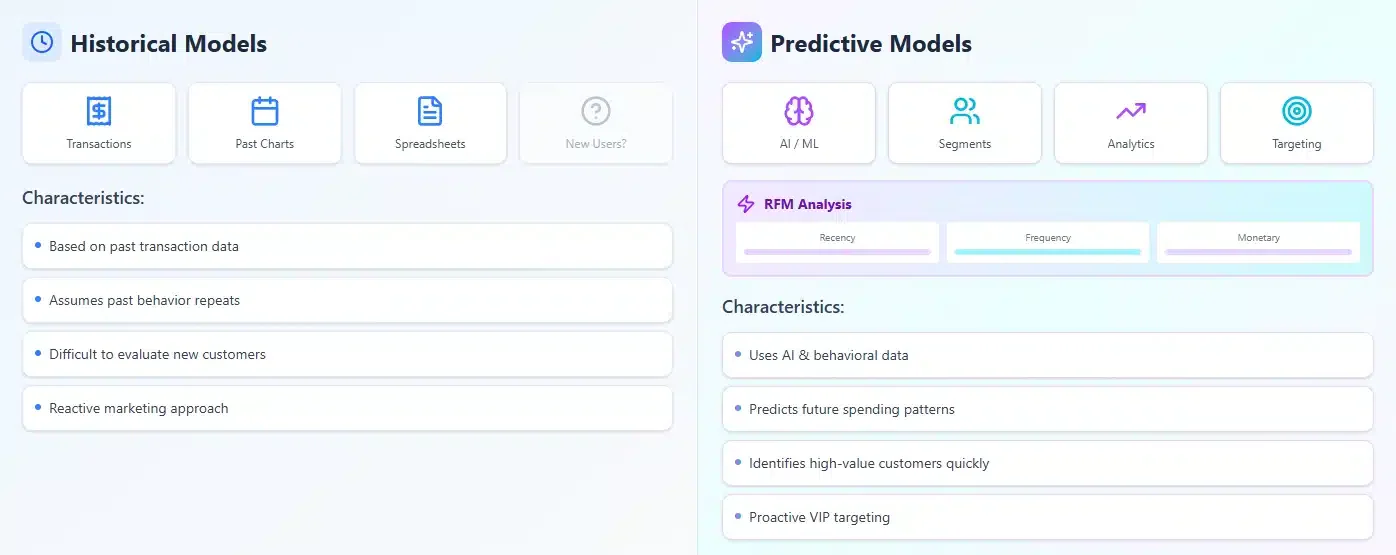
As data analytics evolve the methods for calculating long term value have become more sophisticated by offering two main methodologies which are Historical and Predictive models.
- Historical Models
Historical models look backward by calculating value based on past transactional data. While this provides a solid baseline for established Malaysian businesses it has significant limitations because it assumes past behavior will perfectly mirror future actions. It also struggles to assign an accurate value to brand new buyers who have only made a single purchase because they have no historical track record yet.
- Predictive Models
Predictive models look forward by using machine learning and behavioral data to forecast future spending patterns. These models often rely on RFM Analysis which stands for Recency Frequency and Monetary value to identify high potential buyers.By analyzing purchase patterns predictive models group buyers into behavioral clusters to predict their future worth. If a new buyer matches the behavior of your most profitable segment the model assigns them a high value immediately. This allows your marketing team to proactively target these individuals with VIP treatment before they have even spent a significant amount of money.
Key Factors That Influence Customer Lifetime Value
Value is not created in a vacuum but through dozens of micro interactions a person has with your brand over months or years. Understanding the levers that influence these interactions is the first step toward optimization for your business.
1. The Quality of the Customer Experience (CX)
In the modern market experience often trumps price and even product quality. A seamless and frictionless experience across all touchpoints builds a deep psychological commitment from your buyers. When people feel valued and understood their likelihood of returning to your business skyrockets.
2. The Onboarding Process
First impressions dictate long term realities whether you sell B2B software or a simple subscription box. If a buyer struggles to understand your product or fails to see its immediate value they will churn quickly. Effective onboarding delivers a quick aha moment that cements the relationship from day one.
3. Proactive Customer Support
Support is no longer just a reactive department but a vital retention mechanism for your brand. Implementing proactive support by reaching out before problems arise transforms frustrated buyers into loyal advocates. Resolving issues with empathy and speed ensures your customers stay satisfied for the long haul.
4. Brand Affinity and Community
People buy from brands they align with emotionally and ethically which can drastically increase their lifespan with your company. Building a strong brand identity and fostering a community makes switching to a competitor feel like a betrayal of their own identity. This sense of belonging is a powerful tool to keep your Malaysian customers loyal to your business.
Strategies to Increase Customer Lifetime Value
Knowing your numbers is only half the battle because actively working to improve them is where real growth happens. Here are highly effective strategies to drive up the long term value of your audience.
1. Implement Intelligent Upselling and Cross-Selling
One of the fastest ways to increase your average order value is through strategic upselling and cross selling. Upselling encourages buyers to purchase a higher end version of a product while cross selling recommends complementary items. The key to success is relevance where your recommendations must genuinely add value to the users situation rather than feeling like a cash grab.
2. Launch a Structured Loyalty Initiative
Rewarding your best buyers for their continued patronage is a timeless strategy for any Malaysian business. By implementing a structured customer loyalty program you create a gamified experience that incentivizes repeat purchases. A well executed program creates a switching cost because if a buyer leaves for a competitor they lose the points and status they have accumulated.
3. Personalize the Communication Journey
Generic batch and blast email newsletters are no longer effective in today’s digital landscape. Modern consumers expect hyper personalized communication tailored to their specific preferences and past purchase history. By segmenting your audience and delivering highly relevant content you significantly increase conversion rates and foster a feeling of individual care.
4. Adopt a Subscription or Retainer Model
Transitioning from one off sales to a subscription model is one of the most powerful ways to increase purchase frequency. Subscriptions create predictable recurring revenue and remove the friction of making a new purchasing decision every month. Even traditional e commerce brands in Malaysia have successfully adopted subscribe and save models to lock in long term value.
5. Actively Gather and Implement Feedback
You cannot fix what you do not know is broken so regularly surveying your audience is essential. Using metrics like Net Promoter Score provides invaluable insights into customer pain points. When you actively make changes based on their feedback and communicate those improvements you build unshakable trust with your audience.
The Role of CRM in Maximizing Customer Lifetime Value
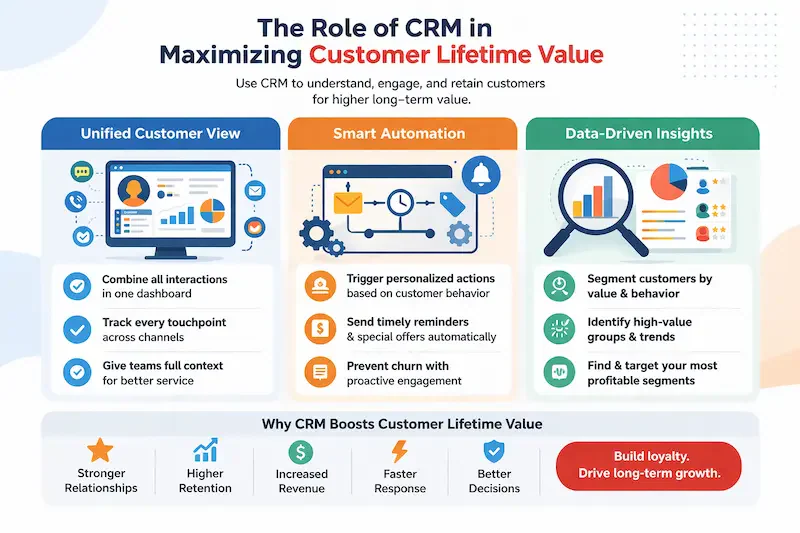
Executing growth strategies at scale is practically impossible without the right technological infrastructure which is why CRM systems are indispensable. A reliable CRM acts as the central nervous system of your retention strategy by turning raw data into actionable relationship building workflows.
- Centralizing the Customer 360-Degree View
The biggest enemy of a cohesive experience is siloed data where teams lack a unified view of the customer journey. Understanding what is a sales CRM involves recognizing its power to unify every touchpoint into a single comprehensive dashboard. With every interaction logged in one place your team has the full context needed to provide a seamless and personalized experience. - Automating Retention Workflows
Modern CRM platforms allow you to set up automated workflows triggered by specific behavioral data to prevent churn. If a frequent buyer has not made a purchase in 90 days the system can automatically trigger a personalized email with a special discount. These automated safety nets ensure that no customer quietly slips away due to a lack of engagement. - Advanced Segmentation and Analytics
To optimize value you must treat different segments differently because an enterprise client requires a different touch than a small consumer. Advanced platforms like CRM software provide the analytical horsepower needed to slice and dice your database based on financial and behavioral criteria.
Common Mistakes in Measuring and Managing CLV
Even well intentioned organizations can stumble when trying to implement these methodologies. Avoiding these common pitfalls is crucial for maintaining accurate data and effective strategies for your business.
- Looking at the Average Across the Entire Base
Calculating a single blended lifetime value across your entire company is often misleading because your database contains a spectrum of buyers. If you only look at the blended average you might under invest in high value whales and over spend on low value occasional shoppers. Always calculate this metric by specific cohorts to get a clearer picture of your actual growth.
- Ignoring the Cost to Serve
Calculating value based solely on gross revenue is a major mistake because it ignores the actual expenses needed to keep a customer. You must factor in the cost of goods sold support hours and local compliance costs like SST to find your true net profit. Ignoring these variables can lead to an inflated sense of profitability that does not reflect your financial health in the Malaysian market.
Industry-Specific Use Cases for Customer Lifetime Value
Practical application of this metric varies depending on your sector and the unique market dynamics in Malaysia.
- E-commerce and Direct-to-Consumer (DTC) Brands
In the Malaysian e commerce space measuring buyer worth is critical for optimizing ad spend and identifying VIP segments. Retailers use this data to balance the impact of return rates and ensure shoppers remain profitable after accounting for SST and delivery costs. High value buyers are then targeted with exclusive loyalty programs to prevent them from switching to competitors.
For example, a typical customer spends RM 50 per order and makes 4 purchases per year. On average, the customer stays active for 3 years, with an estimated 30% profit margin after costs.
The formula: CLV = RM 50 (average order value) × 4 (annual purchases) × 3 (years) × 30% (profit margin) = RM 180
- Software as a Service (SaaS)
For subscription based SaaS companies this metric is the lifeblood of the business due to high upfront acquisition costs. Since organizations rarely break even immediately monitoring the LTV to CAC ratio is essential for sustainable growth. The data also helps determine optimal pricing and identifies features that drive the highest user retention.
For example, the average user pays RM 20 per month with an 80% gross margin. If the monthly churn rate is 5%, the CLV can be calculated as follows:
The Formula: CLV= (RM 20 × 80%) ÷ 0.05= RM 320
- Financial Services and Banking
Banks and insurance providers in Malaysia rely on long term relationships that can span decades. Maximizing value depends on strategic cross selling of products like mortgages or wealth management as a client moves through different life stages. Predictive models help institutions offer the right product at the perfect time to preempt local competitors.
For example, a customer generates RM 500 annually and stays with the bank for 10 years, with an estimated 40% profit margin.
The formula: CLV= RM 500 (annual revenue) × 10 (years) × 40% (profit margin)= RM 2,000
- Telecommunications
Telecom providers prioritize churn prevention due to high acquisition costs and aggressive price undercutting in the local market. Retention agents use projected value to offer discounts or device upgrades to save high value accounts while letting low value ones churn. This ensures that support resources are focused on protecting the overall profit margins of the company.
For example, a subscriber pays RM 30 per month, stays for 36 months, and has a 50% profit margin.
The formula: CLV = RM 30 × 36 (months) × 50% (profit margin) = RM 540
"This analysis provides sharp strategic insights into applying customer value metrics across Malaysia's key sectors. The focus on industry specific retention and operational efficiency offers highly practical guidance for local businesses. This streamlined approach effectively secures long term profitability within a competitive landscape."
Step-by-Step Implementation Guide for CLV Tracking
The true challenge lies in operationalizing this metric within your organization to effectively evaluate long term buyer worth. Implementing a robust tracking system requires cross functional alignment between your marketing, sales, and finance teams. Follow this comprehensive roadmap to integrate this measurement into your daily business operations.
Step 1: Centralize and Cleanse Your Data Silos
Fragmented data is the biggest barrier to accurate measurement especially when teams use different systems for analytics and sales. The first step is to implement a centralized data warehouse or CRM to aggregate transaction histories and support tickets into a single profile. Data hygiene is paramount because duplicate records will severely skew your final calculations.
Step 2: Define Your Value Metric and Profit Margins
Your organization must agree on whether to measure gross revenue or net profit for the most actionable insights. Collaborate with your finance department to quantify costs like shipping, payment fees, and local tax obligations like SST compliance. Subtracting these variable costs from gross revenue provides a true reflection of each accounts financial contribution.
Step 3: Segment Your Audience into Behavioral Cohorts
Calculating a single company wide average lacks granularity so you must divide your audience into distinct cohorts. Segment buyers by their first purchase month or acquisition channel to see which groups become long term loyalists. This allows you to identify which marketing channels bring in high value customers versus one time bargain hunters.
Step 4: Automate the Calculation and Reporting
Manual calculations in spreadsheets are prone to error and quickly become outdated in a fast paced market. Utilize business intelligence tools to create real time dashboards that update your cohort values automatically. Making this data accessible to decision makers ensures that marketing budgets are allocated based on the most accurate data available.
Conclusion
Mastering buyer relationships is the only way to ensure your business remains profitable in the long term. By shifting your focus to sustainable growth you can protect your margins even when market competition gets tough. This approach transforms your database into a powerful engine for predictable recurring revenue.
Implementing a robust tracking system will help you stay ahead of the curve in the Malaysian market. When you accurately measure every variable you gain the clarity needed to make smarter investment decisions. Consistency is key to turning these insights into a lasting competitive advantage for your brand.
If you are ready to see how automated workflows can simplify your data tracking you might want to explore the possibilities through a free demo experience. Visualizing your customer journey in real time could be the breakthrough your team needs to stop overspending on new leads. Take a look at how an interactive session can help you unlock the full potential of your audience today.

Frequently Asked Questions About Customer Lifetime Value (CLV)
High lifetime value serves as proof of stable future cash flow which significantly increases your market multiple during acquisition or loan applications in Malaysia. Investors prioritize businesses that can demonstrate a high LTV to CAC ratio as it indicates a sustainable and low risk growth engine.
Yes, by tracking cohorts based on their acquisition source you can identify which platforms bring in long term loyalists versus one time bargain hunters. This data allows you to stop overspending on low value channels and reallocate your budget toward sources that deliver the highest net profit.
Profitability usually measures a single period while lifetime value forecasts the total financial contribution over the entire relationship span. Understanding this helps Malaysian businesses justify higher upfront service costs for accounts that are projected to yield massive long term returns.
A segment becomes a financial burden if the operational cost to serve and local taxes like SST exceed the total revenue they generate. Identifying these negative value groups allows you to adjust your service model or marketing strategy to ensure every customer contributes to your bottom line.