










 Limited to 100 registrants

Leaving significant revenue on the table is a harsh reality when businesses ignore the premium their most loyal customers are willing to pay. This pricing gap leads to thin margins and allows competitors to secure a dominant lead in the Malaysia market.
Price skimming captures maximum value because getting the price right is more effective than cutting costs. Research published in the Journal of Business Strategy found that for a company with a 10% operating profit margin, even a two percent improvement in net selling prices can improve earnings before interest and taxes by 20%.
Success depends on a supply chain agile enough to handle the rapid transition from exclusivity to high volume mass market demand. This guide explains how the strategic management of your supply chain allows you to align global logistics with price skimming to secure a sustainable long term competitive advantage.
Key Takeaways
Target innovators with a high launch price to recover development costs quickly before reaching a wider market later.
Prioritize high margin cash flow and brand prestige over immediate market share to secure your premium position in Malaysia.
Monitor sales trends in real time to time your price reductions perfectly while ensuring LHDN MyInvois and SST compliance.
Managing manual stock movements while staying compliant with LHDN MyInvois requires significant effort from your team. See how an integrated supply chain management system helps organize your workflow through the banner below.
What is Price Skimming?
Price skimming involves launching products at high prices and lowering them as demand shifts. This approach targets early adopters and exclusivity seekers willing to pay premiums for brand value or innovation. It is most effective when unique features justify the high entry cost within a market facing limited competition.
Businesses use this strategy to recover development costs quickly and maximize early profits. Once the high value segment is captured, prices drop to attract price sensitive buyers and expand market reach. Success depends on a clear value proposition that justifies the initial premium price to the audience.
Price Skimming and Penetration Differences
Miscalculating a product launch price can leave millions in profit on the table or exhaust capital without guaranteeing long term loyalty. For executives, the tension between maximizing immediate margins and capturing a dominant market share is a high stakes gamble that determines if a launch fuels growth or drains resources.
The fundamental difference lies in the entry point and the primary objective:
- Price Skimming: Starts with a high margin premium to recover development costs quickly from early adopters. It prioritizes brand prestige and short term profitability before gradually lowering the price to reach broader segments.
- Penetration Pricing: Starts with a low margin entry to aggressively capture market share and build a large customer base in competitive spaces. It prioritizes volume and long term market dominance over immediate high profits.
Success depends on aligning your pricing with overarching business goals. You must carefully focus on analyzing the relevant opportunity costs because choosing the stability of high margin skimming often means sacrificing the rapid market adoption that a lower price would have secured.
Price Skimming Mechanics and Utility

Failing to capture premium margins at launch leaves massive R&D costs unrecovered. Utilizing price skimming reclaims these investments during peak novelty while anchoring a high end brand position. Review the mechanics below to optimize your market entry and maximize total profitability.
- Starts with a high launch price: Businesses target early adopters who are willing to pay more for innovation, exclusivity, or first access.
- Helps recover development costs faster: Higher early profits can help cover research, design, production, and marketing costs.
- Expands to a wider market later: Once early demand slows, the company lowers the price to attract more price-sensitive customers.
- Strengthens premium positioning: A high initial price can make the product appear more exclusive, advanced, or high-quality.
- Supports better supply control: When production is still limited, a higher price helps manage demand, protect margins, and optimize your total cost of revenue.
- Requires market monitoring: Businesses need to track sales, competitors, inventory, and customer response before reducing the price.
Step-by-Step Implementation of a Price Skimming Strategy
Successfully executing this approach requires a coordinated effort across marketing finance and operations. Here is your roadmap for implementation:
Step 1: Conduct Comprehensive Market Segmentation
Identify your innovators and early adopters using data analytics to determine their maximum willingness to pay and ensure the segment size justifies the initial production run before setting a premium price.
Step 2: Establish a Strong Value Proposition
Justify your premium positioning by emphasizing unique features and status ensuring that every high price point is backed by exceptional quality or a significant technological leap that differentiates your brand.
Step 3: The High-Price Launch
Introduce the product at the highest sustainable price point while focusing marketing efforts on exclusivity and innovation through controlled distribution channels to prevent premature market saturation.
Step 4: Monitor Sales Velocity and Competitor Activity
Closely track sales data to identify when early adopter demand plateaus or when competitor entries require an accelerated price adjustment to maintain your competitive edge.
Step 5: Sequential Price Reductions
Lower prices in calculated increments to appeal to the next demand segment through direct price cuts or introductory versions that retain core functionality while reaching a broader audience.
Industry Use Cases for Price Skimming
Understanding these industry specific applications provides you with a roadmap for how the strategy adapts to different market pressures in Malaysia.
- Consumer Electronics: You likely recognize this as the most visible sector for skimming where brands release flagship models at premium prices. Your early adopters in Malaysia often pay a novelty tax just to own the latest technology before anyone else.
- The Gaming Industry: Console manufacturers often launch hardware at high price points to recoup their massive development costs. Over the lifecycle of your console, you will notice the price drops significantly to reach more price sensitive gamers.
- Pharmaceuticals: When your company develops a life saving drug, you often hold a patent that grants a temporary monopoly. During this period, you employ price skimming to recover costs before generic versions enter the market.
- Fashion and Luxury: Your high fashion labels often introduce seasonal collections at peak prices in malls across Kuala Lumpur. As the season progresses, you begin to mark down these items once the newness wears off.
Is Price Skimming Right for You?
High research and development costs in the Malaysian market often act as a significant hurdle for your business growth. Price skimming serves as a tactical approach for you to secure maximum value from early adopters so your investment capital returns much faster.
Picking the perfect moment to lower your prices ensures your brand remains a premium choice while you maintain full control over your pricing strategy. Maintaining a profitable pricing journey is essential for your brand reputation in the long run.
This guide helps you navigate market pressures so you can establish the most effective launch price for your product. Continue reading to discover how to manage your profit margins automatically so your company remains a dominant force in the industry.
When to Implement Price Skimming
You should only implement price skimming under specific market conditions to ensure your business remains profitable without losing customer trust.
- High Value Perception: You must ensure your product offers strong value such as cutting edge technology or a status symbol.
- Clear Advantage: You need to make it easy for your customers to see why your product costs more than the alternatives.
- Entry Barriers: You can protect your high price phase through patents or a strong brand identity that is hard to mimic.
- Quality Justification: You must ensure your early buyers feel the product is worth every Ringgit of the premium price.
- Regulatory Compliance: Since a high price creates high expectations, you need to deliver a flawless experience while ensuring e-invoicing software Malaysia compliance in your billing to avoid issues with LHDN.
Real-World Case Studies of Price Skimming
Observe Apple’s execution of price skimming in Malaysia by pricing the latest iPhone at a premium for tech enthusiasts. As newer models debut, prices for older versions naturally drop to align with modernized urban cultivation innovations that integrate high end technology into your daily urban lifestyle.
Sony and Microsoft follow a similar pattern by launching gaming consoles at peak prices to recoup massive development costs. Notice the eventual shift toward more affordable versions as these brands pivot their profit focus toward software and recurring subscriptions.
Tesla adopted a top down approach by selling luxury vehicles like the Model S to fund the development of their mass market models. This strategy builds an elite brand image while providing the necessary capital to scale production for more accessible models later.
Maintaining high visibility over these shifting margins is the most effective way to ensure your business remains profitable through every stage of the product lifecycle.
Measuring Success and Adjusting the Strategy
Tracking sales, profit, and demand allows your business to see if a price skimming strategy actually delivers results. The main goal involves knowing exactly when a high price remains effective before the team needs to lower it to capture a wider market in Malaysia.
- Track contribution margin: Check contribution margins to ensure each unit profit covers launch costs during lower volume stages.
- Monitor customer demand: Adjust prices immediately if early adopters in Malaysia show low interest to remain competitive.
- Use real-time sales data: Use real time sales data to identify when demand slows down before revenue drops.
- Plan the right price drop: Forecast how price drops affect total profit to avoid damaging the premium brand image.
- Watch brand perception: Ensure pricing shifts stay compliant with LHDN MyInvois requirements as the market expands.
- Balance old and new customers: The strategy should reward early buyers while still attracting a wider market later.
The Role of Supply Chain and Inventory in Price Skimming
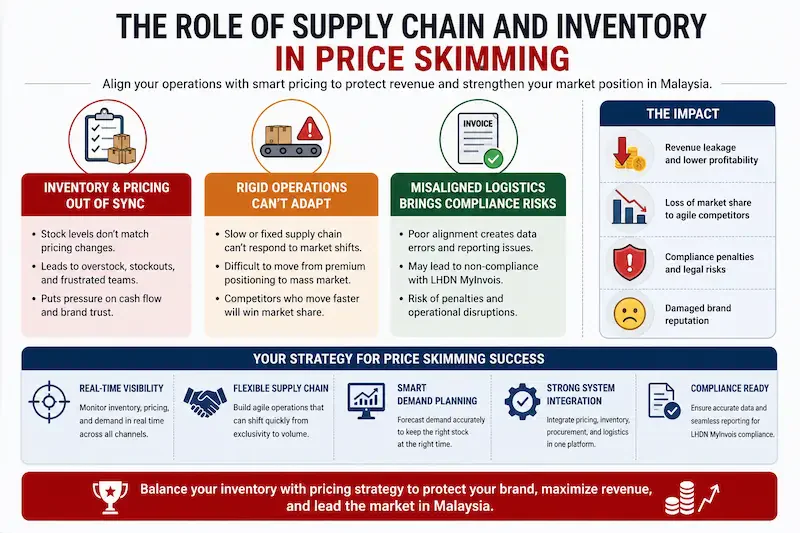
Managing your stock levels while prices shift in the Malaysia market often feels like a constant struggle for your growth . You might find that your inventory counts never match your pricing updates which leaves your team stressed. This imbalance creates massive risks for your cash flow and brand reputation.
The real problem starts when your operational flow fails to react to market shifts because a rigid supply chain cannot handle the move between exclusivity and volume. If unmanaged maverick spend habits persist while retail prices decline, you will struggle to stay afloat among agile competitors in Malaysia. Failing to align your logistics with your pricing strategy can also lead to messy compliance issues.
You need a strategy that protects your brand image while optimizing your total unit cost. Mastering the balance between your inventory and price drops is the only way to ensure your company dominates the industry. Read on to see how you can align your supply chain perfectly to secure your long term success.
Conclusion
Mastering your pricing strategy in Malaysia requires a perfect balance of data and timing . Targeting innovators first allows you to recover research costs quickly while establishing high brand prestige . This approach ensures strong profit margins from day one while you manage demand effectively.
Scaling your supply chain while maintaining operational transparency is vital for long term success. Staying agile during price shifts allows you to reach a wider market without losing the trust of your early adopters. Effectively managing these price transitions protects your bottom line and helps you dominate the industry.
Manual price updates lead to errors that drain your profit and stall growth. Stop finding out about pricing problems after they have already cost you your edge. Explore our free interactive software demo to see how real time data transforms your accuracy today.
Frequently Asked Questions About Price Skimming Strategy
You can safely use this strategy as long as you avoid anti competitive behavior or price gouging. Setting a high price for innovation is legal but you should document your research costs to justify your margins to local regulators.
You can protect your brand reputation by offering exclusive perks to those who bought at launch. Implementing a customer loyalty reward program keeps your premium buyers happy while you reach more price sensitive segments.
You will find that combining these models helps you react faster to demand surges on platforms like Shopee. Using an automated financial management system ensures your SST calculations stay accurate during every rapid price shift.
You should monitor your sales data closely and wait for a clear plateau in early demand. Dropping the price too early might leave profit on the table while waiting too long loses momentum to your competitors.
You have more flexibility with digital products because you do not deal with physical inventory issues. However you must still ensure compliance with local digital service tax and LHDN MyInvois for every subscription sold.