









 Limited to 100 registrants

A delivery reaching your warehouse leaves your operation vulnerable until its quantity and condition are strictly verified. Many Malaysian businesses find this gap between physical delivery and verified receipt to be a major daily bottleneck. Relying on manual documents for incomplete shipments inevitably causes delayed invoice approvals and costly inventory discrepancies.
The impact of these manual gaps is real for local businesses. A 2026 Malaysia digitalisation report notes that only 37% of Malaysian SMEs had adopted cloud-based business systems as of 2024, so many still handle receiving and stock records manually. A Goods Received Note closes this gap as an internal record confirming items were inspected against an approved purchase order.
A properly structured Goods Received Note helps warehouse purchasing and finance teams work from the same verified record. It confirms actual physical receipts flags damaged goods early and supports faster invoice approval when connected with integrated procurement and purchasing management software.
A properly structured Goods Received Note helps warehouse purchasing and finance teams work from the same verified record. It confirms actual physical receipts flags damaged goods early and supports faster invoice approval when connected with integrated procurement and purchasing management software.
A properly structured Goods Received Note helps warehouse purchasing and finance teams work from the same verified record. It confirms actual physical receipts flags damaged goods early and supports faster invoice approval when connected with integrated procurement and purchasing management software.
A properly structured Goods Received Note helps warehouse purchasing and finance teams work from the same verified record. It confirms actual physical receipts flags damaged goods early and supports faster invoice approval when connected with integrated procurement and purchasing management software.
A properly structured Goods Received Note helps warehouse purchasing and finance teams work from the same verified record. It confirms actual physical receipts flags damaged goods early and supports faster invoice approval when connected with integrated procurement and purchasing management software.
Key Takeaways
An internal goods received note acts as a critical operational checkpoint that confirms accepted delivery quantities to prevent inventory errors and supplier overpayments.
A complete GRN must capture seven core data fields including purchase order references and inspection statuses to function as a strict internal control rather than mere administrative paperwork.
Manual GRN processing creates disconnected records and delayed data entry that expose working capital to severe systemic risks.
Partial deliveries, damaged goods, and quantity differences should remain visible exceptions rather than being recorded as complete receipts.
Transitioning to digital receiving requires integrated platforms that align purchasing approvals with physical warehouse receipts. The procurement framework below illustrates how automated systems manage these complex departmental handoffs.

What Is a Goods Received Note?
A goods received note is an internal record created when delivered goods are verified against an approved purchase order. Rather than just logging items, it smoothly bridges your complete procurement process and inventory systems by documenting the accepted quantity and physical condition. This record establishes exactly what your business examined and approved instead of simply proving physical delivery.
An authorised warehouse receiver typically prepares this document before it goes to a supervisor or quality control team for review. By acting as a reliable operational checkpoint, the record prevents overpayments and stops defective materials from entering your production line. Your finance department then relies entirely on this approved document to safely clear supplier invoices.
When Do You Create a Goods Received Note?

Companies must create this record during or immediately after physical inspection because it is vital for inbound logistics operations. inbound logistics operations. Management should enforce the following operational timing rules to prevent financial discrepancies:
Employees must document all inventory discrepancies immediately instead of confirming a clean receipt.
Receivers facing shortages or damaged goods must log the exact accepted amount rather than the originally expected volume.
Recording fully received orders when shortages exist will permanently hide the remaining delivery obligations of suppliers.
Specialized items requiring laboratory testing must enter a quarantine stage and stay in a pending status.
The receiving cycle concludes only when an accountable employee officially accepts or rejects those specific materials.
How Does a Goods Received Note Fit into Procure-to-Pay?
This receiving document safely safeguards the entire procure to pay process entire procure to pay process by accurately transitioning physical inventory into binding financial liabilities. Centralizing this critical record enables automated three way matching to instantly flag vendor discrepancies and prevent cash leakage. Review the structured breakdown below to see how this digital verification protects working capital across every departmental handoff.
| Process stage | Document or record | Responsible team | Control question | Exception action |
|---|---|---|---|---|
| Purchase request | Purchase requisition | Requesting department and procurement | Is the purchase needed and authorised? | Return an incomplete or unauthorised request |
| Order approval | Purchase order (PO) | Procurement and budget approver | Are supplier, price, quantity, and terms approved? | Amend or reject the PO before ordering |
| Delivery | Delivery order and shipment | Supplier and receiving team | Did the delivery reach the correct site? | Isolate an unreferenced or misdirected shipment |
| Inspection | Count and quality record | Warehouse and quality team | Do quantity, identity, and condition agree with the PO? | Record shortages, excess, damage, or failed inspection |
| Receipt | Goods received note | Authorised receiver or supervisor | What quantity was accepted and what remains unresolved? | Post a partial or exception receipt instead of closing the PO |
| Inventory update | Stock transaction | Warehouse or inventory control | Is accepted stock available in the correct location and status? | Quarantine rejected or pending items |
| Invoice matching | PO, GRN, and invoice match | Accounts payable | Do ordered, accepted, and invoiced details agree? | Block or route the mismatch for review |
| Payment approval | Approved payable | Finance and authorised approver | Have material exceptions been resolved? | Hold payment or approve only the supported amount |
Systematizing these delivery outcomes strictly dictates how your stock behaves financially. Full deliveries seamlessly update your inventory balances and financial records. Partial receipts carefully register accepted goods while keeping the remaining order active. Rejected items immediately enter a digital quarantine to permanently block them from available production stock until the company completes a purchase return transaction.
This verified receipt seamlessly supports your three way invoice comparison three way invoice comparison to instantly flag any pricing or quantity discrepancies. Your accounts payable team easily knows whether a vendor mismatch requires withholding immediate payment. Leaders can then track customized system metrics like processing delays or exception rates to continuously optimize operations.
What Information Should a Goods Received Note Include?
A usable goods received note format needs seven core information areas: supplier, purchase order, delivery, item, inspection, exception, and approval data. This seven-field framework is a recommended internal-control design rather than a statutory form requirement.
| GRN field | Information to capture | Primary verifier | Downstream use | Risk if missing |
|---|---|---|---|---|
| 1. Supplier details | Supplier name, code, contact, and relevant location | Procurement or receiver | Supplier identification and follow-up | The receipt may be assigned to the wrong vendor |
| 2. Purchase order reference | PO number, line number, and ordered quantity | Receiver and procurement | Open-order control and invoice matching | Finance cannot reliably connect the receipt to an approved purchase |
| 3. Delivery details | Delivery date, time, site, delivery-order number, vehicle, or batch reference where relevant | Receiving employee | Traceability and cut-off review | Teams may dispute when or where the shipment arrived |
| 4. Item description and quantity | Item code, description, unit of measure, ordered quantity, and received quantity | Warehouse or inventory controller | Stock posting and remaining PO calculation | Incorrect codes or units may distort inventory balances |
| 5. Condition or inspection status | Accepted, rejected, damaged, quarantined, or pending inspection status | Receiver or quality team | Availability and quality control | Unchecked goods may be treated as usable stock |
| 6. Receiver comments and exception notes | Shortage, excess, substitution, damage, photos, and agreed follow-up | Receiver and procurement owner | Supplier resolution and dispute evidence | Differences can remain unresolved or lose context |
| 7. Approval signatures or digital history | Receiver identity, reviewer, timestamps, status changes, and final approval | Supervisor or authorised approver | Accountability and audit-trail support | The company cannot establish who confirmed the receipt |
Each line should preserve the relevant unit of measure. Receiving 10 cartons when the PO is expressed in individual units requires an approved conversion; otherwise, the same physical shipment can produce very different stock results.
A practical goods received note checklist should also test data completeness. Review GRNs without PO references, records posted without an inspection status, receipts awaiting approval, and unexplained changes made after initial confirmation. These indicators reveal whether the form is functioning as a control or merely being completed as paperwork.
Why Does a GRN Matter for Inventory, Finance, and Audit Control?
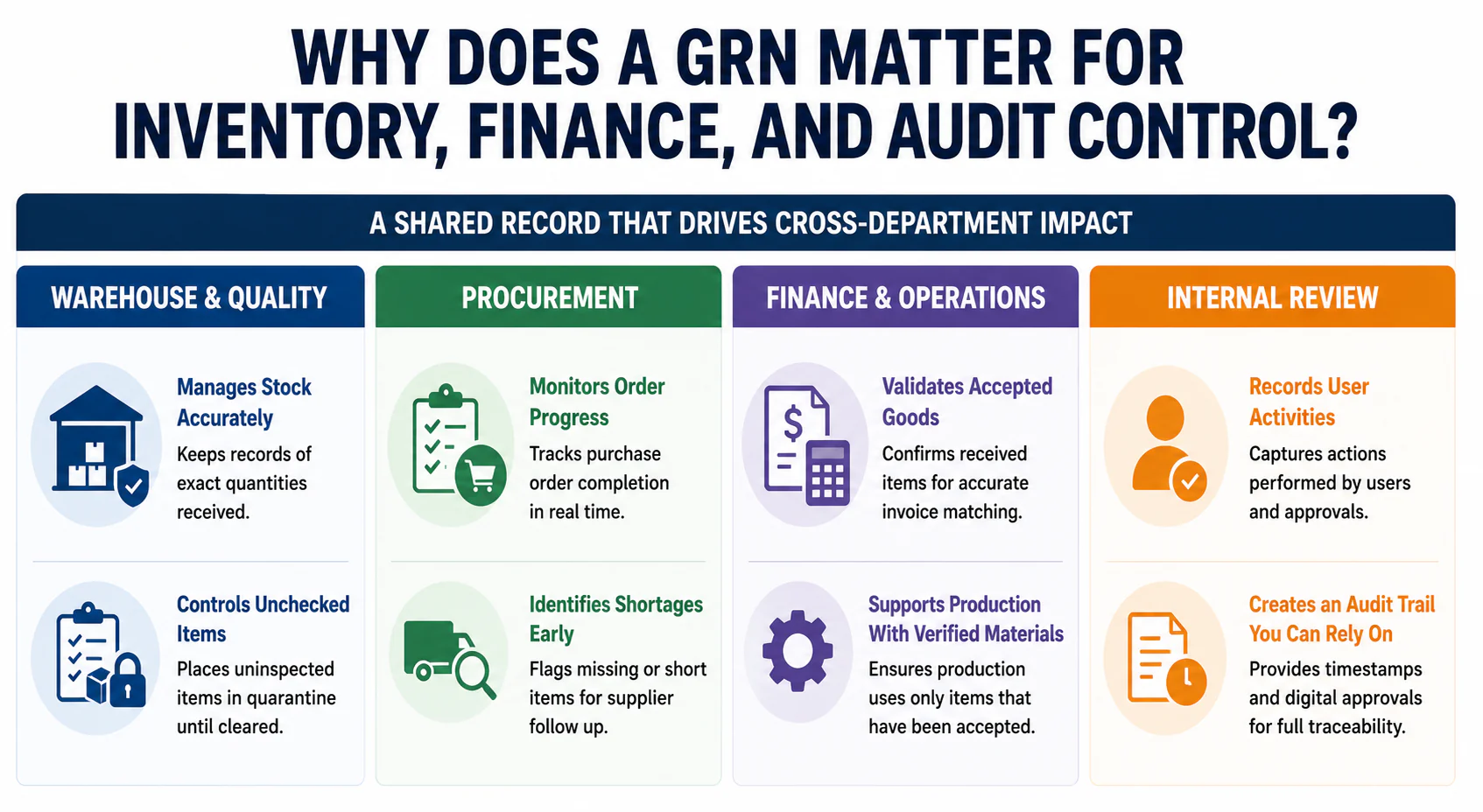
A goods received note provides a shared record to coordinate cross departmental decisions. This document directly impacts core business functions by establishing absolute visibility across the organization:
Warehouse and Quality: It dictates accurate stock quantities while keeping unchecked items in quarantine.
Procurement: It tracks purchase order completion and leaves component shortages open for supplier follow up.
Finance and Operations: It confirms accepted goods for invoice matching and ensures production uses only verified materials.
Internal Review: It captures user actions and timestamps to create a consistent audit trail consistent audit trail of digital approvals.
Beyond departmental alignment, this internal document enforces essential operational controls:
It updates inventory balances while strictly preserving pending inspection statuses.
It supplies absolute physical evidence for invoice validation without ever replacing a formal tax invoice or legally required paperwork.
What Common Problems Occur in Manual GRN Processing?
A verified digital receiving document securely synchronizes procurement and finance teams by providing absolute evidence for invoice validation. Conversely relying on disconnected manual spreadsheets destroys these vital controls. Isolating this critical data across departments exposes working capital to these severe systemic risks.
Missing Purchase Order References
Accepting physical deliveries without verifying the original order instantly breaks the procurement chain. This blind acceptance forces finance teams to halt invoice approvals because they cannot verify agreed pricing or terms creating massive administrative bottlenecks. Organizations must enforce strict system validations that require a verified purchase order selection before any warehouse staff can confirm a receipt.
Duplicate Goods Received Notes
When multiple staff manually record the same physical delivery inventory levels become artificially inflated and the company risks paying the same supplier twice. This double counting destroys working capital accuracy and completely distorts production planning. Implementing unique digital document numbering eliminates this fatal financial risk by automatically blocking duplicate entries at the source.
Partial Deliveries Logged as Complete
Recording a partial physical shipment as a fully completed administrative order permanently erases the remaining delivery obligation of the supplier. This critical paperwork error forces production teams to rely on phantom stock that never actually arrived causing sudden manufacturing halts. Modern systems must strictly preserve line level outstanding quantities to keep supplier obligations legally active and visible.
Damaged Goods Lacking Inspection Data
Receiving defective materials without documenting clear inspection notes shifts the financial loss entirely onto the buying company. Vague physical condition reports make it impossible for procurement to claim refunds or replacements from vendors successfully. Mandatory digital evidence including photographs and specific rejection statuses ensures suppliers remain totally accountable for substandard deliveries.
Strategic leaders must actively track these specific manual friction points because they directly cause cash leakage. Analyzing these exact data trends reveals exactly where internal departmental handoffs break down which frequently overlaps with broader warehouse management challenges regarding disconnected records and delayed stock visibility.
Goods Received Note Template: What Should You Review Before Approval?
GRN approval requires agreement among the delivery, approved PO, physical inspection, and accepted quantity. A goods received note template should help the reviewer decide whether to pass, hold, partially accept, reject, or escalate the transaction—not simply collect signatures.
Use this numbered review before approval:
- Confirm the supplier identity against the approved purchase order.
- Verify the PO number, line references, delivery date, and receiving location.
- Match item codes, descriptions, and units of measure to controlled master data.
- Compare ordered quantity with physically received quantity.
- Separate accepted quantity, rejected quantity, and outstanding PO quantity.
- Review the inspection result and any quarantine or quality status.
Read discrepancy comments and check supporting delivery note paperwork, photographs, or test records where relevant.
- Identify the receiver, exception owner, resolution due date, and required approver.
- Confirm that the final status reflects the actual outcome before inventory or invoice processing continues.
The approval decision should follow the receiving scenario:
| Scenario | GRN outcome | Required follow-up |
|---|---|---|
| Full delivery in acceptable condition | Approve the accepted quantity and close the relevant PO line if no balance remains | Release stock according to normal warehouse rules |
| Partial delivery | Approve only the quantity accepted | Keep the outstanding PO quantity open and record the expected follow-up |
| Excess quantity | Record ordered and delivered figures without automatically accepting the excess | Refer the additional quantity to procurement for authorised acceptance or return |
| Damaged goods | Record accepted and rejected quantities with inspection evidence | Quarantine the damaged stock and assign an exception owner |
| Delivery without a valid PO reference | Do not create an unsupported clean receipt | Hold or segregate the shipment while procurement verifies authorisation |
Do not prematurely close the purchase order to make the paperwork appear complete. The goods received note example should reflect what happened physically, even when that result creates an exception requiring further work.
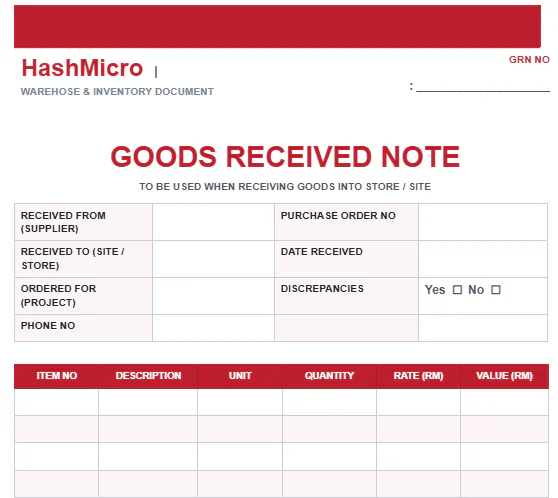
Template Goods Received Note
How Can ERP Automation Improve Goods Received Note Management?
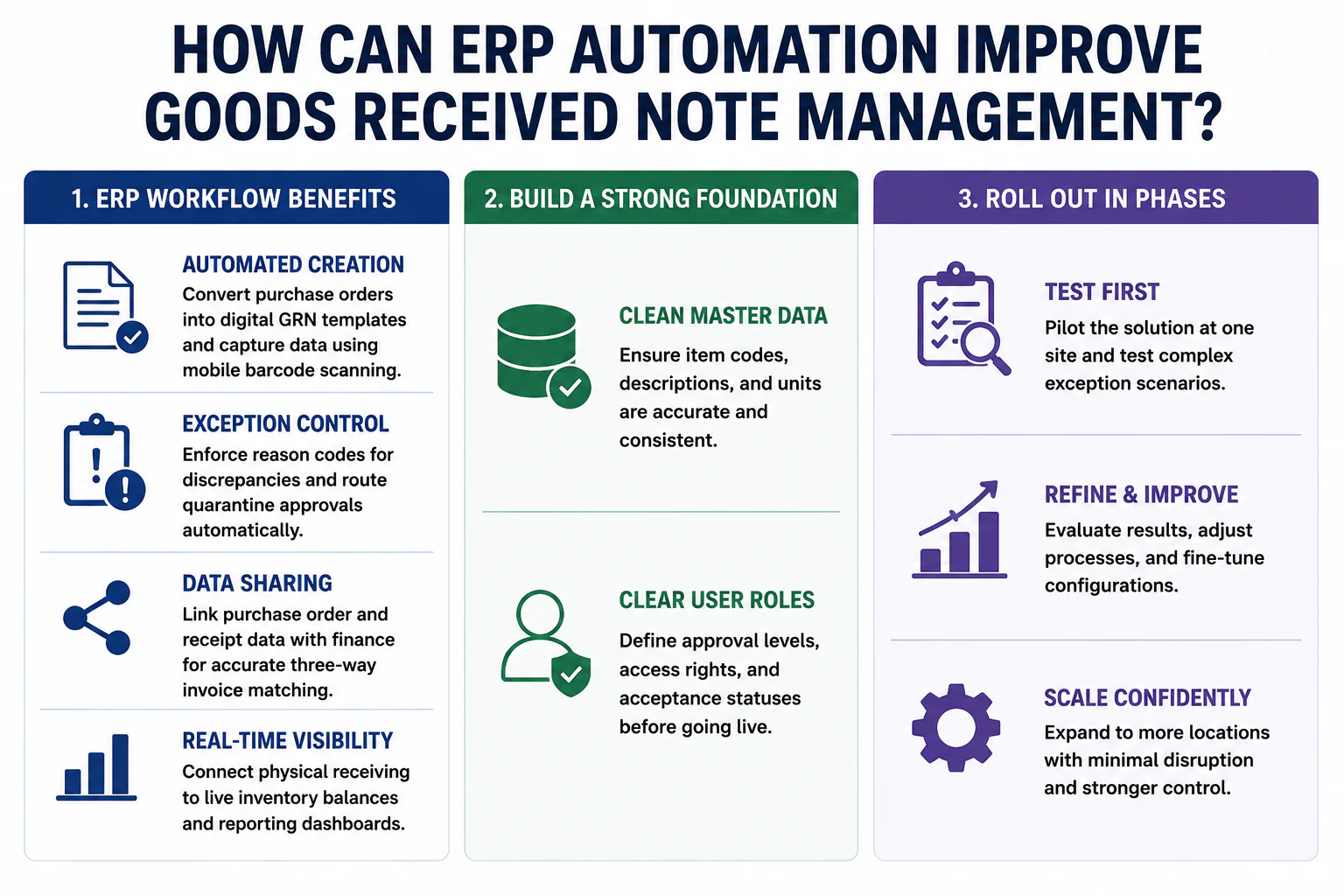
ERP automation converts approved purchase orders into digital receipts instantly. The system links your physical count directly to live inventory balances and invoice matching workflows. Software improves coordination but your warehouse staff must still perform accurate physical inspections at the receiving dock. A practical ERP workflow provides these core capabilities:
Automated creation: Generates receipt templates from purchase orders and supports mobile barcode scanning.
Exception control: Requires mandatory reason codes for discrepancies and routes quarantine approvals.
Data sharing: Connects purchase order and receipt data directly to finance for three way invoice matching.
Automation depends on reliable foundations. Companies must clean their item master data and define exact user approval levels before activating the system. If item codes are duplicated or employees misunderstand acceptance statuses the software will simply process bad data faster.
A phased rollout reduces operational disruption. Management should test complex exception scenarios at a pilot site before full deployment. Seeking expert consultation helps organizations architect an automation strategy that matches their exact warehouse layout and compliance requirements.
How Should You Standardise the Goods Received Note Process?
A standard receiving process defines exact roles for inspection and exception handling across departments. The main objective is establishing unambiguous responsibilities rather than forcing deliveries through unnecessary administrative steps. Companies must map the entire workflow from supplier arrival to final payment approval. Organizations should implement these core operating controls to ensure consistency:
Assign a specific owner to every departmental handoff including partial deliveries.
Establish clear approval limits and separate receiving duties from purchasing roles.
Standardize item codes, warehouse locations, and mandatory data fields.
Track posting times and unresolved exceptions to identify operational bottlenecks.
Multi site businesses must standardize status definitions such as accepted or quarantined across all company locations. A structured workflow allows employees to record facts accurately while keeping delivery exceptions completely visible for management review. Organizations planning to upgrade their receiving methods should configure automated systems that perfectly align with their specific procurement and accounting requirements.
Conclusion
Effective receiving operations transform physical deliveries into accurate financial records. A verified receipt acts as an operational boundary preventing supply chain errors from reaching production. Companies using this document as a strategic control point instantly protect working capital from unverified vendor liabilities.
Disconnected spreadsheets fail to handle the daily complexity of partial deliveries and damaged materials. Organizations need absolute alignment between procurement expectations and warehouse realities to prevent costly delays. Clear exception rules ensure inventory metrics remain perfectly accurate during peak volume periods.
Modern warehouses require systems that instantly connect physical counts with finance workflows. Management teams evaluating automated receiving can observe how software handles complex purchasing scenarios. Accessing a free demo provides a practical environment to review digital approvals and exception tracking in action

Frequently Asked Questions
The warehouse receiver or another authorised receiving employee usually records the receipt after counting and inspecting the goods. Approval may involve a warehouse supervisor, quality team, or purchasing owner depending on the item and exception. Finance should use the approved record for invoice validation rather than create it retrospectively.
The terms are commonly used interchangeably for a record confirming goods received and accepted. Individual organisations or ERP systems may use different labels, so the document's defined purpose, status, and approval rules matter more than its name.
A GRN records goods accepted from a supplier, while a goods return note records items being sent back because of damage, incorrect specifications, excess quantity, or another authorised reason. A rejected quantity may first be recorded as a receiving exception before a return transaction is approved.
Three-way matching compares the purchase order, approved receipt record, and supplier invoice. The GRN provides evidence of the accepted quantity and condition, allowing accounts payable to identify price, quantity, or delivery discrepancies before payment approval.
ERP can create a controlled GRN record from an approved purchase order when an authorised user confirms the actual receipt. Physical counting, inspection, accepted quantity, and exception decisions still require accountable user input or integrated scanning and quality workflows.