






Manufacturing enterprises face severe margin pressures as indirect overhead costs skyrocket. Relying on traditional volume based allocation distorts actual product profitability, causing executives to unknowingly subsidize unprofitable items while overpricing standard goods. To resolve this dangerous blind spot, businesses must shift toward activity based costing.
In fact, according to the Asian Journal of Finance and Accounting, overhead allocation in Malaysian auto manufacturing heavily impacts product pricing accuracy. Activity Based Costing solves this by linking expenses directly to actual production activities, giving businesses the precise cost visibility needed to improve their pricing strategies.
Finance leaders require clear visibility into actual resource consumption, a capability often driven by modern accounting software platforms. This guide explains the core components, challenges, and implementation steps of modern overhead allocation to help organizations eliminate inefficiencies and protect profitability.
Key Takeaways
Activity Based Costing assigns indirect overhead expenses to products and services based on actual resource consumption rather than arbitrary volume metrics.
Traditional costing methods often undercost complex low volume items and overcost standardized high volume goods, leading to distorted profit margins.
Implementing a six step activity costing framework requires identifying cost pools, determining cause and effect cost drivers, and calculating precise driver rates.
Managing detailed cost allocation requires the right tools to handle complex operational data. Modern accounting platforms calculate these cost drivers automatically, giving finance teams a clearer view of actual product margins.
Managing detailed cost allocation requires the right tools to handle complex operational data. Modern accounting platforms calculate these cost drivers automatically, giving finance teams a clearer view of actual product margins.
Managing detailed cost allocation requires the right tools to handle complex operational data. Modern accounting platforms calculate these cost drivers automatically, giving finance teams a clearer view of actual product margins.
Managing detailed cost allocation requires the right tools to handle complex operational data. Modern accounting platforms calculate these cost drivers automatically, giving finance teams a clearer view of actual product margins.
Managing detailed cost allocation requires the right tools to handle complex operational data. Modern accounting platforms calculate these cost drivers automatically, giving finance teams a clearer view of actual product margins.
Managing detailed cost allocation requires the right tools to handle complex operational data. Modern accounting platforms calculate these cost drivers automatically, giving finance teams a clearer view of actual product margins.

What is Activity Based Costing
Activity Based Costing is a precise accounting method that assigns complex indiect overhead costs directly to the specific operational activities that consume them. Instead of spreading expenses like factory rent or equipment depreciation evenly across all output, this approach traces costs based on actual resource consumption to reveal true product margins.
Think of a group of friends dining at a restaurant. Traditional costing splits the bill equally, forcing someone who ordered a simple side dish to subsidize an expensive seafood feast. Activity Based Costing charges everyone exactly for what they consumed. In manufacturing, this ensures complex custom products absorb their fair share of setup and testing costs, rather than unfairly shifting those expenses onto simple high volume goods.
Activity Based Costing vs Traditional Costing
The core difference lies in how overhead is distributed compared to traditional absorption costing methods. These older systems allocate costs based on simple labor or machine hours. While acceptable in older eras, this outdated approach completely fails in modern automated facilities where complex indirect costs like maintenance and engineering now form the largest expense.
Relying on traditional volume metrics today causes dangerous product cross subsidization. Standardized mass produced goods unfairly absorb massive overhead simply for spending more time in production, while customized low volume items easily hide their expensive resource demands. Activity Based Costing fixes this distortion by tracing expenses directly to specific operational tasks, revealing true profitability.
| Comparison Parameter | Traditional Costing | Activity Based Costing |
|---|---|---|
| Allocation Foundation | Volume metrics like direct labor or machine hours | Cause and effect operational activity drivers |
| Cost Pool Variety | Single plant wide pool or few departmental pools | Multiple granular activity cost pools |
| Driver Complexity | Simple single volume based allocation bases | Multiple financial and non financial cost drivers |
| Margin Accuracy | Distorted due to product cross subsidization | Highly precise reflection of resource usage |
| Suitability for Automation | High for basic low product variety operations | High for automated multi product facilities |
| Operational Effort | Low setup and maintenance administrative effort | Requires detailed activity analysis and tracking |
Why Malaysian Finance Leaders Must Adopt Activity Based Costing
As Malaysia rapidly advances its Industry 4.0 initiatives and expands its high value manufacturing and service sectors, corporate leadership teams require highly accurate cost intelligence. Relying on distorted financial data creates severe commercial risks that can silently destroy operational margins. Transitioning to a modern costing framework prevents the following critical business failures:
- Subsidizing hidden losses: Executives might aggressively market standard products that seem highly profitable, completely unaware that unrecorded overhead actually pushes them into a net loss.
- Losing competitive deals: Applying blanket markups overestimates the true cost of custom orders, forcing managers to quote uncompetitive prices and lose profitable deals to agile competitors.
- Misguided capital investments: Without clear visibility into specific operational cost drivers, finance leaders cannot effectively allocate capital for new machinery, factory expansions, or outsourcing.
Core Components of an Activity Based Costing System
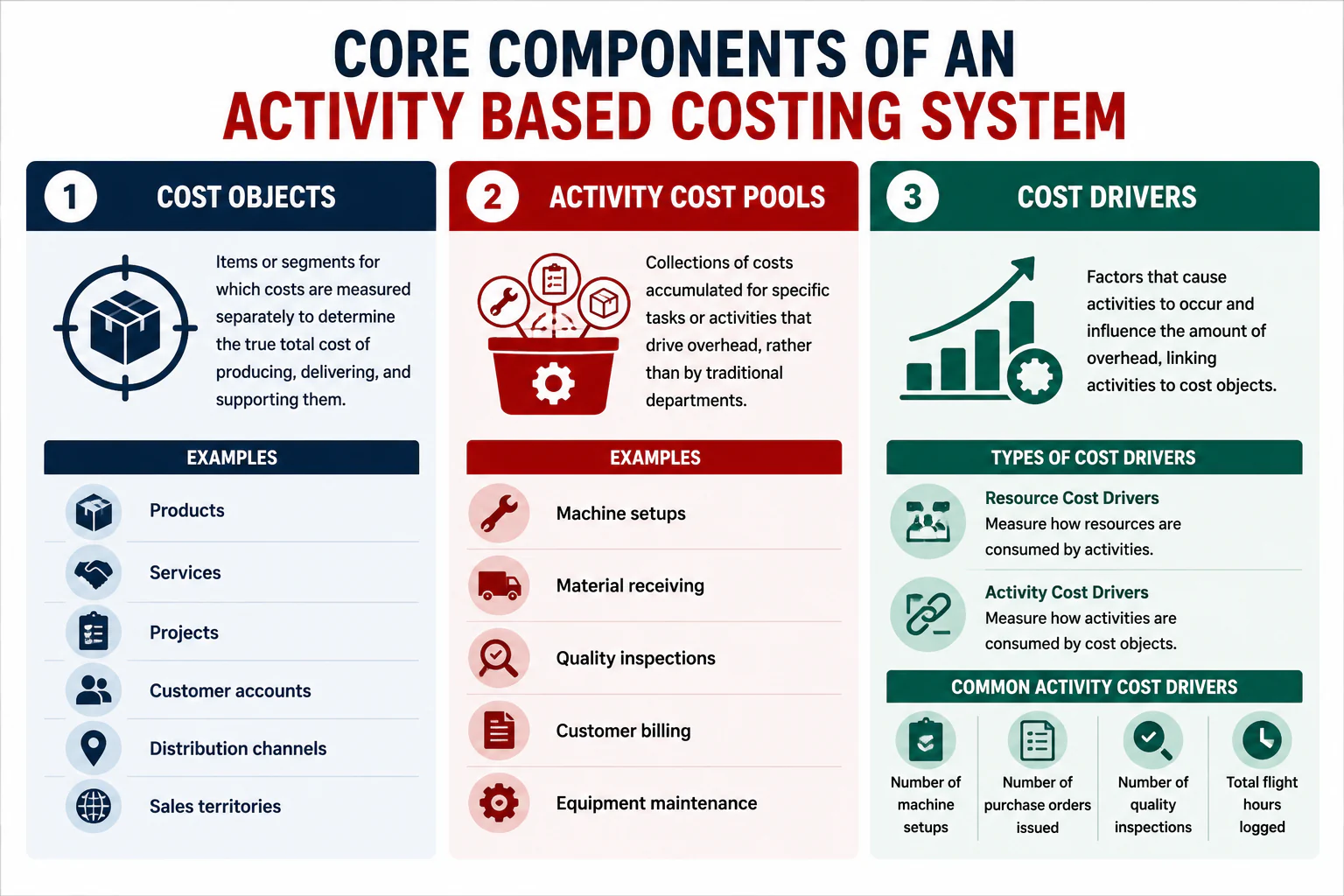
Constructing a functional Activity Based Costing architecture requires a deep understanding of three foundational building blocks that form the structural backbone of the accounting system.
1. Cost Objects
A cost object is any item, entity, or operational segment for which a separate measurement of costs is desired. In a commercial enterprise, cost objects commonly include physical manufactured products, individual service packages, engineering projects, customer accounts, geographic distribution channels, or specific sales territories. The ultimate objective of Activity Based Costing is to determine the true total cost of producing, delivering, and supporting these cost objects.
2. Activity Cost Pools
An activity cost pool is a bucket in which costs related to specific operational tasks or activities are accumulated. Instead of pooling expenses by functional departments like accounting or maintenance, expenses are grouped by the specific activities that drive those costs. Examples of activity cost pools include machine setup activities, material receiving activities, quality inspection activities, customer billing activities, and equipment maintenance activities.
3. Cost Drivers
A cost driver is a causal factor that triggers or dictates the quantitative volume of an activity, directly influencing the amount of overhead incurred and shaping your overall variable costing calculations. Cost drivers are divided into resource cost drivers, which measure the consumption of resources by activities, and activity cost drivers, which measure the consumption of activities by cost objects. Common activity cost drivers include the number of machine setups, number of purchase orders issued, number of quality inspections conducted, and total flight hours logged.
Key Benefits of Implementing Activity Based Costing
Transitioning from traditional accounting methods to a more detailed allocation framework unlocks several strategic advantages for growing enterprises. When finance teams have clear visibility into how daily operations consume resources, they can drive stronger commercial performance. Here are the primary benefits your organization will gain:
Highly Accurate Product Margins
By linking indirect expenses directly to specific tasks, management can see the true cost of every product or service. This precision prevents executives from unknowingly subsidizing highly customized items or overpricing standard high volume goods.
Smarter Resource Allocation
Granular cost tracking allows department heads to identify exactly which operational processes consume the most budget. Armed with this reliable data, leaders can confidently reallocate resources to highly profitable activities and scale down inefficient operations.
Continuous Operational Improvement
This modern accounting framework acts as a diagnostic tool that highlights hidden waste on the production floor. Once managers can clearly see the massive costs associated with excessive machine setups or redundant quality inspections, they can eliminate these non value added activities entirely.
Enhanced Pricing Strategies
With total confidence in their underlying cost data, sales teams can submit aggressive tender bids and negotiate better enterprise contracts. They know exactly how low they can drop their prices to win the market without destroying the overall gross margin.
The Challenges When Implementing Activity Based Costing
While Activity Based Costing provides superior cost accuracy, finance teams must prepare for potential operational hurdles during the initial system design and rollout phases.
1. High Administrative Data Collection Load
Collecting detailed operational data to track activity drivers requires significant time and effort. Without automated digital collection mechanisms, employees must manually log activity hours, setup counts, and inspection runs, which increases administrative workload and introduces potential human error.
2. Employee Resistance to Granular Activity Tracking
Operational staff and shop floor supervisors may view detailed activity logging as micromanagement or unnecessary bureaucracy. Overcoming this cultural resistance requires clear leadership communication explaining that activity tracking aims to optimize workflows and resource allocation rather than monitor individual employee speed.
3. Risk of Excessive System Complexity
A common pitfall during Activity Based Costing implementation is attempting to define too many microscopic activity pools and cost drivers. Creating dozens of cost pools generates overwhelming complexity without providing meaningful improvements in pricing accuracy. Design teams must focus on significant, high impact activities that drive the vast majority of indirect overhead.
How to Implement Activity Based Costing
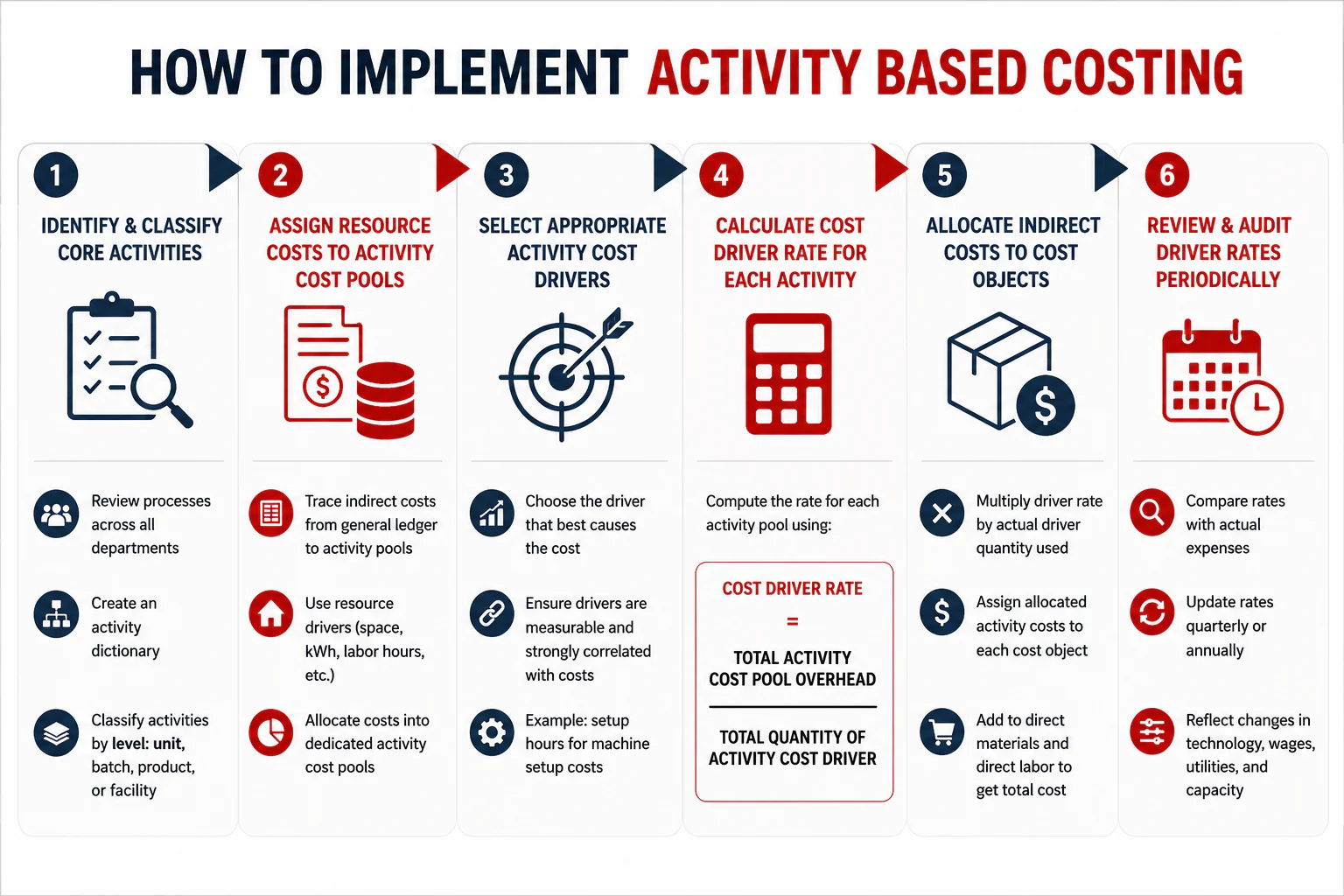
Executing a successful transition to Activity Based Costing requires a structured, multi step implementation methodology designed to capture operational realities while maintaining system clarity.
Step 1: Identify and Classify Core Organizational Activities
Begin by conducting an activity analysis across all operational departments. Interview department heads and review process workflows to build a comprehensive activity dictionary. Group operational tasks into primary activities like machining, setup, inspection, and customer support, while categorizing them into unit level, batch level, product level, or facility level activity hierarchies.
Step 2: Assign Resource Costs to Specific Activity Cost Pools
Trace indirect resource expenses recorded in the general ledger to the identified activity cost pools. This stage one allocation utilizes resource cost drivers such as square footage for building rent, kilowatt hours for machinery electricity, or direct labor hours for supervisory salaries to distribute general ledger balances into dedicated activity cost pools.
Step 3: Select Appropriate Activity Cost Drivers for Each Pool
Identify the specific cause and effect activity driver that best measures the demand placed on each cost pool. Select drivers that are easily measurable and show a strong quantitative correlation with the activity expense. For instance, use the number of setup hours as the cost driver for the machine setup cost pool.
Step 4: Calculate the Cost Driver Rate for Every Activity
Determine the predetermined cost driver rate for each activity pool by dividing the total estimated indirect cost in the pool by the total estimated volume of the activity driver. The mathematical formula is expressed as:
Cost Driver Rate = Total Activity Cost Pool Overhead / Total Quantity of Activity Cost Driver
Step 5: Allocate Indirect Costs to Specific Cost Objects
Execute stage two allocation by multiplying the predetermined cost driver rate by the actual quantity of activity driver consumed by a specific cost object. Add these allocated indirect activity costs to the direct material and direct labor expenses to establish the true total cost of goods manufactured or services delivered.
Step 6: Review and Audit Cost Driver Rates Periodically
Regularly evaluate the accuracy of calculated cost driver rates against actual operational expenditures. Adjust driver rates quarterly or annually to reflect changes in production technology, wage structures, utility tariffs, and facility capacity utilization.
Building Automated Cost Control with Enterprise Ledger Systems
Managing Activity-Based Costing (ABC) through spreadsheets becomes difficult as manufacturing operations grow. Increasing product variants, changing cost drivers, and fragmented operational data can lead to calculation errors and delayed financial reporting.
Enterprise accounting systems automate cost allocation by connecting financial data with operational activities. Key data such as purchasing, inventory movements, machine operations, and customer billing can be captured automatically and assigned to the appropriate activity cost pools.
With ABC rules integrated into a centralized ledger, finance teams can gain real-time visibility into:
Product profitability: Track costs and margins across individual products or product lines.
Customer profitability: Identify differences in costs and margins across customers.
Operational variances: Compare actual costs against expected costs and identify deviations.
Cost allocations: Automatically assign indirect costs based on defined cost drivers.
This automation reduces manual data entry and helps CFOs make faster, data-driven decisions on pricing, production capacity, and outsourcing.
Malaysia Example: Uncovering Hidden Margin Losses with Activity-Based Costing
Illustrative example: A component manufacturer in Bayan Lepas, Penang is experiencing shrinking margins despite record sales. The company allocates factory overhead based mainly on direct labour hours, causing high-complexity, low-volume products to appear more profitable than they actually are.
An Activity-Based Costing (ABC) approach can reveal the hidden costs behind these products by assigning overhead to the activities that consume resources.
For example, the company identifies machine setup as a major cost driver:
Annual setup overhead: RM600,000
Total setup hours: 3,000 hours
Setup cost driver rate: RM200 per setup hour
Custom sensor orders that require frequent machine recalibration and additional quality inspections therefore absorb significantly more overhead than standard high-volume products. By tracing these costs to the activities that generate them, management can identify underpriced products, reduce cross-subsidization, and adjust pricing based on their actual resource consumption.
Connection to Malaysian ABC Research
This example reflects findings from research on Activity-Based Costing in Malaysian manufacturing. Studies have highlighted ABC's value in improving cost accuracy, product costing, and management decision-making, particularly where traditional overhead allocation methods fail to capture differences in resource consumption.
Research involving Malaysian manufacturing companies has also examined the adoption of ABC in relation to factors such as manufacturing complexity, competitive pressure, and the need for more accurate cost information. This supports the broader point illustrated above: as manufacturing operations become more complex, relying solely on traditional volume-based allocation can make product profitability increasingly difficult to assess accurately.
Conclusion
Activity Based Costing transforms how modern organizations understand overhead expenses and evaluate product profitability. By replacing arbitrary volume based allocation methods with cause and effect activity drivers, Activity Based Costing provides corporate leadership with the precise cost intelligence required to optimize pricing, eliminate operational waste, and protect gross margins in competitive markets.
While implementing an activity based framework requires careful activity analysis and cross functional alignment, modern financial technology significantly reduces the administrative burden of cost driver tracking. Establishing continuous visibility over activity cost pools equips financial controllers to navigate shifting market demands with confidence. Schedule a free demo to explore how automated financial control platforms can streamline your corporate cost allocation processes.

FAQ About Activity Based Costing
The main difference lies in how overhead is allocated. Traditional costing distributes indirect expenses using a single volume metric like direct labor hours, whereas Activity Based Costing assigns overhead using multiple activity cost pools and cause and effect cost drivers based on actual resource consumption.
Common manufacturing cost drivers include the number of machine setups, setup hours, number of purchase orders processed, inspection hours, material handling runs, and machine operating hours.
Yes. Activity Based Costing is widely used in service sectors like banking, healthcare, logistics, and legal services to determine the true cost of serving specific client accounts, processing loan applications, or delivering medical care packages.
A cost driver rate is the predetermined rate used to allocate activity costs to cost objects. It is calculated by dividing the total estimated overhead expense in an activity cost pool by the total estimated quantity of the associated cost driver.
Traditional methods assume that all products consume overhead in direct proportion to production volume or labor hours. This causes simple high volume goods to over absorb overhead while complex low volume goods under absorb overhead, resulting in product cross subsidization.
Modern accounting platforms capture operational data automatically from purchasing, inventory, and production logs. The software automatically applies predetermined cost driver rates to calculate real time activity costs for every product and customer account.