










 Limited to 100 registrants

A missed sales forecast, an unexpected stock shortage, or a late supplier delivery can quickly become an enterprise-wide issue. Yet many Malaysian organisations still make critical decisions using fragmented reports, delayed data, and manual coordination across finance, operations, procurement, and supply chain teams.
For COOs, CFOs, CIOs, and functional leaders, the challenge is often not access to data, but turning reliable information into timely and coordinated action. McKinsey’s research on organisational decision-making found that fewer than half of surveyed leaders considered their decisions timely, while 61% said that at least half of the time spent making decisions was ineffective. These delays can affect costs, service levels, cash flow, and customer commitments.
Decision intelligence offers a structured way to address this challenge. It connects data, business context, predictive insight, workflows, and human judgement so enterprises can make and execute better decisions at scale.
Key Takeaways
Decision intelligence turns data into action. It connects insight, judgement, and workflows.
It reduces cross-functional complexity.Teams decide using shared, current business context.
Integrated ERP data is the foundation.Connected data enables faster, more reliable decisions.

What Is Decision Intelligence?
Decision intelligence is a discipline for improving how an organisation makes, executes, and learns from decisions. Rather than treating reporting, forecasting, business rules, and operational processes as separate activities, it brings them together into a repeatable decision-making system.
In practice, decision intelligence connects:
- Trusted data from across the enterprise
- Analytics and predictive models
- Business rules, targets, and operational constraints
- Human expertise, review, and approvals
- Workflows that translate decisions into action
- Feedback loops that improve future decisions
The objective is not to remove people from important decisions. It is to give leaders and teams a clearer view of what is happening, what is likely to happen next, and which action best supports the organisation’s priorities.
For example, when demand rises unexpectedly for a high-margin product, a decision-intelligence approach can help teams assess inventory availability, supplier lead times, warehouse capacity, projected cash-flow impact, and customer commitments before deciding whether to replenish, reallocate stock, or revise purchasing plans.
A dashboard may show that stock is declining. Decision intelligence helps the business determine what should happen next, who is accountable for the action, and how success will be measured.
Decision Intelligence vs Business Intelligence vs Artificial Intelligence
Business intelligence, artificial intelligence, and decision intelligence are closely related, but they do not serve the same role. Business intelligence helps enterprises understand performance, while artificial intelligence can identify patterns or generate predictions. Decision intelligence connects those capabilities to business context, accountability, and execution.
| Aspect | Business Intelligence (BI) | Artificial Intelligence (AI) | Decision Intelligence (DI) |
|---|---|---|---|
| Primary purpose | Explains what happened and what is happening | Identifies patterns, predicts outcomes, or automates specific tasks | Improves how the enterprise decides, acts, and learns |
| Main output | Reports, dashboards, and performance analysis | Predictions, recommendations, classifications, or automation | Contextual decisions linked to accountable actions and workflows |
| Decision context | Often requires users to interpret data separately | May provide insight but does not always reflect full business constraints | Combines data with goals, policies, financial impact, and operational constraints |
| Human role | Interprets reports and makes decisions | Reviews, validates, or oversees model outputs | Applies judgement, approves exceptions, and owns outcomes |
| Example | A dashboard shows declining stock levels | A model forecasts higher demand next month | Teams evaluate demand, supplier lead times, cash flow, and capacity before approving replenishment action |
| Business value | Better visibility | Faster analysis and prediction | More consistent, cross-functional, and executable enterprise decisions |
In short, BI helps answer “what is happening?”, AI can help answer “what may happen?”, and decision intelligence helps determine “what should we do next, given our business priorities and constraints?”
Why Decision Intelligence Matters for Malaysian Enterprises
Malaysian enterprises often operate across multiple locations, business units, warehouses, suppliers, and sales channels. As operations grow, decisions become more interconnected: a purchasing choice can affect inventory availability, working capital, production schedules, fulfilment performance, and customer satisfaction.
It connects decisions across functions.
A decision about replenishment, for example, should not be based on stock levels alone. Leaders may also need to consider demand trends, supplier lead times, warehouse capacity, customer commitments, and cash-flow implications. Decision intelligence brings these factors into a shared decision context, helping finance, procurement, supply chain, and operations teams work from aligned priorities.
It reduces reactive decision-making caused by disconnected data.
When teams rely on separate spreadsheets or delayed reports, they can respond after an issue has already affected cost or service performance. Finance may review outdated cost data, procurement may not see changing demand early enough, and operations may identify supplier risk only after a delivery delay occurs. A more connected view of enterprise data helps teams identify issues earlier and evaluate response options before they escalate.
It makes operational actions more consistent and accountable.
Decision intelligence combines data with business targets, operational constraints, approval rules, and assigned actions. Rather than stopping at a dashboard or forecast, it helps leaders clarify which action should be taken, who is responsible, and how the result should be measured. This supports a more disciplined digital transformation strategy, particularly when enterprise processes span several departments.
Illustrative Enterprise Case Study: Responding to Demand Volatility
Consider a multi-location distributor in Malaysia that experiences a sudden increase in demand for selected high-margin product categories. The sales team sees stronger orders, but inventory is unevenly distributed across warehouses. At the same time, procurement is managing longer supplier lead times, while finance needs to protect cash flow.
Without a connected decision-making process, each team may act independently. Sales may promise delivery dates before stock is confirmed, procurement may place an urgent order without considering available inventory elsewhere, and finance may only see the full spending impact after commitments have been made.
With decision intelligence, leaders can assess demand forecasts, stock by location, supplier lead times, purchase commitments, warehouse capacity, and expected margins in one decision workflow. The business can then decide whether to reallocate stock, prioritise specific customers, expedite selected purchase orders, or adjust replenishment plans.
The value is not simply faster reporting. It is the ability to make a coordinated and executable decision before demand volatility affects customer service or profitability.
How Decision Intelligence Works
A decision-intelligence framework connects enterprise information to action. The process does not need to be overly complex, but it should create a clear path from data to accountability and continuous improvement.
- Data: Collect reliable information from finance, sales, procurement, inventory, supply chain, production, and operations.
- Insight: Analyse current performance and identify potential risks, trends, exceptions, or opportunities.
- Decision: Evaluate available actions against business rules, objectives, constraints, and expected impact.
- Action: Assign ownership, trigger approvals, and execute the chosen workflow.
- Feedback: Measure results and use outcomes to refine future decisions, forecasts, and operating rules.
This process is especially useful for decisions that are recurring, cross-functional, time-sensitive, or financially significant. It creates consistency without removing the need for leadership judgement.
Enterprise Decision Intelligence Use Cases
Decision intelligence can support many enterprise functions, but the strongest use cases are usually those where teams must balance multiple constraints before acting. The following examples show how it can be applied across finance, inventory, supply chain, and operations.
| Function | Decision to Improve | Data and Context Required | Potential Action |
|---|---|---|---|
| Finance | Whether to release, defer, or prioritise spending | Cash position, receivables, budgets, commitments, and forecasted demand | Adjust payment priorities or spending approvals |
| Inventory | When and how much to replenish | Stock availability, sales velocity, safety stock, supplier lead times, and warehouse capacity | Create or revise purchase recommendations |
| Supply Chain | How to respond to supplier disruption | Supplier performance, purchase orders, shipment status, alternatives, and customer commitments | Expedite, reallocate, or source from an approved alternative supplier |
| Operations | How to address capacity constraints or delivery delays | Production schedules, workforce availability, order priorities, equipment status, and service targets | Reschedule work, rebalance resources, or prioritise critical orders |
Finance and Cash-Flow Decisions
Finance teams often need to balance payment obligations, working-capital requirements, revenue expectations, and operational commitments. A connected decision process helps CFOs and finance leaders assess the impact of a spending decision before it affects liquidity or business continuity.
Inventory and Replenishment Decisions
Inventory planning becomes more accurate when teams combine historical demand, current stock, open orders, supplier reliability, lead times, and warehouse capacity. Rather than acting on a single stock threshold, leaders can evaluate the wider operational impact of a replenishment decision.
Place an internal link on inventory forecasting to support readers who need a deeper explanation of demand planning and stock optimisation.
Supply Chain Risk Decisions
Supply chain teams can use decision intelligence to identify supplier delays, shipment risks, and fulfilment exceptions earlier. The system should not only flag a problem; it should provide relevant context so teams can assess alternative suppliers, available inventory, customer priorities, and cost implications.
Operational Capacity Decisions
For manufacturing, retail, distribution, and service operations, daily decisions often involve capacity, workforce allocation, order priority, and service levels. Decision intelligence helps operational leaders assess trade-offs consistently and assign actions to the right teams.
Common Challenges When Implementing Decision Intelligence
Decision intelligence is not achieved simply by adding an AI tool or creating more dashboards. Enterprises need reliable data, defined decision ownership, and workflows that can turn insight into action.
- Fragmented enterprise data: Important data may sit in separate systems, spreadsheets, or departmental reports.
- Unclear decision ownership: Teams may see the same issue but lack clarity on who can approve, escalate, or execute the next step.
- Inconsistent data quality: Forecasting and recommendations are only as reliable as the underlying operational data.
- Over reliance on dashboards: Visibility is useful, but it does not automatically create accountability or coordinated action.
- Limited change management: Leaders and teams need to understand how new decision workflows support—not disrupt—their responsibilities.
A practical starting point is to identify a high-impact recurring decision, such as replenishment, payment prioritisation, supplier escalation, or capacity allocation. Enterprises can then define the relevant data, rules, stakeholders, approvals, and success measures before expanding to other use cases.
How an Integrated ERP Supports Better Decisions
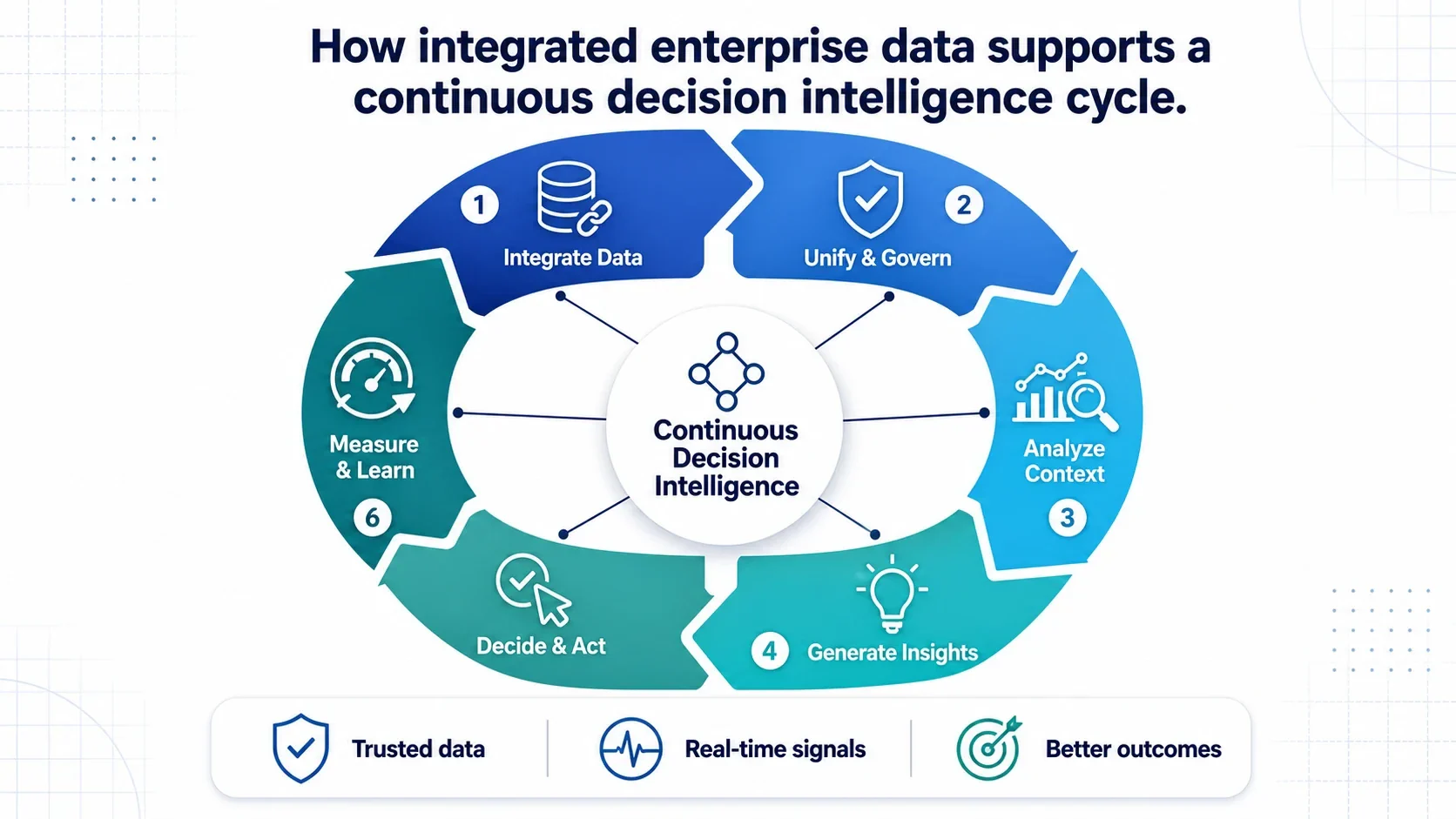
An integrated ERP system can provide the operational foundation for decision intelligence by connecting financial, inventory, procurement, sales, warehouse, and operational data. This reduces the time teams spend reconciling information from disconnected sources.
When enterprise data is connected, leaders can assess decisions using more complete and current information. For example, a purchasing decision can be evaluated alongside available stock, open sales orders, supplier lead times, budget constraints, and projected cash-flow impact.
However, technology alone is not the final answer. The enterprise still needs clear processes, governance, approval paths, and accountable owners. The purpose of an integrated system is to make reliable decision-making easier to repeat across functions and locations.
Conclusion
Decision intelligence helps enterprises move beyond reporting and isolated predictions. It creates a structured approach for connecting trusted data, business context, human judgement, and workflows so decisions can be made and executed with greater confidence.
For Malaysian enterprises managing complex finance, supply chain, inventory, manufacturing, retail, or distribution operations, the opportunity is to reduce reactive decision-making and improve coordination across departments. The best place to start is often one recurring decision where delayed or fragmented information is already creating a measurable business impact.
As a next step, assess whether your current systems provide the connected data, visibility, and workflows needed to support timely cross-functional decisions. An integrated ERP system can provide a stronger foundation for this process. To explore how these capabilities could work in your organisation, consider requesting a free ERP software demo.
As a next step, assess whether your current systems provide the connected data, visibility, and workflows needed to support timely cross-functional decisions. An integrated ERP system can provide a stronger foundation for this process. To explore how these capabilities could work in your organisation, consider requesting a free ERP software demo.
FAQs About Decision Intelligence
Decision intelligence is a structured approach that helps organisations use data, analytics, business rules, workflows, and human judgement to make better decisions and turn them into action.
Business intelligence focuses on reporting and understanding performance. Decision intelligence uses that information alongside predictions, business constraints, and workflows to determine and execute the most appropriate next action.
No. Artificial intelligence can be part of a decision-intelligence framework, particularly for forecasting, recommendations, and pattern recognition. Decision intelligence is broader because it also includes business context, human approval, accountability, and execution workflows.
Finance, procurement, inventory, supply chain, manufacturing, retail, distribution, sales, and operations can all benefit. It is most valuable where decisions are recurring, cross-functional, time-sensitive, or financially significant.
Start with one high-impact decision, define the required data and business rules, assign accountable stakeholders, establish an approval workflow, and measure the outcome. Once the approach is proven, it can be expanded to additional enterprise decisions.