







When managing warehouse inventory, one of the most critical decisions a business owner must make is choosing how to value their stock. This decision directly impacts your Cost of Goods Sold (COGS), net profit, and overall tax liabilities. One of the most widely discussed methods in inventory management is Last in First Out (LIFO).
For Malaysian retailers, e-commerce sellers, and manufacturers, understanding physical and financial inventory movements is essential for accurate reporting under MFRS 102 Inventories. Businesses must also track landed costs, SST treatment, and stock movements across warehouses and production stages in line with MySST.
In this comprehensive guide, we will explore the true meaning of the Last in First Out method, examine its advantages and disadvantages, review real-world examples, and compare it with the FIFO method to understand its impact on inventory management and the bottom line.
Key Takeaways
LIFO assumes that the most recently purchased inventory items are the first ones to be sold, matching current costs against current revenues.
A major advantage of LIFO is that it can lower a company's tax burden during periods of inflation by reporting a higher Cost of Goods Sold (COGS).
Unlike FIFO, the LIFO method can result in older, outdated inventory costs remaining on the balance sheet, which may distort the company's total asset value.
Managing complex inventory valuation methods manually can lead to costly errors. Automating your stock control ensures accurate COGS calculations and real-time financial reporting.

What Does Last in First Out (LIFO) Mean?
Last in, First out (LIFO) is an inventory valuation method which assumes that the last items placed into your inventory are the first ones to be sold. In a physical sense, imagine a large stack of metal pipes at a hardware warehouse. When an order comes in, the warehouse workers do not dig to the bottom of the pile. They naturally take the pipes from the very top, the ones that were delivered most recently.
In financial accounting, using the LIFO method means the cost of your most recent inventory purchases is matched against your current revenue. Meanwhile, the older, historical costs remain on your balance sheet as ending inventory until the new stock is completely depleted.
Advantages and Disadvantages of LIFO
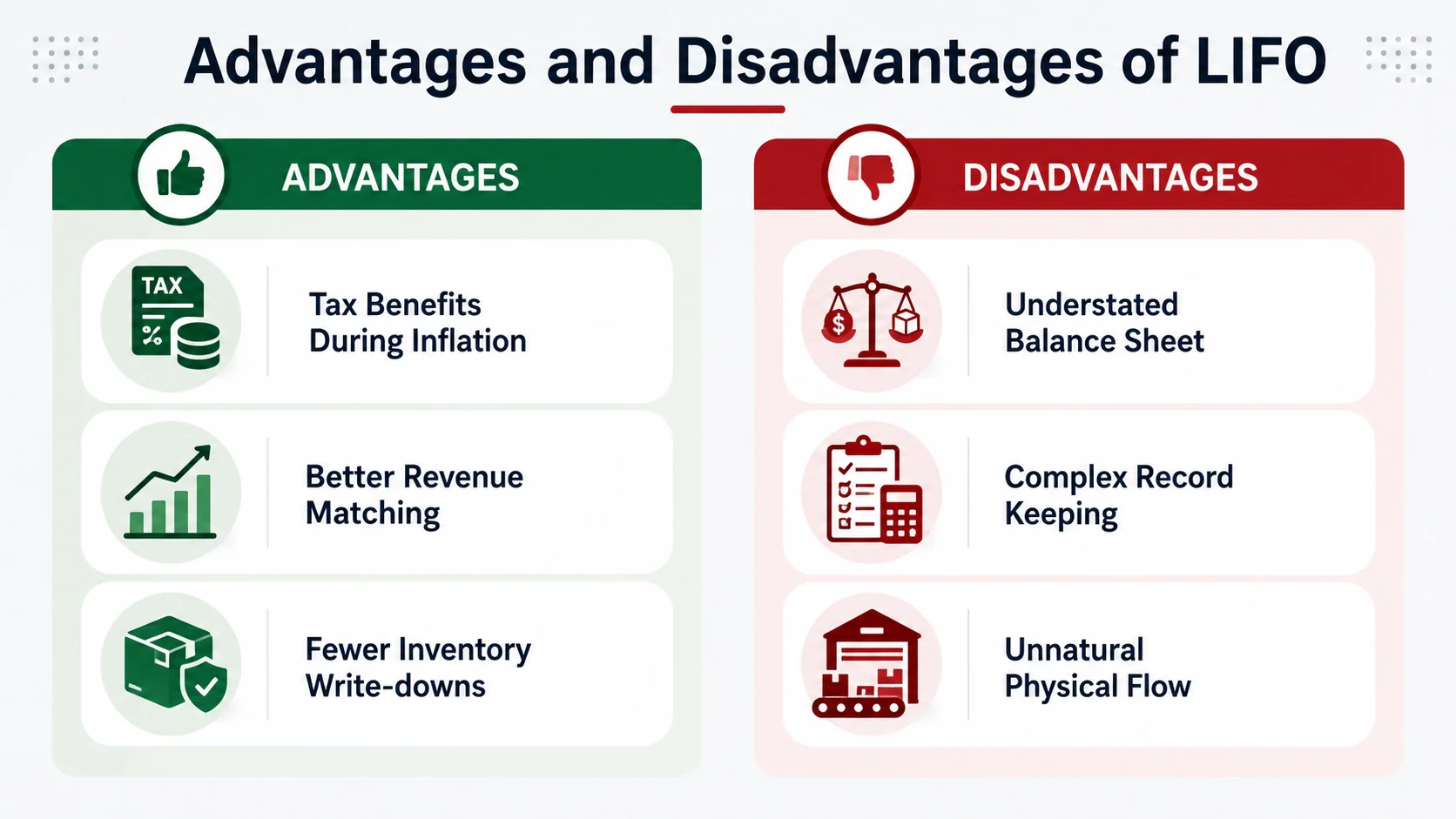
Before deciding how to track your inventory, it is crucial to understand the pros and cons of the LIFO method. While it offers unique financial benefits, it also comes with specific operational complexities.
Advantages of LIFO
- Tax Benefits During Inflation: LIFO can offer tax benefits during inflation because rising prices make newer inventory more expensive. Selling this inventory first increases COGS, which lowers reported net income and may reduce the corporate tax burden.
- Better Revenue Matching: LIFO matches the most recent costs against current revenues. This gives a more accurate picture of a company's current profitability and gross margins, as it reflects the current market price of replacing that inventory.
- Fewer Inventory Write-downs: Because the ending inventory consists of older, cheaper stock, the risk of having to write down inventory due to sudden market price drops is significantly lower.
Disadvantages of LIFO
- Understated Balance Sheet: Because older, cheaper inventory remains on the books, the total asset value on a company's balance sheet can be heavily understated. It does not reflect the current value of the inventory sitting in the warehouse.
- Complex Record Keeping: Tracking multiple layers of inventory costs over several years is highly complex. Without an automated inventory management system, calculating LIFO manually is prone to severe accounting errors.
- Unnatural Physical Flow: For most businesses (like food, fashion, or electronics), selling the newest items first leads to older stock expiring or becoming obsolete. LIFO rarely matches the actual physical flow of goods.
LIFO Storage Systems for Warehouse Operations
Certain warehouse racking systems are well suited to LIFO inventory management because they allow pallets to be loaded and retrieved from the same access point or channel.
- Drive-In Racking
A high-density storage system where forklifts enter dedicated lanes to load and retrieve pallets. It works well for warehouses storing large quantities of a limited range of SKUs. - Push-Back Racking
Pallets are stored several positions deep on inclined rails, allowing new loads to push existing pallets further into the lane. This setup supports LIFO by keeping pallet access within the same aisle. - Pallet Shuttle System
A semi-automated solution that uses a motorized shuttle to move pallets within deep storage lanes. Operators control the shuttle remotely, making it suitable for high-density warehouses that need faster pallet handling. - Selective Pallet Racking
Although typically associated with FIFO, selective racking can also support LIFO when inventory is managed based on the most recently received stock. A warehouse management system (WMS) can help track pallet entry dates and identify which inventory should be retrieved first.
Which Business Suits LIFO?
Because LIFO leaves older stock on the balance sheet for long periods, it is fundamentally disastrous for businesses that sell perishable goods (like food and beverages) or items prone to rapid obsolescence (like fast fashion and consumer electronics). If a grocery store used physical LIFO, their oldest milk would expire at the back of the fridge.
So, who actually benefits from this method? LIFO is best suited for businesses where the inventory does not expire, does not quickly lose relevance, and is difficult to distinguish between old and new batches. Typical examples include:
- Commodity Suppliers: Businesses dealing in sand, gravel, coal, or metals where new shipments are simply piled on top of old ones.
- Automotive Dealerships: Where large, expensive inventories are held, and inflation naturally increases the cost of newer models every year.
- Petroleum and Chemical Plants: Where liquids and gasses are mixed in massive holding tanks, making it impossible to separate the "old" from the "new."
LIFO Example Use Cases: How Does It Actually Work?

To better understand how the LIFO method affects inventory valuation and COGS, it helps to see how the calculation works when inventory is purchased at different prices over time. The following example illustrates how LIFO treats the most recently purchased stock as the first inventory sold when costs increase due to inflation.
A supplier buys cement batches over a year where prices are steadily rising due to inflation:
- Batch 1 (January): 500 bags at RM 20/bag.
- Batch 2 (June): 500 bags at RM 25/bag.
- Batch 3 (November): 500 bags at RM 30/bag.
In December, a developer purchases 600 bags. Under LIFO, the supplier assumes the newest stock is sold first. They fulfill the order by costing 500 bags from the newest Batch 3, and 100 bags from Batch 2.
The COGS is calculated as:
- 500 bags x RM 30 = RM 15,000
- 100 bags x RM 25 = RM 2,500
- Total COGS = RM 17,500
The remaining ending inventory on the balance sheet consists of the oldest stock: the 500 bags from Batch 1 and 400 bags from Batch 2.
LIFO vs. FIFO: The Core Differences
The easiest way to understand LIFO is to compare it to its complete opposite: First in, First Out (FIFO). Under FIFO, the oldest stock is assumed to be sold first.
| Feature | Last In, First Out (LIFO) | First In, First Out (FIFO) |
|---|---|---|
| Flow of Goods | Newest items sold first | Oldest items sold first |
| COGS during Inflation | Higher | Lower |
| Reported Profit | Lower | Higher |
| Ending Inventory Value | Deflated (reflects older, lower costs) | Accurate (reflects current market replacement costs) |
| Best Suited For | Commodities, non-perishable bulk (sand, coal, metals) | Perishables, FMCG, electronics, fashion |
As the table highlights, the choice between these two methods drastically alters a company's financial profile. While LIFO often serves as a financial strategy to shield profits from high taxes during inflationary periods, FIFO remains the gold standard for operational accuracy. FIFO provides a much clearer picture of your balance sheet health and is the most logical choice for businesses dealing with physical products that can expire, degrade, or go out of style.
Conclusion
The Last in First Out (LIFO) method provides a strategic way for businesses to manage their tax liabilities during inflationary periods by matching their most recent, higher costs against current revenues. While it offers clear financial advantages, it also introduces complexities in record-keeping and can leave your balance sheet looking undervalued.
Choosing between LIFO and FIFO depends heavily on your industry type, the physical nature of your products, and local accounting standards. Regardless of which valuation method you use, tracking different cost layers across multiple warehouse locations is nearly impossible to do accurately on manual spreadsheets.
To ensure your COGS is calculated flawlessly and your stock levels are always optimized, upgrading to a digital solution is key. Try a free demo to know how to automates inventory valuation, prevents stockouts, and gives you real-time visibility into your business's financial health.

FAQ about Last In First Out (LIFO)
LIFO stands for Last In, First Out. It is an inventory valuation method that assumes the last items placed into inventory are the first ones sold. This means the costs of the most recent purchases are matched against current revenues.
A common real-life example of LIFO is a pile of coal or sand. When a truck delivers new sand, it dumps it on top of the pile. When the next customer buys sand, the loader scoops it from the top—meaning the newest sand (last in) is the first to be sold (first out).
Companies often prefer LIFO during periods of inflation. Because the newest inventory is usually the most expensive, LIFO results in a higher Cost of Goods Sold (COGS). A higher COGS leads to lower reported net income, which reduces the company's short-term tax liability.
LIFO assumes the newest inventory is sold first, which can leave older, outdated costs on the balance sheet. FIFO (First In, First Out) assumes the oldest inventory is sold first, meaning the ending inventory on the balance sheet closely reflects current market prices.
No. LIFO is terrible for perishable goods like food or pharmaceuticals. If a grocery store used physical LIFO, they would sell the freshest milk first, causing the older milk in the back of the fridge to expire and become unsellable waste.
A stack follows the LIFO (Last In, First Out) principle, meaning the most recently added item is always the first one to be removed. This works similarly to a stack of plates, where new plates are placed on top and the top plate is the first one taken off. As a result, items can only be added to or removed from the top of the stack.