









 Limited to 100 registrants

Every year, hundreds of consumer goods, medicines, and cosmetics are pulled from shelves across Malaysia after a product recall is issued. The action protects shoppers, but it also exposes manufacturers, distributors, and retailers to financial loss and reputational damage.
In 2024 alone, the National Pharmaceutical Regulatory Agency (NPRA) recorded dozens of pharmaceutical and cosmetic recalls in Malaysia, with several cases requiring nationwide retrieval inside 24 hours. Independent industry studies estimate a single mid sized product recall can cost a manufacturer between RM 2 million and RM 40 million once logistics, legal fees, and brand recovery are added together.
For businesses in Malaysia, understanding product recall requirements is essential for reducing risks and maintaining customer trust. Discover from this article how the right strategies and tools, including a reliable inventory system approach, can support compliance and protect your business reputation.
Key Takeaways
A product recall removes unsafe or defective products from the market to protect consumers and maintain regulatory compliance.
A structured product recall process helps businesses reduce compliance risks and avoid audit issues during NPRA reviews.
Choosing an inventory system with the right features helps businesses meet NPRA requirements and improve product recall management.
Poor recall management can lead to compliance issues, operational delays, and a loss of customer trust. Discover practical strategies and tools that help businesses improve recall handling and maintain better control over the process.
Understanding the Important of Product Recall for Your Businesses
A product recall is the process of removing defective or unsafe products from the market after they have been distributed or sold to consumers. In Malaysia, recalls are regulated by authorities such as the National Pharmaceutical Regulatory Agency (NPRA), Medical Device Authority (MDA), and Ministry of Domestic Trade and Cost of Living (KPDN), depending on the product category.
Product recalls generally fall into two types, voluntary recalls initiated by companies after identifying safety or quality control issues through internal checks, customer complaints, or testing processes, and mandatory recalls ordered by regulators when products fail to meet required standards.
A product recall differs from a product withdrawal. Withdrawals are usually based on business decisions, such as packaging or labeling updates, while recalls are driven by safety, quality, or compliance concerns and often require action across the supply chain.
Product Recall Classifications in Malaysia
National Pharmaceutical Regulatory Agency (NPRA) uses two classifications for regulated product recalls, namely Degree of Recall and Level of Recall. These categories determine the severity of the risk and the scope of the recall process, while businesses in Malaysia are expected to include them in their internal recall SOPs.
Degree of Recall: Degree I, II, and III
NPRA recognizes three Degrees of product recall. Each Degree carries its own mandatory embargo timeline that begins the moment the recall is officially classified.
- Degree I covers products that pose a major health hazard, such as contaminated medicines or undeclared scheduled poisons. NPRA requires an embargo within 24 hours, which means the affected product must be quarantined and stop moving across the supply chain inside one day.
- Degree II applies to products with minor or temporary health risks, or those that are substandard but unlikely to cause serious harm. The embargo for a Degree II product recall must be enforced within 72 hours of classification.
- Degree III is used for products that breach NPRA conditions without a direct safety threat, for example a labelling defect or a registration lapse. The embargo timeline for Degree III is 30 days from the date of classification.
Level of Recall: Level A, B, and C
On top of Degree, NPRA assigns a Level that tells you who in the supply chain must be reached and notified.
- Level A is the widest scope. It means the product has already moved into the hands of end consumers, so retrieval must cover hospitals, pharmacies, clinics, retailers, and the public.
- Level B is limited to the retail layer, including hospitals, registered pharmacies, and clinics that hold the product but have not dispensed it.
- Level C is the narrowest, covering only wholesalers and sub distributors who still hold the stock before it reaches retailers.
The matrix below combines both scales so businesses can see at a glance what an NPRA product recall demands of them. Read the rows by Degree (the urgency) and the columns by Level (the reach).
| Degree × Level | Level A (Consumers) | Level B (Retail) | Level C (Wholesaler) |
| Degree I (24 hours) | Nationwide retrieval within 24 hours and public notice issued. | Retail quarantine within 24 hours and all dispensing activities stopped. | Wholesale stock locked within 24 hours and distribution stopped. |
| Degree II (72 hours) | Consumer retrieval completed within 72 hours and return channels opened. | Retail outlets stop sales within 72 hours. | Wholesaler stock placed under embargo within 72 hours. |
| Degree III (30 days) | Consumer correction or replacement completed within 30 days. | Retailers replace or relabel stock within 30 days. | Wholesalers update records and correct stock within 30 days. |
Why Businesses Need Product Recall Management?
Product recalls involve a range of activities beyond product removal, including regulatory compliance, communication, and supply chain coordination. Implementing a structured recall management process helps businesses respond effectively, reduce operational disruptions, and limit financial and reputational risks.
Key benefits of product recall management include:
- Reducing compliance and regulatory risks
Product recalls in Malaysia are subject to strict requirements set by authorities such as NPRA, MDA, and KPDN. A structured recall management process helps businesses maintain proper documentation, meet reporting deadlines, and demonstrate compliance during audits or regulatory reviews. - Protecting customer trust and brand reputation
How a company responds to a product issue often influences public perception more than the issue itself. Prompt recall actions, transparent communication, and effective product retrieval can help preserve customer confidence and reduce long-term reputational damage. - Improving product traceability across the supply chain
Strong recall management relies on accurate product tracking from suppliers to end customers. Better traceability allows businesses to identify affected batches more quickly, locate products efficiently, and avoid unnecessary recalls involving unaffected inventory. - Minimizing recall costs and operational disruptions
Product recalls can result in significant expenses related to product retrieval, storage, disposal, and replacement. By isolating only the affected products and coordinating recall activities efficiently, businesses can reduce costs while minimizing disruptions to daily operations. - Supporting faster response and decision-making
A well-defined recall process enables teams to react quickly when quality, safety, or compliance issues arise. Faster response times help contain risks earlier, reduce the number of affected products in circulation, and improve the overall effectiveness of recall efforts.
Pproduct recall management is not only a compliance requirement but also an important part of risk management. The right processes and technology can help organizations maintain better control over recalls while protecting both customers and business performance.
Common Causes of Product Recalls
Most product recall cases in Malaysia trace back to a small set of root causes. Grouping them helps quality and supply chain teams design the right preventive controls before a recall becomes unavoidable.
- Manufacturing Defects
Manufacturing defects problem happen when production uses worn equipment, inconsistent raw materials, or incomplete Good Manufacturing Practice (GMP) checks. Although defects may only affect a specific batch, weak traceability systems can cause larger production volumes to be recalled. - Contamination Risks
Contamination is a common reason behind pharmaceutical and food product recalls. It may involve microbial contamination such as bacteria or mold, chemical contamination such as heavy metals or cleaning substances, or physical contamination like glass and metal fragments. - Labelling Errors
Incorrect dosage instructions, missing halal certification, or undeclared allergens can create safety concerns for consumers. Labels play an important role because users depend on the information for proper and safe product use. - Packaging Failures
Packaging issues can include broken seals, unsuitable container materials, or child resistant caps that do not function correctly. Even if the product quality meets standards, packaging failures can still lead to recalls. - Regulatory Non Compliance
Failure to meet requirements related to SIRIM certification, KPDN guidelines, or NPRA registration standards can result in product recalls. While these cases are commonly associated with lower severity levels, they may become more serious if safety risks are identified later.
Each cause links directly to a control point that an inventory and quality system can monitor in real time, from incoming raw materials to outgoing shipments. That is the bridge to the prevention steps in the next sections of this article.
How Does Product Recall Management Work?
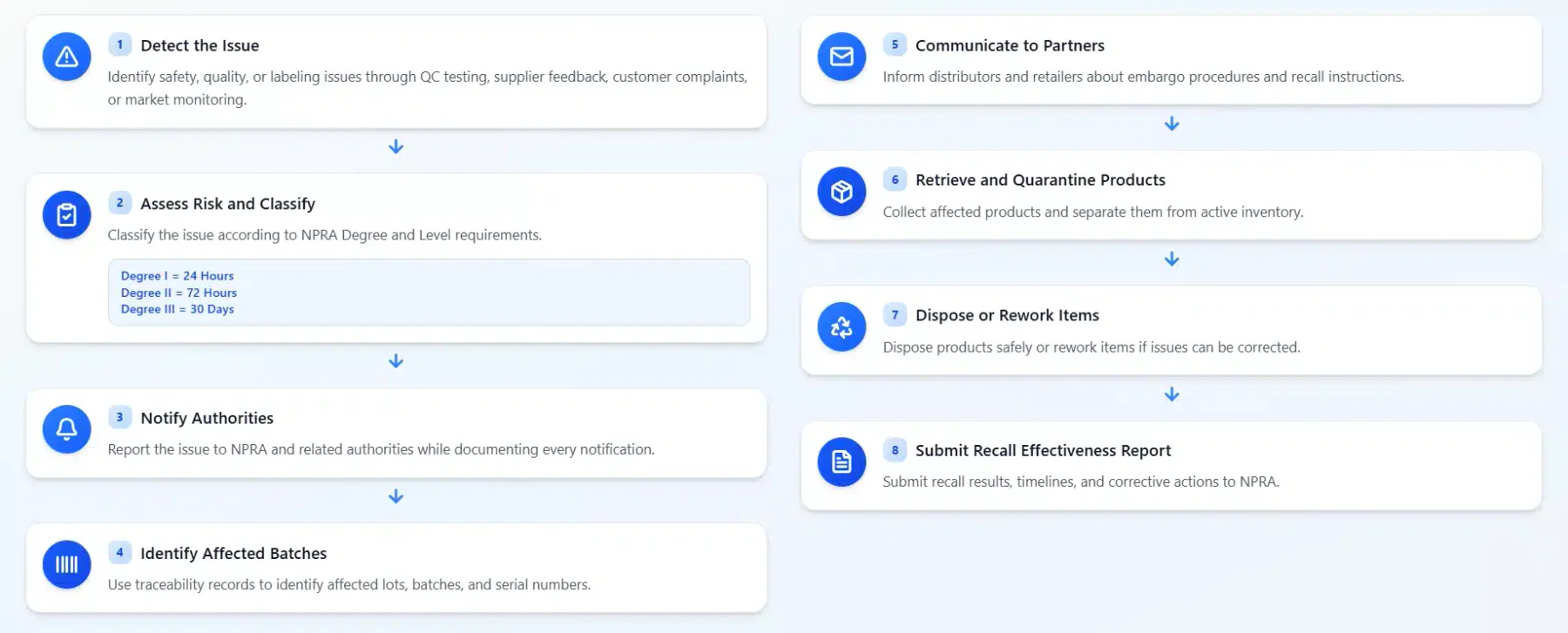
A working product recall follows a defined sequence. Skipping or reordering steps creates audit gaps that NPRA will flag in the post recall review. The eight steps below reflect both NPRA expectations and the practice used by leading manufacturers in Malaysia.
Step 1: Detect the Issue
Detect the safety, quality, or labelling problem as early as possible through QC testing, supplier complaints, customer reports, or post market surveillance. The faster a defect is detected, the smaller the recall scope tends to be.
Step 2: Assess Risk and Classify (NPRA Degree and Level)
Assess the severity of the issue and classify it against NPRA criteria. Confirm whether the case is Degree I (embargo within 24 hours), Degree II (within 72 hours), or Degree III (within 30 days), and decide the Level (A, B, or C) based on how far the product has moved. See the NPRA portal for the current decision rules.
Step 3: Notify NPRA and Relevant Authorities
Notify NPRA through npra.gov.my, which is the official reporting channel for pharmaceutical and cosmetic product recall in Malaysia. Inform MDA, KPDN, or SIRIM in parallel when their product categories are involved. Keep timestamps for every notification.
Step 4: Identify Affected Batches via Traceability
Identify every affected lot, batch, and serial number using your inventory and traceability records. Strong lot tracking lets you isolate the exact batches at risk rather than recalling an entire product line by default.
Step 5: Communicate to Distributors and Retailers
Communicate the recall to all downstream partners with clear instructions on the embargo, return procedure, and customer messaging. Confirm receipt of the notice in writing so you can prove the chain of communication later.
Step 6: Retrieve and Quarantine Products
Retrieve the recalled units from warehouses, distribution centres, retail shelves, and (for Level A) from consumers. Quarantine each returned item in a controlled zone that is fully separated from saleable stock to prevent accidental re release.
Step 7: Dispose or Rework Recalled Items
Dispose of the recalled stock through approved waste management partners, or rework the items if the defect can be corrected and re tested. Keep destruction certificates as part of the audit trail to support audit preparation and provide the documentation your team will need when NPRA reviews the recall.
Step 8: Submit Recall Effectiveness Report to NPRA
Submit a Recall Effectiveness Report to NPRA that documents retrieval percentages, timelines, root cause analysis, and corrective actions. This step is mandatory in Malaysia and is the single most overlooked stage of a product recall in our experience reviewing client SOPs.
The Role of Traceability in Reducing Recall Impact
Traceability helps businesses monitor product information across every stage of the supply chain. While it cannot prevent product recalls, it can reduce their impact, cost, and duration through better tracking and response processes.
4 Types of Traceability (Upstream, Downstream, Internal, External):
- Upstream traceability (also called backward traceability)
Tracks a product back to its suppliers and raw materials. When a contamination case appears, upstream data lets you pinpoint which supplier shipment caused the defect within hours, not weeks. - Downstream traceability (forward traceability)
Follows the product from your warehouse to every distributor, retailer, and end customer. This is the data NPRA expects to see when classifying a recall at Level A, because it determines how far you must reach to retrieve the product. - Internal traceability
Covers product movement inside your own factory or warehouse, from raw material intake, through production, to finished goods storage. It is the foundation that connects upstream and downstream data into a single record. - External traceability
Deals with distribution after the goods leave your control, including third party logistics, export shipments, and cross border partners. Without it, a Malaysian exporter cannot prove compliance in regional product recall cases.
Strong traceability helps businesses limit recalls to wholesalers or retailers and reduce wider customer impact. Weak traceability can expand the scope of a product recall and affect the supply chain system. A WMS integrated with an ERP system supports this process by improving product tracking and reducing dependence on manual records.
NPRA Recall Procedure: What Malaysian Businesses Must Do?
The NPRA recall procedure is a mandatory process that regulated businesses in Malaysia must follow when a product recall occurs. It works alongside internal SOPs and provides an official framework for handling product recall activities and compliance requirements.
The procedure follows specific timelines based on the level of recall severity. Degree I recalls require action within 24 hours, Degree II recalls within 72 hours, and Degree III recalls within 30 days. These deadlines are important because delays in response can lead to compliance issues and regulatory consequences.
Businesses must submit reports and supporting documents through the NPRA portal while maintaining records of every action taken during the recall process. After product retrieval is completed, recall effectiveness checks are carried out to measure the success of the process and determine whether further corrective action is required.
Case Study: Managing an NPRA Product Recall in Malaysia
PharmaCare Manufacturing Sdn Bhd, a pharmaceutical manufacturer in Malaysia, identified a labeling issue affecting a product batch that had already been distributed to pharmacies and clinics. Following NPRA requirements, the company quickly classified the recall and used its traceability system to identify affected batches and notify distribution partners.
The company documented all retrieval activities, quarantined returned products, and submitted the required reports through the NPRA portal. As a result, PharmaCare was able to complete the recall within the required timeline while maintaining compliance and minimizing operational disruption.
How Inventory Management Technology Reduces Product Recall Risk?
In Malaysia, modern inventory management technology is the technical foundation that makes NPRA compliance achievable inside the 24 hour, 72 hour, and 30 day embargo windows. Five capabilities matter most for product recall preparedness.
- Real Time Batch Tracking
This feature records the location and status of products throughout the supply chain, from raw materials to final distribution. Better tracking helps businesses identify affected batches quickly and reduce the scope of product recalls. - Expiry Monitoring
Expiry monitoring identifies products that are approaching their shelf life limits and sends alerts before issues occur. This helps businesses reduce the risk of recalls caused by expired products. - Automated QC Alerts
Automated quality control alerts notify the responsible team when products fail quality checks and prevent affected batches from moving forward. The records generated also support compliance and review processes. - Supplier Traceability
Supplier traceability stores important information such as certifications, inspection results, and shipment records. This makes it easier to identify the source of quality issues and manage supplier related risks. - ERP and WMS Integration
Integration between ERP and WMS systems connects inventory, warehouse, and financial information in one place. This helps businesses manage recalls more efficiently and reduces reliance on manual records.
None of these tools replace the judgment of a trained quality team. They handle the data work that humans cannot do at the speed NPRA requires, which is what makes them an NPRA compliance enabler rather than a simple operational upgrade.
Choosing the Right Inventory System for Product Recall Compliance
Choosing the right inventory system in Malaysia comes down to whether it is built to satisfy NPRA expectations on day one or whether your team will need to bolt on workarounds later. A platform with strong inventory control at its core gives the recall team the data discipline NPRA looks for. The criteria below cover the minimum every NPRA ready solution should meet.
- Lot and Serial Number Tracking
A reliable inventory system should provide lot and serial number tracking with complete batch genealogy from raw materials to finished products. This feature helps businesses locate affected batches faster and reduce the scope of product recalls. - Built In Quality Control Module
The system should include a quality control module that automatically isolates failed batches and stores testing records in one place. Keeping quality information organized allows teams to respond faster when issues arise while also providing documentation needed for audits and compliance reviews. - Supplier Management Capabilities
Strong supplier management features help businesses store certifications, audit findings, and shipment records within a single system. This makes it easier to monitor supplier performance and identify the source of quality problems without relying on scattered documents or manual searches. - Recall Reporting and Documentation
Reporting tools are important because they help businesses generate recall scope reports and recall effectiveness reports within required timelines. Faster access to accurate data supports compliance requirements and helps organizations respond more efficiently during product recall situations.
Inventory platforms help businesses manage key requirements such as lot tracking, QC workflows, and supplier traceability within a connected ERP and WMS environment. Explore how these capabilities align with your current product recall SOP and identify potential gaps before your next NPRA audit.
Conclusion
A product recall in Malaysia involves more than simply removing products from the market. It is a regulated process with strict NPRA timelines, where businesses need to respond quickly and maintain clear records of affected batches, suppliers, and reporting procedures.
For manufacturers, distributors, and retailers, preparation should begin before a recall happens. This includes classifying products according to NPRA requirements, improving traceability across the supply chain, training teams on recall procedures, and using systems that can support reporting and recall management.
Learn how an inventory management system can support your product recall process and book a free consultation to review your current setup.

FAQ about Product Recall for Malaysian Business
The cost varies widely by industry and recall scope. Industry studies place a mid sized product recall in Malaysia between RM 2 million and RM 40 million, but the figure can climb higher once you add legal fees, regulatory fines, brand damage, and lost future sales. Direct costs include retrieval logistics, storage of quarantined stock, destruction or rework expenses, and customer refunds. Indirect costs, such as drop in market share and loss of distributor confidence, often exceed the direct ones over the following 12 to 24 months.
Failing to comply with an NPRA product recall in Malaysia can lead to enforcement action under the Sale of Drugs Act 1952, the Control of Drugs and Cosmetics Regulations 1984, and the Food Act 1983, depending on the product category. Penalties may include fines, suspension of product registration, revocation of manufacturing licences, and in serious cases, criminal liability for directors. Non compliance also disqualifies a company from future tenders with government hospitals and public sector buyers in Malaysia.
Recovery starts with the recall itself. Brands that act faster than NPRA requires, communicate transparently with customers, and publish corrective actions tend to recover within 12 to 18 months. Practical steps include issuing a public apology with verified facts, refunding or replacing affected products without friction, sharing a root cause investigation summary, and publicly committing to upgraded QC and traceability systems. Brands that hide information or blame suppliers usually suffer a longer reputational hit than the original product recall would have caused.
Yes. NPRA does not exempt SMEs from product recall obligations. The Degree, Level, and embargo timelines (24 hours, 72 hours, or 30 days) apply equally to a one product startup and a multinational manufacturer. The difference is operational capacity. SMEs often lack a dedicated quality team, which is why most regulators advise smaller businesses to keep written recall SOPs, train at least one staff member as the recall coordinator, and use an inventory system with built in lot tracking so they can meet the same NPRA deadlines.
In most cases, no. Products under a safety related NPRA product recall must be quarantined and either destroyed through approved waste partners or reworked under regulator supervision. Re selling recalled stock locally or exporting it to another country is illegal in Malaysia and can trigger additional charges under cross border trade and consumer protection laws. The only situations where rework is permitted are when the defect is minor (for example a labelling correction) and the regulator has approved the corrective action plan in writing.