







A customer may buy once and never return without proper after-sales service. Many Malaysian businesses still manage warranties, complaints, and follow-ups manually, leading to missed service requests and weaker customer trust. Using a centralized after-sales service system helps businesses organize customer records, warranty claims, and support tickets more efficiently.
After-sales service is especially important for Malaysian SMEs, which contribute over 97% of business establishments according to SME Corp Malaysia. Customer retention also directly affects profitability, with DELIGHT reporting that a 5% increase in retention can raise profits by 25% to 95%. At the same time, PwC Future of Customer Experience Study found that many customers stop buying after a single bad service experience.
This guide explains what after-sales service means, the five core service types, and how businesses can measure performance using KPI frameworks and CRM sales systems built for Malaysian B2B operations.
Key Takeaways
After-sales service helps businesses improve customer satisfaction and retention through structured post-purchase support.
Businesses need multiple types of after-sales service, from warranty support to support long-term growth.
A scalable after-sales service system starts with understanding current operational gaps before standardizing workflows, KPIs, and customer support processes.
Manual after-sales handling often causes slow response times, missed follow-ups, and unresolved complaints. An integrated system helps centralize customer communication and improve service consistency.

Understanding After-Sales Service for Business
After-sales service is every support activity a business provides once a customer has completed a purchase, from product setup and warranty claims to training, complaints handling, and loyalty follow-ups. The goal is straightforward, which is keeping the customer satisfied long enough that they buy again and recommend your business to others.
People often confuse after-sales service with general customer service, but they cover different parts of the buyer journey. Customer service is the broader function that includes pre-sales enquiries, in-store help, and post-sales support all at once. After-sales service narrows the focus to the period that begins the moment a transaction closes.
After-sales service begins once payment and delivery are completed and continues until a customer makes a repeat purchase, renews a contract, or becomes inactive. Treating it as a structured process with clear timelines and follow-ups helps businesses move from reactive support to a more consistent system that improves customer retention and long-term revenue.
Why After-Sales Service Matters for Businesses in Malaysia?
After-sales service has become increasingly important in Malaysia because businesses are expected to maintain customer trust, provide continuous support, and comply with legal responsibilities even after a transaction is completed. As competition continues to grow, companies are also expected to deliver faster and more reliable customer experiences after purchase.
Here the reason why after-sales service matters:
1. Legal and Compliance Responsibilities
Malaysian businesses must comply with the Consumer Protection Act 1999, which requires companies to honour product quality, warranty, and repair obligations after purchase. Reliable after-sales processes help businesses maintain compliance while protecting customer trust and satisfaction.
2. Fast and Personalized Customer Communication
Customers in Malaysia expect businesses to provide fast and personalized support during after-sales interactions. Many companies now rely on WhatsApp for customer communication and centralized support systems to handle enquiries, warranty claims, and follow-ups more efficiently.
3. Long-Term After-Sales Support
Several industries in Malaysia require continuous after-sales engagement for extended periods after purchase. Industries such as automotive, electronics, F&B, and property development often manage long-term maintenance, service requests, and customer support for months or even years.
4. Customer Retention and Repeat Purchases
Strong after-sales service plays an important role in improving customer retention and encouraging repeat purchases. Customers are more likely to remain loyal to businesses that provide reliable support and positive post-purchase experiences.
5. Business Profitability and Growth
Improving customer retention can significantly increase business profitability because retaining existing customers is generally more cost-effective than continuously acquiring new ones. Effective after-sales service therefore supports long-term business growth and sustainability.
As customer expectations continue to rise, strong after-sales service has become an essential strategy for Malaysian businesses to maintain trust and strengthen customer relationships. Businesses that invest in effective after-sales support are more likely to build long-term loyalty and remain competitive in the market.
The Difference of 5 Types of After-Sales Service
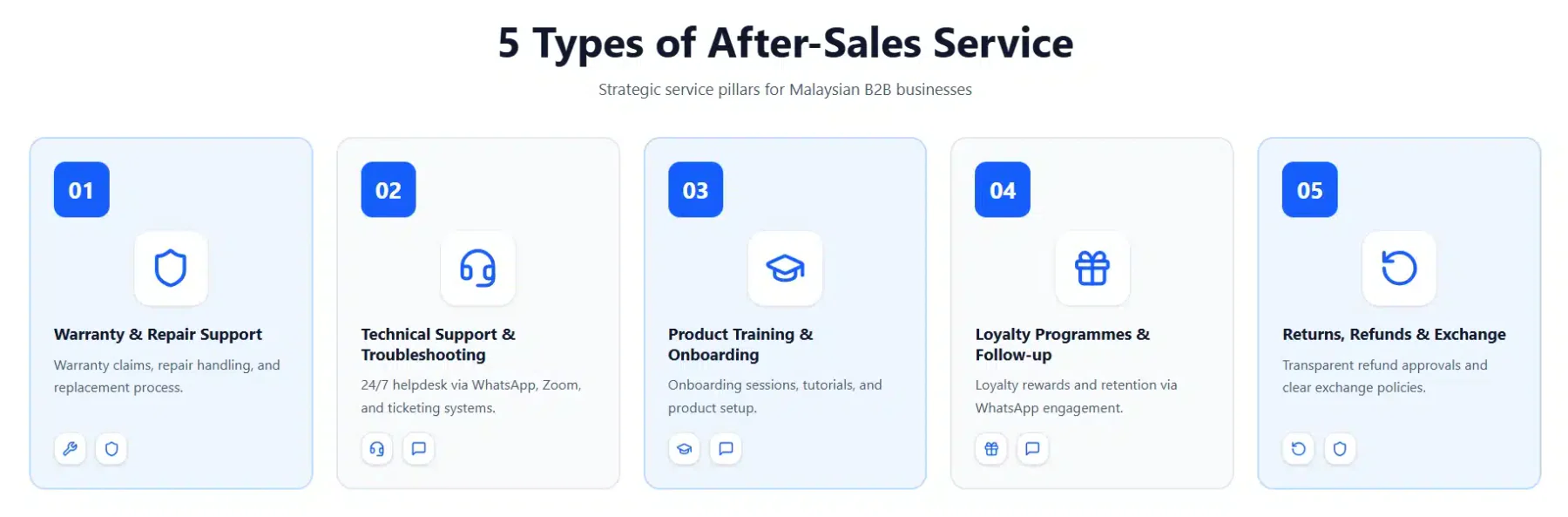
After-sales service rarely arrives in a single shape. Most businesses run several types in parallel, each with its own staff, timing, and tooling. The five categories below cover what nearly every Malaysian B2B operation needs to define, at minimum.
1. Warranty and Repair Support
Warranty and repair support ensures customers receive assistance when products experience issues during the coverage period. This process usually includes handling claims, managing repairs or replacements, and coordinating service logistics to maintain customer trust and product reliability.
2. Technical Support and Troubleshooting
Malaysian businesses must comply with the Consumer Protection Act 1999, which requires companies to honour product quality, warranty, and repair obligations after purchase. Reliable after-sales processes help businesses maintain compliance while protecting customer trust and satisfaction.
Technical support helps customers resolve problems when a product or service does not function as expected. Businesses typically provide assistance through helpdesks, remote support channels, ticketing systems, or on-site technicians depending on the complexity of the issue.
3. Product Training and Customer Onboarding
Customer onboarding and training help users understand how to properly use a product after purchase. Structured guidance during the early stages often improves user experience, reduces misuse, and increases long-term customer retention. Structured onboarding over the first 30 to 90 days is often the single biggest predictor of whether the customer stays.
4. Loyalty Programes and Follow-up Communication
Loyalty programes and follow-up communication help businesses maintain customer relationships beyond the initial purchase. Common activities loyalty programe platform include rewards programes, customer feedback collection, promotional offers, and personalized follow-ups to encourage repeat purchases and engagement.
5. Returns, Refunds, and Exchange Policies
Clear return, refund, and exchange policies help businesses handle customer issues more efficiently while reducing disputes. Transparent procedures and consistent processing channels improve customer confidence and create a smoother post-purchase experience.
After-Sales Service Examples
After-sales service practices among Malaysian businesses often differ from the examples commonly discussed in international case studies. Local execution leans on direct channels, personal touch, and visible follow-through. Four real-world patterns appear most often.
- Automotive Dealer, Klang Valley
Some automotive dealerships in Klang Valley send short WhatsApp video updates after scheduled servicing to explain inspections, replaced parts, and future maintenance needs. This approach helps improve transparency, strengthen customer trust, and encourage repeat service visits. - Electronics Retailer, Penang
Some electronics retailers in Penang provide setup assistance and follow-up support for higher-value purchases to improve customer satisfaction after the sale. These follow-ups can also encourage positive Google reviews and strengthen long-term customer retention. - Manufacturing Supplier, Johor
Manufacturing suppliers in Johor often provide after-sales support such as warranty handling, technical assistance, and maintenance follow-ups for industrial clients. These services help reduce operational downtime and improve long-term customer retention. - SaaS Vendor, Kuala Lumpur
Some SaaS providers in Kuala Lumpur conduct onboarding sessions and monthly check-ins during the first three months of a contract. Regular follow-ups and automated CRM reminders help improve customer engagement, reduce churn, and create upselling opportunities.
Key Metrics for After-Sales Service Performance
Understanding after-sales performance requires more than just handling customer complaints. Businesses also need measurable indicators to evaluate how efficiently their support processes operate and where improvements are needed.
- Difficult to track after-sales performance manually
Businesses often struggle to measure complaint response times, warranty resolution rates, and customer satisfaction without proper KPI tracking systems. - Repeat Complaint Rate becomes harder to monitor as ticket volume grows
Tracking repeat complaints requires complete customer history visibility, which spreadsheets usually cannot handle efficiently beyond 50 tickets per month. - Poor KPI visibility can increase operational costs
Without accurate reporting, businesses may overlook inefficiencies that lead to higher after-sales expenses and repeated service issues. - Reducing repeat complaints can improve profitability
Lowering repeat complaint rates helps businesses decrease ticket handling costs and generate significant long-term savings. - Regular KPI reviews improve service consistency
Monthly monitoring of response time and resolution rate, combined with quarterly reviews of CSAT and repeat complaints, helps businesses maintain stronger after-sales performance.
By consistently monitoring these KPIs, businesses can improve operational visibility, reduce service inefficiencies, and create a more reliable after-sales experience for long-term customer retention.
How to Build an After-Sales Service System

Building a structured after-sales process does not start with software. It starts with knowing what your team actually does today and where the work breaks down. The five steps below help businesses move from inconsistent after-sales handling to a structured system that can support long-term growth.
Step 1: Audit the Current Process
Document every after-sales activity your team performs in a typical month. Capture who handles what, which channel each request comes through, and how long the average response takes. The point of this step is visibility, not change. Most operators discover that two or three people are doing similar work in parallel without realizing it.
Step 2: Define KPIs and Service Level Agreements
Pick three to five KPIs from the table in the previous section. Then attach a Service Level Agreement (SLA), which is a written commitment to a response and resolution standard. A common starting point for B2B operations in Malaysia is a four-hour first response and a 24-hour resolution target for non-critical issues.
Step 3: Map Customer Touchpoints
Businesses need to map every customer interaction that happens after a purchase, including delivery confirmation, onboarding, complaints, follow-ups, and renewals. Simple customer journey map helps teams identify operational gaps, while businesses using a structured client management system can track customer interaction history more accurately and efficiently.
Step 4: Choose a System That Fits Your Scale
The right after-sales system depends on operational size and ticket volume. Small businesses may manage support effectively with WhatsApp Business and spreadsheets, while growing companies often require client management or CRM platforms with ticketing features, and larger enterprises typically need ERP systems that integrate after-sales operations with inventory, billing, and field service management.
Step 5: Train the Team and Set Escalation Rules
A system only works when the people running it know the rules. Train every frontline staff member on the new process, the SLA, and the tools. Build an escalation matrix, which is a simple chart showing who handles what and when an issue should move up a level. Most teams absorb this in a half-day workshop and refine it through the first month of live use.
How CRM and ERP Software Support After-Sales Operations?

As after-sales operations grow, manual processes and disconnected spreadsheets often make it difficult for teams to respond quickly and maintain consistent customer support. CRM and ERP systems help businesses centralize customer information, automate workflows, and improve operational visibility across after-sales activities.
- Automatic ticket creation improves response management
CRM and ERP systems can collect requests from email, WhatsApp, web forms, and phone logs into a centralized ticket queue to prevent missed enquiries. - Centralized customer history increases service efficiency
Agents can instantly access customer records, including past purchases, warranty claims, and previous tickets, without searching through multiple systems. - SLA tracking helps maintain response standards
Automated Service Level Agreement (SLA) timers and escalation workflows help businesses monitor response deadlines and prevent unresolved issues from being overlooked. - Real-time reporting improves operational visibility
Managers can monitor Key Performance Indicator (KPIs) such as resolution rates, Customer Satisfaction Score (CSAT) trends, and ticket backlogs through live dashboards instead of relying on manual reporting. - CRM and ERP systems reduce operational inefficiencies
Automated workflows help lower response times, reduce repeat complaints, and improve ticket handling capacity without increasing headcount. - System requirements depend on business scale
Smaller businesses may only require a client management or CRM platform for ticketing and communication, while larger companies often need ERP systems that integrate after-sales with inventory, finance, and field service operations.
Choosing between a dedicated CRM platform and a full ERP depends on how connected after-sales needs to be to the rest of the business. The right CRM or ERP solution helps businesses simplify after-sales operations, improve customer experience, and reduce the operational friction that comes with scaling support processes.
Conclusion
After-sales service is no longer just an additional support function, but a critical part of customer retention and long-term business growth in Malaysia. Businesses that still rely on manual handling and disconnected communication channels often face slow response times, unresolved complaints, and declining customer trust that directly impact profitability.
Building a structured after-sales system helps businesses improve service consistency, strengthen customer relationships, and gain better operational visibility. With clear KPIs, defined workflows, and the right CRM or ERP support, companies can reduce repeat complaints, speed up resolution times, and create a smoother customer experience across every touchpoint.
As customer expectations continue to rise, investing in a scalable after-sales system becomes essential for maintaining competitiveness and customer loyalty. Book a free demo to explore how the right CRM or ERP solution can help simplify support processes and enhance customer satisfaction.

FAQ about After-Sales Service
After-sales service focuses specifically on post-purchase activities such as warranty handling, onboarding, maintenance, and follow-up, while customer support covers broader interactions before and after a sale.
Small businesses can start with structured follow-ups, WhatsApp Business communication, shared ticket tracking, and clear response procedures before investing in larger CRM or ERP systems.
Industries such as manufacturing, automotive, electronics, SaaS, retail, healthcare, and property development benefit significantly because they involve ongoing customer relationships and long-term support needs.
Businesses should consider upgrading when ticket volume increases, response times become inconsistent, customer information is difficult to track, or teams start relying on disconnected spreadsheets.
Yes. Strong after-sales service improves customer retention, repeat purchases, upselling opportunities, referrals, and long-term customer lifetime value.