







An employee calls at 6am to say their father has died and they need three days off. Compassionate leave offers a clear solution by giving employees paid or unpaid time off after the death or serious illness of an immediate family member. Without a clear policy, similar situations may still be handled differently across departments or employees.
In Malaysia, compassionate leave is an employer-provided benefit, not a statutory leave under the Employment Act 1955. This guide explains how to set clear eligibility, leave days, approval processes, and documentation requirements.
Compassionate leave gives employees paid or unpaid time off after the death or serious illness of an immediate family member. In Malaysia, it is an employer-provided benefit rather than statutory leave under the Employment Act 1955, so a clear policy helps ensure consistent treatment while giving employees time to handle family responsibilities.
Key Takeaways
Compassionate leave is not a statutory entitlement in Malaysia under the Employment Act 1955; it is governed entirely by company policy.
Most Malaysian employers grant between 1 to 3 days of leave per event, scaled by the employee relationship to the deceased.
Paid compassionate leave is treated as ordinary wages, while unpaid leave reduces gross salary and may shift EPF contribution to a lower wage band.
Many Malaysian companies manage compassionate leave through messages or spreadsheets, causing inconsistent approvals and payroll errors. A centralized HR system standardizes leave policies and adjusts EPF, SOCSO, and PCB calculations automatically.

What is Compassionate Leave Meaning?
Compassionate leave is time off granted to an employee who is dealing with a death, a critical illness, or a serious emergency involving a member of their family. It exists so the employee can attend to funeral arrangements, religious rites, hospital visits, or the administrative work that follows a death, without having to spend annual leave or claim sick leave they are not medically entitled to.
Four features separate it from the other leave types a Malaysian employer manages:
- The trigger is a family event, not the employee's own health: This is what puts it outside section 60F of the Employment Act 1955, which covers sick leave certified by a registered medical practitioner for the employee themselves.
- Notice is usually zero: Deaths do not schedule themselves. The request almost always arrives by phone or message outside working hours, which is why the approval route matters as much as the entitlement itself.
- The entitlement is discretionary: Because no statute defines it, the number of days, who qualifies, and whether it is paid are all set by the employer.
- Eligibility is often narrower than other leave: Many Malaysian policies restrict full compassionate leave to confirmed employees and give probationers a reduced allocation or unpaid time off instead.
Companies may label compassionate leave as bereavement or emergency leave, with different rules and approvers. Defining each leave type clearly helps ensure consistent employee entitlements.
What Is the Difference Between Compassionate Leave, Bereavement Leave, and Emergency Leave?
Bereavement leave is a more specific form of compassionate leave, while emergency leave is a broader category that may not include a family death. None of these leave types is legally required in Malaysia, and the table below explains how they are typically distinguished in employee handbooks.
| Feature | Compassionate Leave | Bereavement Leave | Emergency Leave |
|---|---|---|---|
| What it covers | Death, critical illness, or a serious family crisis | Death only, and the mourning period that follows | Any urgent unforeseen event, including accidents, floods, or a child's medical emergency |
| Typical trigger | A death or hospitalisation in the immediate family | A death in the immediate family | An unplanned event the employee could not have scheduled around |
| Statutory in Malaysia? | No | No | No |
| Usually paid? | Yes, for the allocated days | Yes, for the allocated days | Often deducted from annual leave, or unpaid once the allocation runs out |
| Typical days granted | 1 to 3 days per event | 1 to 3 days per event | Case by case, commonly capped at 2 to 3 days a year |
| Documentation asked for | Death certificate or burial permit, sometimes only after the employee returns | Death certificate or burial permit | Whatever evidence fits the event, such as a police report or hospital slip |
| Who uses the term | Most Malaysian and Singaporean employers | Multinationals following US or UK handbook wording | Companies that prefer one flexible bucket over several named leave types |
Is Compassionate Leave Mandatory Under Malaysian Law?

No Malaysian law requires an employer to give compassionate leave. The Employment Act 1955 lists the leave types a covered employee must receive, and compassionate leave is not on that list. If your company grants it, that is your own decision, recorded in your own documents.
What the Employment Act 1955 Actually Covers
The Employment Act 1955, also cited as Act 265, is the main law setting minimum working conditions in Malaysia. Since 1 January 2023 it covers all employees working under a contract of service, although a few overtime and shift-related protections still apply only to those earning up to RM4,000 a month.
The Act names five kinds of leave and sets a minimum for each. Here is the complete list, with the section number that creates each one:
| Leave Type | Section | Statutory Minimum |
|---|---|---|
| Annual leave | s. 60E | 8 days for less than 2 years of service, 12 days for 2 to 5 years, and 16 days for more than 5 years |
| Paid sick leave | s. 60F | 14, 18 or 22 days by length of service, plus up to 60 days where hospitalisation is necessary |
| Maternity leave | s. 37 | 98 consecutive days |
| Paternity leave | s. 60FA | 7 consecutive days |
| Public holidays | s. 60D | 11 gazetted days, of which 5 are compulsory |
| Compassionate leave | None | Not provided for anywhere in the Act |
Read the last row against the five above it. Every leave type the Act guarantees has a section number attached to it. Compassionate leave has none, because Parliament never wrote one. A useful way to check any claimed entitlement is to ask which section creates it. If nobody can name the section, it is company policy, not law.
Why Compassionate Leave Sits in Company Policy, Not in the Act
Because the Act is silent, the obligation has to come from somewhere else. In Malaysian practice it comes from one of three documents:
- The employment contract: If the letter of offer promises compassionate leave, it becomes a contractual term. Refusing it is then a breach of contract rather than a breach of the Employment Act.
- The employee handbook: Most Malaysian handbooks are incorporated into the contract by reference, meaning the contract states that the handbook forms part of it. That single sentence makes the compassionate leave clause enforceable.
- The collective agreement: Where a trade union is recognized, the agreement becomes binding once the Industrial Court takes cognizance of it. Compassionate leave terms in collective agreements are often more generous than anything in a standard handbook.
There is a consequence here that HR teams routinely underestimate. Once compassionate leave has been granted consistently over a period, it can amount to an established practice, and withdrawing it without notice or consultation invites a dispute at the Industrial Court.
How Many Days Do Malaysian Companies Actually Give?
Most Malaysian employers grant between one and three days per event, scaled by how closely the employee was related to the person who died. Because there is no statutory scale, the figures below describe the bands commonly observed in Malaysian handbooks.
Common Practice by Relationship to the Deceased
| Relationship to the Employee | Days Commonly Granted | Notes |
|---|---|---|
| Spouse | 3 days | Almost always the maximum allocation, and almost always paid |
| Child | 3 days | Some policies extend this where the employee is the sole surviving parent |
| Parent | 3 days | The single most common compassionate leave request in Malaysia |
| Sibling | 2 days | A few policies grant 3 days where the sibling lived in the same household |
| Parent-in-law | 2 days | Sometimes limited to the first occurrence, or reduced to 1 day |
| Grandparent | 1 to 2 days | The most inconsistent category across employers |
| Other relatives | 0 to 1 day | Frequently handled as annual leave or unpaid leave instead |
Cultural and Religious Considerations in Malaysia
A compassionate leave policy written from a template will fail in Malaysia if it ignores how long funeral obligations actually last for each community:
- Muslim funerals: Normally take place within 24 hours of death, so the immediate need is urgent but short. However, families commonly hold tahlil gatherings on the third, seventh and fortieth day.
- Chinese funerals: Often involve a wake lasting three to five days before the burial or cremation, and in some families seven days. A flat three-day allocation can end before the funeral itself takes place.
- Hindu funerals: Are usually held within a day of the death, with observances continuing to the sixteenth day. The heaviest obligations fall in the first three days.
Two design choices handle this well: either allow the allocated days to be taken non-consecutively within a defined window (e.g., 30 days from the date of death), or let employees extend using annual leave with automatic approval.
Factors That Change the Entitlement
- Confirmation status: Many policies give probationers half the allocation, or unpaid leave only, with the full entitlement starting upon confirmation.
- Where the funeral is held: Policies that grant an extra day for outstation travel, and two for a funeral overseas, remove the single most frequent source of ad-hoc requests.
- Per event or per year: Most Malaysian policies apply the entitlement per event. Those that impose an annual cap should state what happens when it is exhausted.
- Employment type: Contract staff, part-timers, and foreign workers are often on a different allocation. If your workforce includes migrant employees, review our guide to payroll for foreign workers in Malaysia.
Paid or Unpaid: How Compassionate Leave Affects Payroll
Because compassionate leave is not statutory, the pay decision belongs to the employer, and each option produces a different set of numbers on the payslip and in monthly statutory submissions.
Paid Compassionate Leave and Statutory Contributions
When compassionate leave is paid, the day is treated exactly like a normal working day. The employee receives their ordinary wages, and those wages remain wages for every statutory purpose:
- EPF: The paid leave amount remains part of the employee’s monthly wages, so EPF contributions continue to be calculated based on the applicable contribution rate.
- SOCSO & EIS: Since the employee’s wages remain unchanged, the contribution amount is determined using the applicable PERKESO contribution schedule for that wage level.
- PCB: Monthly tax deductions are calculated based on the employee’s gross remuneration, which remains unchanged when compassionate leave is fully paid.
Unpaid Compassionate Leave and Salary Deduction
Unpaid leave is not a deduction from wages under section 24 of the Employment Act 1955. It is a case of wages never being earned for days that were not worked. It requires no written consent from the employee and no approval from the Director General of Labour.
For a monthly-rated employee, the daily figure is the ordinary rate of pay (monthly wages divided by 26). Here is an example for an employee earning RM3,000 a month who takes two unpaid compassionate days:
| Calculation Step | Amount (MYR) |
|---|---|
| Ordinary Rate of Pay (RM3,000 ÷ 26) | RM115.38 |
| Two Unpaid Days (RM115.38 × 2) | −RM230.77 |
| Gross Wages for the Month | RM2,769.23 |
EPF contributions for wages up to RM5,000 are read off the Third Schedule in wage bands. Dropping from RM3,000 to RM2,769.23 moves the employee into a lower band, which reduces both the employee and employer contributions. SOCSO and EIS behave similarly under their respective contribution tables.
Recording Compassionate Leave on the Payslip
Section 18A of the Employment Act requires employers to issue a payslip showing wages and deductions. A clear payslip format shows paid compassionate days inside basic salary with the leave balance updated separately, while unpaid days appear as a distinct line item (e.g., "Unpaid Leave - 2 Days") rather than an unexplained deduction.
How to Write an Effective Compassionate Leave Policy
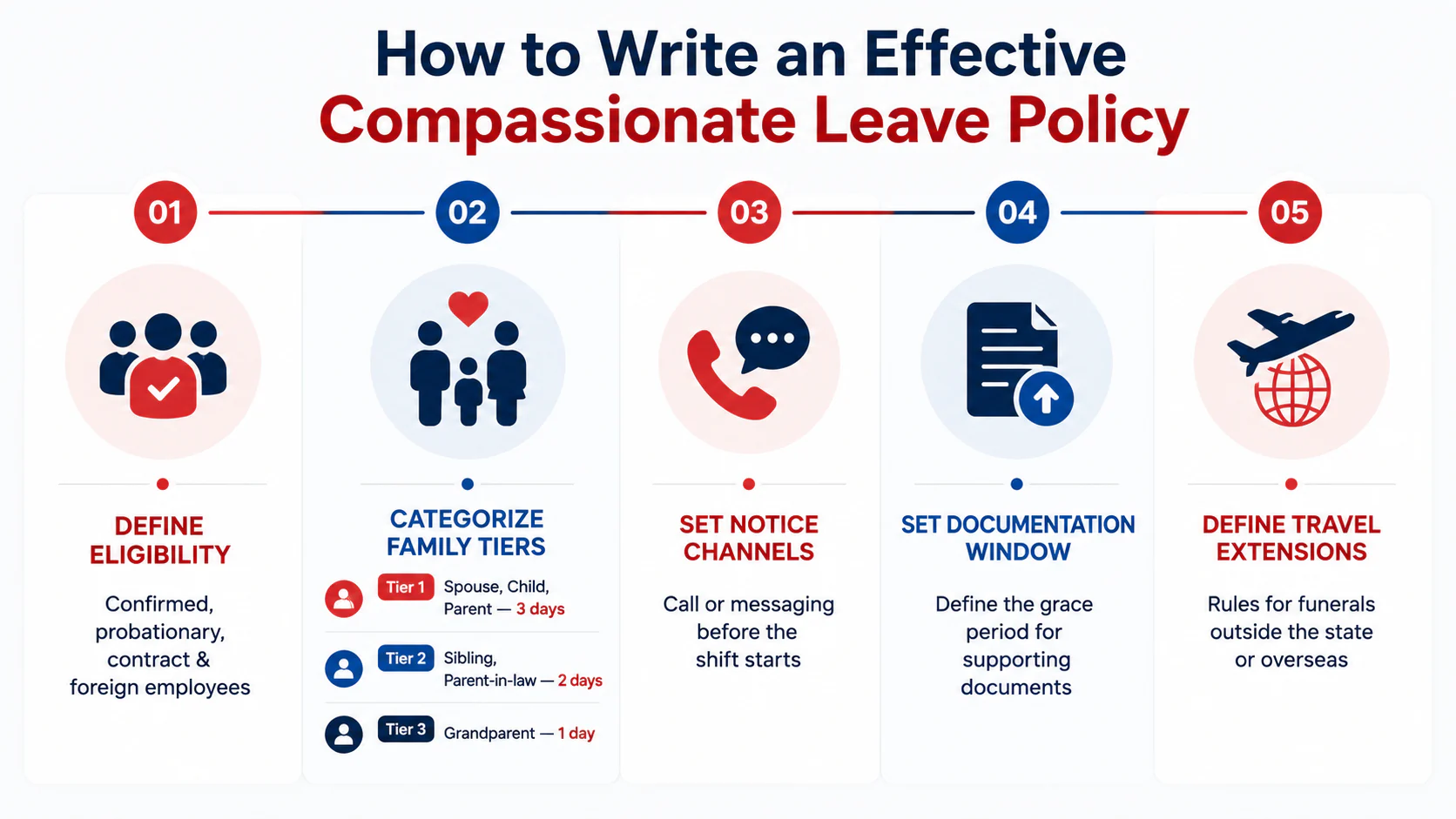
Drafting a robust compassionate leave policy eliminates ambiguity during emergencies and prevents line managers from issuing conflicting approvals. When crafting your employee handbook clause, cover these essential structural elements:
1. Scope of Eligibility
Clearly state which employee groups are entitled to compassionate leave, such as confirmed employees, probationers, contract workers, or foreign employees. The policy should also explain whether eligibility differs based on employment status, length of service, or other internal requirements.
2. Categorized Family Tiers
Define which family relationships qualify for compassionate leave and the number of paid days available for each category. For example, Tier 1 may cover a spouse, child, or parent with 3 paid days, while Tier 2 covers siblings or parents-in-law with 2 days, and Tier 3 covers grandparents with 1 day.
3. Notice & Application Channels
Specify how and when employees should notify their supervisor or HR when an emergency occurs. The policy can require employees to inform the relevant person through a phone call, messaging application, or another approved channel as soon as possible, preferably before their normal shift starts.
Specify how and when employees should notify their supervisor or HR when an emergency occurs. The policy can require employees to inform the relevant person through a phone call, messaging application, or another approved channel as soon as possible, preferably before their normal shift starts.
4. Documentation Submission Window
Set a clear timeframe for employees to submit supporting documents after taking leave. Providing a reasonable grace period after returning to work allows employees time to obtain documents such as death certificates or medical records while ensuring HR can maintain proper leave records.
5. Travel & Extension Provisions
Outline whether employees may receive additional leave when they need to travel to attend a funeral or support an immediate family member outside their working state or overseas. The policy should clarify the number of additional days available, approval requirements, and whether the extension is paid or unpaid.
Sample Policy Clause Template for Malaysian Handbooks
| Sample Handbook Clause |
|---|
|
"Confirmed employees are eligible for paid compassionate leave per event as follows: 3 working days for the loss of an immediate family member (Spouse, Child, Parent); 2 working days for a Sibling or Parent-in-law; and 1 working day for a Grandparent. Employees must notify their direct supervisor prior to shift commencement. Official documentation (Death Certificate or Burial Permit) must be submitted via the HR portal within seven (7) working days of returning to work. Any extended leave requested beyond this allocation shall be offset against Annual Leave or taken as Unpaid Leave, subject to manager approval." |
How Employees Apply and How HR Should Approve Compassionate Leave
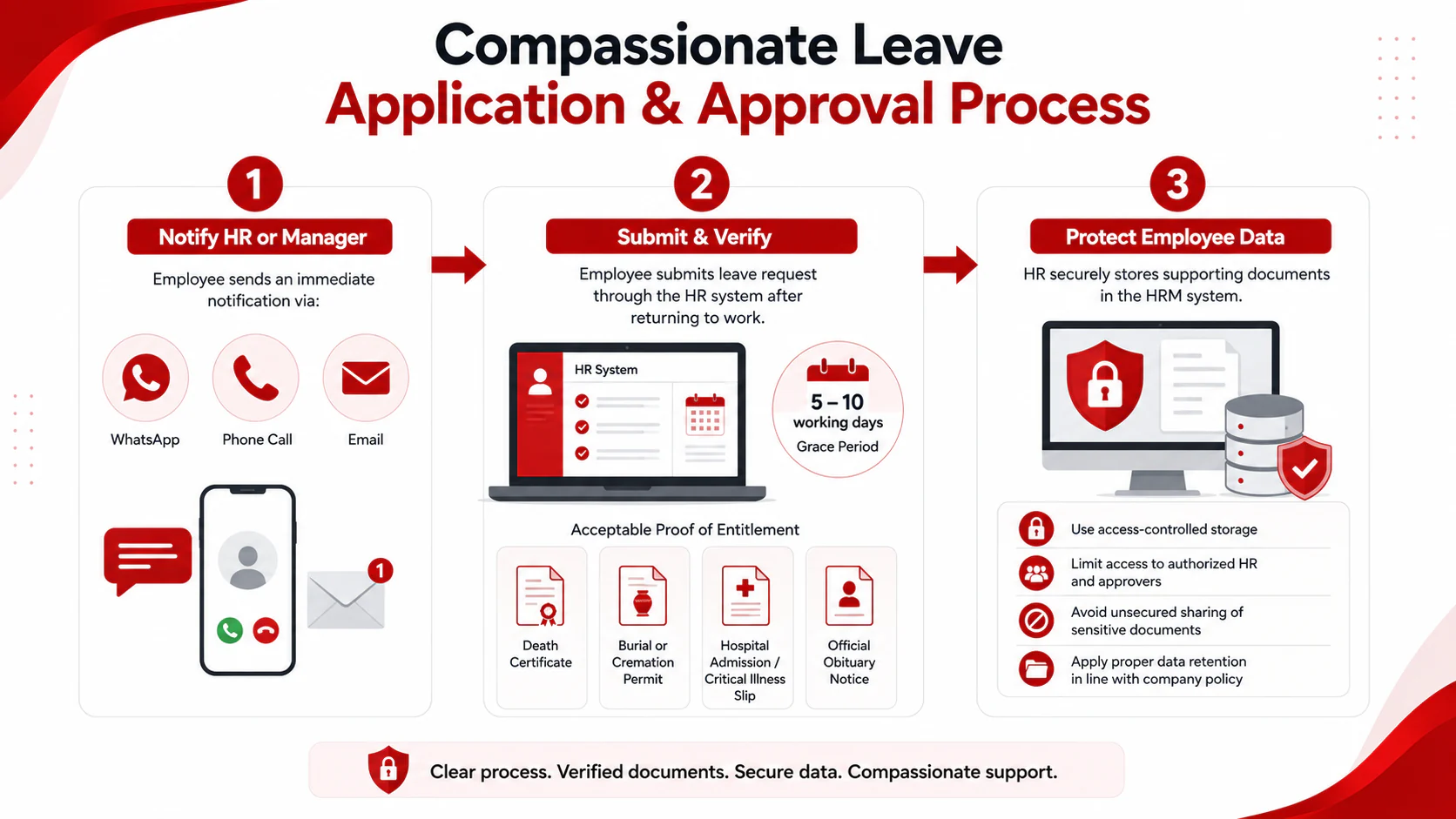
Emergency approval processes must balance organizational governance with empathy. Requiring immediate paper forms during an active bereavement creates unnecessary stress and forces staff into non-compliance.
Application Workflow and Grace Periods
Establish a two-step application SOP:
- Immediate Verbal / Messaging Notification: The employee notifies their line manager or HR representative via WhatsApp, phone call, or email as soon as possible to request immediate absence.
- Formal System Submission & Grace Period: Upon returning to work, the employee logs the leave into the HR system. Provide a 5 to 10 working day grace period for uploading proof of entitlement, recognizing that official death certificates from the National Registration Department (JPN) or foreign embassies can take time to issue.
Acceptable Proof of Entitlement
To verify leave usage and prevent fraudulent claims, HR policies should clearly state which documents employees can provide as proof of entitlement. Depending on the circumstances, acceptable documents may include:
- Death Certificate: An official death certificate issued by JPN or the relevant international authority can be used to verify the death of an immediate family member.
- Burial or Cremation Permit: This document can serve as supporting evidence when a death certificate is not yet available or when additional confirmation of the funeral arrangements is required.
- Hospital Admission/Critical Illness Slip: For compassionate leave related to a severe family illness, an official hospital document can confirm the employee’s immediate family member was admitted or receiving critical medical treatment.
- Official obituary notice: Where formal certificates are delayed, an official obituary notice may be accepted when accompanied by a statutory declaration to support the claim.
Protecting Sensitive Employee Data Under Malaysia's PDPA 2010
Death certificates and medical letters contain sensitive Personal Identifiable Information (PII), such as NRIC numbers, home addresses, and medical diagnoses. Death certificates and medical letters contain sensitive personal information, so HR departments must handle them securely under Malaysia's Personal Data Protection Act 2010 (PDPA).
An HRM system can help store these documents securely with access controls, limit visibility to authorized HR staff and approvers, prevent unsecured sharing, and support proper data retention.
Death certificates and medical letters contain sensitive personal information, so HR departments must handle them securely under Malaysia's Personal Data Protection Act 2010 (PDPA). An HRM system can help store these documents securely with access controls, limit visibility to authorized HR staff and approvers, prevent unsecured sharing, and support proper data retention.
- Use Access-Controlled Storage: Store uploaded documents securely within the company’s HR system or other protected digital databases, with appropriate access controls to prevent unauthorized viewing or downloads.
- Limit Document Access: Restrict visibility to authorized HR personnel and relevant approvers who need the information to verify and process the leave request.
- Avoid Unsecured Sharing: Do not circulate death certificates, medical letters, or other sensitive documents through open company chats, group emails, or other channels where unauthorized employees may access them.
Apply Proper Data Retention: Keep supporting documents only for as long as necessary for HR, payroll, audit, or legal purposes, in line with the company’s data retention policy.
Managing Compassionate Leave Without Manual Tracking
Relying on physical paper forms, unrecorded text messages, or manual spreadsheets for emergency leave creates major administrative risks. Unrecorded leave days result in payroll calculation mistakes, misapplied EPF/SOCSO contributions, and compliance disputes during labor audits.
Modern HR platforms centralize leave and payroll data to support the right payroll calculations through a single automated workflow:Mobile Self-Service Submissions: Employees or managers can submit urgent leave requests directly from their mobile devices, allowing HR and managers to review requests quickly while keeping leave records and team schedules updated.
- Automated Document Attachments: Employees can securely upload supporting documents, such as death certificates or medical letters, directly to the relevant leave request. Documents can also be submitted within the approved grace period without relying on separate emails or physical copies.
- Seamless Statutory Payroll Sync: The system can automatically update payroll based on whether compassionate leave is paid or unpaid. For unpaid leave, the relevant salary adjustments can flow into EPF, SOCSO, EIS, and PCB calculations without requiring HR staff to enter formulas manually.
- Complete Audit Trails: Every leave request can retain its approval history, leave balance changes, supporting documents, and relevant payroll records. This provides HR with a clear digital trail for internal reporting, employee queries, and labor inspections.
Conclusion
Compassionate leave is not a statutory requirement in Malaysia, but it is one of the most vital workplace policies an employer can establish. While the law leaves the decision entirely to management, having a clear, transparently documented policy ensures that employees receive compassionate support during times of crisis without exposing the company to inconsistent approvals or industrial relations disputes.
By defining eligibility tiers, establishing clear documentation SOPs, and ensuring unpaid leave days are accurately processed through your payroll system, HR teams can build a compliant and empathetic workplace culture.
Ready to modernize your leave tracking and statutory payroll management? Schedule consultation with our expert to see how automated HR software can streamline your company's leave workflows and payroll accuracy.
schedule consultation with our expert

FAQ about Compassionate Leave
Compassionate leave in Malaysia depends on company policy, as it is not provided under the Employment Act 1955. Employers decide the number of days, eligible family members, whether it is paid, and what proof is required. Employees usually notify HR or their manager as soon as possible and submit supporting documents, such as a death certificate, when required.
Most Malaysian employers grant 1 to 3 paid days per event for immediate family members (spouse, child, parent) and 1 to 2 days for secondary relatives (siblings, grandparents, parents-in-law).
Yes. Unpaid leave reduces monthly gross wages. For salaries up to RM5,000, EPF is calculated using wage bands in the Third Schedule, which can shift the employee into a lower contribution band for both employer and employee shares.
Employers typically require a Death Certificate issued by JPN, a Burial Permit, or a hospital critical illness slip, usually submitted within a 5 to 10 working day grace period after returning to work.
Compassionate leave usually covers the death of an immediate family member and may also include serious illness or accidents involving close relatives. Eligible family members often include a spouse, child, parent, or sibling, while other relatives may receive different entitlements. Since each employer sets its own rules, the policy should clearly define qualifying events and family relationships.