







Construction projects generate large amounts of cost, schedule, site, and contract data that are often stored across different systems. This makes it harder for project teams to identify delays, control costs, and respond quickly to on-site issues. AI in construction helps address these challenges by analyzing project data, identifying patterns, and providing actionable insights while leaving final decisions to construction professionals.
As digital transformation accelerates, Malaysian construction companies are becoming more prepared to adopt AI-powered technologies. A 2024 CIDB summary of an Autodesk and Deloitte report ranked Malaysia second among six Asia-Pacific markets for digital technology adoption, highlighting a strong foundation for using AI to support estimating, scheduling, document management, safety monitoring, and other project workflows.
To maximize the benefits of AI in construction, businesses should start with a specific operational challenge rather than adopting the technology for its own sake. The following guide explores practical use cases to help construction companies adopt AI more effectively.
Key Takeaways
Successful AI adoption in construction combines intelligent automation with human oversight to improve project outcomes.
AI can improve construction workflows from planning to maintenance, provided critical decisions remain under human supervision.
A structured AI implementation plan helps construction companies achieve measurable improvements while maintaining efficient project execution.
Managing complex construction projects can lead to inefficiencies and higher costs. Digital solutions help simplify operations and improve project performance.

What Is AI in Construction?
AI in construction is a technology that helps construction companies improve project planning, cost estimating, scheduling, safety monitoring, and asset maintenance by analyzing large volumes of project data. Using technologies such as machine learning, computer vision, generative AI, and predictive analytics, AI identifies patterns and provides recommendations to support decision-making, while engineers and project teams remain responsible for the final decisions.
It is important to distinguish AI from other construction technologies. Tools such as Building Information Modeling (BIM), IoT devices, drones, sensors, and digital twins mainly collect or organize project data, while AI analyses that information to identify risks, predict outcomes, or highlight issues that require attention. Any AI-generated output should still be reviewed against project requirements and professional judgement before action is taken.
How Is AI Used in the Construction Industry?

AI can support many activities across the construction project lifecycle, but its role varies depending on the workflow. The table below shows common construction processes where AI can assist, along with the human oversight needed before decisions are implemented.
Design and BIM Analysis
AI can compare design alternatives, inspect model information, and flag potential conflicts for review. It may help teams prioritize issues before coordination meetings, but it does not replace design checks, engineering calculations, or formal approval by the responsible professional.
Cost Estimating and Tender Analysis
AI-powered construction estimating software can assist with quantity takeoff, extract tender information, and compare resource assumptions with previous projects. The output serves as a draft estimate or decision support rather than a final tender price. A quantity surveyor should still verify the project scope, unit rates, exclusions, and contractual context before submitting a bid.
Project Scheduling and Resource Allocation
AI in construction project management can identify patterns associated with delays, compare schedule options, and highlight possible labour, equipment, or material constraints. This is useful for teams managing multiple construction projects, although resource changes still require operational approval.
Site Progress and Safety Monitoring
AI can support site safety and progress monitoring by comparing authorized site photos or video with planned progress to identify possible delays, hazardous conditions, or incorrect PPE use. These alerts help teams prioritize inspections, but they do not prevent incidents, prove compliance, or replace competent supervision. A construction monitor can also provide the structured progress records needed for review.
Procurement and Material Planning
AI can estimate material demand from the programme, detect unusual consumption, and identify supplier or delivery risks. Linking work schedules with purchasing and inventory gives the model better context, while buyers and project managers remain responsible for orders, substitutions, and supplier commitments.
Construction Document and Contract Analysis
Generative AI can search drawings, RFIs, contracts, variation orders, and reports, then summarize relevant passages for review. It may flag missing information or inconsistent terms, but contract variations, claims, valuations, and legal interpretations require authorized human approval.
Equipment and Facility Maintenance
AI can analyze sensor data and maintenance history to flag patterns associated with equipment deterioration. After handover, similar analysis can support facilities teams in prioritizing inspections and maintenance. Sensor networks provide data, but the AI model performs the analysis.
Benefits of AI in Construction
As more Malaysian construction companies adopt digital technologies, AI is helping project teams improve efficiency and make more informed decisions. The following benefits highlight where AI can add practical value across construction operations.
Better Project Planning and Cost Control
AI can surface schedule variance, cost variance, and emerging project risks earlier than periodic manual reporting. Teams can compare scenarios before changing resources or sequencing. This strengthens project control without treating a model forecast as a guaranteed outcome. Earlier visibility also gives teams more time to investigate whether a variance comes from scope, quantity, rates, productivity, construction procurement, or reporting quality.
Improved Site Visibility and Safety Support
Regular analysis of site records can create a more consistent view of progress and help safety teams prioritize conditions that need inspection. Repeated records can also reveal locations or activities that produce frequent alerts. The benefit is faster attention, not guaranteed safety. Professionals must verify every alert and apply the project’s control procedures.
Faster and More Consistent Decisions
AI reduces repeated searching, summarizing, and comparison work. When stakeholders use one governed data source, they can review the same project facts instead of reconciling separate files. Consistent prompts, review criteria, and approval records also make recurring analyses easier to audit. Material decisions still sit with project managers, engineers, quantity surveyors, and authorized reviewers.
Challenges and Risks of Construction AI in Malaysia
While AI offers significant opportunities, its effectiveness depends on how well construction data and processes are managed. Malaysian construction companies should understand these challenges to ensure AI delivers reliable and practical results.
Fragmented Data and System Integration
Construction project data is often scattered across spreadsheets, drawings, emails, and different software platforms, making it difficult for AI to produce accurate insights. Before implementing AI, businesses should standardize data formats, establish consistent naming conventions and version control, and integrate project information so every recommendation remains traceable and can be verified against the original project records.
Implementation Cost and Digital Skills
Adoption requires software, integration, training, process redesign, and change management. A CIDB article citing the Autodesk and Deloitte survey reported that 42% of surveyed Asia-Pacific construction and engineering businesses viewed limited digital skills as a barrier, while 34% cited insufficient technology budgets. These figures describe the survey sample, not a Malaysian industry census.
Privacy, Cybersecurity, and AI Governance
Cameras, wearables, location records, and worker identities may involve personal data. Malaysian organizations should assess whether the Personal Data Protection Act 2010 and current DPIA guidance apply, then define access, retention, security controls, and lawful processing. The National Guidelines on AI Governance and Ethics provide responsible AI principles such as privacy, security, transparency, and accountability. AIGE is guidance, not a dedicated AI statute.
Model Errors and Human Accountability
AI can produce false alerts, inaccurate predictions, or recommendations that miss project context. Human approval should remain mandatory for design, tender prices, site shutdowns, variations, subcontractor evaluation, claims, invoices, and closure. Stakeholder duties continue under Malaysia’s Occupational Safety and Health Act 1994 and the Construction Work (Design and Management) Regulations 2024.
How to Implement AI in Construction?
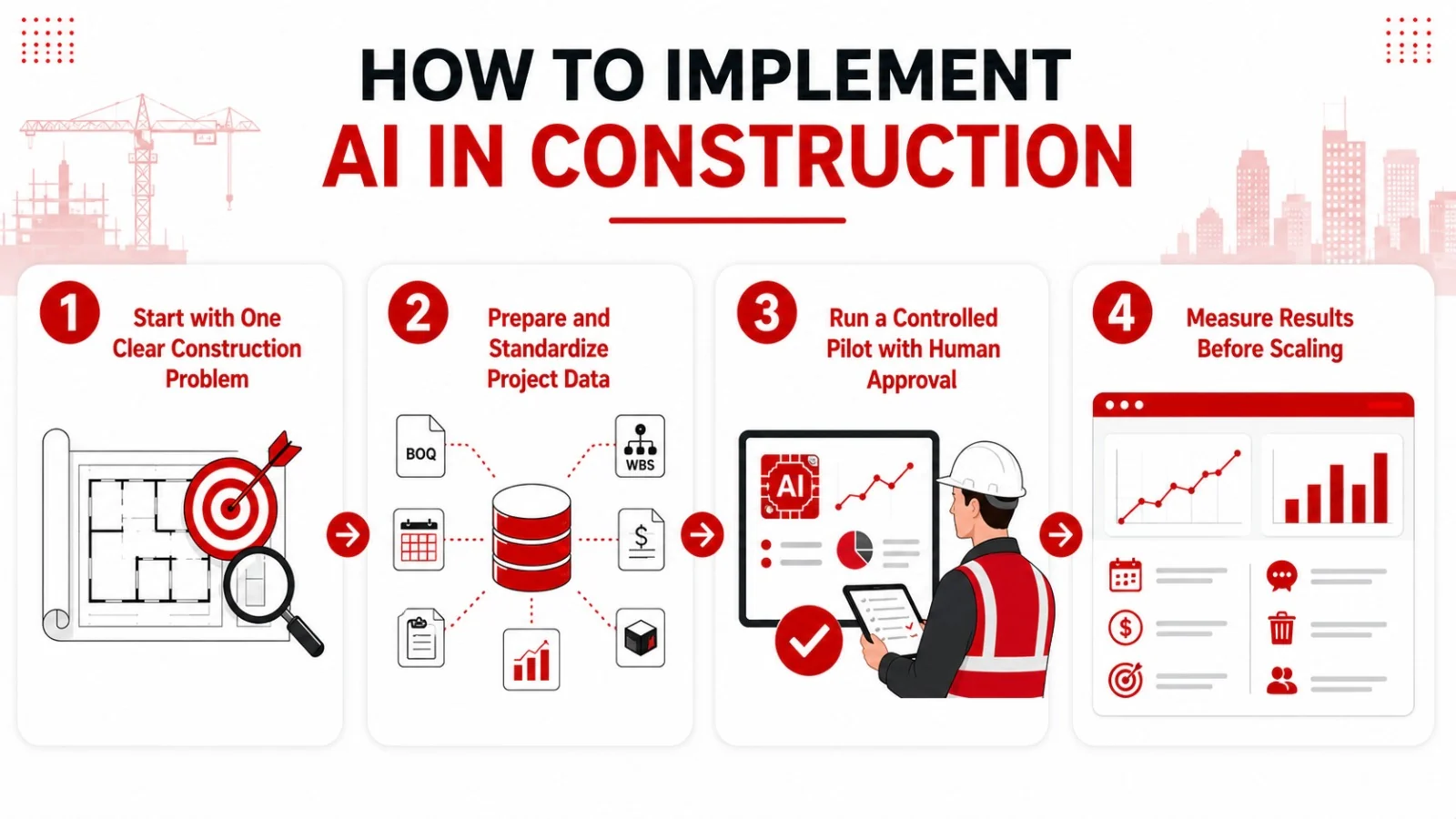
Successfully adopting AI in construction requires more than choosing the right technology. A structured implementation plan helps ensure AI supports existing workflows, delivers measurable value, and remains aligned with project requirements. Here are the key steps to implement AI effectively.
1. Start with One Clear Construction Problem
Instead of applying AI across the entire organization, begin with a specific and measurable challenge such as reducing Request for Information (RFI) ageing, improving cost estimation, managing material delays, or streamlining progress reporting. Focusing on one workflow makes it easier to evaluate AI's impact and refine the implementation before expanding to other processes.
2. Prepare and Standardize Project Data
AI performs best when project data is accurate, consistent, and well organized. Standardize key information such as Bills of Quantities (BOQs), Work Breakdown Structures (WBS), schedules, costs, contracts, inventory, and progress reports, while defining clear data ownership, access permissions, and update procedures to improve data quality and reliability.
3. Run a Controlled Pilot with Human Approval
Start with a pilot project or a single construction workflow before deploying AI more broadly. Allow AI to assist with analysis and recommendations, but ensure that qualified professionals review and approve any actions involving budgets, schedules, contracts, or site operations.
4. Measure Results Before Scaling
Evaluate the pilot using measurable indicators such as schedule and cost variance, forecast accuracy, RFI response time, material waste, equipment downtime, and user adoption. Expanding AI to additional projects should only be considered after the benefits, risks, and overall performance have been properly assessed.
How AI in Construction Improves Efficiency Across Project Stages
Integrating artificial intelligence into construction operations helps teams reduce manual planning errors, control material costs, and maintain tight project schedules. Rather than replacing human oversight, software tools process site data quickly to assist project managers and field crews at every phase of a build.
Pre-construction: Software analyzes historical cost data, subterranean geological surveys, and site plans to improve budget forecasting, flag complex soil risks before excavation, and model precise project parameters.
Construction: Connected sensors and automated machinery controls monitor real-time pressure, track equipment torque, and adjust tool alignment automatically to prevent structural deviations and ground settlement.
Post-construction: Systems evaluate long-term structural integrity, track ground stability, and organize digital handovers for ongoing maintenance of heavy infrastructure and subterranean assets.
To see how these principles apply to high-risk infrastructure projects, large-scale local implementations offer clear operational insights.
Case Study: AI-Driven Autonomous Tunnelling in Malaysia’s KVMRT Project
During the construction of the Klang Valley Mass Rapid Transit (KVMRT) Line 2 in Kuala Lumpur, infrastructure contractor Gamuda deployed the world's first Autonomous Tunnel Boring Machine (A-TBM). Tunnelling through Kuala Lumpur's complex karstic limestone geology traditionally carried severe risks of ground settlement and sinkholes, requiring constant manual adjustments by human operators.
By integrating neural network algorithms into the TBM control systems, the machine continuously analyzed real-time sensor data, cutterhead torque, and slurry pressure to steer itself autonomously. This system improved tunnelling advance rates while eliminating major ground settlement incidents across difficult subterranean stretches. Technical documentation from the project engineering team highlights how automated alignment processing reduced human steering errors and maintained consistent tunnel accuracy throughout the project.
How Integrated Project Data Supports Construction AI
Construction AI needs structured BOQ, WBS, progress, cost, procurement, contract, and claim data. A construction ERP can provide this foundation by connecting commercial and operational workflows, recording approvals, and preserving the source behind each result. Better data also makes it easier to investigate an incorrect recommendation. The system of record should show what changed, who approved it, and which version was used by the model.
HMX Construction supports BOQ and AI-assisted BOQ extraction, WBS, physical and financial progress, cost sheets, contracts, job orders, progressive claims, invoicing, and project completion controls. Its AI Coworker for Construction can use connected project data to help teams review costs, progress, documents, and risks. These capabilities support analysis and governed action rather than replacing professional approval.
Conclusion
AI is helping construction companies improve how they manage project planning, cost control, scheduling, safety monitoring, and other data-intensive processes. Its greatest value lies in supporting professionals with faster analysis and clearer insights, while important engineering and project decisions continue to rely on human expertise.
To achieve meaningful results, AI should be introduced alongside reliable project data, standardized workflows, and clear governance. Starting with a specific business challenge, evaluating outcomes, and expanding gradually allows construction companies to adopt AI in a practical way while maintaining accuracy, accountability, and professional oversight.
For businesses planning their digital transformation, a free demo can help illustrate how integrated construction management supports reliable project data and AI-enabled workflows.






FAQ about AI in Construction
AI supports construction project management by analysing project data to assist with cost estimating, scheduling, resource allocation, progress tracking, document review, and risk identification. It helps project teams identify potential issues earlier, compare different scenarios, and prioritise actions. However, engineers and project managers remain responsible for reviewing AI-generated insights and making the final decisions.
Yes. AI can assist with quantity takeoff, extract information from tender documents, compare estimates with historical project data, and identify potential cost variations. These capabilities can reduce manual effort and improve consistency, but a quantity surveyor should always verify the project scope, quantities, unit rates, assumptions, exclusions, and the final tender price before submission.
AI can help improve construction site safety by analysing authorised site images, videos, or sensor data to identify potential hazards, unsafe conditions, or incorrect use of personal protective equipment (PPE). These alerts help safety teams prioritise inspections and respond more quickly, but AI cannot guarantee compliance or prevent incidents. All findings should be reviewed by qualified safety personnel.
No. AI is designed to support construction professionals rather than replace them. It can automate repetitive tasks, analyse large volumes of project data, and provide recommendations, while engineers, quantity surveyors, project managers, and site supervisors continue to apply professional judgement, oversee operations, and make decisions that require experience, accountability, and regulatory compliance.
AI, BIM, and IoT serve different but complementary roles in construction. AI analyses data to generate predictions, recommendations, or automation. Building Information Modelling (BIM) creates and manages digital models containing project information, while the Internet of Things (IoT) connects sensors and devices that collect real-time data from construction sites and equipment. In many projects, BIM and IoT provide the data that AI analyses to support better planning and decision-making.
AI can help Malaysian contractors manage documentation and site records needed for CIDB reporting, such as safety records, Green Card compliance logs, and quality inspections. By automating document tracking and flagging missing records early, AI reduces last-minute compliance gaps. However, formal CIDB submissions and assessments still require review by authorized personnel.
Yes. AI can compare actual site progress against the work schedule and BOQ to prepare progress claim data faster. Computer-vision tools can also verify on-site completion against planned quantities from photos or video. However, the final Interim Payment Certificate (IPC) still requires authorization from the project quantity surveyor and relevant parties under the PAM or JKR contract terms.