









 Limited to 100 registrants

Businesses often underestimate the total cost of implementing a warehouse management system by focusing only on the initial software price, resulting in unexpected expenses for integrations, training, hardware, or implementation services. Understanding WMS pricing helps businesses build a more realistic budget, compare vendors fairly, and avoid costly surprises during deployment.
For Malaysian businesses, WMS budgeting should be evaluated in Malaysian Ringgit (RM) and aligned with local procurement requirements, operational complexity, and expansion plans. Bank Negara Malaysia provides the official reference for Malaysia’s currency, which is useful when reviewing RM-based quotations and budget assumptions.
This guide explains warehouse management system (WMS) pricing, the factors that influence costs, common pricing models, and how to compare the total cost of ownership before requesting a quotation.
Key Takeaways
WMS pricing in Malaysia depends on operational requirements, including warehouse complexity, system modules, integrations, implementation, and support services.
When comparing WMS options, evaluate the total cost of ownership because lower upfront prices may exclude essential services such as ERP integration, training, or post-go-live support.
Providing accurate operational details helps vendors recommend a WMS scope that aligns with current needs and future business growth.
Understanding the key factors that influence WMS pricing helps businesses plan a more realistic budget and avoid unexpected implementation costs. Requesting a tailored WMS quotation provides a clearer estimate based on your warehouse size, workflows, and future growth plans.
How Much Does Warehouse Management Software Cost in Malaysia?
There is no single fixed price for warehouse management software in Malaysia. The final cost depends on each company’s operational scope, including the number of warehouses, SKU volume, transaction activity, workflow complexity, required modules, integrations, implementation services, and ongoing support.
For example, an enterprise operating multiple distribution centres with batch, serial-number, or expiry-date tracking will usually require a broader scope than a business managing one warehouse with standard fulfilment workflows. Likewise, real-time integration with ERP, supply chain and e-commerce platforms, 3PL partners, or barcode devices may require additional configuration and testing.
Instead of asking only, “What is the WMS price?”, enterprise buyers should clarify what is included, what is excluded, and how costs could change as operations expand. This creates a more realistic view of the required investment in RM.
How WMS Pricing Models Work
WMS vendors may structure pricing differently depending on the deployment model, required features, and commercial arrangement. Understanding the model helps buyers compare quotations on a more consistent basis.
- Subscription-based pricing: The company pays a recurring fee, commonly monthly or annually. The total cost may depend on users, warehouses, modules, transaction volume, or service tier.
- Perpetual licence pricing: The company pays an upfront licence fee to use the software, while maintenance, upgrades, and support may be charged separately over time.
- Module-based pricing: Costs are determined by the features included, such as receiving, putaway, barcode scanning, wave picking, replenishment, mobile access, reporting, advanced traceability, even for access to AI assistants.
- User- or device-based pricing: Pricing may increase based on the number of warehouse users, handheld scanners, terminals, or connected devices required across locations.
- Custom enterprise pricing: Vendors prepare a tailored quotation based on operational requirements, integration needs, rollout phases, and support expectations.
Pricing models example:
| Pricing Model | Vendor Example | Example Pricing |
|---|---|---|
| Subscription-based | Zoho Inventory | RM118 to RM1,017 per organisation per month, depending on the selected plan. |
| Perpetual licence | HDF WMS | One-time perpetual licence fee based on the required modules and implementation scope. Pricing is provided by quotation. |
| Module-based | Descartes Finale | Starts from RM2,039 per month, with additional charges for the Barcode WMS Module and other add-ons. |
| User-based | Oracle WMS Cloud | Approximately RM2,247 per user per month, with a minimum requirement of 20 users. |
| Custom enterprise | HashMicro | Tailored quotation based on warehouses, modules, users, integrations, implementation, and support requirements. |
How to Compare WMS Vendor Pricing in Malaysia
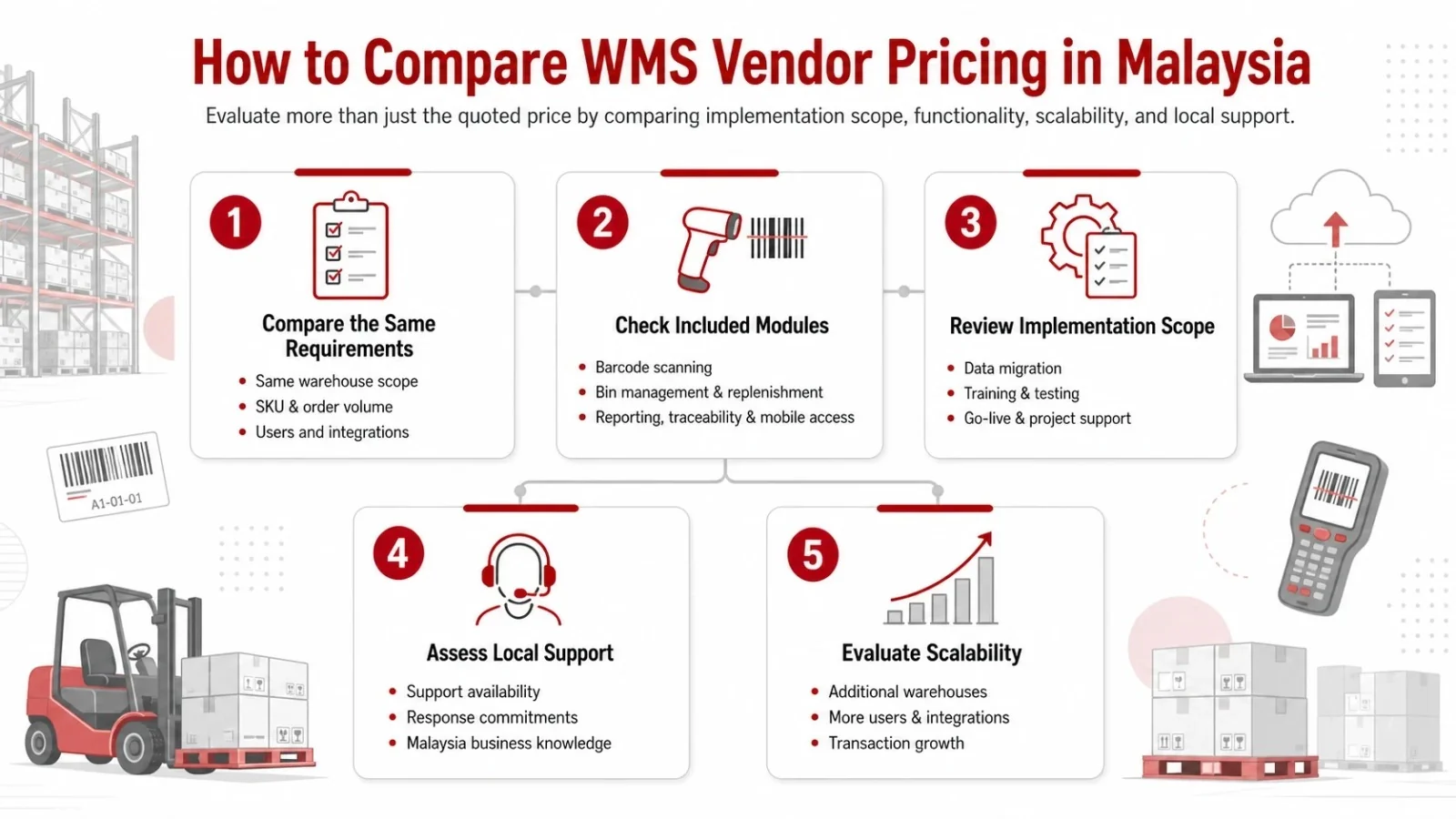
Vendor pricing should be assessed based on the scope behind the quotation, not only the initial amount in RM. A lower proposal may exclude services or capabilities that are essential for a complex warehouse operation.
- Compare the same requirements: Give each vendor the same operational brief, including warehouse count, workflows, SKU volume, order volume, users, and integration requirements.
- Check included modules: Confirm whether barcode scanning, bin management, replenishment, reporting, traceability, and mobile access are included or charged separately.
- Review implementation scope: Compare data migration, configuration, testing, training, go-live support, and project management services.
- Assess local support: Clarify support hours, response commitments, training availability, and whether the team understands Malaysian business operations.
- Evaluate scalability: Check how the price may change when adding warehouses, users, modules, integrations, or transaction capacity.
What Is Included in WMS Pricing?
A WMS quotation can cover more than access to warehouse software. The exact inclusions vary by vendor and project scope, so buyers should request a detailed breakdown before approving the investment.
- Core warehouse functions: Receiving, putaway, picking, packing, dispatch, stock transfers, cycle counts, and inventory visibility.
- Warehouse configuration: Setup for warehouse zones, racks, bins, storage rules, replenishment logic, and user permissions.
- Traceability capabilities: Batch tracking, serial-number tracking, expiry-date monitoring, and audit trails for controlled inventory.
- Integration services: Connectivity with ERP, accounting, sales, procurement, e-commerce, transport, or 3PL systems.
- Hardware support: Barcode scanners, mobile devices, label printers, and related configuration where required.
- Implementation services: Data migration, testing, training, go-live assistance, and post-implementation support.
Important notes: Do not assume that every WMS quotation includes all functions, integrations, hardware, and implementation services listed above. Request a written cost breakdown that clearly states what is included, excluded, charged separately, and covered by post-go-live support.
Key Factors That Affect WMS Pricing in Malaysia
The same WMS platform can require a very different investment depending on how an enterprise operates. These factors commonly affect the final quotation and total cost of ownership.
- Number of warehouses: Multi-site operations often require additional configuration, rollout planning, and user training. Each warehouse may have different layouts, inventory rules, or operational processes, increasing the overall implementation effort.
- Operational complexity: Advanced picking methods, high order volumes, cross-docking, returns, and replenishment rules can expand the implementation scope. More complex warehouse workflows typically require additional system configuration, testing, and user training.
- Inventory tracking requirements: Batch, serial, lot, and expiry tracking can require more detailed workflow configuration and controls. Businesses with strict traceability requirements may also need additional reporting and compliance features.
- Integration requirements: ERP, e-commerce, 3PL, marketplace, transport, and hardware integrations may involve additional development and testing. The number of connected systems and the complexity of data exchange can significantly influence implementation costs.
- Users and devices: The number of warehouse staff, supervisors, mobile users, scanners, and terminals can affect licensing or deployment costs. Additional devices may also require setup, configuration, and ongoing technical support.
- Implementation timeline: A phased rollout may spread costs over time, while an accelerated deployment may require more project resources. Project duration can also influence consulting, training, and change management requirements.
One-Time vs Ongoing WMS Costs
Enterprise buyers should separate one-time implementation expenses from recurring costs. This makes it easier to estimate the full WMS budget in RM and avoid overlooking costs that may appear after the initial go-live.
One-Time WMS Costs
One-time costs are generally associated with preparing the system for use. These may include implementation, configuration, data migration, integration development, training, hardware setup, and user acceptance testing.
Ongoing WMS Costs
Ongoing costs typically cover software subscriptions or maintenance, technical support, upgrades, additional users, new modules, cloud hosting, and future integrations. These costs should be considered when calculating the long-term value of the WMS investment.
| Cost Category | Typical Cost Type | Examples |
|---|---|---|
| Software licence or initial subscription | One-time or recurring | Upfront licence fee or initial subscription setup in RM |
| Implementation and configuration | One-time | Workflow setup, warehouse mapping, user roles, and testing |
| Data migration | One-time | Transferring SKU, stock, bin, supplier, or transaction data |
| ERP integration | One-time and ongoing | Integration setup, monitoring, updates, and maintenance in RM |
| Training and go-live support | One-time | Training warehouse users, supervisors, and administrators |
| Support and maintenance | Ongoing | Technical assistance, patches, updates, and service support |
| Additional modules or users | Ongoing | New warehouses, users, scanners, reporting tools, or integrations |
How to Compare WMS Quotations
Compare each WMS quotation based on the same operational scope, not only the total price in RM. Check the following points to identify what is included and any potential additional costs.
- Confirm the scope of work: Ensure every quotation covers the same warehouses, users, modules, workflows, and implementation phases.
- Request an itemized breakdown: Ask vendors to separate software, implementation, integration, training, hardware, and ongoing support costs.
- Identify exclusions: Clarify whether data migration, API connections, custom reports, additional warehouses, and post-go-live support are excluded.
- Review contract terms: Check payment milestones, renewal terms, support coverage, upgrade policies, and additional-user charges.
- Assess implementation capability: Evaluate the vendor’s project approach, industry experience, training plan, and go-live support.
- Compare future scalability: Understand the cost implications of expanding warehouse locations, transaction volume, users, or integrations.
Why Enterprise Businesses Need a Tailored WMS Scope
Enterprise warehouses rarely have identical workflows, inventory controls, or integration needs. The right WMS software scope helps ensure that the quotation reflects the actual operational requirements of the business rather than a generic package that may not support future growth.
A suitable scope should consider current warehouse processes, system integrations, reporting requirements, compliance needs, and expansion plans. This gives procurement and operations leaders a clearer basis for evaluating investment, implementation risk, and long-term value.
Warehouse Management System (WMS) Pricing Comparison
| WMS Vendor | Estimated Pricing | Pricing Model | Pricing Notes |
|---|---|---|---|
| HashMicro | Custom quotation | Scope-based | Pricing depends on warehouse count, selected modules, users, integrations, workflow configuration, and implementation requirements. |
| Oracle WMS Cloud | Approx. RM2,247/user/month | Per hosted named user | The published price requires at least 20 users, bringing the estimated minimum software cost to RM44,946 per month. The standard subscription term is three years. |
| HDF WMS | Custom quotation | Perpetual licence and modular pricing | One-time licence with no subscription or per-user fees. The standard licence includes unlimited users and up to 100 concurrent connections. Implementation is priced separately based on modules, warehouse requirements, and ERP integration scope. |
| Descartes Finale | From RM2,039/month | Usage and add-ons | Pricing varies by users, integrations, order volume, and add-ons. Its optional Barcode WMS Module may increase the final cost. |
| Zoho Inventory | RM118 to RM1,017/month | Subscription tiers | The Advanced Warehousing add-on costs approximately RM507 per month. It suits lighter warehouse requirements and is not directly comparable with a full enterprise WMS. |
Conclusion
Warehouse management software pricing in Malaysia should be assessed as a complete operational investment, not as a single software fee. The most accurate quotation depends on warehouse complexity, required functionality, integration needs, implementation services, and long-term support.
By comparing WMS vendors against the same requirements and reviewing both one-time and ongoing costs in RM, enterprise businesses can choose a solution that supports more reliable inventory control, efficient fulfilment, and scalable warehouse operations.
If you're evaluating a warehouse management system, a free demo helps you explore its features, see how it fits your workflows, and get a tailored quotation.