









 Limited to 100 registrants

Choosing between HashMicro and Infor WMS depends on your warehouse complexity, ERP integration needs, operational scale, and local implementation support in Malaysia. The better choice is not always the system with the most advanced enterprise features, but the one that fits your workflows and growth plans.
According to word bank logistics performance increasingly depends on speed, visibility, and connected supply chains, Malaysian businesses need a WMS that supports both daily warehouse control and long-term scalability.
This HashMicro vs Infor Warehouse Management System comparison explains where each system fits best, from inventory visibility and warehouse execution to ERP integration, scalability, and implementation considerations.
Key Takeaways
The comparison helps teams shortlist WMS options based on fit, integration, automation, scalability, and implementation needs.
HashMicro WMS suits Malaysian SMEs and mid-market businesses needing ERP-connected warehouse operations and local support.
Infor WMS suits large enterprises needing advanced automation, labor management, analytics, multi-site control, and global scalability.
The better WMS choice depends on business size, warehouse complexity, ERP needs, support, and growth plans.
A warehouse management system helps businesses control stock, improve visibility, and connect warehouse operations across departments.

HashMicro vs Infor WMS Comparison Table
The table below gives a quick shortlist view of HashMicro vs Infor WMS based on business fit, warehouse needs, integration, and implementation priorities. It is designed to help procurement, operations, and management teams compare both systems before reviewing the detailed sections.
| Criteria | HashMicro WMS | Infor WMS |
|---|---|---|
| Pricing Tier | Available upon request based on business requirements and selected modules | Available upon request based on enterprise project requirements |
| Deployment | Cloud, on-premise, or hybrid deployment options | Cloud and enterprise deployment options depending on business setup |
| Best For | Malaysia-based growing businesses and mid-market companies needing connected warehouse and ERP workflows | Large enterprises managing complex, multi-site, and global warehouse operations |
| Malaysia Support | Malaysia-local implementation and support for local business operations | Global vendor and partner ecosystem for enterprise support needs |
| Local Integration | Supports connected workflows across inventory, procurement, accounting, reporting, and warehouse operations | Suitable for integration with broader enterprise system environments |
| Implementation Time | Depends on modules, workflow complexity, and customization scope | Depends on warehouse scale, automation needs, and enterprise system requirements |
HashMicro vs Infor WMS: Which One Should You Choose?
Choose HashMicro WMS if your Malaysian business needs a warehouse management system connected with ERP, inventory, procurement, accounting, and reporting. Choose Infor WMS if your company manages enterprise-scale warehouse complexity with advanced automation, labor management, analytics, and global distribution needs.
For businesses in Malaysia that prioritize local implementation support and connected back-office workflows, HashMicro WMS is the stronger fit. Infor WMS is more suitable for enterprises with complex warehouse execution requirements across larger operational networks.
HashMicro WMS fits companies that need stock movement, purchasing, finance, reporting, and warehouse resource planning to work within one ecosystem. This makes it relevant for growing businesses that want warehouse decisions to stay aligned with daily operational and management data.
Infor WMS fits companies with high transaction volumes, multi-site warehouse structures, and specialized automation needs. It is better positioned for enterprises that require advanced warehouse execution tools across complex supply chain environments.
Where HashMicro WMS Stands Out
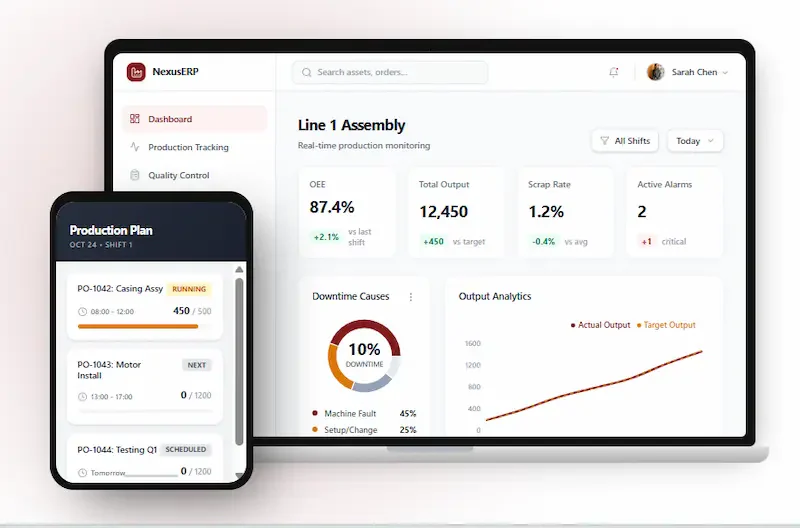
HashMicro WMS stands out for Malaysian businesses that need help managing warehouse operations connected with ERP, inventory, procurement, accounting, and reporting. It helps teams manage stock data, purchasing records, financial updates, and warehouse performance in one connected platform, reducing the need for separate systems.
HashMicro WMS 2026 also includes Hashy AI, an AI assistant that supports warehouse planning through demand forecasting, auto-replenishment alerts, and inventory anomaly detection. By using warehouse, inventory, and purchasing data within the same ecosystem, Hashy AI helps teams identify unusual stock movements, prepare replenishment actions, and plan demand with better operational context.
Its main value is practical control. Businesses, including retail warehouse teams, can track stock movement across multiple warehouses, improve inventory visibility and warehouse efficiency, customize workflows, and connect warehouse activity with accounting processes. With Malaysia-local implementation support, HashMicro is a strong fit for companies that need smoother operations, clearer reporting, and easier system adoption.
Where Infor WMS Stands Out
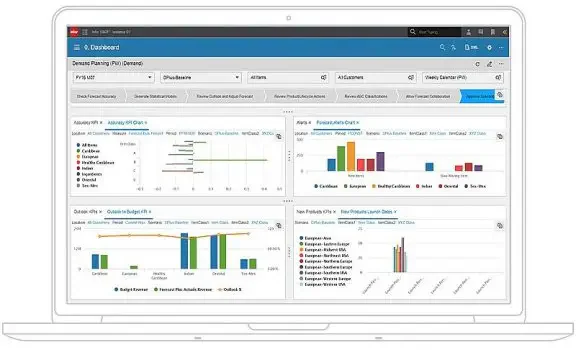
Infor WMS stands out as an enterprise-grade warehouse management system for companies with complex warehouse operations. Based on Infor’s public product materials, it supports advanced capabilities such as automation, labor management, 3D visualization, voice processing, embedded analytics, and global-scale warehouse operations.
These features can help large businesses manage high-volume warehouse activity, multi-site distribution, workforce productivity, and more specialized fulfillment workflows. For companies that need deeper warehouse execution control, Infor WMS may offer stronger support for advanced automation, labor optimization, and operational analytics.
Overall, Infor may be more suitable for large enterprises with highly complex warehouse environments, especially when global scalability and advanced warehouse management capabilities are key requirements.
Feature-by-Feature Comparison
| Feature | HashMicro WMS | Infor WMS | Buyer Fit |
|---|---|---|---|
| Warehouse Operations | Connected warehouse workflows covering receiving, stock movement, order fulfillment, procurement, and accounting updates | Designed for complex warehouse execution with high transaction volumes and multi-site distribution | Choose HashMicro for connected daily operations; choose Infor for enterprise-level warehouse complexity |
| Inventory Tracking and Visibility | Monitors stock levels, stock movement, and multi-warehouse inventory within one platform | Supports complex warehouse networks with advanced tracking and execution capabilities | Choose HashMicro for practical multi-location visibility; choose Infor for complex enterprise inventory control |
| Automation Depth | Provides practical workflow automation for stock transfers, approvals, receiving, and reporting | Offers advanced enterprise automation including labor optimization, voice processing, and automation-heavy workflows | Choose HashMicro for practical automation; choose Infor for deeper enterprise automation requirements |
| Reporting and Analytics | Connects warehouse, inventory, procurement, accounting, and reporting data for broader business visibility | Provides embedded analytics and deeper performance monitoring for large warehouse environments | Choose HashMicro for connected business reporting; choose Infor for advanced warehouse analytics |
| ERP Integration | Integrated with a broader ERP ecosystem including procurement, inventory, accounting, and reporting | Suitable for enterprise environments requiring broader integration capabilities | Choose HashMicro for WMS and ERP alignment; choose Infor for enterprise integration needs |
| Implementation and Support | Offers Malaysia-local implementation support, setup guidance, and training assistance | Relies on a global vendor and partner ecosystem for regional and multinational deployments | Choose HashMicro for Malaysia-local support; choose Infor for global implementation structures |
| Malaysia Market Readiness | Supports Malaysian warehouse needs across F&B halal, Shopee-Lazada fulfillment, automotive parts distribution, and agri-processing, with local support and LHDN e-Invoicing compatibility through connected ERP and accounting workflows | Fits enterprise warehouse environments that may need partner-led localization for Malaysia-specific workflows and compliance requirements | DOSM reported Malaysia e-commerce revenue at RM1,230.1 billion in the previous year, so local warehouse visibility, integration, and compliance readiness matter more as fulfillment volume grows |
| Scalability | Supports growing businesses and mid-market companies scaling warehouse and back-office operations | Designed for enterprise-scale operations with global warehouse networks and specialized logistics requirements | Choose HashMicro for growing and mid-market operations; choose Infor for enterprise and global warehouse complexity |
Which WMS Is Better for Malaysian Businesses?
For Malaysian businesses comparing the best warehouse management system in Malaysia, the better choice depends on business size, warehouse complexity, and integration needs. HashMicro WMS may fit SMEs, growing companies, mid-market distributors, and businesses evaluating retail warehouse management software that connects warehouse operations with ERP, inventory, procurement, accounting, and reporting. This helps teams manage stock movement, purchasing updates, and financial records in one connected workflow.
Local support also matters because WMS implementation depends on clear communication, workflow adaptation, user training, and support availability. For Malaysian businesses, local implementation support can help align the system with daily warehouse processes, team readiness, and reporting needs.
Infor WMS may be more suitable for enterprise warehouses, 3PL providers, and complex logistics operations that need advanced automation, labor management, analytics, and global scalability. In short, HashMicro fits businesses that need practical WMS and ERP integration in Malaysia, while Infor fits larger operations with more complex warehouse requirements.
When Should You Choose HashMicro WMS?
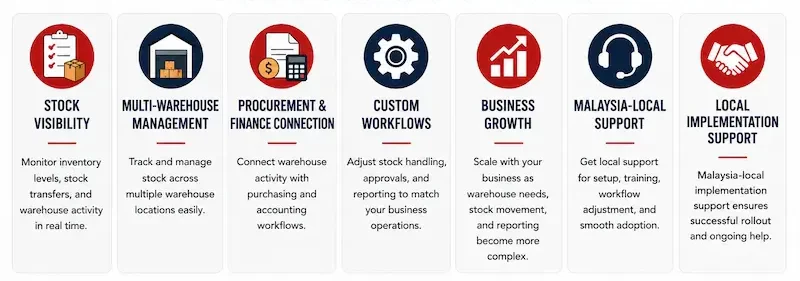
Choose HashMicro WMS if your business needs a warehouse management system that is practical for daily operations and connected with other departments. It is especially suitable for Malaysian businesses that need WMS linked with ERP, inventory, procurement, accounting, and reporting.
HashMicro WMS is worth considering if you:
- Stock visibility: Helps teams monitor inventory levels, stock transfers, and warehouse activity more clearly.
- Multi-warehouse management: Supports businesses that need to track stock across different warehouse locations.
- Procurement and finance connection: Connects warehouse activity with purchasing and accounting workflows.
- Custom workflows: Allows businesses to adjust stock handling, approvals, and reporting based on their operations.
- Business growth: Supports companies as warehouse activity, stock movement, and reporting needs become more complex.
- Local support: Provides Malaysia-local support for setup, training, workflow adjustment, and adoption.
- Prefer local implementation support: Malaysia-local support can help with setup, training, workflow adjustment, and smoother system adoption.
In short, HashMicro WMS fits businesses that want better warehouse visibility, fewer disconnected systems, and smoother coordination between warehouse, procurement, accounting, and management teams. You can explore HashMicro WMS or book a free demo to see whether it fits your warehouse needs.
When Should You Choose Infor WMS?
Choose Infor WMS if your business has large and complex warehouse operations that need advanced control, automation, and scalability. It is generally more suitable for enterprises, multinational companies, and complex logistics operations.
- Enterprise-scale warehouse operations: Infor WMS can be suitable for businesses that manage high-volume stock movement, large warehouse teams, and multiple operational layers.
- Highly complex warehouse processes: It fits companies with detailed receiving, zone picking methods, packing, replenishment, and fulfillment workflows that require stronger execution control.
- Advanced automation: Businesses that rely on automated warehouse processes may benefit from Infor WMS capabilities for improving execution speed and process consistency.
- Labor management: Infor WMS may help enterprises monitor workforce tasks, productivity, and warehouse activity more closely.
- Analytics: Companies that need deeper performance insights can use analytics to review warehouse trends, bottlenecks, and operational efficiency.
- Existing Infor ecosystem: If a company already uses Infor solutions, Infor WMS may provide better alignment with its existing enterprise system environment.
- Multi-country operations: Infor WMS can fit businesses that manage warehouses or distribution networks across different countries.
- Global-scale WMS requirements: It is suitable for companies that need a WMS designed for long-term scalability across complex logistics networks.
In short, Infor WMS may be the right choice when enterprise complexity, automation depth, labor control, analytics, and global scalability are key priorities.
Conclusion
The right choice depends on business fit. For Malaysian businesses needing a connected warehouse management system with ERP, inventory, procurement, accounting, and local implementation support, HashMicro WMS is the clearer fit.
Infor WMS suits enterprise warehouse operations with advanced automation, labor management, and global-scale execution requirements. It is better positioned for large enterprises or complex logistics environments.
A free demo can help you see how HashMicro WMS connects with your warehouse, purchasing, and accounting workflows before making a final decision. Book a free demo to see HashMicro WMS in action for your industry.

FAQ About HashMicro vs Infor WMS
HashMicro can be a better fit for Malaysian businesses that need WMS connected with ERP, inventory, procurement, accounting, and reporting in one ecosystem. Infor WMS is more suitable for large enterprises with advanced warehouse automation, labor management, and global-scale requirements.
The main difference is business fit. HashMicro focuses on connected ERP-WMS operations, making it practical for companies that want warehouse data linked with wider business workflows. Infor WMS is more focused on enterprise warehouse execution, advanced automation, labor management, analytics, and global scalability.
Yes, Infor WMS can be suitable for Malaysian businesses, especially large companies with complex warehouse operations or regional distribution needs. The fit depends on warehouse scale, automation requirements, existing systems, and long-term operational complexity.
HashMicro WMS may be the stronger practical fit for SMEs in Malaysia when local implementation support and ERP integration are key priorities. It helps smaller and growing businesses connect warehouse activity with inventory, procurement, accounting, and reporting without relying on many separate systems.
Yes. HashMicro WMS connects warehouse activity with inventory, procurement, accounting, and reporting within the same platform. For Malaysian businesses managing stock across multiple locations, this helps keep warehouse data aligned with purchasing and financial records without switching between separate tools.
HashMicro WMS connects with HashMicro’s accounting module, so warehouse transactions such as goods receipts and order fulfillment flow into the same financial records. E-invoicing readiness under LHDN depends on the accounting and billing layer, not the WMS layer directly. Malaysian businesses requiring MyInvois-compatible e-Invoices should verify whether the connected accounting module supports the required format.
Marketplace integrations depend on ERP configuration and available connectors, not the WMS module alone. Businesses managing fulfillment from Shopee or Lazada need to confirm whether the system can automatically sync incoming orders, stock levels, and shipping updates. Gaps in this sync are a common source of inventory discrepancies between warehouse records and sales channel data.
HashMicro provides a local implementation team in Malaysia, meaning onboarding, training, and issue resolution are handled directly without going through a regional partner. Infor WMS operates through a global partner ecosystem, so local support quality depends on the assigned partner in each territory. For Malaysian businesses that need fast response times and on-ground support during operational disruptions, this distinction becomes more relevant outside standard business hours.