





Unexpected delays, failed delivery attempts, and missing tracking updates can undermine an otherwise well-executed supply chain because customers judge the order by its final handoff. A coordinated last mile delivery process addresses these problems by validating order data before dispatch, planning routes around actual constraints, notifying recipients proactively, and recording exceptions consistently.
This approach is particularly relevant in Malaysia, where Klang Valley traffic, high-rise access in major cities, long regional routes across Sabah and Sarawak, and seasonal peaks create different operating conditions. Businesses therefore need delivery rules that reflect local traffic, building access, service windows, and regional coverage rather than applying one model nationwide.
A fleet management system can support this process by providing a connected view of vehicle availability, driver assignments, route activity, maintenance schedules, and delivery performance.
Key Takeaways
Last mile delivery ensures orders reach customers accurately, on time, and with complete delivery visibility.
Last mile delivery works through connected stages, from fulfilment and dispatch to the final customer handoff.
Strong last mile delivery performance requires both the right technology and well-defined operational responsibilities.
Delivery delays and rising logistics costs make last mile operations harder to manage. Learn how the right last mile delivery solution can improve efficiency and on-time performance.
What is Last Mile Delivery?
Last mile delivery is the final stage of the supply chain, where an order moves from a fulfilment centre, distribution hub, retail store, or warehouse to the customer's address. While the starting point varies depending on the fulfilment model, the objective remains the same by ensuring orders reach customers accurately, on time, and with full delivery visibility.
Depending on the business, deliveries may begin from a parcel hub, dark store, retail branch, or distribution warehouse. Also known as final mile delivery, this customer-facing process follows different routes, vehicle types, and proof of delivery requirements based on the industry's operational needs.
How does Last Mile Delivery Works?
Efficient last mile delivery starts before a driver leaves the depot. Accurate inventory, order picking, dispatch planning, vehicle capacity, and customer data help ensure deliveries stay on schedule. For example, even a short delivery from a fulfilment centre in the Klang Valley depends on these connected operational steps.
1. Order receipt and inventory confirmation
The order enters the order workflow and available stock is checked against the requested quantity, location, and promised date. A false stock balance can create a delivery commitment that operations cannot fulfil.
2. Picking and packing
Warehouse staff retrieve the correct item, verify its quantity and condition, and pack it for the expected handling environment. Labels, customer contact details, special instructions, and any required documents must match the order.
3. Transfer to a local hub
If the fulfilment centre is not the final dispatch point, prepared orders move to a hub closer to the delivery area. The transfer must preserve scan events and custody information so the order does not disappear between facilities.
4. Sorting and consolidation
Orders are grouped by zone, route, vehicle type, service level, or delivery window. Good consolidation reduces unnecessary backtracking while keeping urgent or time-sensitive orders visible.
5. Driver and vehicle assignment
Dispatchers match delivery jobs with an available driver and a suitable vehicle. Capacity, access restrictions, licence requirements, shift limits, and the nature of the goods should influence the assignment.
6. Route planning
Stops are sequenced using actual operating constraints rather than straight-line distance alone. In the Klang Valley example, the plan may account for peak-hour traffic, toll routes, high-rise access, parking limitations, and customer time windows.
7. Customer notification
The recipient receives an expected window, tracking status, or request to confirm availability. Clear communication gives the customer a chance to correct an address, provide access instructions, or nominate a safe handoff option.
8. Delivery and proof of delivery
The driver completes the handoff and records evidence such as a signature, photo, recipient name, timestamp, or location. The required proof should reflect the value, sensitivity, and dispute risk of the shipment.
9. Exception and return handling
If the delivery fails, the reason is recorded using consistent categories and the next action is assigned. The order may be rescheduled, redirected, returned to a hub, inspected, refunded, or placed into a reverse-logistics workflow
Although customers only see the delivery, its success depends on the entire fulfilment and dispatch process. Even an efficient route can fail because of incomplete addresses, missorted parcels, or missed notifications. A well-planned warehouse setup also improves dispatch readiness and reduces staging errors before vehicles depart.
Why is Last Mile Delivery Important?
The importance of last mile delivery extends beyond completing an order. It directly affects customer satisfaction, operational efficiency, and overall logistics costs for several reasons.
- Shapes the customer experience
Last mile delivery is the only part of the supply chain customers interact with directly. On-time deliveries, accurate tracking, and smooth handoffs help improve customer satisfaction (CSAT), encourage repeat purchases, and strengthen brand trust.
- Improves operational efficiency
Reliable deliveries reduce redelivery attempts, customer service enquiries, return handling, and unnecessary fuel or energy consumption. They also help businesses maintain more accurate inventory records after dispatch.
- Accurate delivery promises
Efficient last mile operations allow businesses to offer realistic delivery windows instead of broad estimates, helping manage customer expectations and improve service reliability.
- Significant impact on logistics costs
Last mile delivery is often the most expensive stage because it involves many stops and variable delivery conditions. Costs also depend on network design, delivery density, geography, product type, service level, and whether deliveries use an in-house fleet or third-party carriers.
What Drives Last Mile Delivery Costs?
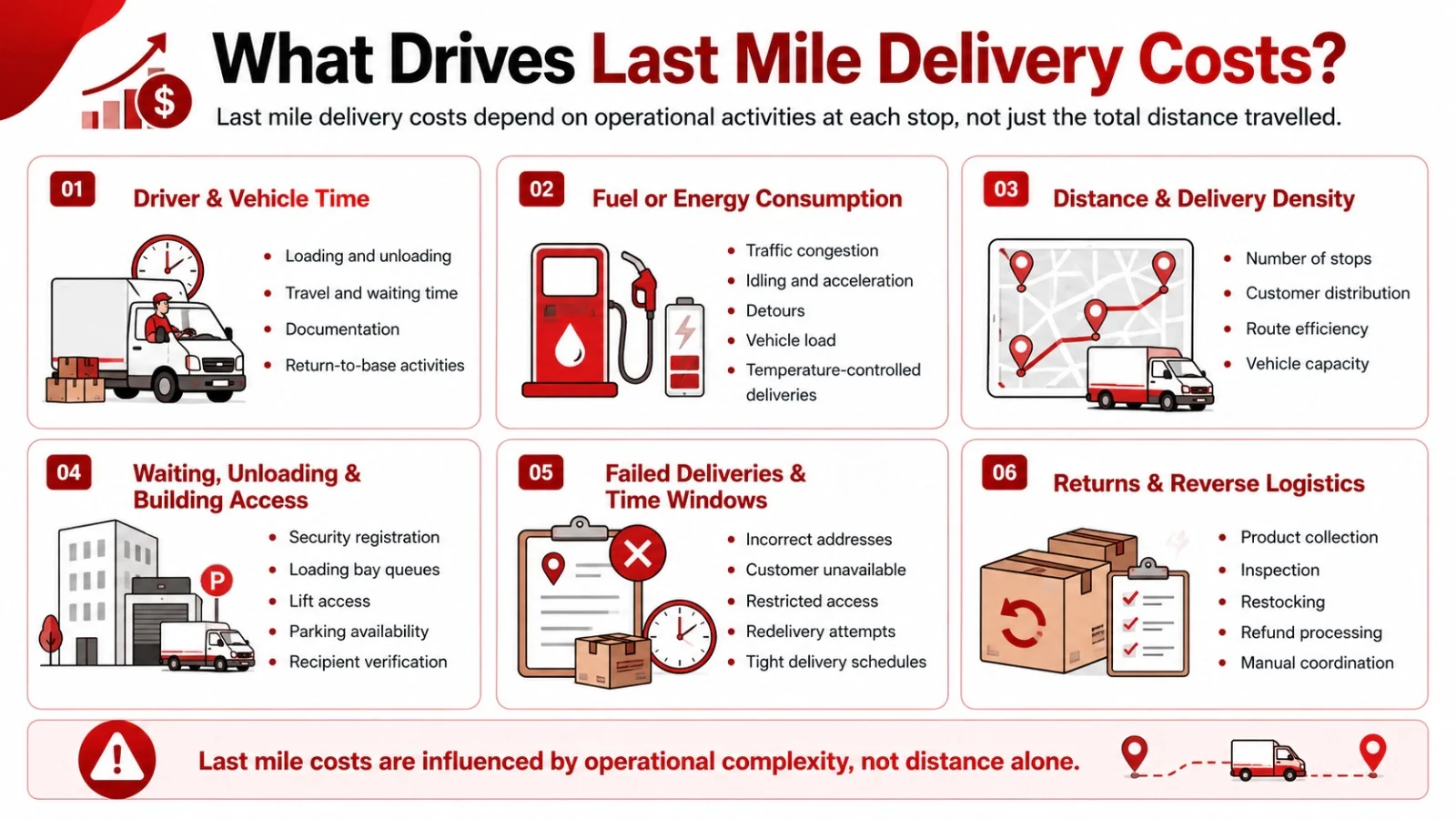
Final-mile cost is shaped by the work required at each stop, not by mileage alone. Frequent stops, idling, access delays, failed attempts, and manual coordination can consume paid time without increasing the number of completed deliveries.
Driver and Vehicle Time
Paid driver hours and vehicle availability are consumed by loading, travel, waiting, handoff, documentation, and return-to-base activity. Routes with long stop times may complete fewer drops even when total distance is modest.
Fuel or Energy Consumption
Fuel or battery use rises with congestion, idling, repeated acceleration, detours, vehicle load, and temperature-control requirements. A short urban route can therefore use resources differently from a longer route with steady movement.
Distance and Delivery Density
High drop density can reduce travel between customers, while scattered destinations increase non-productive kilometres. Density must still be balanced with vehicle capacity, service windows, and the time required at each location.
Waiting, Unloading, and Building Access
Security registration, loading-bay queues, lift access, parking searches, site inductions, and recipient verification all add service time. High-rise residential and commercial deliveries may need access instructions before arrival.
Failed Attempts and Narrow Delivery Windows
An unavailable recipient, incorrect address, restricted access, or missed time window can trigger redelivery and extra customer contact. Very narrow windows also reduce the dispatcher's ability to consolidate stops efficiently.
Returns, Reverse Logistics, and Manual Coordination
Returned goods require collection, inspection, status updates, transport, restocking, replacement, or disposal. Costs increase when teams coordinate these actions through separate spreadsheets, calls, and messages without a clear owner.
These drivers show why cost per drop should be interpreted with route context. A higher figure may reflect remote coverage, specialist handling, or strict time windows rather than poor driver performance. Managers should compare like-for-like routes before setting targets or changing service rules.
Common Last Mile Delivery Challenges
Most last mile delivery challenges are caused by multiple operational factors, including traffic, inaccurate addresses, fluctuating demand, warehouse errors, recipient availability, and disconnected systems. Understanding the root cause helps businesses resolve these issues more effectively.
Late Delivery
Traffic, late dispatch, unrealistic route plans, long service times, vehicle problems, or upstream fulfilment delays can push orders beyond their promised windows. Teams need reason codes that distinguish these causes before they revise routes or staffing.
Failed First Attempt
A delivery may fail because the recipient is unavailable, the address is incomplete, access is restricted, payment is unresolved, or communication arrives too late. Each cause requires a different preventive action.
High Cost per Drop
Low stop density, excess waiting, empty mileage, poor consolidation, specialist vehicle needs, and repeated attempts can raise the cost of completing each delivery. Comparing routes without these variables can produce misleading conclusions.
Limited Visibility
Customers and service teams lose confidence when scan events are missing or status updates remain trapped in separate systems. A shared exception view is more useful than a generic 'in transit' message after a route has already deviated.
Peak-Period Overload
Campaigns and festive seasons can compress picking, sorting, dispatch, and delivery capacity at the same time. Temporary labour or vehicles may help, but weak cut-off rules and inaccurate demand assumptions can still create backlogs.
Difficult Returns
Returns become slow when collection approvals, item condition, refund status, transport, and restocking are owned by different teams. Clear eligibility rules and scan-based custody reduce uncertainty for both customers and operations.
This is why corrective work should combine warehouse, customer-data, dispatch, and transport evidence instead of relying only on a driver's account of the final stop. Reviewing other recurring logistics challenges can help managers separate last-mile symptoms from wider process and coordination issues.
How to Improve Last Mile Delivery
Businesses should establish reliable data, process rules, and performance baselines before investing in additional tools. Since last mile delivery depends on both inbound logistics and outbound logistics, these processes should be coordinated first. Technology can automate workflows and surface exceptions earlier, but it cannot replace clear ownership or consistent processes.
Validate delivery addresses before dispatch
Check postcode, unit number, building name, contact number, access instructions, and geographic coordinates where appropriate. Flag incomplete records early enough for the customer-service team to correct them before route release.Define order cut-off and service-level rules
Set clear cut-off times, handling times, delivery zones, excluded dates, and service windows. Promised dates should reflect inventory availability and operational capacity, not only the time at which an order was placed.Consolidate orders by zone or delivery window
Group compatible orders so vehicles spend more time completing stops and less time crossing the same area repeatedly. Protect urgent, temperature-sensitive, high-value, or restricted-access deliveries from unsuitable consolidation.Optimize route sequence using operational constraints
Build routes around capacity, traffic, road restrictions, delivery windows, service time, driver shifts, and vehicle suitability. A practical route is one a driver can execute, not merely the shortest line on a map.Send proactive customer notifications
Notify recipients before arrival and provide a channel for corrections or access instructions. Communications should be triggered by reliable route events and should not promise an exact time when operating conditions remain uncertain.Record proof of delivery consistently
Define the required evidence for each delivery type and train drivers to capture it at the point of handoff. Consistent timestamps, recipient details, photos, signatures, and reason codes support customer service and dispute resolution.Create clear workflows for failed deliveries and returns
Specify who decides whether to retry, redirect, return, refund, or inspect an order. Use standard reason codes and deadlines so failed deliveries do not remain in an undefined status.Track route and delivery KPIs daily
Monitor on-time delivery, first-attempt delivery rate, cost per drop, stops per route, average service time, route completion time, proof-of-delivery completion, exception rate, and return rate. Segment the results by zone, service type, vehicle, and customer window before comparing performance.Review recurring patterns, not only individual exceptions
Use weekly or monthly reviews to identify repeat problem addresses, buildings, time windows, products, routes, and handoff reasons. Correct the underlying rule or data source when the same issue appears across multiple orders.Route optimization is most effective when it considers real-world factors such as traffic conditions, delivery time windows, vehicle capacity, and stop priorities rather than relying on distance alone.
Technologies Used in Last Mile Delivery
A modern delivery operation relies on multiple systems with specialized roles rather than a single application. The key is defining which system manages each function and ensuring status updates flow accurately between warehouse execution, order allocation, dispatch, fleet management, financial reporting, and customer-facing delivery records.
ERP
Enterprise resource planning unifies core business records such as orders, inventory, customers, fleet costs, billing, and management reporting. It provides cross-functional control, but it does not replace the detailed execution logic of every specialized logistics application.OMS (Order Management System)
An OMS manages order capture, validation, allocation, fulfilment status, service rules, cancellations, and channel coordination. It decides how an order progresses commercially and operationally before and during fulfilment. Businesses that need more detail can review how order management systems coordinate allocation, fulfilment status, and service rules across sales channels.WMS (Warehouse Management System)
A WMS controls picking, packing, staging, location movements, scan checks, and dispatch readiness inside the warehouse. Its accuracy determines whether the correct parcel reaches the correct dispatch lane at the expected time. For warehouse-side execution, the guide to warehouse management systems explains how structured picking and location control support dispatch readiness.Dispatch Software
Dispatch software creates and assigns delivery jobs, monitors route release, and manages on-road exceptions. It gives dispatchers an operational view of drivers, stops, unassigned work, delays, and follow-up actions.Route Optimization
Route optimization calculates stop sequences using constraints such as traffic, capacity, time windows, road restrictions, and estimated service time. It supports dispatch decisions but depends on accurate addresses and realistic operating inputs.Fleet Management
Fleet management monitors vehicle availability, utilisation, maintenance, fuel or energy use, driver behaviour, and lifecycle costs. It helps ensure that the assigned vehicle is available, suitable, and maintained for the planned work. A separate overview of fleet management covers vehicle control, utilisation, and maintenance planning in greater detail.GPS Tracking and POD
GPS tracking provides vehicle or driver-location updates, while proof of delivery records the completed handoff. Together they improve transit visibility and provide evidence, but they do not perform inventory allocation or warehouse control.For a broader market view, businesses can review best logistics software options in Malaysia before defining a shortlist around operational fit, ownership, and integration needs.
Case Studies of Last Mile Delivery in Malaysia
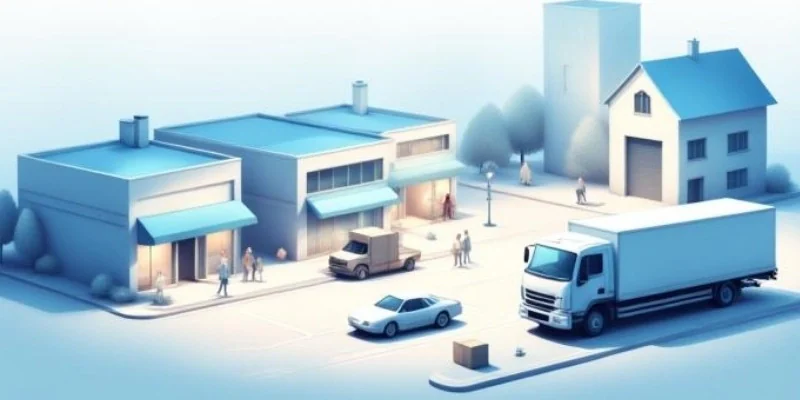
Seasonal events such as Hari Raya, Chinese New Year, and major online shopping campaigns like 11.11 and 12.12 can significantly affect last mile delivery. Higher order volumes, limited staffing, changing road conditions, and varying recipient availability often create pressure across picking, sorting, line-haul transfers, and local dispatch.
This growing demand reflects Malaysia's expanding digital economy. According to the Department of Statistics Malaysia (DOSM), e-commerce transaction income reached RM1,288.1 billion in 2024, an 8.8% increase from RM1,184.1 billion in 2023. While this figure does not represent parcel volumes or delivery capacity, it highlights the increasing level of online commerce that businesses must support.
To prepare for peak periods, businesses should establish temporary order cut-off times, allocate carrier capacity, plan overflow routes, adjust staffing, and define customer communication procedures in advance. After the peak, comparing forecasts with actual delivery performance helps improve planning for future demand.
Conclusion
Last mile delivery is more than the final step in the supply chain, it reflects the effectiveness of every process that comes before it. Consistent performance depends on accurate order data, efficient warehouse preparation, realistic dispatch planning, route optimization, clear customer communication, reliable proof of delivery, and effective exception management.
For businesses in Malaysia, these practices should be adapted to local operating conditions, from dense urban areas and rural delivery routes to seasonal demand spikes. Measuring performance with relevant KPIs and route-specific data also provides a more reliable basis for improving delivery efficiency, controlling costs, and maintaining service quality over time.
If you want better last mile visibility and route control, request a free demo to see how a logistics management solution can support your delivery operations.
FAQ about Last Mile Delivery
Last mile delivery refers to the final stage of the delivery process, while courier delivery is a service provided by a carrier. A courier company performs last mile delivery, but businesses with their own fleets can also manage this stage without using an external courier.
No. Last mile delivery is also essential for retailers, wholesalers, manufacturers, distributors, healthcare providers, food and beverage businesses, and any organisation that delivers products directly to customers or business locations.
Yes. Small businesses can improve delivery performance by optimising delivery schedules, verifying customer information, using route planning tools, and partnering with reliable third-party logistics providers.
Performance is commonly measured using KPIs such as on-time delivery rate, first-attempt success rate, cost per delivery, average delivery time, customer satisfaction, and return rates.
Yes. Many businesses outsource last mile delivery to third-party logistics (3PL) providers or courier companies to expand delivery coverage, reduce fleet investment, and handle seasonal demand more efficiently.ation tools to support delivery operations.