







 Limited to 100 registrants

Most workplace training fails at the point of application, not delivery. Employees may complete a full training session but still forget the specific steps needed on the job. Microlearning addresses this gap through short, focused modules that reinforce key procedures when employees need them, such as a five-minute SOP refresher before the next shift.
For Malaysian enterprises managing multiple branches, shifts, and departments, the challenge is making training consistent and easy to track. HR needs verifiable records, Operations needs consistent processes, IT needs access control, and Finance may need proof of compliance. With initiatives such as HRD Corp levy-funded training, microlearning offers a practical way to keep employees updated while connecting learning with daily operations.
Discover how microlearning actually works in workplace training and where it fits your operations. Use it to map your requirements before deciding whether your process needs stronger workflow, HRM, learning management system, ERP, or reporting support.
Key Takeaways
Microlearning works best when each module teaches one role-specific task, policy, or behavior that can be checked through completion data or assessment.
For Malaysian enterprise teams, microlearning is useful for onboarding, SOP refreshers, HR policy rollouts, finance process updates, safety reminders, and system adoption training.
Microlearning works best as a tool for reinforcement, refreshers, and quick performance support rather than replacing in-depth training.
Employees often forget critical process steps when training is too long, scattered, or hard to revisit during daily work. Microlearning helps teams deliver short, role-based lessons that employees can complete quickly and apply directly on the job.
What is Microlearning in Enterprise Training?
Microlearning is a short and focused training method that teaches one task, policy, or behavior at a time. Each module has a clear objective and measurable outcome, using formats such as short videos, mobile quizzes, or supervisor briefings to help employees apply workplace procedures more consistently.
For Malaysian enterprises, microlearning is useful for delivering consistent training across departments and locations, including onboarding, SOP refreshers, and system adoption. It can also connect with broader HR workflows, complementing recruitment software, workforce records, and employee management processes.
How Does Microlearning Work in Workplace Training?
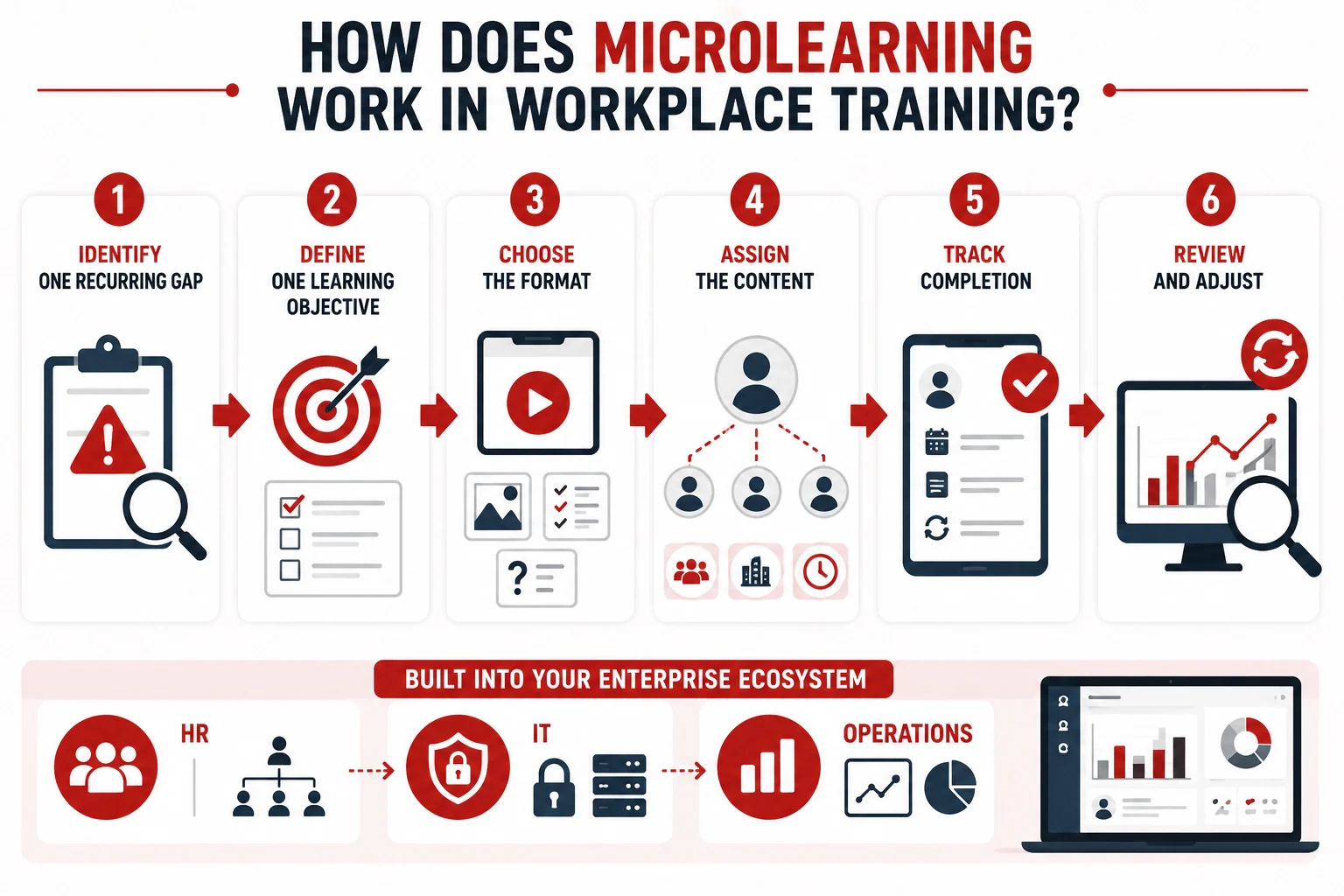
Microlearning in workplace training works through a small number of observable stages that turn one recurring performance gap into one focused lesson. The workflow below shows how that single lesson moves from problem to measurable outcome.
- Identify one recurring gap
Start from a real, repeating mistake or bottleneck on the floor rather than a broad training wish. One clear gap keeps the lesson specific and easy to measure later. - Define one learning objective
Translate that gap into a single behavior you want people to change, so the lesson has one job and one success signal instead of a mixed agenda. - Choose the format
Match the content to how the task is actually done, whether that is a short video, a checklist, an image walkthrough, or a two-question quiz. The format should fit the moment of need, not the training team's convenience. - Assign the content
Deliver it to the right people by role, department, branch, shift, or access level, so only the staff who need it receive it. Targeted delivery keeps the lesson relevant and avoids noise for everyone else. - Track completion
Record completion date, content version, score, and refresher status for each person. This gives you an evidence trail rather than an assumption that the message was received. - Review and adjust
Combine manager feedback with operational data to confirm whether the gap actually closed, then update or retire the lesson. This closes the loop and keeps the library from going stale.
Each of these stages usually touches an enterprise system rather than a standalone app. HR compliance provides the role and department data needed to determine who should receive each assignment, while IT manages access and version control, and Operations uses completion and performance data to monitor training outcomes.
"The value of microlearning is not the short runtime, it is the discipline of fixing one clear performance gap at a time. When each lesson has a single objective you can actually measure, training stops being a broadcast and starts changing behaviour on the floor."
provides the role and department data needed to determine who should receive each assignment, while IT manages access and version control, and Operations uses completion and performance data to monitor training outcomes.
What Business Problems can Microlearning Solve?
Microlearning works best for practical workplace training that needs to be reinforced regularly. It helps employees refresh key knowledge and apply it more consistently in their daily tasks. Its value comes from connecting short lessons to measurable improvements in employee performance and appraisal, while providing clearer insights into employee understanding.
while providing clearer insights into employee understanding.
1. Slow onboarding for new branch staff
Short-format training breaks first-week tasks into role-based modules so new hires reach basic productivity faster. Monitor onboarding milestone completion, and keep in mind that new employees may still need direct coaching for anything the modules cannot cover.
2. Inconsistent SOP adoption
Reinforcing one process step at a time helps teams apply the SOP correctly instead of absorbing a long document at once. Monitor the SOP acknowledgement rate, and make sure SOP versions are properly controlled so no one learns an outdated step.
3. Recurring warehouse mistakes
A focused module targets the specific error before the next shift, keeping the correct behavior visible at the moment it matters. Monitor repeat error frequency, and confirm the data actually identifies the real root cause rather than a symptom.
4. HR policy updates
A short explanation with an acknowledgement step reaches many employees at once and gives HR a clear record of who has accepted the change. Monitor policy acknowledgement status, and watch that employees do not misunderstand the legal context behind the update.
5. Finance process compliance
Short reminders of approval or document rules help teams follow the correct steps during time-sensitive work such as month-end. Monitor the exception rate or missing document count, and make sure finance has defined the correct control first.
6. System adoption problems
Teaching one ERP or HRM action per module lets each user learn only the steps relevant to their work. Monitor support ticket volume, and remember that poor system design cannot be fixed by training alone.
8 Microlearning Examples for Malaysian Enterprise Teams

The following microlearning examples are designed for enterprise teams in Malaysia that need practical, measurable training across departments, locations, and employee roles. These are not case studies; they are adaptable formats that HR, operations, finance, IT, or department managers can use during planning discussions.
Manufacturing SOP update
Delivered as a three-minute process video plus one scenario question for production operators and line supervisors. This works because a process change usually affects only one or two steps, and a short video can show the exact sequence better than a written SOP. Monitor SOP acknowledgement and assessment score.
Warehouse safety refresher
Delivered as a shift briefing card with a quick checklist for warehouse pickers, packers, and forklift-related teams. A short card used at the start of a shift keeps the correct behavior visible at the moment it matters, which suits staff who rarely sit at a desk. Monitor completion rate and how often the same safety issue is observed again.
Retail branch onboarding
Delivered as mobile first-week task modules for new retail branch staff and assistant supervisors. Short mobile modules let new hires learn basic tasks in the flow of their first shifts and keep onboarding consistent across branches. Monitor time-to-first-task and manager feedback.
F&B hygiene reminder
Delivered as a visual hygiene checklist before shift opening for kitchen crew, service staff, and branch managers. A short visual checklist reinforces the daily standard without slowing shift preparation and is easier to follow in a fast kitchen than a long policy. Monitor checklist completion and hygiene audit notes.
Finance month-end process guide
Delivered as a short approval-flow walkthrough with a quiz for finance executives, approvers, and department admins. Month-end errors usually come from missed steps or wrong approval order, so a walkthrough that follows the real flow helps staff apply it correctly under time pressure. Monitor missing document count and process adherence.
HR policy rollout
Delivered as a policy summary with an acknowledgement question for all employees or selected departments. A short summary with an acknowledgement step reaches many people at once and gives HR a clear record that each employee has read and accepted the change. Monitor policy acknowledgement status.
Sales product update
Delivered as a short product comparison card plus an objection-handling quiz for sales teams and account managers. The card gives the key product differences while the quiz prepares the team for common objections, keeping messaging consistent even when updates are frequent. Monitor quiz score and manager coaching notes.
ERP or HRM system adoption training
ERP or HRM system delivered as a screen-based walkthrough for one transaction, assigned to system users by role such as HR, finance, sales, or warehouse. Focusing on one transaction and assigning by role lets each user learn only the steps relevant to their work instead of the whole system at once. Monitor support ticket volume and completion rate.
What are The Limitations of Microlearning?
Microlearning is weak for complex, high-risk, or behavior-changing training when used alone. It is useful as reinforcement, refresher content, and performance support, but it should not replace full instruction, coaching, certification, or formal assessment where the risk level is high.
The biggest limitation is shallow coverage. A five-minute module can explain one approval rule, but it cannot fully train a finance manager to design internal controls. It can remind a supervisor about a safety step, but it cannot replace certified safety training where regulation or operational risk demands deeper instruction.
| Limitation | What can go wrong | Control to put in place |
|---|---|---|
| Shallow coverage for complex skills | Employees learn fragments without understanding the full process | Map each module to a broader curriculum |
| Fragmented learning | Teams receive many short lessons with no clear sequence | Use role-based learning paths |
| Content governance issues | Different branches use different versions of the same SOP | Assign module owners and approval workflows |
| Weak assessment design | Completion is recorded but understanding is not tested | Set quiz, scenario, or manager review thresholds |
| Low manager follow-up | Employees complete modules but do not change behavior | Add supervisor observation and review notes |
| Poor fit for high-risk training when used alone | Employees may treat serious topics as simple reminders | Escalate to full training, certification, or coaching |
Governance matters as much as the content, since HR, compliance, and operations need to agree on who owns each module, who approves updates, and how versions are controlled. The trade-off is that shorter HR modules are easier to consume but there are more of them, so without regular review employees may follow instructions that no longer match the latest SOP. The safest approach is to use short-format learning as reinforcement, refreshers, and onboarding support, while deeper competence stays inside a wider training plan.
How Should You Implement Microlearning Across Teams?
To implement microlearning across teams, start with one high-impact business problem, define one focused learning objective, assign ownership, choose a suitable format, test with managers, track completion and understanding, then review results before scaling across departments or branches.
A practical readiness checklist can help HR, operations, IT, and finance align before creating content:
- Objective: What exact task, policy, or behavior should the employee learn?
- Owner: Which department owns the module and approves future updates?
- Audience: Which role, branch, department, shift, or employee group should receive it?
- Format: Should the content be mobile, printed, video-based, quiz-based, or manager-led?
- Assignment rule: How will employees be assigned the module?
- Tracking field: What data should be recorded, such as completion date, version, quiz result, or acknowledgement?
- Assessment: How will the company check understanding beyond completion?
- Review cadence: When will HR or managers review performance data and update the module?
Map how training workflows should connect with employee roles, branch structures, manager dashboards, and approval controls. Choose a problem where the expected behavior is easy to observe, such as incomplete handover notes, repeated stock movement errors, missed policy acknowledgement, or incorrect use of one ERP screen. Build one short module, test it with a manager, and gather feedback from the employees who will actually use it.
Conclusion
Microlearning can help Malaysian enterprise teams make training more focused, repeatable, and easier to track. It works best when each module teaches one role-specific task, policy, or behavior that can be assigned, completed, assessed, and reviewed through practical business data.
It is not a replacement for every form of training. Complex, regulated, technical, and high-risk skills still need deeper instruction, coaching, and formal assessment. However, for onboarding, SOP refreshers, HR policy rollouts, finance process updates, warehouse reminders, and ERP or HRM adoption, short-format learning can become a useful part of the enterprise training toolkit.
If you want to see how short-format training can work inside a connected HRM or ERP system, try a free demo and explore how the platform can support your company’s training, tracking, and reporting in one place

Frequently Asked Questions
There is no universal duration for a microlearning module. It should be short enough to focus on one task, decision, policy, or behaviour, while still giving employees enough context to apply it correctly. Enterprises should judge length by the learning objective, employee role, assessment quality, and whether the content can realistically be completed during a work break.
Microlearning can support and reinforce classroom or instructor-led training, but it should not replace deeper instruction for complex, high-risk, technical, or regulated skills. It works best for refreshers, reminders, process updates, practice checks, and post-training reinforcement.
HR, operations, sales, finance, warehouse, retail branch, and customer-facing teams can all benefit when the training need involves repeatable tasks, frequent process updates, or measurable behaviour. The best fit depends less on department popularity and more on whether the task can be taught clearly and tracked consistently.
Integration is helpful when companies need role-based assignment, completion tracking, employee records, manager visibility, and reporting. Small pilots can start manually, but scaling microlearning across branches, shifts, or departments usually requires stronger system governance.
Management should review practical KPIs such as completion rate, assessment score, time-to-competency, policy acknowledgement, repeat error frequency, support ticket volume, manager feedback, and training update cycle time. ROI should be assessed with business context, not training activity metrics alone.