







Managing operations today means dealing with sudden demand shifts, unexpected supplier delays, and constant inventory imbalances. When disruptions occur, the sheer volume of operational signals simply becomes too overwhelming to analyze manually.
According to EY, organizations are increasingly investing in generative AI to improve supply chain visibility and evaluate operational scenarios, helping teams respond faster to operational complexity. However, AI delivers the best results only when supported by high quality data, strong governance, and human oversight.
Understanding how this setup works in practice is vital for navigating modern logistical challenges. This article provides a clear and complete breakdown of how these systems function across different operations to improve the management of your supply chain, giving you the perspective needed to build a more resilient network.
Key Takeaways
AI analyzes supply chain data to empower human decisions without replacing manual accountability.
Different AI tools serve specific operational functions that require mandatory human checkpoints.
Achieving these benefits requires reliable data and active human oversight.
Connecting these operational benefits relies on a unified supply chain management system to align data and daily workflows.
What Is AI in Supply Chain?
AI in supply chain is a set of advanced technologies that analyze data across demand, suppliers, production, inventory, warehouse, and transport to assist decision-making. By processing these massive datasets, the system generates forecasts, anomaly flags, risk signals, exceptions, and recommended options.
While it empowers planning and execution teams with deep data analysis, AI does not replace human accountability. It is not a single tool making automatic final decisions. Instead, strict system permissions and human review separate analysis from actual execution. AI acts purely as a strategic advisor, ensuring your professionals have the precise insights needed to make the final call.
What Supply Chain Problems Can AI Help Address?
What Supply Chain Problems Can AI Help Address?

These complex logistics challenges and operational problems rarely happen in a vacuum; they leave behind clear data trails. AI helps teams identify these operational signals early, connecting visible problems directly to the strategic decisions required:
| Operational Problem | Data Signal | Decision Required |
|---|---|---|
| Forecast error | Order changes, historical demand, seasonality | Adjust forecast, replenishment, or capacity plan |
| Supplier delay | Lead-time variance, late PO status, quality history | Follow up, expedite, or evaluate alternate supply |
| Stock imbalance | Inventory level, ageing, demand forecast | Replenish, transfer, hold, or reduce stock |
| Logistics disruption | Shipment status, ETA, capacity, external alerts | Change route, carrier, priority, or customer commitment |
In complex enterprise networks, a single symptom like a stock imbalance can stem from multiple overlapping causes. While AI excels at isolating risk signals and mapping scenarios, a flagged anomaly isn't automatically the root cause. AI acts as a powerful advisory tool, but your operations leaders remain essential to validate these insights before executing strategic decisions.
What Types of AI Are Used in Supply Chain Management?
Rather than focusing on a technical taxonomy, it is more practical to evaluate supply chain AI by its functional utility. Each type serves a distinct purpose, relying on clear human checkpoints to maintain strict operational governance:
- Predictive analytics and machine learning: Identifies patterns and estimates likely outcomes (e.g., demand forecasts or delay probabilities). Human Checkpoint: Planners validate assumptions and exceptions.
- Optimisation: Compares possible actions under constraints (e.g., replenishment or route options). Human Checkpoint: Managers verify cost, feasibility, and policy.
- Computer vision: Analyses visual input (e.g., damage flags or quality alerts). Human Checkpoint: Operators verify the physical condition.
- Generative AI: Summarises, explains, or drafts information. Human Checkpoint: Users check accuracy and context.
- AI agents: Coordinates defined tasks or workflows (e.g., exception investigations). Human Checkpoint: Actions strictly follow permissions and approval rules.
When integrated, predictive models flag delays, optimization provides alternatives, generative AI summarizes impacts, and AI agents draft follow-ups. Understanding exactly what an AI agent is and does what an AI agent is and does ensures strict governance, while generative AI simply translates complex analytics for leaders to validate.
How Is AI Used Across the Supply Chain?
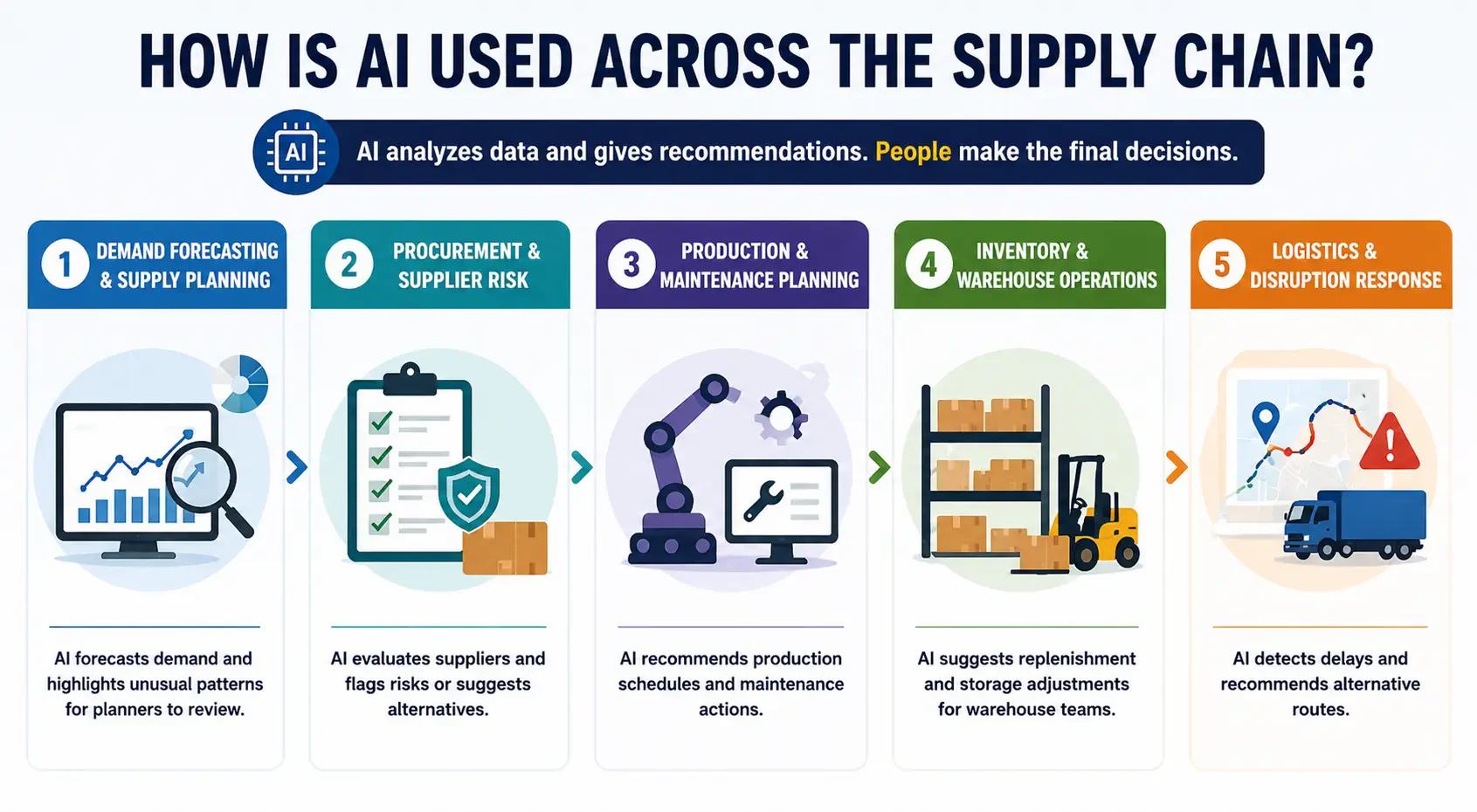
AI functions as a strategic advisory layer across operations. Imagine the application of AI in a manufacturing and distribution enterprise managing regional demand, diverse global suppliers, multiple inventory locations, and complex outbound logistics. Within this environment, AI processes network data to guide human decisions, never executing them autonomously.
Demand Forecasting and Supply Planning
Analyzing historical orders and capacity, AI calculates forecast ranges and flags anomalies. Planners review outputs to create replenishment plans. Forecasts never automatically trigger commitments. Abnormal demands or missing data always require manual review.
Procurement and Supplier Risk
Within a modern procurement management system, AI evaluates lead times and delivery history to flag supplier risks or suggest alternative sourcing. Buyers validate signals to expedite orders or switch suppliers. Since AI does not replace due diligence, buyers must still evaluate contracts.
Production and Maintenance Planning
AI compares material availability with downtime history to output alternative schedules and maintenance recommendations. Production teams finalize schedules based on material readiness. Maintenance alerts do not guarantee zero equipment failure; physical inspections remain essential.
Inventory and Warehouse Operations
Through advanced AI inventory management, the system analyzes stock levels and workloads to propose replenishments and slotting adjustments. Warehouse leads evaluate physical capacity before executing changes. AI promises neither zero stockouts nor fully autonomous warehouses. Physical verification must precede transfers if system records mismatch reality.
Logistics and Disruption Response
Processing timely updates on shipment status and route conditions, AI outputs delay alerts and alternative routes. Logistics teams weigh costs and commitments before acting. While AI does not completely eliminate every sudden supply chain disruption, its quality relies entirely on timely data accuracy and human governance.
Benefits of AI in Supply Chain
While algorithms promise transformation, these advantages remain strictly potential. Extracting real business value demands flexible data architecture and continuous human oversight before organizations can safely unlock the following capabilities:
Accelerated Exception Detection
Supported by timely data, technology accelerates exception detection. Success depends entirely on quality inputs and strict permissions.
Consistent Scenario Analysis
Attaining better prioritisation requires clear business rules. Consistent scenario analysis becomes achievable given defined constraints and objectives.
Enhanced Visibility
Cross functional visibility relies on seamlessly integrated data sources, avoiding fragmented operations across different stages.
Better Planning Support
Algorithms deliver planning support when reinforced by continuous outcome monitoring and clear process ownership.
Limitations of AI in Supply Chain
Deploying intelligent systems introduces critical vulnerabilities. Without rigorous governance frameworks and mandatory control points, operational reliance exposes supply networks to systemic threats requiring active management:
Misleading Alerts
Poor data generates misleading alerts. Fragmented definitions produce conflicting interpretations during execution.
Context Exclusion
Models exclude unrepresented context. Changing algorithm performance disrupts planning as conditions shift without mandatory human review.
Opaque Outputs and Drift
Per the NIST AI Risk Management Framework, leaders must safeguard against incomplete data, model drift, and opaque output.
Over Automation Threats
Improper governance increases privacy exposure. The greatest vulnerabilities remain false confidence and over automation weakening professional accountability.
What Data and Systems Does Supply Chain AI Need?
Supply chain algorithms require core inputs like demand, schedules, and inventory. Success demands accurate, timely data backed by clear ownership and strict controls rather than massive repositories.
Deploying intelligence never guarantees compliance with Malaysian privacy frameworks. Leaders must evaluate infrastructure using this readiness checklist:
| Ready | Needs Work | Not Available |
|---|---|---|
| Source has a clear owner | Records exist but definitions conflict | Critical data is not captured |
| Data is sufficiently complete | Data requires manual consolidation | Access has not been approved |
| Refresh timing matches the decision | Updates arrive too late | No reliable source exists |
| Users understand the measure | Ownership is unclear | No baseline can be established |
| Permissions are defined | Integration is unstable | Outcome cannot be monitored |
How Can Malaysian Companies Start Using AI in Supply Chain?
Adoption must begin with a single critical decision rather than an enterprise wide transformation program. To build a highly resilient supply chain foundation, Malaysian organizations can systematically implement artificial intelligence by following five sequential execution steps.
1. Choose One Important Decision
Select a recurring operational choice with visible friction, sufficient frequency, a designated process owner, and comparable outcomes, such as replenishment for a core product category.
Deliverable: One sentence problem statement and named process owner.
2. Define the Operational Measure
Establish current baselines, desired direction, review periods, measurement owners, and clear pass or fail conditions. KPIs must connect directly to the decision rather than relying solely on ease of tracking.
Deliverable: Baseline, target direction, and measurement owner.
3. Audit Data, Access, and Ownership
Review source availability, completeness, accuracy, timing, definitions, permissions, and integration gaps. Classify every source accurately.
Deliverable: Readiness checklist and data gap list.
4. Run a Controlled Pilot
Limit testing boundaries by product group, location, supplier category, user group, and timeframe. Define strict visibility, approval, escalation, override tracking, and termination triggers.
Deliverable: Pilot scope, approval rules, escalation path, and error log.
5. Monitor Results and Expand Carefully
Compare pilot outcomes against baselines by evaluating actual usage, recommendation quality, error types, operational side effects, override frequency, and environmental shifts. Avoid expansion solely based on technical capability.
Deliverable: Continue, revise, or stop decision with justification.
How AI in Supply Chain Management Enhances Sustainability
Reducing emissions directly lowers enterprise costs, making sustainability a core operational metric. Artificial intelligence provides the analytical power to track these environmental variables across vast networks. The technology highlights immediate opportunities to reduce carbon footprints by calculating fuel efficient routes and preventing overproduction.
However, technology cannot achieve green logistics autonomously. The system simply flags high emission segments and suggests greener alternatives. Your operations leaders must ultimately balance these environmental insights against delivery speed and budget constraints to make the final strategic choices.
Conclusion
Artificial intelligence successfully connects customer demand, supplier records, production schedules, inventory levels, warehouse activity, and logistics events into a unified operational view. This integration empowers supply chain networks to generate accurate forecasts, surface critical risk signals, deliver timely exception alerts, and recommend optimal tactical options.
Achieving meaningful value depends entirely on structured fundamentals. Successful deployment requires clear operational decisions, adequate data quality, defined functional ownership, strict permission controls, established baselines, continuous monitoring, and mandatory human review before execution.
Organizations exploring these systems often benefit from observing a free demo to understand how automated recommendations integrate with daily operational workflows before committing internal resources.






FAQ
Artificial intelligence analyzes demand, supplier, production, inventory, warehouse, and logistics data to generate forecasts, alerts, patterns, and recommended actions. Human teams must always review these automated outputs before making final operational decisions.
Potential benefits include faster exception detection, scenario analysis, task prioritization, and cross-functional visibility. These advantages depend entirely on data quality, clear functional ownership, robust system integration, and continuous monitoring.
No, artificial intelligence cannot fully replace a supply chain. Supplier relationships, commercial negotiation, physical verification, accountability, risk judgment, and complex exception management permanently require human oversight and direct intervention.
Artificial intelligence does not replace management jobs entirely. Instead, it changes job composition by reducing repetitive analysis while increasing the organizational need for data interpretation, process ownership, governance, and decision review.
No single system serves as the best choice. Selection depends on the specific operational decision: predictive models handle forecasting, optimization algorithms compare choices, computer vision assists physical inspection, and generative models support document summarization.
What Supply Chain Problems Can AI Help Address?
Operational challenges rarely happen in a vacuum; they leave behind clear data trails. AI helps teams identify these operational signals early, connecting visible problems directly to the strategic decisions required: