









 Limited to 100 registrants

Malaysian universities from Selangor to Sabah and Sarawak struggle to maintain consistent standards across physical and online classrooms. Students face poor connectivity and digital fatigue, while lecturers burn out juggling attendance, lab sessions, and grading across disconnected software tools.
Academic blended learning solves this by uniting physical lectures, self-paced digital modules, and campus labs into one structured curriculum. Managed through a Learning Management System (LMS), software designed to deliver and track courses, it expands access for off-campus students while giving department heads clear visibility into academic progress.
Executing this model requires an organized learning system aligning curriculum delivery, student evaluation, and faculty workload. This guide outlines how blended learning functions in modern universities, key differences between teaching formats, practical implementation steps, and fixes for common classroom disruptions.
Key Takeaways
Blended learning integrates digital coursework and physical campus sessions into a unified educational framework.
Understanding the four primary learning formats helps institutions design the right curriculum balance for theoretical and practical modules.
A successful rollout relies on syncing the campus LMS with central database records before scaling platform features.
Many educational institutions still rely on disconnected portals, manual attendance spreadsheets, and standalone software to manage blended courses. An integrated Education Management System unifies physical timetables, online coursework, and student records into a single platform, simplifying course administration and academic tracking across the entire campus.

What Is Blended Learning in Academic Institutions?
Blended learning is a planned teaching framework that combines structured in-person classroom instruction with self-paced digital learning under a central campus system. Beyond simply using video call tools, a managed blended program aligns four operational layers: student groups, teaching modes, faculty responsibilities, and academic records.
For instance, a university with a main campus in Kuala Lumpur and branch sites across Malaysia can deliver core theoretical lectures online through structured modules. Working adult students can complete pre-recorded coursework asynchronously before attending hands-on weekend tutorials, where lecturers evaluate practical performance using standardized rubrics.
Blended learning does not require replacing physical attendance entirely. Practical science experiments or medical demonstrations require physical presence in campus laboratories even when preparatory readings and follow-up reports are submitted online. The course remains blended because these physical and digital steps form one connected learning journey.
Core Components of a Blended Course
- Synchronous interactive sessions: Live online or physical classes dedicated to real-time discussions, problem-solving, and immediate Q&A.
- Asynchronous digital modules: Pre-recorded video explanations, reading materials, and self-paced quizzes completed before set deadlines.
- On-campus practicals: Mandatory physical attendance for laboratory experiments, technical workshops, art studios, or invigilated exams.
- Digital assessments: Online quizzes, essay submissions, and peer reviews managed through the campus learning platform.
- Faculty consultation hours: Scheduled office hours where lecturers provide targeted academic support to students.
What Are the Different Learning Methods, and How Do They Differ?
Before implementing a digital transformation strategy, academic boards must understand the core educational delivery formats used across Malaysia and how they compare in daily operation.
| Format | Student Location | Teaching Timing | Primary Dependency | Main Limitation |
|---|---|---|---|---|
| Blended Learning | All students complete online and physical steps together | Sequenced step-by-step learning path | Moderate reliance on digital learning platforms | Students lose momentum if online tasks feel disconnected |
| Hybrid Learning | Mix of on-campus and remote students in one class | Combination of real-time lectures and self-paced tasks | High reliance on audio-visual setup and campus LMS | Remote students may feel disconnected if lecture audio is poor |
| Fully Online | All students participate remotely from home or off-campus | Real-time streams or self-paced video modules | High reliance on personal devices and home internet | Unsuitable for physical science labs or hands-on practice |
| In-Person | All students and lecturers meet inside a campus classroom | Fixed timetable and physical location | High reliance on physical room capacity and campus venues | Difficult for working adult students or commuters to attend |
Selecting the right delivery model depends entirely on course objectives and student needs. While fully online and in-person formats represent opposite ends of accessibility and classroom capacity, blended learning bridges this gap by offering flexible remote access without compromising essential campus laboratory work. Nevertheless, educational institutions still need a robust SIS (Student Information System) to address the various needs of students and teaching methods.
Which Blended Learning Models Work Best for Academic Institutions?
Colleges and universities can implement four distinct blended teaching models depending on classroom capacity, internet availability, faculty availability, and laboratory requirements.
1. Flipped Classroom with Campus Practicals
Ideal for lab-heavy science, engineering, and medical courses. Students review pre-recorded lectures online beforehand, reserving campus visits strictly for hands-on experiments. Requiring a short online quiz to unlock lab registration ensures students arrive prepared.
2. Rotational Cohort Model
Suits campuses with room capacity limits by splitting students into cohorts that alternate weekly between physical and online classes. Using standardized slide decks and shared assignment prompts keeps instruction consistent across both groups.
3. Dual-Mode Concurrent Classroom
Integrates on-campus auditorium lectures with live-streaming remote participants. Setup requires wide-angle cameras, classroom microphones, and a chat moderator. Assigning a teaching assistant to handle virtual questions prevents lecturers from neglecting remote students.
4. Hub-and-Spoke Regional Learning
Designed for multi-campus universities with regional study centers. Central professors broadcast master lectures from the main campus, while regional tutors conduct local tutorials and grading. Standardized rubrics and regular faculty syncs maintain consistent evaluation standards.
How Can You Implement Blended Learning Successfully?
Rolling out a reliable blended learning program requires systematic preparation, good technical support, and close cooperation between faculty members and campus IT teams.
1. Define Learning Goals Before Buying Software
Start by analyzing what students must learn rather than shopping for complex video software features. Identify which course topics require physical demonstration, which can be taught through digital reading, and what evidence is needed to grade students fairly. Building a basic requirements brief prevents spending money on unnecessary software tools.
2. Segment Students Based on Schedule and Access Needs
Group students according to their practical needs, geographic location, and home internet conditions. Distance learners, working adult students, and full-time campus residents operate under completely different daily schedules and connectivity levels. Designing course pathways around these realities ensures every student can access study materials without constant technical roadblocks.
3. Provide Practical Digital Training for Faculty Members
Teaching a blended class requires different skills than lecturing in a traditional room. Universities should train professors on how to manage digital learning platforms, set up online discussion boards, and troubleshoot basic media tools. Providing clear teaching guides reduces stress for academic staff.
4. Integrate the LMS with the Campus Academic Database
Ensure your learning platform exchanges data automatically with your primary student database or Academic Information System, often known as SIAKAD in regional institutions. Student enrolment, course additions, attendance sheets, and final grades must sync automatically between systems. Manual data entry leads to missing grades and wasted administrative hours.
5. Run a Structured Pilot Program with Selected Courses
Test the blended setup with one department or a small selection of courses before rolling it out university-wide. Include a mix of tech-savvy professors and less experienced staff to catch realistic classroom problems. Collect weekly feedback on course engagement and software glitches to refine the teaching process.
6. Evaluate Learning Evidence and Adjust Before Scaling
Review course metrics at the end of every semester before expanding the program. Look beyond simple attendance numbers by evaluating assignment submission rates, average exam scores, and student satisfaction feedback. Use this data to adjust course structures or offer extra support to faculty members who need assistance.
What Challenges Can Disrupt Blended Learning?
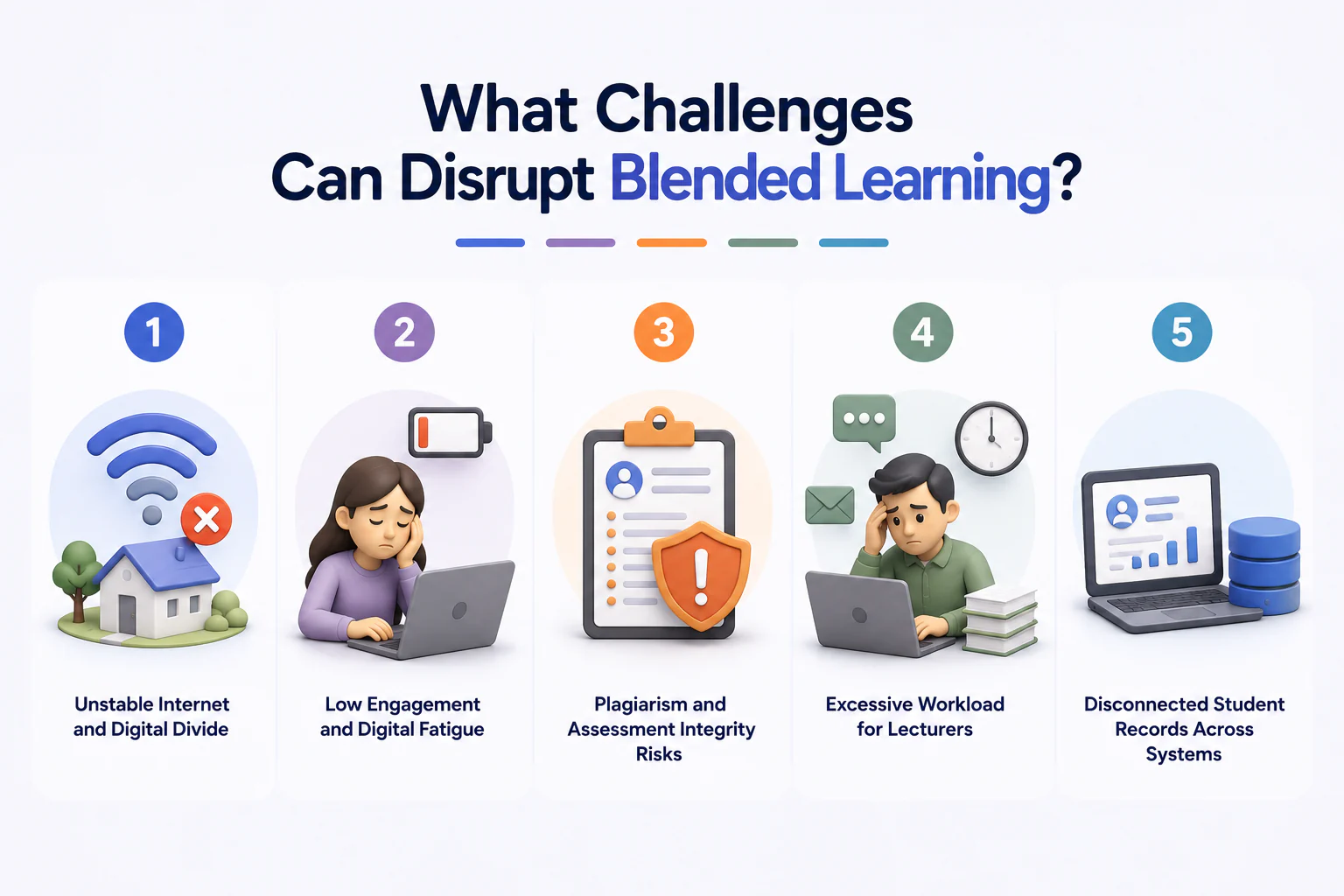
Most academic blended learning disruptions stem from technical issues, confused responsibilities, or lack of student support rather than the teaching format itself. Here are five major challenges and practical ways to resolve them.
Unstable Internet Connectivity and the Digital Divide
Students living in rural areas often face slow or unreliable home internet, causing digital coursework modules to load slowly. Campus IT departments should compress video recordings so they can be downloaded easily in low-resolution formats. Providing offline PDF reading guides ensures students with limited internet do not fall behind in their studies.
Low Engagement and Digital Fatigue
Sitting through long, passive online lectures causes students to lose focus quickly. Lecturers should break video modules into shorter fifteen-minute explanations interspersed with quick online polls, short discussion boards, or interactive quizzes. Active participation keeps students attentive throughout the course.
Plagiarism and Assessment Integrity Risks
Conducting online examinations remotely increases the risk of cheating or unauthorized essay copying. Academic boards should combine online multiple-choice quizzes with open-book analytical questions, oral presentations, and mandatory on-campus physical midterms or final exams to ensure fair grading.
Excessive Workload for Lecturers
Lecturers often feel overwhelmed when forced to manage physical classrooms, monitor digital portals, grade online assignments, and respond to late-night emails simultaneously. Institutions must set clear boundaries by establishing dedicated virtual office hours and using auto-graded quizzes for routine knowledge checks. An AI note taker can also help during online or in-person sessions by capturing key discussion points, decisions, and follow-up tasks, reducing the amount of manual note-taking required from lecturers
An AI note taker can also help during online or in-person sessions by capturing key discussion points, decisions, and follow-up tasks, reducing the amount of manual note-taking required from lecturers
Disconnected Student Records Across Multiple Systems
When paper attendance sheets, online quiz scores, and final grades live in separate files, student records become messy and error-prone. Institutions should link their learning platform directly to their main campus software, creating a single verified record for every student's enrolment, attendance, and academic achievements.
How Should Institutions Measure Blended Learning Success?
Evaluating a blended program requires looking at a complete chain of academic evidence rather than relying solely on basic attendance sheets. A practical evaluation framework covers seven straightforward areas:
- System Access: Can students log in easily, view course slides, submit assignments, and receive help when software breaks?
- Class Participation: Do students join online discussions, complete weekly digital readings, and hand in assignments before deadlines?
- Academic Mastery: Do exam results and project grades show that students understand core course concepts?
- Practical Competency: Can science and vocational students execute hands-on laboratory tasks correctly during on-campus sessions?
- Record Quality: Do student enrolment lists, attendance logs, assessment scores, and final transcripts match across all campus databases?
- Faculty Workload: Is teaching workload manageable, or are lecturers showing signs of burnout from managing dual channels?
- Student Retention: Has the blended format helped lower course drop-out rates and improve overall semester pass rates?
Reporting dashboards should help academic deans make practical decisions. For example, if a report shows high online completion but poor laboratory exam scores, the department knows it needs to strengthen its hands-on practical sessions rather than spending money on additional digital software tools.
When Is Blended Learning Not the Right Choice?
Blended education adds extra administrative coordination and technical requirements. If a simpler teaching format meets course needs effectively, institutions should use that simpler option. A straightforward reading module can run fully online, while high-risk medical clinical practice or heavy machinery operations should remain fully in-person.
Reconsider using a blended learning model if:
- Online modules cannot be accessed reliably due to severe student connectivity limitations;
- Practical skills cannot be evaluated safely or accurately through digital coursework;
- Students lack basic digital devices required for core coursework tasks;
- Lecturers receive no technical support or training on managing digital platforms; or
- Campus software systems cannot sync student grades accurately between platforms.
Choosing a simpler teaching format is not a failure to modernize. It shows that your institution prioritizes practical student learning over technological trends.
Case Study: Blended Learning Adoption in Malaysian Higher Education
A comprehensive review from The Mathematical Statistician and Engineering Applications (MSEA) about blended learning practices in Malaysian higher education shows that while digital transformation has significantly expanded course access, implementation outcomes vary widely depending on institutional infrastructure. Academic evaluations reveal distinct operational drivers that separate successful program rollouts from high-friction implementations.
Institutions achieving high student engagement and smooth course delivery typically attribute their success to three core structural factors:
- Centralized System Integration: Universities that deploy unified management solutions, such as HashMicro Education System, eliminate administrative disconnects by automatically syncing class schedules, LMS coursework, attendance logs, and academic transcripts.
- Structured Asynchronous Pre-Work: Departments that establish clear digital modules and pre-recorded materials prior to physical sessions report higher student preparation during on-campus practicals.
- Predictable Cohort Scheduling: Establishing clear rotation schedules for physical campus visits helps working and commuting students manage their learning timetables effectively.
Conversely, academic review findings identify common operational bottlenecks that disrupt blended learning adoption:
- Fragmented Digital Tools: Relying on separate, unlinked software applications for attendance, video hosting, and grading causes missing academic records and administrative confusion.
- Faculty Administrative Overload: Lecturers face severe burnout when forced to manually reconcile student data across disconnected teaching platforms.
- Infrastructure Gaps: Students in rural regions face bandwidth constraints that prevent seamless access to heavy online coursework files.
These findings demonstrate that successful blended learning in Malaysia relies less on adopting multiple individual software tools and more on establishing a single, integrated administrative backbone.
Conclusion
A successful blended learning strategy connects students, lecturers, academic policies, and software tools into one smooth system. It defines clearly what activities happen on campus, what tasks take place online, who provides technical support, and where official academic records live.
For Malaysian educational institutions, the best next step is running a controlled pilot on a single course. Map out student schedules, technical tools, potential learning risks, and grading requirements. When student records, course enrolment, facility scheduling, and academic reporting are connected through modern campus ERP systems and LMS integrations, school leaders spend less time fixing software issues and more time delivering quality education.
Ready to streamline your institution’s blended learning workflows? Experience how an integrated campus management system simplifies course administration, student tracking, and academic reporting by claiming a free trial today.

Frequently Asked Questions
Choose blended learning when a course requires practical lab experiments, supervised physical exams, face-to-face group projects, or specialized campus equipment. Fully online learning works fine for theoretical lectures and simple reading modules, but blended learning bridges the gap when physical presence is necessary for academic quality.
Lecturers should upload compressed, downloadable video recordings and offer low-bandwidth text guides or PDF slides. Allowing remote students to complete self-paced quizzes during flexible time windows prevents technical outages from hurting their academic grades.
The systems should automatically sync student IDs, course enrolments, class lists, assignment submissions, quiz results, attendance logs, and final semester grades. Automatic data syncing prevents manual entry errors and ensures official academic transcripts remain accurate.
Maintaining assessment integrity is a shared effort. Lecturers design balanced open-book or project-based assignments, campus IT maintains secure browser settings for online quizzes, and department heads schedule mandatory on-campus physical midterms or final exams for high-stakes courses.
Review student attendance, assignment submission rates, exam pass rates, faculty feedback, software support tickets, and grade record accuracy at the end of the pilot semester. Expand the program to other departments only after technical bugs and faculty workload issues are resolved.
Yes. By rotating student cohorts between online study weeks and on-campus practical sessions, universities can halve physical classroom density, optimize lecture hall usage, and serve larger student intakes without constructing new campus buildings.