







Managing cash flow across growing businesses in Malaysia can become challenging as delayed customer payments, rising liabilities, and fluctuating revenue put pressure on available funds. Understanding whether the issue is a temporary liquidity shortage or a more serious insolvency risk allows management to respond before financial problems disrupt daily operations or lead to legal consequences.
For Malaysian businesses, maintaining clear visibility over accounts receivable, liabilities, and working capital can help identify cash flow problems earlier. Automated financial tracking can support more accurate monitoring of incoming and outgoing funds, giving management better information to manage cash shortages, evaluate restructuring options, and maintain financial stability.
This article explains the key differences between illiquidity and insolvency, their implications for businesses, and how accounting software and better financial tracking can support early intervention and long-term financial stability.
Key Takeaways
Insolvency is a financial condition of illiquidity, while bankruptcy is a formal legal status declared by a court.
Understanding the structural differences enables corporate leaders to protect assets and avoid director personal liability.
Early detection of cash flow strain allows companies to implement debt restructuring before facing forced liquidation.

What is Bankruptcy and Insolvency?
Insolvency is a financial condition where an individual or business cannot meet its financial obligations as they fall due. It can be assessed through the cash flow test, which looks at the ability to pay current liabilities using available liquid assets, and the balance sheet test, which compares total liabilities with total realizable assets.
Bankruptcy, by contrast, is a formal legal process imposed by a court to manage an insolvent debtor’s financial affairs, assets, and liabilities. While insolvency can sometimes be resolved through early cash flow management or restructuring, bankruptcy involves formal administration of remaining assets to settle creditor claims according to legal priorities.
The Difference Between Bankruptcy and Insolvency
The key difference is that insolvency refers to a financial state where a business cannot meet its obligations, while bankruptcy is a formal legal process that may follow when insolvency remains unresolved. Understanding this distinction helps businesses identify financial distress early and take corrective action before legal proceedings become necessary.
| Comparison Parameter | Insolvency | Bankruptcy |
|---|---|---|
| Nature of Occurrence | A financial condition or state of illiquidity | A formal legal status and judicial proceeding |
| Legal Standing | The entity retains operational ownership and legal rights | Rights and assets are transferred to a court liquidator |
| Payer Relationship | Debts remain active liabilities owed to individual creditors | Debts are pooled and administered under statutory priority |
| Primary Cause | Inability to generate cash or balance sheet asset deficits | Unresolved insolvency leading to formal court petitions |
| Resolution Options | Debt restructuring, refinancing, or operational turnaround | Court ordered liquidation, asset distribution, or discharge |
The Challenges When Insolvency Occurs

Entering a state of financial insolvency triggers immediate operational friction across every department of an enterprise. Management must navigate severe liquidity constraints while attempting to keep daily core business activities functioning.
1. Cash Flow Gridlock: The inability to generate immediate liquid funds blocks payments for raw materials, utility bills, and monthly payroll obligations.
2. Vendor Credit Line Freeze: Key suppliers lose confidence, cancel existing credit terms, and demand upfront cash payments before dispatching essential goods.
3. Banking and Credit Restrictions: Financial institutions freeze existing overdraft facilities and decline loan extension applications due to heightened risk profiles.
4. Operational Efficiency Impairment: Key operational staff resign due to job insecurity, leading to reduced productivity and service delivery delays.
5. Compounding Debt Servicing Costs: Unpaid liabilities incur default interest rates and penalty fees that accelerate working capital depletion.
The Challenges of Corporate Bankruptcy
The Challenges When Bankruptcy Happens
When a business moves from insolvency into formal judicial bankruptcy, the consequences transition from financial pressure to complete legal restructuring or dissolution.
1. Total Loss of Management Control: The board of directors loses all operational decision making authority to an appointed liquidator or receiver.
2. Forced Asset Liquidation: Corporate assets, real estate, and equipment are sold off quickly, often at significant discounts to settle creditor claims.
3. Severe Reputational Damage: Formal bankruptcy records permanently damage corporate credibility, making future business ventures difficult to secure.
4. Director Disqualification and Personal Exposure: Company leaders face legal scrutiny, potential restrictions on holding future directorships, and personal asset risk in cases of misconduct.
5. Automatic Termination of Commercial Contracts: Key client agreements and partnership contracts are automatically terminated under standard legal insolvency clauses.
Strategies for Maintaining Financial Stability
Core Strategies to Prevent Corporate Financial Distress
Preventing financial distress requires businesses to identify early warning signs and take action before temporary cash flow problems develop into more serious financial difficulties. Several practical strategies can help management maintain financial stability:
- Conduct regular financial health audits by reviewing cash flow forecasts, aged accounts receivable, debt obligations, and other key financial indicators. Using the right accounting software can make these reviews more efficient by providing up-to-date financial data and helping identify declining liquidity and potential payment issues before they affect daily operations.
- Monitor cash flow and working capital closely to understand how quickly cash enters and leaves the business. This allows management to adjust budgets, control unnecessary spending, and ensure sufficient funds are available for essential expenses and supplier payments.
- Maintain communication with banks and creditors when cash flow challenges are expected. Discussing temporary difficulties early can create opportunities to negotiate extended payment terms, revised repayment schedules, or other arrangements that protect important business relationships.
- Take corrective action early when financial warning signs appear. Addressing issues through cost adjustments, debt restructuring, or additional financing can help businesses manage temporary pressure and reduce the risk of escalating into formal insolvency proceedings.
How to Navigate and Prevent Corporate Insolvency
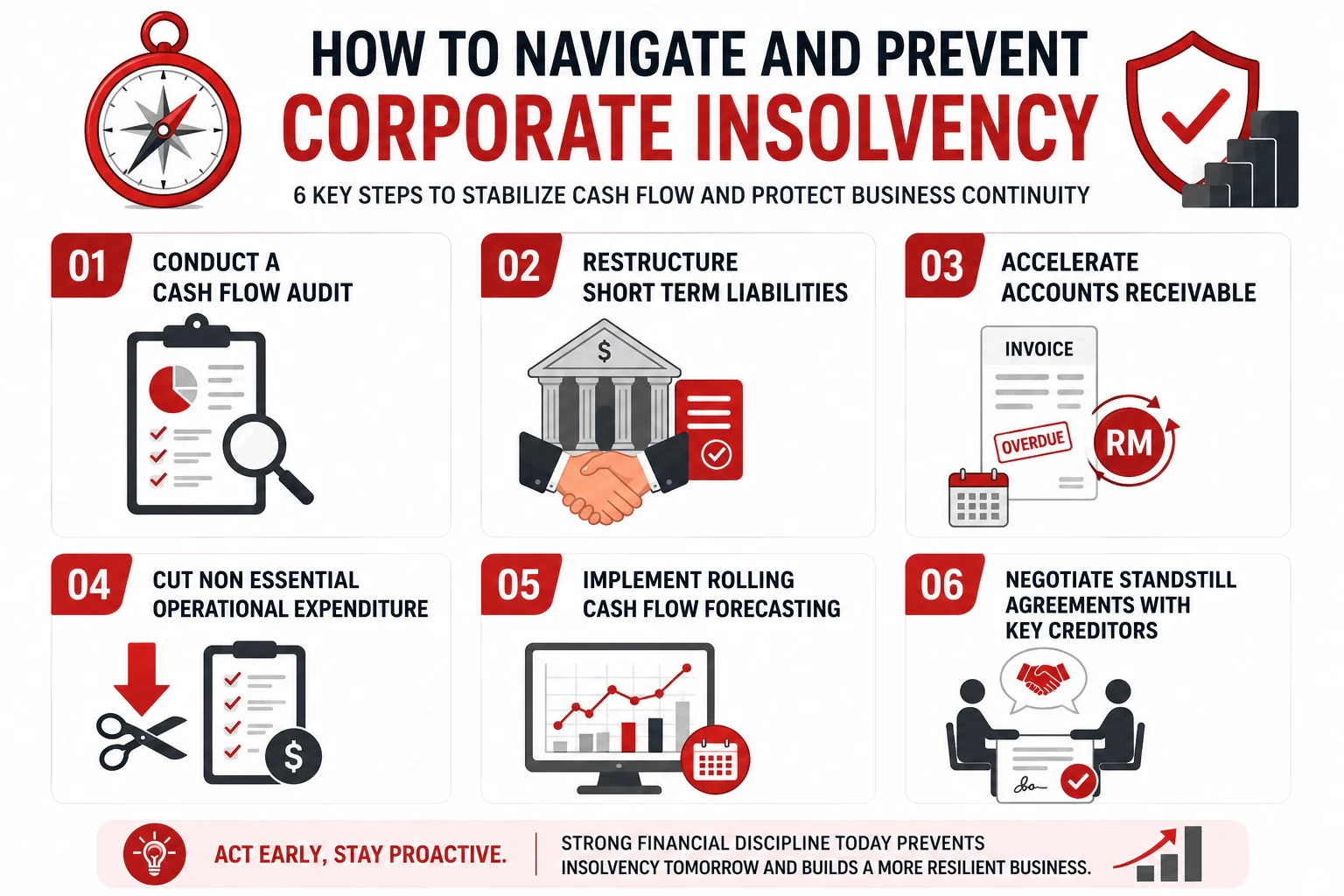
Navigating out of a period of financial illiquidity demands a structured, multi-step operational response focused on stabilizing working capital and restoring balance sheet health.
Step 1: Conduct a Comprehensive Cash Flow Audit
Begin by auditing every active cash inflow and outflow stream. Identify non essential recurring expenses, eliminate discretionary overheads, and establish strict internal authorization thresholds for every outgoing payment.
Step 2: Restructure Short Term Liabilities
Engage with primary lenders and trade creditors to restructure immediate debt obligations. Seek to convert short term, high interest debt into longer term structured payment plans to reduce monthly debt servicing costs.
Step 3: Accelerate Accounts Receivable Collection
Focus administrative resources on collecting overdue customer invoices. Offer modest early payment discounts to encourage rapid payment settlements and enforce strict credit holds on delinquent client accounts.
Step 4: Cut Non Essential Operational Expenditure
Freeze non critical hiring, defer capital expenditure projects, and re-negotiate vendor contracts to reduce fixed operating expenses while maintaining core product or service delivery standards.
Step 5: Implement Rolling Cash Flow Forecasting
Transition from static annual budgets to weekly rolling cash flow forecasts. This grants leadership clear visibility over upcoming liquidity gaps weeks in advance, allowing for timely corrective actions.
Step 6: Negotiate Standstill Agreements with Key Creditors
Formalize temporary standstill arrangements with major debt holders while executing turnaround plans. This prevents unexpected legal enforcement actions while restructuring efforts are underway.
Case Study: Over 31,000 Bankruptcy Cases Recorded in Malaysia
According to official data reported by The Star, Malaysia recorded more than 31,000 bankruptcy cases since 2021, with approximately 46 percent stemming from default on personal loans. This high volume of insolvency cases highlights the pervasive nature of debt mismanagement across both personal and business spheres in regions like Kuala Lumpur, Johor, and Penang.
This statistics demonstrate that financial failure is rarely an overnight event; it stems from unchecked debt accumulation and unmanaged cash outflows. While personal loans dominate individual insolvencies, commercial enterprises face identical risks when short term liabilities outpace incoming cash flow. When a business relies excessively on high interest credit lines to cover daily operating expenses, even minor market disruptions can turn manageable financial pressure into irreversible corporate bankruptcy.
Conclusion
Understanding the distinction between insolvency and bankruptcy is essential for business leaders managing financial risks. Insolvency refers to a financial condition where a business struggles to meet its obligations, while bankruptcy is a formal legal process that may result in asset liquidation and loss of business control.
Preventing financial distress requires proactive financial management, effective working capital control, and continuous monitoring of cash flow. By tracking liquidity metrics, managing receivables and liabilities, and maintaining clear communication with creditors, businesses can identify financial risks early and take corrective action before they escalate.
Businesses can also use automated financial tracking and accounting software to improve visibility over cash flow and financial performance. Schedule a free demo to discover how automated financial control can help identify cash flow risks and support more informed financial decisions.

FAQ about Bankruptcy and Insolvency
Yes. A company is insolvent when it cannot pay its debts as they fall due or when its liabilities exceed its assets. However, it only becomes bankrupt when a court issues a formal judicial order declaring bankruptcy or placing the business into court supervised liquidation.
Cash flow insolvency occurs when a business lacks liquid funds to settle immediate obligations despite having sufficient long term assets. Balance sheet insolvency occurs when total corporate liabilities exceed the total value of all assets on the balance sheet.
During bankruptcy, an appointed liquidator gathers and sells the company assets to distribute proceeds among creditors according to statutory priority rules, starting with secured creditors and liquidator fees, followed by preferential claims like employee wages.
Yes. If directors continue trading while knowing the company is insolvent (wrongful trading) or engage in fraudulent activities to avoid creditor payouts, courts can hold them personally liable for corporate debts.
A business can recover from insolvency by conducting a cash flow audit, negotiating debt restructuring with lenders, accelerating accounts receivable collections, cutting non essential operational costs, and injecting fresh equity capital.
Automated financial platforms provide real time visibility into cash positions, track aged receivables, send automated overdue payment alerts, and forecast future cash flow requirements, allowing management to prevent liquidity crises early.