







Your company provides an employee with a car, phone line, and partly furnished apartment. These non-cash benefits may be taxable as Benefit in Kind (BIK) in Malaysia. For example, the car may be valued as a taxable benefit based on its cost, while the phone line and accommodation may also be subject to tax depending on how they are provided and used.
Key Takeaways
Benefit in kind is a non cash benefit from an employer that still counts as taxable employment income in Malaysia.
Employers value BIK using either the formula method or the prescribed value method, applied consistently for the same benefit all year.
Each BIK is valued separately step by step, then combined to determine the employee’s total taxable benefit.
BIK calculations can be complex and error-prone. An integrated BIK management system automates calculations, reduces admin, and keeps payroll and tax reporting accurate.

What Is Benefit in Kind?
Benefit in kind (BIK) is a non-cash benefit provided by an employer, such as a company car, accommodation, or phone line. Although employees do not receive cash, the benefit can still be treated as taxable employment income, with its value added to their annual taxable income.
BIK is valued using recognized methods rather than simply the employer’s actual cost, and the employer must record and report the value. This makes accurate tracking important, especially when benefits change during the year or are shared between employees.
Benefit in Kind vs Perquisite vs Allowance
The three terms sit side by side on Malaysian payslips and are often used as if they mean the same thing. They do not. All three are taxable, but each one is valued in a different way.
| Feature | Benefit in Kind | Perquisite | Allowance |
|---|---|---|---|
| Form it takes | Use of an asset or a service | Something of monetary value given outright | A fixed cash payment |
| Convertible into cash | No | Yes | Already cash |
| Common examples | Company car, living accommodation, driver, furnishings | Cash bonus, gift voucher, share option, company shares | Phone allowance, travel allowance, meal allowance |
| How the value is set | Formula method or prescribed value method | The amount received or the market value of the item | The amount paid |
| Ownership | Stays with the employer | Passes to the employee | Passes to the employee |
| Taxable | Yes, unless specifically exempt | Yes, unless specifically exempt | Yes, unless specifically exempt |
The key difference is convertibility: a company car that remains with the employer is a benefit in kind, while a cash bonus that belongs to the employee is a perquisite. Misclassifying a benefit can also affect the wage base, statutory contributions, and compensation records.
Common Types of Benefit in Kind
Most benefits in kind in Malaysia fall into a short list of recurring items. The table below sets out the ones employers meet most often, together with the basis normally used to value each.
| Type of Benefit | Typical Example | Basis of Valuation |
|---|---|---|
| Company car | A vehicle assigned to a manager for work and personal use | Prescribed value based on the cost of the car when new |
| Fuel | A petrol card issued with the company car | Prescribed annual value, separate from the car itself |
| Living accommodation | An apartment rented by the employer for the employee | Its own rules, based on the rent paid or the defined value |
| Driver | A driver assigned to a senior employee | Prescribed annual value per driver |
| Gardener | A gardener paid by the company for the employee's home | Prescribed annual value per gardener |
| Household servant | Domestic help engaged and paid by the employer | Prescribed annual value per servant |
| Furnishings | Furniture and fittings supplied with company housing | Prescribed value by level of furnishing |
| Mobile phone | A handset and line paid for by the company | Exempt where the use is work related, within limits |
| Club membership | A recreational club membership held in the employee's name | The entrance fee or subscription borne by the employer |
| Insurance premium | A personal policy paid on the employee's behalf | The premium paid by the employer |
How the Value of Benefit in Kind Is Calculated
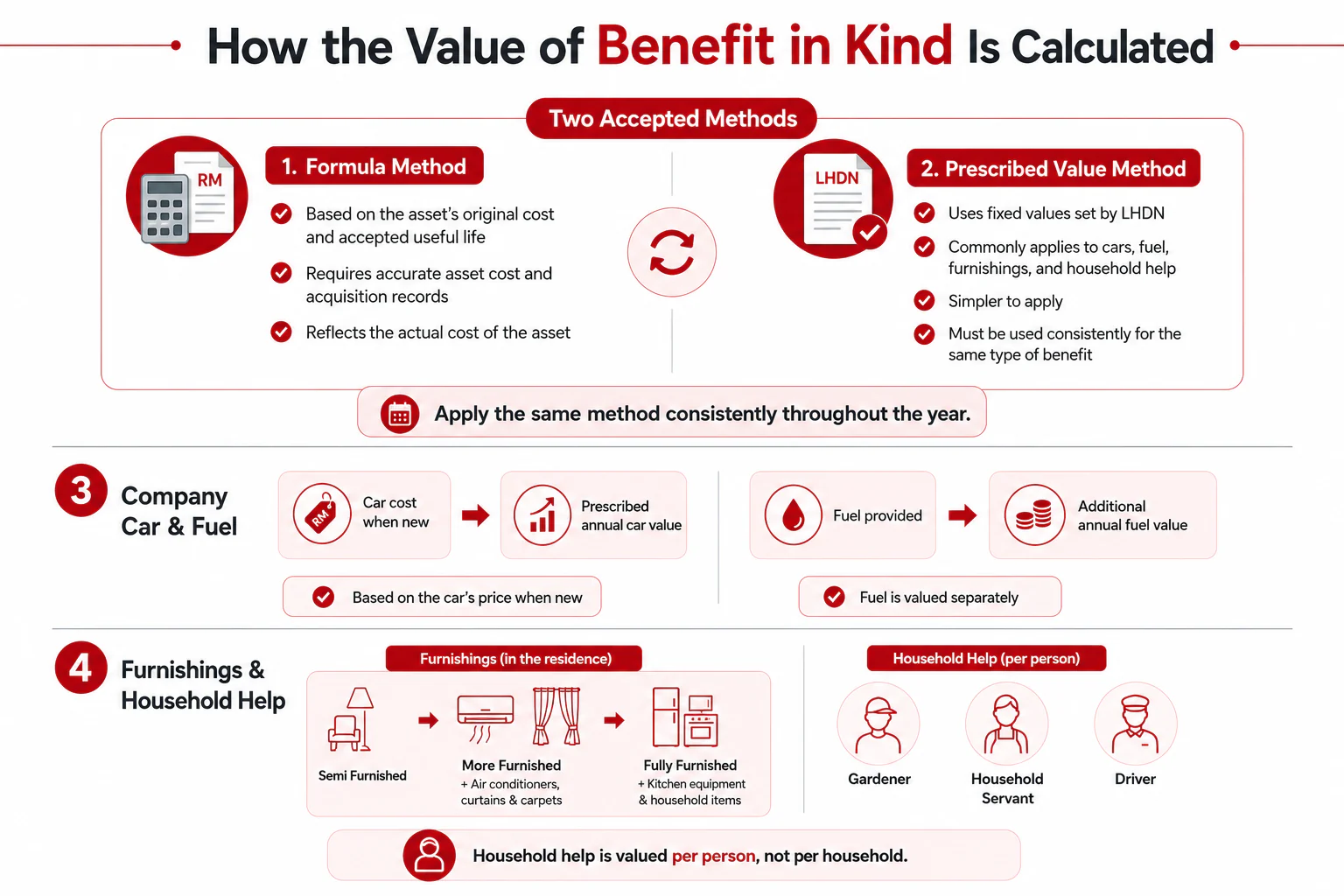
There are two accepted methods for calculating BIK: the formula method and the prescribed value method. The chosen method should be applied consistently to the same type of benefit throughout the year to avoid different values for the same benefit.
1. The formula method
The formula method calculates the annual BIK value based on the asset’s original cost and its accepted useful life. It is suitable for employers who maintain clear records of asset costs and acquisition dates.
This method provides a value based on the actual cost of the asset, making it useful when detailed information is available. However, accurate records are essential to ensure the calculation is correct.
2. The prescribed value method
The prescribed value method uses fixed values set by LHDN for common benefits such as cars, fuel, and household help. It is simpler to apply because employers do not need to calculate the value based on the asset’s original cost.
However, the prescribed value may not reflect the actual cost of the benefit. Employers should therefore apply the prescribed values consistently and ensure that the selected method is used throughout the year for the same type of benefit.
3. Prescribed values for a company car and fuel
A company car is valued according to what the vehicle cost when it was new, grouped into bands. Fuel provided alongside the car carries its own annual value on top of that.
| Cost of the Car When New (MYR) | Annual Value of the Car (MYR) | Annual Value of the Fuel (MYR) |
|---|---|---|
| Up to 50,000 | 1,200 | 600 |
| 50,001 to 75,000 | 2,400 | 900 |
| 75,001 to 100,000 | 3,600 | 1,200 |
| 100,001 to 150,000 | 5,000 | 1,500 |
| 150,001 to 200,000 | 7,000 | 1,800 |
| 200,001 to 250,000 | 9,000 | 2,100 |
| 250,001 to 350,000 | 15,000 | 2,400 |
| 350,001 to 500,000 | 21,250 | 2,700 |
| 500,001 and above | 25,000 | 3,000 |
Two points decide how much tax follows. The band is fixed by the price of the car when it was new, not by what it is worth today, and the fuel value applies on its own even where the car itself is older.
4. Prescribed values for furnishings and household help
Where an employer supplies housing, the furniture inside it is valued separately from the property. The amount rises with how completely the home is furnished.
| Benefit Provided | Annual Prescribed Value (MYR) |
|---|---|
| Semi furnished with furniture in the lounge, dining room or bedrooms | 840 |
| Semi furnished, plus air conditioners, curtains and carpets | 1,680 |
| Fully furnished, including kitchen equipment and other household items | 3,360 |
| Gardener | 3,600 per gardener |
| Household servant | 4,800 per servant |
| Driver | 7,200 per driver |
Household help is valued per person, not per household. An employee with both a gardener and a servant paid for by the company carries two separate annual values, not one combined figure.
Which Benefits in Kind Are Tax Exempt
Not every benefit an employer provides becomes taxable income. A defined set of benefits is exempt, mostly those tied to health, family, and the practical demands of doing the job.
The benefits usually treated as exempt in Malaysia include:
-
Medical, dental and maternity benefits
Employer-paid medical, dental, and maternity treatment can be exempt from tax. This may also cover traditional medicine when provided by a registered practitioner. -
Childcare benefits
Childcare provided or subsidized by the employer may qualify for tax exemption, subject to the applicable annual limit. -
Leave passage
Certain employer-provided travel benefits can be exempt, including qualifying local trips and limited overseas travel within the permitted amount. -
Communication devices and lines
Mobile phones, tablets, broadband, or similar communication facilities provided for work may be exempt when registered in the employer’s name and used for business purposes. -
Food and drink on the premises
Meals and drinks provided at the workplace can be exempt when they are made available to employees on the same terms. -
Discounts on company goods
Employee discounts on products or goods sold by the employer may qualify for exemption, subject to the applicable annual limit.
These exemptions are subject to specific conditions and limits. An HRM system can help employers track employee benefits and maintain accurate records, making it easier to monitor exemption limits and identify any taxable excess.
How Benefit in Kind Affects Statutory Contributions
Benefit in kind (BIK) is generally treated differently from cash wages when calculating statutory contributions. While BIK can increase an employee’s taxable income, its non-cash nature generally means it is not included in the wage base used for EPF, SOCSO, and EIS contributions.
This creates an important distinction in payroll: an employee may have higher taxable income because of BIK, while their monthly statutory contribution amounts remain based on cash wages. However, if the benefit is provided as a cash allowance instead, it may be treated as wages and affect the contribution base.
Employers should therefore classify each benefit correctly before processing payroll, especially for benefits such as housing and transport. Checking the applicable statutory definitions helps prevent incorrect contribution calculations and costly corrections later.
How Benefit in Kind Is Reported Each Year
Reporting is the employer's responsibility, not the employee's. The company calculates the value, records it through the year, and passes it to the employee in a form they can file with.
1. Where benefit in kind appears on the annual statement
Employers report taxable BIK in the Form EA (Borang EA) issued to each employee. The taxable value is shown separately from cash salary and exempt benefits, allowing employees to transfer the correct amount to their annual tax return without recalculating it themselves.
2. How it affects monthly tax deductions
Because taxable BIK increases an employee’s taxable income, it can also affect the monthly tax deduction (MTD) from their salary. Although the employee receives no additional cash, their tax deduction may increase, so recording BIK throughout the year helps prevent unexpected tax shortfalls at year end.
3. Key dates employers work to
Employers need to meet the deadlines for issuing Form EA and submitting their annual employer return. Since both depend on BIK records collected throughout the year, maintaining accurate records from the time each benefit is provided makes year-end reporting easier and reduces the risk of last-minute corrections.
A Step-by-Step Benefit in Kind Calculation

Take a manager who receives a company car that cost RM120,000 when new, fuel supplied with it, and a semi furnished apartment fitted with air conditioners, curtains and carpets.
Each component is valued on its own using the prescribed value method, then added together to give the annual benefit in kind figure.
| Component | Basis | Annual Value (MYR) |
|---|---|---|
| Company car | Falls in the 100,001 to 150,000 band | 5,000 |
| Fuel | Fuel value for the same band | 1,500 |
| Furnishings | Semi furnished with air conditioners, curtains and carpets | 1,680 |
| Total benefit in kind for the year | Sum of the three components | 8,180 |
The total BIK value is added to the manager’s taxable employment income for the year, even though no additional cash is paid. The manager’s cash salary and wage base for monthly statutory contributions remain unchanged, while a car provided for only part of the year is included in prorated salary calculations based on the months the employee used it.
The manager’s cash salary and wage base for monthly statutory contributions remain unchanged, while a car provided for only part of the year is included in prorated salary calculations based on the months the employee used it.
Common Mistakes and How to Avoid Them
Most benefit in kind problems are record keeping problems rather than technical ones. Five recur across Malaysian companies:
Assuming every benefit is exempt
Not every employee benefit qualifies for tax exemption. Exemptions usually apply only to specific benefits and may have conditions or annual limits. Employers should check whether each benefit meets the requirements and treat any amount above the permitted limit as taxable.
Recording benefits and cash allowances on one line
BIK and cash allowances are treated differently for tax and statutory contribution purposes. Combining them can make it difficult to determine the correct taxable value and wage base. Keeping each benefit type separate from the start makes payroll calculations and reporting easier to verify.
Changing valuation method partway through the year
Switching between the formula and prescribed value methods can result in inconsistent values for the same type of benefit. Employers should select the appropriate method and apply it consistently throughout the year to avoid recalculations during annual reporting.
Not keeping the original cost of assets
The original cost and acquisition date may be needed when calculating certain BIK values, particularly under the formula method. Without accurate asset records, employers may struggle to calculate the benefit correctly or support the figures during a tax review.
Collecting benefit data only at year end
Waiting until year end to record BIK makes it harder to identify when a benefit started, ended, or changed. Recording each benefit when it is provided also makes part-year calculations more accurate and reduces the need to reconstruct missing information later.
Conclusion
Benefit in kind (BIK) reporting follows a simple process: identify the benefit, apply the correct valuation method, check for exemptions, and include the taxable value in the annual statement. Keeping each step consistent helps ensure accurate tax reporting.
The most important part is maintaining accurate records throughout the year. Even exempt benefits need to be recorded, while misclassifying a BIK as a cash allowance can affect statutory contributions and payroll calculations.
Learn more about how our solution can support your payroll process with schedule a free demo today.

FAQ about Benefit in Kind
Yes. A benefit in kind is treated as part of employment income and is added to the employee's taxable income for the year, unless it falls within a specific exemption such as medical, dental, maternity or childcare benefits.
A benefit in kind cannot be converted into cash and the asset stays with the employer, such as a company car. A perquisite has monetary value and passes to the employee outright, such as a cash bonus or a gift voucher.
Generally no. EPF, SOCSO and EIS contributions are calculated on wages, which centre on money paid to the employee, so a non cash benefit sits outside that base. Paying the same benefit as a cash allowance would bring it into the base.
The employer. The company values each benefit, keeps the records, and reports the amount on the annual statement of remuneration issued to the employee, who then carries that figure into their own tax return.