







Tracking buyers across physical branches, online storefronts, and payment terminals often creates conflicting records and fragmented transaction histories. A Customer Data Platform (CDP) solves this by merging scattered touchpoints into verified, persistent customer profiles that all operational tools can access.
However, the acronym CDP also denotes Continuous Data Protection and the Carbon Disclosure Project in corporate reporting, making clear terminology essential as governance priorities rise. According to PwC's 2026 Global Digital Trust Insights, data trust and protection rank among the top cybersecurity investment drivers for 63% of local organizations.
Knowing whether you genuinely need an identity resolution layer prevents costly, redundant software investments. Read on to discover how a CDP operates, how it synchronizes with your sales lead tracking workflows, and how to evaluate your company's actual data readiness before deploying new technology.
Knowing whether you genuinely need an identity resolution layer prevents costly, redundant software investments. Read on to discover how a CDP operates, how it synchronizes with your sales lead tracking workflows, and how to evaluate your company's actual data readiness before deploying new technology.
Knowing whether you genuinely need an identity resolution layer prevents costly, redundant software investments. Read on to discover how a CDP operates, how it synchronizes with your sales lead tracking workflows, and how to evaluate your company's actual data readiness before deploying new technology.
Key Takeaways
A CDP unifies customer data from websites, apps, POS, CRM and support into one persistent profile per customer through identity resolution.
CDPs are not the same as CRMs, DMPs or MDM systems, each holds different data, serves different teams, and solves a different problem.
A CDP does not make a business PDPA-compliant, centralizing personal data increases the obligations that already apply.
Many Malaysian businesses that think they need a CDP actually need customer segmentation that works, which is a CRM capability.
Scattered customer data limits your growth potential. Centralizing your customer management ensures your sales and marketing teams always have the right insights.

What Is a Customer Data Platform (CDP)?
A Customer Data Platform (CDP) is a software engine that consolidates first party customer data from multiple touchpoints into unified, individual profiles. Using identity resolution, it connects separate interactions such as online browsing, in store purchases, and support tickets into a single reliable source of truth.
Unlike traditional data warehouses that only store records for historical analysis, a CDP is built for action. It operates behind the scenes to feed updated customer segments directly into marketing, sales, and service tools, allowing teams to deliver consistent engagement without waiting for manual data extracts.
How Does a Customer Data Platform Work?
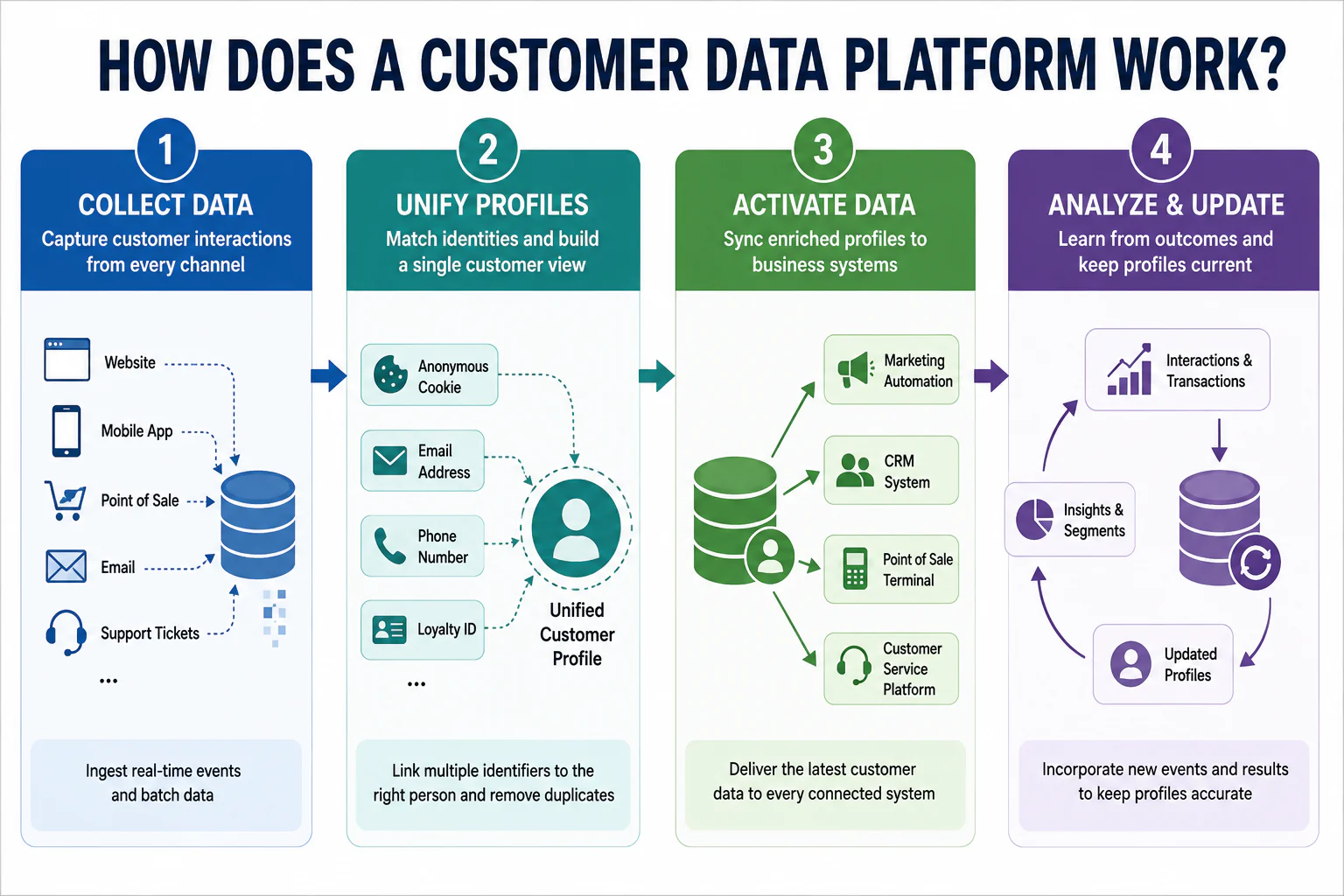
A Customer Data Platform functions as an automated data pipeline connecting raw touchpoints with external business applications. The system processes customer data through four technical stages:
1. Collecting First Party Data
The platform ingests real time event logs and batch records across available channels. These data streams include website browsing sessions, mobile application usage, point of sale transactions, email responses, and customer support tickets.
2. Unifying Profiles Through Identity Resolution
Raw interaction traces usually carry separate identifiers such as an anonymous cookie, email address, phone number, or loyalty ID. The system matches these data points to link fragmented records to the correct individual, creating a single persistent profile.
3. Activating Data Across Connected Systems
Once profiles are consolidated, the platform synchronizes the updated customer attributes with operational applications. Systems such as marketing automation tools, CRM software, point of sale terminals, and customer service platforms receive the latest profile state to maintain consistent customer context.
4. Analyzing Feedback and Updating Records
Subsequent interactions and transaction results generated by connected systems flow back into the platform. This incoming event data updates the persistent profile, ensuring future segment queries reflect recent customer activity.
Core Components of a Customer Data Platform Architecture
A Customer Data Platform relies on four interconnected technical modules to transform raw, fragmented interaction traces into high-value operational assets:
1. Data Ingestion Engine
This layer ingests high-velocity event streams from first-party touchpoints, including web interactions, POS checkouts, and support logs. By validating and standardizing disparate incoming formats in real time, it eliminates the data schema mismatches that typically break downstream reporting.
2. Identity Resolution Engine
Acting as the platform's computational core, this module links deterministic data like verified emails and phone numbers with probabilistic signals such as browser cookies. It resolves duplicate records across separate channels into a single, persistent profile without overwriting historical behavioral context.
3. Real-Time Segmentation Module
Rather than relying on static database queries that age quickly, this engine categorizes audiences dynamically based on cross-channel behaviors and transaction thresholds. Segments refresh instantaneously when user behavior shifts, allowing commercial teams to target active intent instead of outdated history.
4. Data Activation Layer
This component manages bidirectional data pipelines to operational tools, such as CRM systems, marketing automations, and service desks. By streaming real-time profile states across your stack, it ensures automated workflows trigger immediately without requiring manual data extraction.
The Differences Between CRM, CDP, DMP, and MDM
Selecting the right data architecture requires distinguishing how records are processed across operations. While DMPs handle broad ad reach and implementing enterprise master data management frameworks ensures enterprise-wide data hygiene, a CDP turns first-party behavioral traces into actionable customer profiles. Comparing their technical boundaries prevents overlapping software investments:
Selecting the right data architecture requires distinguishing how records are processed across operations. While DMPs handle broad ad reach and implementing enterprise master data management frameworks ensures enterprise-wide data hygiene, a CDP turns first-party behavioral traces into actionable customer profiles. Comparing their technical boundaries prevents overlapping software investments:
Selecting the right data architecture requires distinguishing how records are processed across operations. While DMPs handle broad ad reach and implementing enterprise master data management frameworks ensures enterprise-wide data hygiene, a CDP turns first-party behavioral traces into actionable customer profiles. Comparing their technical boundaries prevents overlapping software investments:
| Operational Dimension | Customer Data Platform (CDP) | Customer Relationship Management (CRM) | Data Management Platform (DMP) | Master Data Management (MDM) |
|---|---|---|---|---|
| Primary Data Source | First-party behavioral and transactional data | Direct contact records and interaction logs | Anonymous third-party audience data | Enterprise master records across entities |
| Core Operational Purpose | Unifying cross-channel traces to activate personalized workflows | Managing sales pipelines, account history, and customer service | Targeting paid advertising across external ad networks | Governing data consistency for customers, vendors, and products |
| Key Users | Marketing and operational teams | Sales and support teams | Media buyers and ad planners | IT and data management teams |
These platforms complement rather than replace each other. While front-line teams rely on modern customer relationship software to manage known contact interactions, DMPs expand top-of-funnel reach, MDMs govern data integrity, and CDPs orchestrate first-party signals to automate personalized workflows.
What Problems Does a CDP Solve?
As businesses adopt multiple digital tools, customer records quickly become fragmented across separate databases. Organizations implement a Customer Data Platform to resolve five critical operational bottlenecks:
1. Fragmented Records Across Disconnected Systems
Customer traces scattered across offline checkouts, web visits, and support portals make calculating exact unique customer numbers difficult. A CDP unifies these touchpoints into a persistent, consolidated profile.
2. Slow Audience Targeting and Data Bottlenecks
Marketing teams often wait days for IT personnel to pull manual database queries. A CDP automates data ingestion, enabling teams to build dynamic advanced customer segmentation models that update instantly as customer behavior changes.
3. Inconsistent Engagement and Channel Fatigue
Disconnected platforms lead to irrelevant messaging, such as promoting items an individual recently bought in-store. A CDP synchronizes purchase histories across all touchpoints, protecting communication relevance and strengthening your wider digital customer loyalty program.
4. Delayed Detection of Churn Signals
Tracking drops in activity across multiple separate platforms often happens too late to take corrective action. A CDP aggregates cross-channel behavioral drops into real time indicators, allowing service teams to intervene before accounts disengage.
5. Inaccurate Cross-Channel Attribution
Evaluating channel performance is difficult when conversion data lives in isolated analytics tools. A CDP connects the complete customer path from initial discovery to repeat checkout, providing a clear view of actual revenue drivers.
CDP and PDPA Compliance in Malaysia
Implementing a Customer Data Platform does not automatically make an organization compliant with Malaysia's Personal Data Protection Act (PDPA). Because a CDP consolidates high volumes of personal identifiable information into a single repository, it centralizes data protection obligations and regulatory exposure.
1. Consent and Purpose Limitation Across Integrated Channels
Unifying customer traces from websites, point of sale terminals, and support desks involves continuous data transfers between software applications. Under the PDPA, individual consent and specific processing purposes must travel with each customer profile. If a user opts out of promotional messaging on one channel, the CDP must reflect that preference across all connected systems immediately rather than keeping outdated permissions in isolated databases.
2. Regulatory Thresholds and Mandatory Governance
Consolidating customer databases often pushes businesses beyond critical PDPA compliance thresholds under the Act A1727 amendment framework:
- Data Protection Officer (DPO): Centralizing large customer volumes may trigger the requirement to formally appoint a DPO, particularly when managing sensitive consumer records or exceeding processing volume thresholds.
- Mandatory Breach Notification: Because a CDP houses interconnected customer profiles, security incidents can affect significant user volumes. Under current guidelines, organizations must report qualifying data breaches to the Personal Data Protection Commissioner within 72 hours.
- Direct Processor Obligations: Under Act A1727, third party software providers and cloud data processors are directly bound by the Security Principle to align with Malaysia's core personal data protection principles. Businesses must ensure any CDP vendor maintains verified encryption standards, clear server location protocols, and transparent incident reporting procedures.
Does Your Business Actually Need a CDP?
Investing in a Customer Data Platform is an architectural decision driven by operational complexity, not company size. Organizations often mistake basic data accessibility issues for problems that require an enterprise resolution engine.
Operational Indicators That Signal CDP Readiness
A business genuinely requires a Customer Data Platform when fragmented data sources prevent teams from executing standard commercial workflows:
- High System Fragmentation: Customer interaction records sit in four or more isolated databases that cannot exchange real time events automatically.
- Unclear Total Audience Count: Commercial and finance teams cannot determine the exact number of unique customers without manually reconciling spreadsheets across multiple departments.
- Repetitive Segmentation Bottlenecks: Audience targeting criteria and personalization logic must be rebuilt by hand for every campaign due to lack of dynamic data syncing.
- Scale Exceeding Manual Capacity: Transaction volumes and cross channel events have expanded beyond what batch file exports and scheduled spreadsheet merges can handle.
When a CRM System Remains Sufficient
A dedicated CDP is unnecessary if an organization operates primarily through one or two commercial channels and handles direct customer relationships. Standard customer segmentation based on recency, frequency, and total spend can already be executed directly within a modern CRM platform.
If your primary objective is managing contact histories and running structured campaigns from an existing database, adding an identity resolution layer provides little added value. In these operational setups, relying on your current CRM avoids redundant software costs and unnecessary maintenance overhead.
Conclusion
A Customer Data Platform delivers true architectural value only when an organization manages complex, multi-channel touchpoints and possesses the operational readiness to act on real-time data. Rather than replacing existing systems, a CDP functions as the central engine that unifies scattered behavioral records, feeding enriched context back into your operational tools.
Successful adoption requires balancing data unification with strict regulatory governance. Consolidating records demands clear consent tracking, verified processor security, and active compliance oversight. When deployed strategically, a CDP transforms fragmented customer interactions into reliable operational drivers across sales, marketing, and support channels.
Evaluating how a unified data layer aligns with your existing technology stack is the most practical step forward. Request a free demo now to see how our platform unifies customer records, automates segmentation, and accelerates cross-channel workflows.
FAQs About Customer Data Platforms
In business, CDP stands for customer data platform. The acronym is also used to refer to continuous data protection in IT, and the Carbon Disclosure Project in sustainability reporting.
An example is a software setup that observes a customer browsing a website, ties that behaviour to an in-store purchase they made previously, and triggers a follow-up marketing email based on those combined actions.
No. A data warehouse stores and analyses data, while a CDP resolves identity and activates profiles.
No. Compliance depends on how data is controlled, not on tooling. In fact, a CDP centralises the very data the PDPA governs.
Costs are highly variable. According to CDP.com, enterprise deployments in the US market range from USD 100,000 to 500,000 per year.
No, because they operate on different layers. For most businesses, the right sequence is to fix the CRM first.