







Many sales teams in Malaysia struggle to close deals consistently because their sales process is unclear or inconsistent. Without a structured workflow, teams often face poor follow-ups, uneven pipeline management, and lower conversion rates. Implementing a clear sales process helps businesses improve consistency, organize sales activities, and increase overall sales performance.
This is supported by research from McKinsey, which found that companies with structured and documented sales processes tend to achieve 28% more revenue growth and higher win rates. When combined with CRM software, businesses also gain better pipeline visibility, more accurate tracking, and improved coordination across the sales team.
This article will discuss the seven essential steps in sales process, key workflows worth automating, and strategies businesses can use to improve sales performance, increase win rates consistently, and optimize pipeline management with a CRM sales system.
Key Takeaways
A structured sales process helps businesses improve consistency, optimize sales activities, and achieve more predictable results.
The seven-step sales process helps businesses manage each sales stage more systematically and improve overall sales effectiveness across different industries.
Continuously improving your sales process helps businesses stay competitive, adapt to changing buyer behavior, and achieve better sales performance over time.
Many businesses struggle with inefficient sales processes and missed follow-ups. An integrated sales automation solution helps improve lead management and sales efficiency.

What Is a Sales Process in Business?
A sales process is a structured series of steps used by sales teams to guide prospects from the first interaction to a successful deal. By following a consistent process, businesses can standardize how sales reps approach potential customers, making sales activities more organized and results more predictable.
A defined sales process also helps companies monitor each sales stage more effectively, making coaching and performance evaluation easier. In addition, it speeds up onboarding for new sales reps because they can quickly learn a proven workflow. Many businesses today integrate their sales process into CRM or sales management system to gain better pipeline visibility and identify areas for improvement.
Sales Process vs Sales Methodology vs Sales Cycle
These three terms get used interchangeably, but they describe three different things, and confusing them leads to confused tactics.
| Term | Definition | Focus | Example |
| Sales Process | A structured series of steps used to guide prospects from first contact to closing a deal. | Sales workflow and stages | Prospecting → Qualification → Closing |
| Sales Methodology | The selling approach or technique used during the sales process. | Communication and sales strategy | SPIN Selling, Challenger Sale |
| Sales Cycle | The time required to convert a prospect into a customer. | Sales duration and efficiency | 30-day or 120-day sales cycle |
The difference matters because each one fixes a different problem. If your win rate is low, the methodology probably needs work. If your conversion at one stage is poor, your process has a gap. If your cycle is long but conversion is healthy, the issue is throughput rather than skill.
Why Your Business Needs a Defined Sales Process?
A defined sales process helps businesses create more consistent and measurable sales performance by reducing guesswork throughout the pipeline. Companies with a structured sales process also tend to achieve higher win rates and better overall sales efficiency.
Some of the main benefits of a defined sales process include:
- Higher win rates through more consistent sales execution
Sales teams follow the same qualification, follow-up, and closing approach, which reduces inconsistency and improves the chances of converting opportunities into customers. - Shorter sales cycles with clearer workflows and follow-ups
A structured process helps reps know what actions to take at each stage, reducing delays and helping deals move through the pipeline faster. - Faster onboarding for new sales representatives
New sales reps can adapt more quickly because they already have a clear framework, workflow, and sales stages to follow from the beginning. - Better visibility into pipeline performance and bottlenecks
Businesses can track where deals are slowing down, identify weak stages in the pipeline, and make improvements more effectively.
- More accurate sales decisions based on clear data
Standardized sales activities produce more reliable reporting, helping managers make better forecasting and performance decisions.
- Improved conversion rates across each sales stage
Clear sales steps help teams handle leads more effectively, improving the likelihood of prospects moving from one stage to the next.
- Stronger consistency in how sales teams manage opportunities
Every sales rep follows similar processes and standards, creating a more organized pipeline and more predictable sales performance.
Research from HubSpot’s 2024 Sales Trends Report also found that teams using a defined sales process generally achieve higher win rates compared to teams without one.
By implementing a structured sales process, businesses can improve sales consistency, reduce inefficiencies, and make it easier for teams to maintain stronger performance over time. When supported by CRM sales software, companies can also monitor pipeline activity more accurately and optimize each stage of the sales cycle more effectively.
The 7 Steps of the Sales Process
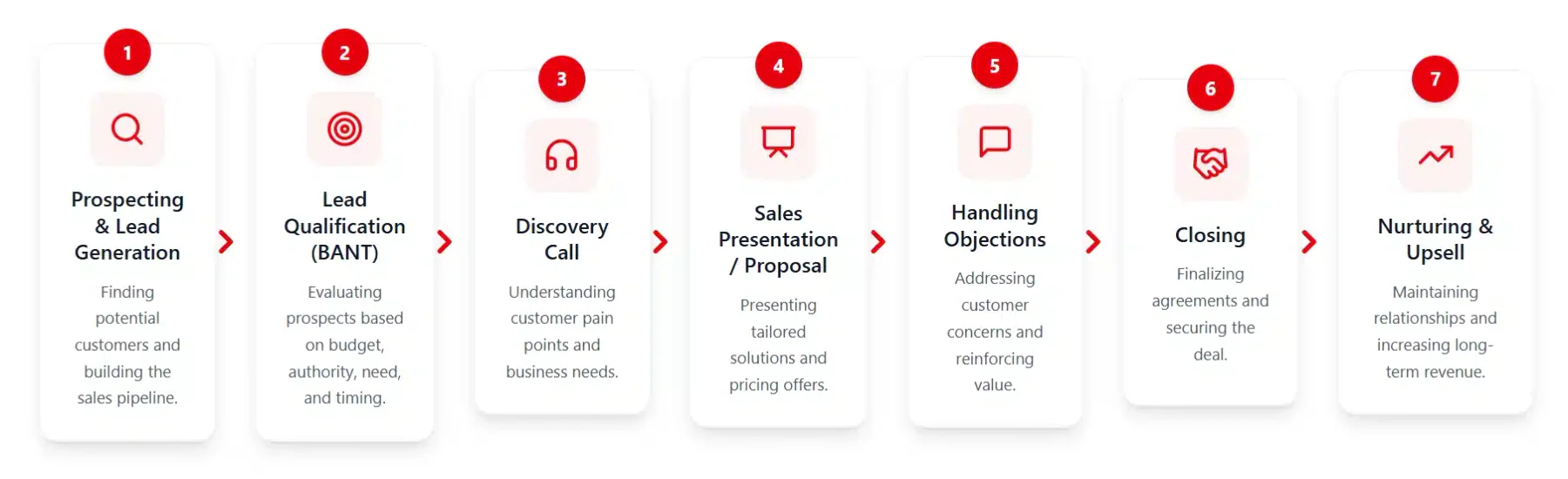
The framework below applies whether you sell software, industrial equipment, or professional services. What changes between industries is the time each step takes, not the steps themselves.
Step 1: Prospecting and Lead Generation
This stage focuses on identifying potential customers that match the ideal customer profile (ICP) and starting the first interaction. Leads can come from outbound outreach, inbound marketing, referrals, or business partnerships. The main goal is to build a healthy sales pipeline and secure qualified discovery calls with potential buyers.
Step 2: Lead Qualification with BANT
Not every prospect is ready to buy, which is why sales teams use the BANT framework: Budget, Authority, Need, and Timing. This method helps sales reps evaluate whether a prospect has the budget, decision-making power, business need, and urgency to move forward. By qualifying leads early, businesses can focus their time on high-potential opportunities.
Step 3: Discovery Call
The discovery call helps sales reps understand the prospect’s challenges, goals, and pain points in greater detail. Instead of focusing on product promotion, reps should ask open-ended questions and actively listen to the buyer’s needs. A successful discovery call usually reveals the customer’s main problem, the impact of the issue, and their expected timeline for making a decision.
Step 4: Sales Presentation or Proposal
After gathering information during discovery, the sales team presents a tailored solution that directly addresses the customer’s needs. A strong proposal typically explains the buyer’s problem, how the product or service solves it, pricing details, and supporting case studies or examples. Personalized presentations are generally more effective than generic sales pitches.
Step 5: Handling Objections
During the sales process, prospects may raise objections related to pricing, timing, product suitability, or internal approval. Sales reps should treat these concerns as opportunities to provide clarification and reinforce value rather than as rejection. Addressing objections effectively helps build trust and move the deal closer to closure.
Step 6: Closing
Closing is the stage where the prospect agrees to move forward with the purchase. In B2B sales, this process often involves multiple stakeholders such as operations, procurement, and finance departments before final approval is given. When the earlier sales stages are handled properly, closing becomes a smoother confirmation process instead of a hard sell.
Step 7: Nurturing and Upsell
The sales process continues even after the deal is closed. Businesses should maintain customer relationships through regular follow-ups, customer support, and upselling opportunities. Strong post-sales engagement can improve customer retention, increase long-term revenue, and create opportunities for repeat business.
Common Sales Process Mistakes in Business Field
Even teams with a documented process fall into predictable traps. These five are the most common.
- Skipping qualification
A rep books a demo without checking whether the prospect has budget or authority. Two weeks later, eight hours have gone into a deal that was never going to close. - Pitching before diagnosing
The rep opens the discovery call with a slide deck instead of a question. The prospect tunes out within five minutes. - Talking more than listening
Discovery calls where the rep talks more than half the time produce lower close rates. Gartner research shows the gap is roughly 2.5 times in favour of reps who let the prospect talk. - No follow-up system after the proposal
The rep sends the proposal and goes quiet when the buyer goes quiet. Buyers interpret silence as disinterest. A cadence of three follow-ups over 10 business days recovers a meaningful share of these deals. - No defined exit criteria
Without explicit conditions for moving a deal forward, deals advance on the rep’s optimism rather than the buyer’s readiness. The result is a pipeline that looks healthy on Friday and collapses on Monday.
What Parts of the Sales Process Should You Automate?
Sales process automation does not mean replacing salespeople. It means removing the manual administrative work that pulls reps away from selling. McKinsey research shows the average B2B sales rep spends about 28 percent of their week on actual selling activity. The rest is admin, CRM updates, and internal meetings. Automation closes that gap.
Four areas worth automating
| Automation Area | Description | Main Benefit |
| Lead Scoring & Routing | Automatically classifies leads as hot, warm, or cold and assigns qualified leads to the right sales rep. | Faster response time and higher conversion opportunities. |
| Pipeline Stage Updates | Automatically updates deal stages after sales reps complete activities such as discovery calls or note submissions. | Reduces manual work and improves pipeline accuracy. |
| Follow-up Email Sequences | Sends automated personalized follow-up emails after important sales stages like discovery or proposal submission. | Ensures consistent communication with prospects. |
| Quote & Proposal Generation | Sales force automation helps businesses automatically generate quotations and proposals using customer, pricing, and product data stored in the CRM. | Saves time and speeds up the sales process. |
What you should NOT automate?
Some sales activities are still more effective when handled manually, especially those that require trust, flexibility, and stronger personal communication. These activities usually include:
- Initial communication with high-value prospects
- Relationship-building discussions with potential clients
- Pricing negotiations and custom offer discussions
- Contract and agreement negotiations
- Complex customer problem-solving conversations
Meanwhile, a well-configured CRM sales module can automate repetitive administrative tasks, such as:
- Follow-up reminders and email scheduling
- Lead assignment and pipeline updates
- Sales activity tracking and reporting
- Proposal and quotation workflows
- Customer data recording and status updates
This balance between automation and human interaction helps businesses improve efficiency while maintaining a better customer experience.
How to Continuously Improve Your Sales Process?

A sales process is never finished. Buyer behavior shifts, competitors change tactics, and your product evolves. Teams that keep improving every quarter outperform teams that set a process once and leave it alone.
1. Track the right metrics per stage
Conversion rate per stage tells you where deals leak. Average time per stage tells you where they stall. Win rate by source tells you where your best prospects come from.
2. Review your buyer persona at least twice a year
The buyer who signed last year is not necessarily the buyer signing this year. Biannual persona review keeps your messaging aligned with the current market.
3. Audit your tech stack for redundancy and gaps
Most teams accumulate tools without removing old ones. Run a quarterly audit and consolidate. Every tool that is not actively used is friction.
4. Identify bottlenecks using CRM pipeline data
Your CRM’s stage by stage conversion report tells you where to focus coaching. If 80 percent of deals advance from discovery to proposal but only 40 percent advance from proposal to close, your closing skills need work, not your discovery skills.
5. Run regular pipeline review meetings
Once a week, the team reviews every deal in the pipeline. Stalled deals get unstuck or removed. HubSpot’s 2024 Sales Trends Report found that high-performing teams review pipeline at least weekly, while low performers do not review at all.
Sales Process by Industry: How It Differs
The seven-step framework is universal. What changes is how each step plays out in practice. Three industries below illustrate the range.
1. B2B SaaS
In B2B SaaS companies, sales cycles are usually shorter, typically ranging from 14 to 30 days. Discovery and product demos are often combined through free trials or product-led experiences, while proposals are generally simpler and faster. However, businesses still need to ensure customers fully understand the product before closing the deal.
2. Manufacturing and Distribution
Manufacturing and distribution businesses usually have longer sales cycles because the buying process involves technical evaluations and multiple decision-makers. Engineers, procurement teams, and management often participate in the approval process, making qualification and proposal stages more complex.
3. Professional Services
Professional service businesses rely heavily on relationships and referrals throughout the sales process. Trust is often built before formal proposals are introduced, while pricing and service offerings are usually customized based on client needs. Because of this, the proposal stage often becomes the most important factor in winning the deal.
How to Map Your Sales Process in a CRM?
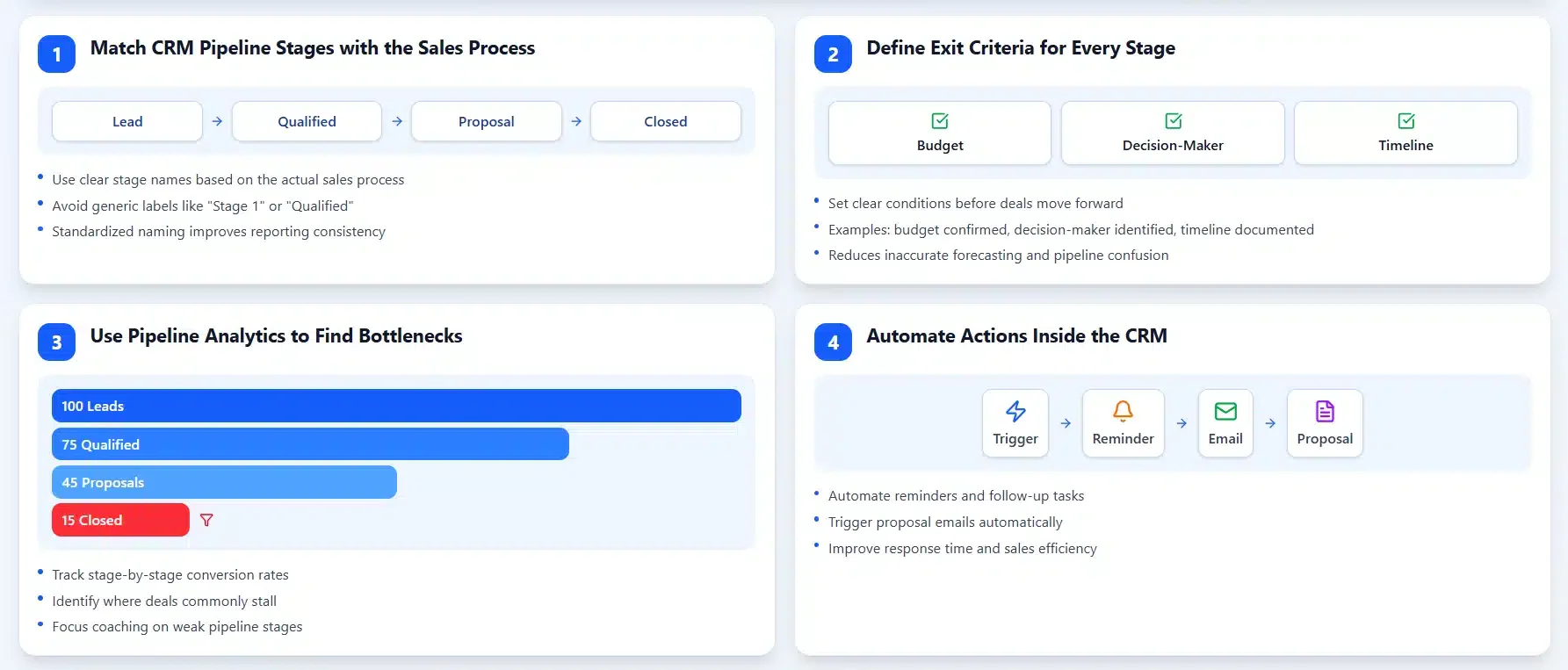
Most sales teams lose visibility because their CRM pipeline stages do not match how their buyers actually make decisions. The pipeline becomes a dumping ground rather than a coaching tool. The fix is to map your process into the CRM properly from the start.
1. Name your pipeline stages after the 7 steps
Use the actual step names, not generic CRM defaults like Stage 1 or Qualified. When the pipeline mirrors the process, every rep speaks the same language and reporting becomes self-explanatory.
2. Set explicit exit criteria for each stage
A deal should not advance from Discovery to Proposal because the rep thinks it is ready. Define the conditions. Budget confirmed, decision-maker identified, timeline documented. Deals that do not meet the criteria stay where they are. This single discipline eliminates the optimism gap that wrecks most B2B forecasts.
3. Use pipeline analytics to identify drop-off
Your CRM should produce a stage by stage conversion report. The stage with the steepest drop-off is your highest-leverage coaching target. If 70 percent of deals stall between proposal and close, the team needs closing coaching, not more lead generation.
4. Configure automation around the stages
When a rep moves a deal to Proposal, an automated email should send the template. When the deal sits there for more than five days, a reminder should ping the rep. The CRM software you choose should make this configurable without engineering work.
Conclusion
A structured sales process is not bureaucracy. It is the foundation that lets a team move from improvising every deal to running a predictable revenue engine. The three themes in this article work together. The seven steps give you structure. Automation removes the admin that steals selling time. Continuous improvement keeps the process aligned with how your buyers actually behave today, not how they behaved last year.
Sales leaders in Malaysia who want to put this into practice quickly should start by mapping their current process against the seven steps and fixing the stages that have no exit criteria. To manage your sales process inside a CRM built for mid-market B2B, try a free demo and see how the seven steps map onto your real pipeline.

FAQ about Sales Process in Business
For most mid-market B2B teams in Malaysia, building and rolling out a structured sales process takes between four and twelve weeks. The timeline depends on team size, the complexity of the existing pipeline, and how much documentation you already have. A focused approach starts with mapping current activities, defining stage exit criteria, then training the team over two to four weeks before going fully live.
Start with a short workshop that walks through each stage, the exit criteria, and real examples from your own pipeline. Pair every rep with weekly coaching sessions for the first month so questions get answered quickly and bad habits do not return. Reinforce the process by using consistent stage names inside your CRM and tying every pipeline review directly to the seven-step structure.
Yes, alignment between sales and marketing matters because both teams shape the buyer journey. Marketing typically owns lead generation and early nurturing, while sales takes over once a lead meets qualification criteria. Sharing definitions, stages, and lead handover rules removes the friction that often causes deals to stall between the two teams.
Inbound starts when a prospect contacts you first, usually through a website form, content download, or referral, so qualification and discovery tend to move faster. Outbound starts with the rep researching and reaching out, which adds time at the prospecting stage. The middle and closing steps stay similar, but the energy spent on the first two stages flips between the two motions.
Four areas benefit most from automation, namely lead scoring and routing, pipeline stage updates, follow-up email sequences, and quote or proposal generation. These remove repetitive admin work and return six to ten hours per rep per week. High-touch activities like negotiation, first contact with enterprise prospects, and relationship check-ins should stay manual.