






Manufacturers often struggle to improve equipment uptime, product quality, planning accuracy, and cost control because operational data is fragmented across machines, spreadsheets, maintenance records, and business systems. AI in manufacturing can help solve this problem by analyzing connected data, detecting unusual patterns, estimating risks, and recommending actions before production issues become more serious.
In Malaysia, this approach is becoming more relevant as the New Industrial Master Plan 2030 supports smart manufacturing, productivity growth, and greater use of advanced technology. Since local manufacturers have different equipment, skills, and levels of data maturity, AI adoption should begin with a focused use case supported by reliable factory data and clear human oversight.
The following sections explain how AI in manufacturing works with ERP manufacturing software to improve production planning, maintenance, quality control, inventory, and cost visibility.
Key Takeaways
AI in manufacturing enables smarter, data-driven decisions by analyzing production data to improve efficiency, quality, and productivity.
AI applications in manufacturing help optimize production, maintenance, inventory, and quality control to improve operational efficiency.
Implementing AI in manufacturing requires a phased approach, clear objectives, reliable data, and cross-functional collaboration.
Without a unified system, manufacturers often face inaccurate data, manual processes, and limited visibility that reduce the effectiveness of AI. Choosing an integrated manufacturing platform helps businesses build the digital foundation needed to support AI and long-term operational growth.

What is AI in Manufacturing?
AI in Manufacturing is the use of artificial intelligence to support and optimize manufacturing processes through data-driven analysis and intelligent decision-making. By applying technologies such as machine learning, computer vision, and language models, manufacturers can monitor production, detect anomalies, predict outcomes, and improve operational efficiency.
However, AI delivers value only when it operates within a connected manufacturing workflow. Accurate, contextual data enables AI to produce reliable recommendations that support business objectives, while human oversight ensures informed decision-making. For example, AI can detect unusual machine vibrations and predict a potential failure, allowing maintenance teams to schedule inspections before an unexpected breakdown disrupts production.
How Does AI Work in Manufacturing?
AI in manufacturing follows a continuous process that turns operational data into actionable insights. By collecting information from machines, production systems, and business applications, AI helps manufacturers identify issues, improve efficiency, and support faster decision-making. The workflow generally consists of four key stages.
1. Collect and Connect Manufacturing Data
The process begins by gathering data from across the factory, including IoT sensors, machine telemetry, quality inspections, maintenance records, inventory transactions, and ERP or MES systems. Rather than analyzing each data source separately, AI combines them to build a complete picture of production activities. This context allows the system to understand not only what is happening, but also why it is happening.
2. Analyze Patterns and Generate Insights
Once the data has been prepared, AI models analyze it to identify patterns that would be difficult to detect manually. Instead of relying on fixed rules, AI continuously evaluates changing production conditions to predict equipment failures, detect quality deviations, forecast demand, or identify process inefficiencies before they become costly problems.
3. Support Operational Decisions
After analyzing the data, AI generates recommendations that can be integrated into daily manufacturing workflows. For example, the system may notify maintenance teams about potential machine failures, flag products for additional quality inspection, or recommend adjustments to production schedules and inventory levels. These insights enable managers and operators to respond more quickly while reducing manual analysis.
4. Learn from Results and Improve Performance
AI models continue learning as new operational data becomes available. By comparing predictions with actual outcomes, manufacturers can measure model accuracy and refine performance over time. This continuous improvement helps AI adapt to changes such as new equipment, production methods, materials, or customer demand, ensuring recommendations remain relevant as operations evolve.
AI vs Automation, Robotics, and Generative AI
AI, automation, robotics, and generative AI each serve different purposes in manufacturing. While automation and robots execute tasks, AI analyses data to support decisions, and generative AI creates content such as reports or work instructions. Together, they help improve productivity and operational efficiency.
| Concept | Input | Output | Manufacturing Example |
|---|---|---|---|
| AI | Operational data and examples | Prediction, classification, recommendation, or anomaly | Estimates machine failure risk from sensor and service data |
| Automation | Rules, triggers, and fixed sequences | A predefined action | Stops a conveyor when a safety sensor is triggered |
| Robotics | Control instructions and physical feedback | Physical movement or task completion | Moves components between assembly stations |
| Generative AI | Prompts, documents, records, and language context | New or transformed content | Summarises an approved maintenance manual for a technician |
Core AI Technologies Used in Manufacturing
AI in manufacturing is not a single technology but a combination of tools designed to solve different operational challenges. Each technology has a specific role, from detecting defects and predicting equipment failures to optimizing production schedules and simplifying access to operational knowledge.
- Machine Learning
Machine learning analyses historical and real-time manufacturing data to identify patterns that are difficult to detect manually. It is commonly used for predictive maintenance, demand forecasting, defect classification, and anomaly detection. By recognizing trends before problems occur, manufacturers can reduce unplanned downtime, improve production planning, and make more proactive decisions. - Computer Vision
Computer vision uses cameras and AI-powered image recognition to inspect products and monitor manufacturing processes automatically. It can detect surface defects, verify component placement, count finished products, and identify unsafe working conditions with greater speed and consistency than manual inspections. This helps improve product quality while reducing inspection time and human error. - Optimization Algorithms
Optimization algorithms evaluate multiple production scenarios to determine the most efficient use of resources. They support production scheduling, machine allocation, workforce planning, inventory replenishment, and material prioritization by balancing operational constraints such as capacity, deadlines, and available resources. As a result, manufacturers can improve throughput while minimizing costs and production delays. - Natural Language Processing (NLP) and Generative AI
NLP and generative AI help employees interact with manufacturing information using natural language. These technologies can summarize production reports, generate work instructions, retrieve technical documentation, answer operational questions, and assist with maintenance records. This reduces the time employees spend searching for information and improves knowledge sharing across teams. - Digital Twins and Simulation
Digital twins create virtual representations of machines, production lines, or entire factories, allowing manufacturers to test different scenarios before implementing changes in the real world. By simulating production conditions, businesses can evaluate process improvements, optimize machine settings, and reduce operational risks without interrupting ongoing operations.
Although each technology has a different role, they often work together within the same manufacturing workflow. When integrated with systems such as ERP, MES, and IoT, they provide more accurate insights, automate routine processes, and help manufacturers make faster, data-driven decisions.
8 Applications of AI in Manufacturing

1. Predictive Maintenance
Unexpected equipment failures can disrupt production and increase repair costs. Through predictive maintenance, AI analyzes sensor data and maintenance history to identify early signs of potential failures, enabling maintenance teams to schedule inspections before breakdowns occur and reduce unplanned downtime while improving equipment reliability.
2. Visual Quality Inspection
Manual inspections can be inconsistent, especially in high-volume production. Computer vision automatically detects defects, missing components, or assembly errors, helping quality teams improve inspection accuracy and product consistency.
3. Production Planning and Scheduling
Balancing demand, production capacity, machine availability, and material supply is often a complex task. AI analyzes these factors to recommend more efficient production schedules, while data from a manufacturing execution system provides real-time shop-floor visibility to support planning decisions. This enables planners to evaluate different scenarios, respond to operational changes, and optimize resources while maintaining control over final scheduling decisions.
4. Inventory and Demand Forecasting
Changing customer demand makes inventory planning difficult. AI inventory management analyses sales history, production plans, and consumption patterns to forecast demand, helping manufacturers reduce stock shortages, excess inventory, and unnecessary purchasing costs.
5. Supply Chain Risk Monitoring
Supplier delays and transportation disruptions can interrupt production. AI continuously monitors supplier performance, inventory levels, and demand signals to identify risks early, allowing procurement teams to take corrective action before operations are affected.
6. Energy and Resource Optimization
Manufacturers often struggle to identify why energy and material consumption increases. AI analyses machine performance and production data to detect inefficiencies, helping businesses optimize resource usage while maintaining production quality.
7. Worker Safety and Assistance
Monitoring workplace safety across an entire factory can be challenging. AI-powered computer vision can detect unsafe conditions, while generative AI helps employees quickly access approved safety procedures and operational guidance.
8. Document and Knowledge Assistance
Finding technical documents and work instructions can slow daily operations. Generative AI enables employees to quickly retrieve, summarize, and organize approved manufacturing information, improving productivity and knowledge sharing.
These applications demonstrate that AI is most effective when integrated into everyday manufacturing workflows rather than used as a standalone technology. By combining AI with systems such as ERP, MES, and IoT, manufacturers can improve productivity, reduce operational risks, and make faster, data-driven decisions.
Benefits of AI in Manufacturing
When integrated with reliable data and connected manufacturing systems, AI can improve efficiency, productivity, and decision-making across the production process. The following are some of the key benefits manufacturers can expect.
- Reduced Equipment Downtime
Plants that shift from fixed-interval servicing to condition-based scheduling typically cut emergency call-outs and spare-part rush orders, because maintenance windows are planned around the production calendar instead of interrupting it. - Improved Product Quality
AI-powered inspection systems can identify defects more consistently than manual inspections, even in high-volume production environments. By detecting quality issues earlier, manufacturers can reduce rework, minimize scrap, and deliver more consistent products. - Better Production Planning
AI evaluates production capacity, machine availability, labour resources, and customer demand to recommend more efficient production schedules. This helps manufacturers optimize resource utilization while reducing production delays and bottlenecks. - More Accurate Inventory Management
AI forecasts material consumption and inventory requirements based on historical trends and production data. Better forecasting enables manufacturers to avoid stock shortages, reduce excess inventory, and improve purchasing decisions. - Higher Operational Efficiency
By automating repetitive tasks and analyzing large volumes of operational data, AI reduces the time spent on manual processes. Employees can focus on higher-value activities while making faster, data-driven decisions. - Improved Traceability and Visibility
AI combines data from ERP, MES, IoT, and other manufacturing systems to provide a clearer view of production performance. This allows managers to monitor operations in real time, identify issues more quickly, and respond with greater confidence. - Faster Access to Operational Knowledge
Generative AI helps employees quickly retrieve technical documents, maintenance records, and standard operating procedures using natural language. This improves knowledge sharing, reduces search time, and supports faster problem-solving across teams.
Challenges and Risks of AI in Manufacturing
Manufacturing AI introduces design and governance requirements that must be addressed before a solution is scaled. These challenges are manageable, but ignoring them can produce unreliable recommendations, cyber exposure, weak accountability, and low user adoption.
Data and Legacy-System Challenges
Manufacturing data is often scattered across spreadsheets, legacy machines, separate databases, and paper records. Incomplete or inconsistent data can reduce AI accuracy and make results difficult to trace. Companies can start with a small pilot project using data from a single production line or machine before expanding further.Security, Reliability, and Governance
Businesses adopting AI agents in manufacturing should monitor AI activities, maintain audit trails, and review model performance regularly. They should also require human approval for high-impact decisions to reduce risks and support informed decision-making.
Skills and Change Management
AI adoption depends on people as much as technology. Operators and production teams should be involved in testing and improving AI systems, while training helps users understand AI outputs, their limitations, and the actions they should take. Clear responsibilities and continuous feedback also improve trust and adoption.AI Adoption in Malaysian Manufacturing
AI adoption in Malaysian manufacturing supports national goals of improving productivity, product quality, export competitiveness, skilled employment, and Industry 4.0 readiness. The transition began with the Industry4WRD framework and continues under the New Industrial Master Plan (NIMP) 2030, which aims to develop at least 3,000 smart factories by 2030 through AI, automation, IoT, and robotics.
However, AI readiness varies across manufacturers. Multinational companies, local businesses, and SMEs differ in equipment connectivity, data quality, technical expertise, and investment capacity. In addition, industries such as electronics, food processing, automotive, chemicals, and medical devices each have unique production, quality, and traceability requirements that influence AI implementation.
AI adoption in Malaysia help manufacturers improve production efficiency, resource utilization, and decision-making by combining AI with smart factory technologies such as IoT and robotics. To sustain these benefits, companies are also strengthening governance through better cybersecurity, employee upskilling, ethical AI practices, and integration with existing manufacturing systems, ensuring AI can be deployed reliably across different industries.
How to Implement AI in Manufacturing
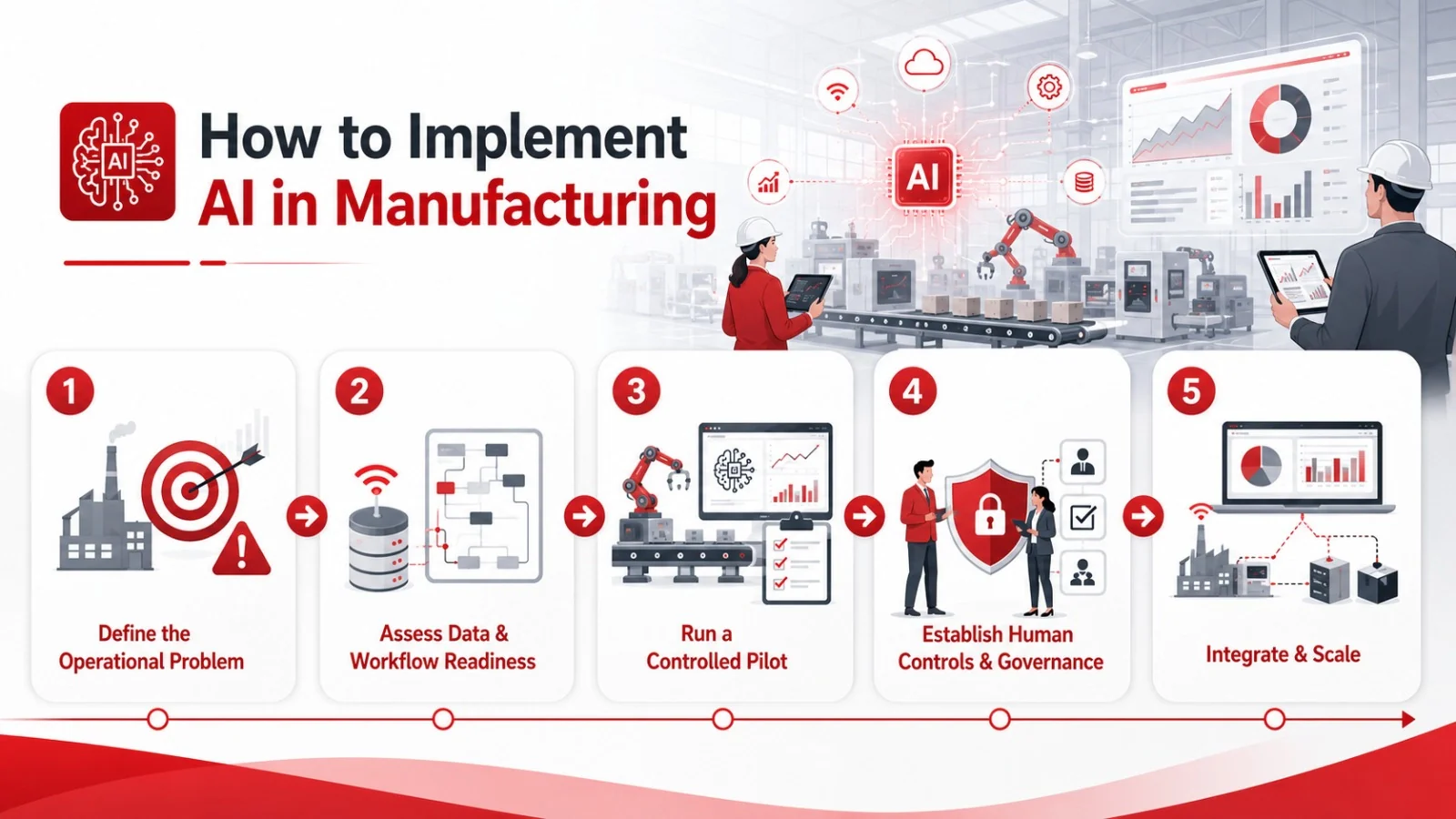
1. Define the Operational Problem
Begin with a specific pain point and decision. A plant may want to reduce unplanned stoppages on five critical motors by improving the timing of inspections. Assign a process owner, record the current downtime and alert process, and identify who will act on the recommendation. Prioritize candidate use cases by business impact, available data, implementation complexity, and operational risk.
2. Assess Data and Workflow Readiness
Map the sensor readings, maintenance history, asset identifiers, work orders, failure records, and operating conditions needed for the pilot. Check quality, access, ownership, latency, and missing context. Document how maintenance currently receives information and where a risk alert should enter the process. This step often reveals that workflow design matters as much as the model.
3. Run a Controlled Pilot
Limit the test to the selected motors, one site, and one type of recommendation. Define acceptance criteria before training or configuration begins. These may include warning lead time, false-alert tolerance, reviewer response, avoided emergency work, and user acceptance. Compare results with the baseline over representative operating conditions. A high technical accuracy score is not enough if planners ignore the alerts or the workflow does not improve.
4. Establish Human Controls and Governance
Name the model owner, maintenance process owner, alert reviewer, escalation contact, and change authority. Define the data each role can access and record all model or threshold changes. Specify what the system may recommend, which actions require approval, and when users must revert to the standard inspection process. Include procedures for poor data, system unavailability, and unexpected model behavior.
5. Integrate and Scale
After a successful pilot, integrate AI into daily workflows and monitor its performance over time. Scale gradually once the system is proven reliable, and evaluate ERP systems designed for manufacturing to support broader integration, governance, and connected operations across functions such as maintenance, quality, planning, and inventory.
AI Integration with Manufacturing Systems
AI delivers the most value when connected to manufacturing systems such as ERP, production, inventory, maintenance, quality management, procurement, CRM, and accounting. These systems provide the operational context AI needs by connecting assets, materials, suppliers, and production data into a single workflow. Solutions like HashMicro AI, integrated within an ERP platform, enable AI to access connected business data and generate more relevant recommendations.
With this integration, AI can move beyond generating insights to supporting real business actions. Instead of only detecting anomalies, it can recommend maintenance, place production batches on hold, adjust forecasts, suggest schedule changes, or notify the right person for approval. Access permissions, transaction history, and workflow status ensure recommendations remain accurate, traceable, and accountable.
A connected data environment also helps AI produce more practical and reliable recommendations. By using current production data, inventory levels, and approved manufacturing records, AI can better reflect real operating conditions and reduce the risk of inaccurate decisions. However, human oversight remains essential, especially for safety-critical processes and high-impact operational decisions.
Conclusion
AI is transforming manufacturing by turning operational data into actionable insights that improve production planning, maintenance, quality control, inventory management, and overall efficiency. However, its success depends on reliable data, connected manufacturing systems, clear governance, and human oversight. Rather than replacing people, AI helps manufacturers make faster, more informed decisions while reducing operational risks.
As AI adoption continues to grow in Malaysia, manufacturers have greater opportunities to strengthen productivity and remain competitive through smart manufacturing initiatives. Starting with a focused use case, integrating AI into existing workflows, and scaling based on proven results allows businesses to achieve sustainable improvements while adapting to changing operational needs.
If you're looking to explore how AI can support your manufacturing operations, try a free demo to see how an integrated manufacturing solution can help optimize your production processes.






FAQ about AI in Manufacturing
Yes, AI can still work with legacy manufacturing equipment, although additional data collection tools may be required. Manufacturers can install external sensors, industrial gateways, PLC connections, or monitoring devices to capture information such as vibration, temperature, cycle time, and energy consumption. Data from manual inspections and maintenance records can also be included. The best approach depends on the machine’s condition, available interfaces, and the operational problem the AI is expected to address.
There is no fixed amount of data required because each AI use case has different needs. A predictive maintenance project requires equipment readings and failure history, while a quality inspection project needs images of both acceptable and defective products. More importantly, the data must be accurate, relevant, and representative of actual operating conditions. Manufacturers should assess data quality and coverage before deciding whether they have enough information to begin a controlled pilot.
Not necessarily. AI can often be connected to an existing ERP, MES, maintenance system, or machine database through APIs, integration platforms, or industrial gateways. This allows manufacturers to introduce AI without replacing their entire technology environment. A system replacement may only be necessary when existing software cannot provide accurate data, support integration, or record the actions generated from AI recommendations. Manufacturers should evaluate these limitations before investing in a new platform.
Using an existing AI-enabled manufacturing platform is usually more practical for companies with limited technical resources or standard operational needs. It can reduce development effort while providing established capabilities for production planning, maintenance, inventory, and reporting. A custom solution may be suitable when the manufacturer has specialised processes, unique equipment, or proprietary data that standard platforms cannot support. The decision should consider internal expertise, implementation cost, integration requirements, and long-term maintenance responsibility.
Yes, SMEs can adopt AI without creating an internal data science department. They can begin with AI capabilities already included in manufacturing, ERP, maintenance, inventory, or quality-management software. A focused pilot can be managed by the process owner, operational users, IT support, and the software provider. Starting with one measurable problem also reduces implementation complexity and allows the business to build internal knowledge before expanding AI into additional production workflows.