










 Limited to 100 registrants
In modern business operations, efficient supply chains depend on clear documentation. Although purchase requisitions and purchase orders are often treated as similar terms, they represent different stages of procurement and misunderstanding them can lead to weaker financial control, compliance issues, and vendor-related problems.
This issue has practical consequences. A 2023 study by Universiti Teknologi Malaysia found that organizations without structured and digital requisition-to-PO controls were 3.7 times more likely to experience financial losses caused by procurement fraud and unauthorized spending.
This guide explains the differences between purchase requisitions and purchase orders in terms of purpose, legal status, and their impact on procurement processes. It also discusses how a structured PR-to-PO workflow supported by automation and governance can improve procurement process and strengthen operational control.
Key Takeaways
A Purchase Requisition (PR) is an internal document used by employees to request permission to buy goods or services while a Purchase Order (PO) is the official, legally binding external document sent to a vendor confirming that purchase.
The Key differences between PR and PO is Communication and Action
Transitioning from an informal “email-and-invoice” system to a formal PR-to-PO workflow requires a strategic approach. Follow these steps to ensure a smooth implementation
Procurement inefficiencies can lead to higher operational costs and reduce visibility across purchasing activities. To improve control and support better decision-making, many businesses are turning to digital procurement solutions.
What is a Purchase Requisition?
A Purchase Requisition (PR) is an internal document that formalizes the need for goods or services, marking the official start of the procurement process. It serves as a request for fund allocation and permission to buy, but because it is strictly internal, it does not constitute a legal contract with a vendor.
The Purpose of a Purchase Requisition
Purchase requisitions centralize spending control to prevent “maverick spend” by ensuring all expenses are vetted before financial commitment. By documenting “who needs what and why,” they enable procurement to negotiate effectively, verify existing inventory, and prevent duplicate orders, ensuring every purchase aligns with strategic company goals.
Key Components of a Purchase Requisition
While the format may vary depending on the organization’s size and industry, a standard purchase requisition typically includes the following information:
- Requestor Details: The name of the employee and the department initiating the request.
- Date of Request: When the need was first formally identified.
- Description of Items: Specific details, part numbers, or service descriptions to ensure the correct items are sourced.
- Quantity and Units: How many items are needed (e.g., 50 units, 2 boxes, 10 hours of service).
- Estimated Cost: A projected price based on previous purchases or market research.
- Suggested Vendor: If the requestor has a preferred supplier, though the procurement team may choose another.
- Budget Code/Cost Center: The specific internal account that will be charged for the purchase.
- Reason for Purchase: A brief justification for why the items are necessary for business operations.
What is a Purchase Order?
Once a purchase requisition is approved internally, it is transformed into a purchase order (PO). A purchase order is a legally binding document sent by a buyer to a seller, indicating types, quantities, and agreed prices for products or services. Unlike the requisition, the PO is an external document. Once accepted by the vendor, it constitutes a contract that protects both the buyer and the seller.
The Legal Significance of a PO
Converting a PR to a PO transforms an internal request into a binding legal commitment. By detailing terms, delivery, and shipping requirements, the PO serves as vital evidence for dispute resolution and a payment guarantee for vendors. For high-volume transactions, leveraging the purchase order system is essential to track these commitments and ensure consistent supplier compliance
Types of Purchase Orders
There are several variations of purchase orders used in different business scenarios:
- Standard Purchase Order: Used for one-time, specific purchases where all details (items, price, date) are known.
- Planned Purchase Order: Similar to a standard PO, but the delivery dates are tentative and released as needed.
- Blanket Purchase Order: An agreement to buy a large quantity of goods over a long period at a set price, with multiple delivery dates.
- Contract Purchase Order: A high-level agreement that sets the terms and conditions but does not specify the items to be purchased yet.
Key Differences Between PR and PO
Distinguishing between these two documents is vital for financial clarity. The following table summarizes the fundamental differences:
1. Internal vs. External Communication
The purchase requisition is a conversation within the company. Purchase order system is a conversation between the company and the outside world. This distinction is important because internal errors in a PR can be corrected easily, whereas errors in a PO can lead to legal complications or financial losses once the vendor acts upon them.
2. Authorization vs. Execution
A requisition is about getting authorization. It answers the question, “Are we allowed to spend this money?” The purchase order is about execution. It answers the question, “How and when will we get these items?” This separation of duties is a core principle of internal controls, preventing any single individual from having total control over a financial transaction.
| Feature | Purchase Requisition (PR) | Purchase Order (PO) |
| Nature | Internal document | External document |
| Purpose | Requesting permission to buy | Ordering from a vendor |
| Legal Status | Not legally binding | Legally binding contract |
| Parties Involved | Employee and Purchasing Department | Purchasing Department and Vendor |
| Timing | Created at the start of the procurement process | Created after PR approval |
Steps to Build a PR-to-PO Workflow
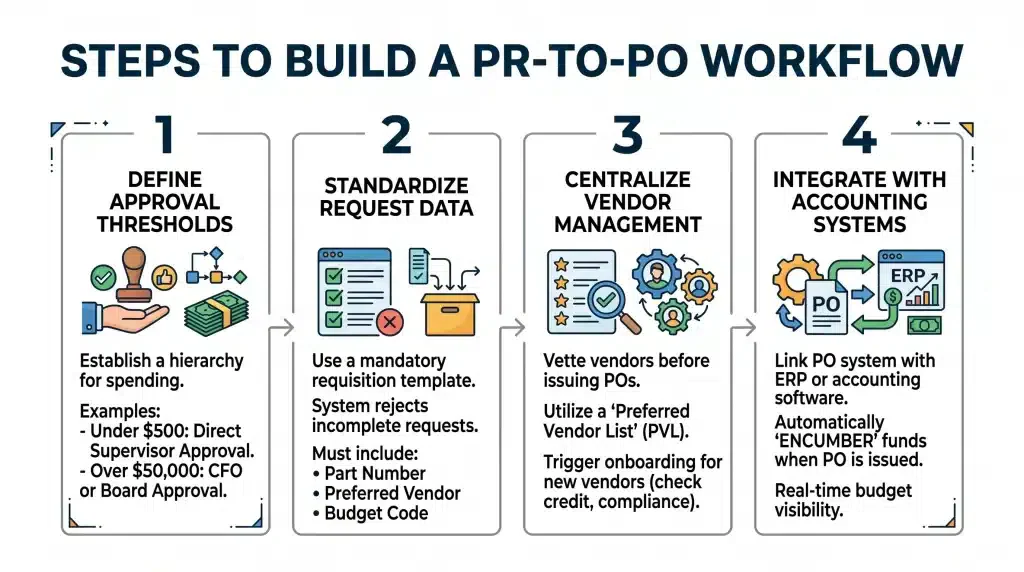
Transitioning from an informal “email-and-invoice” system to a formal PR-to-PO workflow requires a strategic approach. Follow these steps to ensure a smooth implementation:
Step 1: Define Approval Thresholds
Not every purchase requires the CEO’s signature. Establish a hierarchy where low-value items (e.g., under $500) can be approved by a direct supervisor, while high-value capital expenditures (e.g., over $50,000) require CFO or Board approval. This prevents the procurement department from becoming a bottleneck for minor operational needs.
Step 2: Standardize the Request Data
Create a mandatory template for requisitions. If a requestor doesn’t provide a part number, a preferred vendor, or a budget code, the system should reject the PR automatically. Standardizing data at the “ask” stage ensures that the purchasing agent has all the information needed to generate a PO without constant back-and-forth communication.
Step 3: Centralize Vendor Management
Before a PR can be converted into a PO, the vendor must be vetted. Implementation should include a “Preferred Vendor List” (PVL). When an employee submits a requisition, they should ideally select from this list. If they request a new vendor, a separate onboarding process—checking for creditworthiness, tax compliance, and diversity certifications—must be triggered.
Step 4: Integrate with Accounting Systems
The true power of a PO is realized when it “talks” to your ERP (Enterprise Resource Planning) or accounting software. When a PO is issued, the system should automatically “encumber” those funds in the budget. This means the money is marked as “spent” even before the invoice arrives, providing a much more accurate view of real-time financial health.
Benefits of Purchase Requisitions
Implementing a formal requisition process might seem like adding “red tape,” but for a growing business, it provides several indispensable benefits.
Prevention of Fraud and Unauthorized Spending
By requiring a requisition for every purchase, companies create a “paper trail” (even if digital). This makes it significantly harder for employees to make personal purchases on the company dime or for vendors to submit “ghost invoices” for goods that were never requested.
Budget Management
Requisitions allow finance teams to see “committed spend” before it actually happens. If a department has a monthly budget of $10,000 and has already submitted requisitions for $9,500, the finance team can flag any subsequent requests before the company is legally obligated to pay a vendor. This proactive approach is much more effective than trying to cut costs after the PO has already been sent.
Inventory Optimization
Sometimes, a request for new equipment can be fulfilled by moving surplus items from another department. The requisition process gives the procurement team a chance to check existing assets before buying new ones, directly contributing to cost savings.
Benefits of Purchase Orders
While the PR manages the internal side, the PO is the tool for managing external relationships and legal risks.
Legal Protection
In the event of a dispute—such as a vendor charging more than agreed or delivering sub-par materials—the PO is the “source of truth.” It provides clear documentation of what was promised, at what price, and by what date. Without a PO, a business is in a much weaker position during negotiations or legal proceedings.
Operational Efficiency for Vendors
Vendors prefer POs because they provide clear instructions. A PO reduces the back-and-forth emails and phone calls. It allows the vendor to simplify their own fulfillment process, which often leads to better service and potentially better pricing for the buyer.
Accurate Financial Reporting
For the accounting department, POs are essential for “accrual accounting.” They allow the company to record liabilities when they are incurred, rather than just when the cash leaves the bank. This leads to a much more accurate picture of the company’s financial health at any given moment.
Best Practices for Documentation

To maximize the utility of both PRs and POs, organizations should follow standardized best practices. Inconsistent documentation can lead to confusion and defeat the purpose of having a procurement system in the first place.
Standardize the Forms
Whether using paper or digital systems, every PR and PO should follow a consistent template. This ensures that no critical information—like tax IDs, shipping terms, or department codes—is missed. Standardization also makes it easier for the accounts payable team to process documents quickly.
Implement Hierarchical Approvals
Not all purchases require the same level of scrutiny. A $50 request for printer ink might only need a supervisor’s nod, while a $50,000 request for a new server should likely go to the CTO or CFO. Setting up automated approval workflows based on the dollar amount of the requisition saves time and ensures that high-value decisions are made by the right people.
Maintain a Centralized Repository
Storing PRs and POs in fragmented folders or individual email inboxes is a recipe for disaster during an audit. A centralized, searchable database allows the procurement team to quickly reference past orders, compare vendor performance over time, and generate comprehensive reports.
Common Pitfalls in the PR and PO Cycle
Even with a formal system in place, many companies fall into traps that undermine the efficiency of their procurement process. Recognizing these pitfalls is the first step toward avoiding them.
- The “Emergency” Bypass: Employees often claim a purchase is an emergency to skip the requisition process. If “emergencies” become the norm, the procurement team loses its ability to negotiate prices, leading to significantly higher costs.
- Vague Line Items: A requisition for “office supplies” is useless. Without specific quantities and descriptions, the purchasing agent cannot create an accurate PO. This leads to the delivery of incorrect items, restocking fees, and wasted time.
- Ignoring the “Three-Way Match”: A PO is only effective if it is compared against the packing slip (receipt) and the final invoice. Failing to perform this three-way match leads to paying for goods that were never received or overpaying for items that were damaged.
- Data Silos: When the requisition lives in an email, the PO lives in a Word doc, and the invoice lives in the accounting software system, visibility is lost. This fragmentation makes it impossible to track the “total cost of ownership” or analyze spending patterns.
Conclusion
The difference between a purchase requisition and a purchase order is a matter of financial and legal security. A PR manages internal control by stopping unauthorized spending and vetting budgets. A PO handles external commitments by setting legal terms and holding vendors accountable. This system ensures every purchase is authorized before it occurs.
Effective implementation uses four practical tools: approval limits, clear data, central vendor management, and ERP integration. These are proven defenses. Research indicates that organizations without a strict PR-to-PO process are four times more vulnerable to fraud, duplicate payments, and ghost invoices.
Mastering this workflow gives finance teams better visibility and builds stronger supplier trust. For businesses in Malaysia and across ASEAN, these steps are the baseline for growth and compliance. Turning procurement into a strategic control center creates a more resilient and agile organization.
FAQ About Purchase Requisitions and Purchase Orders
No, a purchase requisition is an internal document used to request permission to buy. It is not legally binding for external vendors. Only a purchase order, once accepted by the vendor, serves as a legal contract.
While small, recurring office expenses might be handled through petty cash or corporate cards, a purchase order is highly recommended for most business transactions to ensure legal protection and budget tracking.
This is called a mismatch. The accounts payable team will typically hold payment until the discrepancy is resolved through ‘three-way matching,’ which involves checking the PO, the receiving report, and the invoice.
A purchase requisition is usually initiated by the employee or department that needs the goods or services. It is then sent to their manager or the finance department for approval.