







Manual quoting often triggers pricing errors, unauthorized discounts, and margin erosion across complex product deals. A Configure, Price, Quote (CPQ) system resolves this by turning quote generation into a governed workflow that aligns pricing, configuration, and approval rules with managing enterprise sales leads throughout the pipeline before proposals reach customers.
Manual quoting often triggers pricing errors, unauthorized discounts, and margin erosion across complex product deals. A Configure, Price, Quote (CPQ) system resolves this by turning quote generation into a governed workflow that aligns pricing, configuration, and approval rules with managing enterprise sales leads throughout the pipeline before proposals reach customers.
Manual quoting often triggers pricing errors, unauthorized discounts, and margin erosion across complex product deals. A Configure, Price, Quote (CPQ) system resolves this by turning quote generation into a governed workflow that aligns pricing, configuration, and approval rules with managing enterprise sales leads throughout the pipeline before proposals reach customers.
Key Takeaways
CPQ helps teams configure valid offerings, apply approved pricing rules, and create controlled customer quotes.
The strongest CPQ business case usually starts with recurring configuration errors, discount exceptions, or manual quote-to-order re-entry.
CRM, CPQ, and ERP have different responsibilities: customer context, quote governance, and operational execution.
To explore how automated quote governance, dynamic pricing rules, and ERP handoffs can be structured for your specific operational model.

What Is Configure, Price, Quote (CPQ)?
Configure, Price, Quote (CPQ) is a commercial management software category designed to validate product selections, enforce standardized pricing rules, and automate the creation of accurate customer proposals. By connecting sales activities with underlying commercial policies, CPQ ensures sales representatives only quote feasible product bundles at preapproved price points and profit margins.
At an operational level, CPQ eliminates the risks of relying on disconnected spreadsheets and manual memory. The system automates the verification of product dependencies, applies relevant customer discount tiers or tax structures, and passes consistent transaction data directly into downstream enterprise resource planning software and accounting systems for execution.
What Do Configure, Price, and Quote Mean?
Configure, Price, Quote functions as a centralized commercial engine that eliminates spreadsheet errors by aligning product compatibility, dynamic pricing policies, and proposal creation into a single automated pipeline. By connecting sales inputs directly with operational rules and profit margin thresholds, CPQ governs the quote-to-order lifecycle through three sequential stages:
Configure: Validating Product Feasibility
The configuration module acts as the first checkpoint, automatically verifying that selected products, add-ons, and service terms are technically compatible. It enforces compatibility rules and minimum order requirements instantly, preventing sales teams from quoting unfulfillable product combinations.
Price: Enforcing Dynamic Pricing Policy
Once the configuration is verified, the pricing engine calculates total costs by applying approved price books, customer tiers, currencies, and tax rules. If a requested discount breaches minimum margin thresholds, the system automatically routes the proposal for managerial sign-off.
Quote: Generating Governed Proposals
The quoting engine compiles the validated products and pricing into a standardized, legally compliant commercial pricing quotation. It maintains version control across all revisions and pushes finalized transaction data directly into downstream ERP and order fulfillment systems without manual re-entry.
When Does CPQ Software Matter for Enterprise Quoting?
Implementing a dedicated quoting engine becomes critical when product and pricing complexity begins creating financial leakage or operational bottlenecks across departments. Organizations should prioritize CPQ implementation when facing the following operational challenges:
- Complex Product Dependencies: Offerings involve intricate compatibility rules, optional service modules, custom installation requirements, or strict minimum order parameters.
- Dynamic Multi-Tier Pricing: Base prices, customer discounts, currencies, and tax treatments vary widely across different distribution channels, regional branches, or customer contracts.
- Margin Approval Bottlenecks: Custom discount requests require multi-level managerial review based on gross margins, order volume, or deal territory, creating administrative delays.
- Version Control Frictions: Sales teams generate multiple uncoordinated proposal revisions, making it difficult to identify the legally and commercially approved document.
Manual Quote-to-Order Re-entry: Finalized customer proposals must be manually keyed into billing, inventory, or order management platforms, increasing data entry error rates.
How Does CPQ Software Work From Quote to Order?
CPQ software bridges the operational gap between CRM deal negotiations and downstream ERP fulfillment, transforming unstructured sales proposals into error-free commercial instructions. By mirroring the strict operational control seen in formal requisition and purchase order lifecycles, the system embeds product dependencies, real-time cost logic, and governance controls directly into the sales pipeline, orchestrating the complete quote-to-order handoff through four structured phases:
1. Opportunity Scoping and Solution Configuration
The workflow initiates in the CRM, where sales reps capture client requirements and select product models, service packages, or software tiers. The CPQ engine immediately evaluates these selections against centralized compatibility matrices, preventing incompatible bundles or unfulfillable scopes before pricing begins.
2. Automated Pricing and Policy-Driven Approvals
Once the configuration is validated, CPQ calculates total deal value by applying customer tiers, regional tax rules, and active discount structures. If a quote breaches predefined gross margin thresholds, the system automatically routes the proposal through hierarchical approval matrices, capturing complete and traceable audit trails.
3. Governed Proposal Generation and Contract Signing
After securing internal approvals, the platform compiles specifications, pricing schedules, and legal terms into a standardized quotation document. CPQ maintains strict version control during negotiations, ensuring the final signed proposal perfectly mirrors the agreed commercial terms.
4. Direct Order Conversion and Downstream Execution
Upon customer sign-off, CPQ transfers transaction data directly into the ERP, billing, and inventory systems without manual re-entry. This automated handoff creates accurate sales orders, triggers fulfillment workflows, and schedules compliant tax invoices without operational discrepancies.
Which CPQ Features Protect Commercial Control?

The most useful CPQ features are those that enforce approved commercial rules and preserve an audit trail. Instead of selecting software from a generic checklist, connect each capability to a failure mode recognised by your CFO, sales leader, operations manager, or IT team.
| Capability | Risk it controls | Questions to ask during evaluation |
|---|---|---|
| Product catalogue and configuration rules | Incompatible bundles or incomplete scopes | Who owns rules, and how are changes approved? |
| Price books and pricing logic | Outdated prices or inconsistent customer treatment | Can prices vary by branch, currency, channel, or contract? |
| Discount controls | Unauthorised margin concessions | Are thresholds visible and routed to the right approver? |
| Approval workflow | Delayed or undocumented exceptions | Is there a time-stamped history of decisions? |
| Quote templates | Inconsistent terms or missing information | Can legal, tax, and commercial content be governed? |
| Version history | Disputes over what was offered | Can users compare revisions and identify the accepted version? |
| Permissions and segregation of duties | Excessive access or self-approval | Can roles be aligned with company policy? |
| Reporting and dashboards | Limited visibility into quote behaviour | Can management review revisions, exceptions, and conversion errors? |
| Integration capabilities | Re-entry between CRM, CPQ, ERP, and billing | Which fields transfer, and who owns integration support? |
A useful CPQ approval workflow should make the reason for an exception understandable. “Special price” is not enough; reviewers may need the customer segment, expected volume, contribution margin, contract term, and expiry date. The system should support the policy your organisation can actually maintain.
What Business Benefits Can CPQ Deliver?
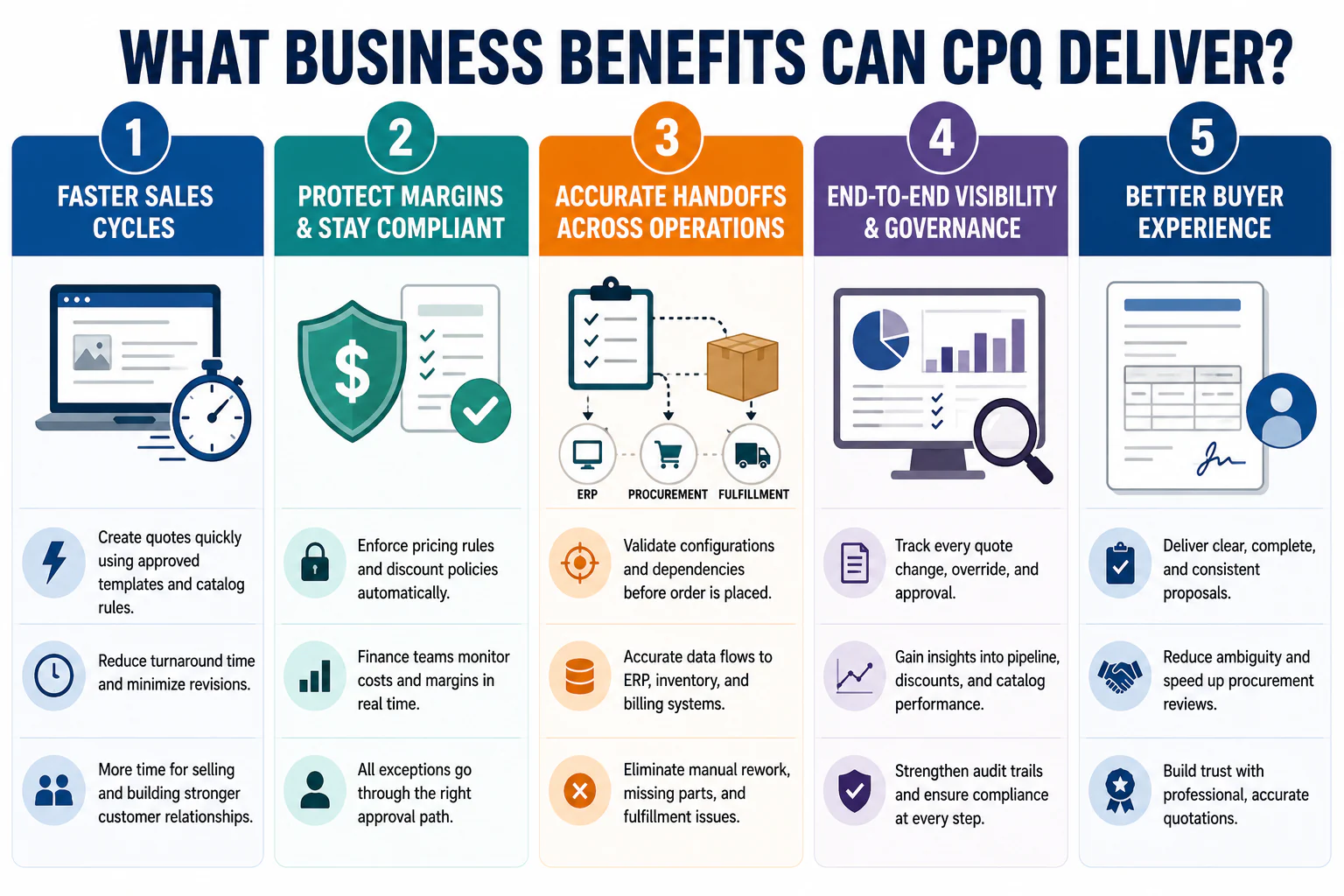
Implementing a CPQ system establishes cross-departmental commercial control, transforming proposal generation from a disconnected administrative task into a strategic driver of revenue and operational efficiency across five key business areas:
1. Accelerated Sales Velocity and Reduced Deal Friction
CPQ eliminates administrative drag by automating proposal generation from pre-approved templates and catalog rules. Sales representatives spend significantly less time manually checking product compatibility or drafting custom layouts, allowing them to shorten response times, reduce proposal revisions, and focus on active customer negotiations.
2. Safeguarded Profit Margins and Policy Adherence
Centralized pricing rules protect profitability by replacing informal email-based approvals with automated discount governance. Finance teams gain real-time visibility into cost structures and margin thresholds, ensuring that any custom concessions or price deviations are automatically routed through authorized approval workflows.
3. Clear Operational Handoffs and Downstream Data Accuracy
By validating technical specifications and dependencies before a deal closes, CPQ ensures that order details transfer accurately to inventory, procurement, and fulfillment teams. This clean data handoff eliminates fulfillment disputes, missing bill-of-materials components, and manual re-entry errors across ERP and billing systems.
4. Transparent Pipeline Visibility and Audit Governance
CPQ establishes a complete audit trail by recording all quote revisions, price overrides, and managerial approvals within a single platform. Revenue operations leaders can leverage centralized reporting to identify pipeline bottlenecks, track discount trends, and optimize catalog performance across regional branches.
5. Standardized and Professional Buyer Experience
Customers receive clear, structured, and legally consistent proposals complete with accurate itemized scopes, transparent pricing, and validated terms. This level of clarity minimizes contractual ambiguity, streamlines client procurement reviews, and speeds up final contract signing.
Which Businesses and Industries Need CPQ?
Adoption of CPQ depends on catalog complexity, tiered pricing, and approval rules rather than company size. With insights from UOB's 2026 Business Outlook Study highlighting that 71% of regional firms plan to expand digital investments, businesses handling customizable products or multi-channel sales increasingly deploy CPQ across key sectors to secure productivity gains:
Advanced and Configurable Manufacturing
Manufacturing companies deal with complex bills of materials (BOM), machinery specifications, optional components, and custom maintenance add-ons. They use CPQ to enforce engineering-led compatibility rules during the quoting process, ensuring sales teams do not configure incompatible machine parts. This automated validation prevents downstream production delays, inaccurate component sourcing, and costly fulfillment errors.
Wholesale and Multi-Branch Distribution
Wholesale distributors manage thousands of SKUs with fluctuating customer discount tiers, regional price books, volume rebates, and branch-specific stock levels. Alongside front-end tools like integrated pos systems, CPQ allows distributors to centralize pricing logic and delegate regional permissions. Sales representatives can quote customized bulk packages within approved margin thresholds, reducing pricing disputes and eliminating manual order corrections across branches.
Professional Services and Project Contracting
Service-oriented firms, including IT system integrators, engineering consultants, and construction contractors, face evolving project scopes, milestone schedules, and labor rate cards. These businesses use CPQ to standardize rate cards, govern resource allocation estimates, and enforce change-order approval gates. This ensures that quoted project assumptions align with actual delivery capacity and invoicing milestones.
SaaS and Subscription-Based Businesses
Software and recurring-service providers manage multi-year contracts, tiered usage plans, licensing add-ons, and mid-cycle renewals. CPQ enables SaaS companies to model co-terming, prorated billing, and automated renewal quotes. By standardizing contract terms and discounting governance, sales teams can structure complex subscription packages without creating revenue recognition issues for the finance department.
How Is CPQ Different From CRM and ERP?
CRM, CPQ, and ERP manage distinct yet complementary phases of the quote-to-cash lifecycle. While CRM tracks customer pipelines and ERP handles backend fulfillment, neither system is built to manage dynamic bundling rules or complex pricing tiers during sales negotiations.
CPQ bridges this critical operational gap. It centralizes product validation, discount thresholds, and proposal generation, ensuring only feasible, profitable deals transition from sales opportunities into binding ERP orders:
| System | Primary Operational Focus | Core Data Managed | Handoff Function in the Revenue Cycle |
|---|---|---|---|
| CRM | Front-end pipeline tracking and client relationship management | Customer profiles, communications, sales stages, and deal sizes | Feeds qualified lead details and deal scope into CPQ |
| CPQ | Commercial governance, configuration rules, and price calculations | Price books, bundle dependencies, discount matrices, and quote templates | Passes approved commercial terms and items directly to ERP |
| ERP | Backend operations, inventory management, and financial fulfillment | Sales orders, general ledgers, stock allocations, and tax invoicing | Receives validated quote data to trigger fulfillment and billing |
What Should You Prepare Before Implementing CPQ?
Successful CPQ deployment requires standardizing commercial policies, cleaning master data, and aligning on strategies for maximizing ERP investment returns before software configuration begins. Automating unverified pricing rules or fragmented product lists will only amplify existing operational errors across departments. To ensure technical readiness and smooth cross-functional adoption, enterprise stakeholders must execute structured preparatory frameworks across four core operational areas:
Sales Operations: Standardizing Quoting Workflows
Map current quote-to-order paths to identify recurring revision bottlenecks and manual spreadsheet dependencies. Define explicit user permissions for creating, editing, and withdrawing proposals, while standardizing mandatory fields such as scope, validity dates, and acceptance terms to ensure consistency.
Finance and Commercial Policy: Structuring Pricing Governance
Clean central price books, localized tax configurations, and multi-currency tables across all regional branches. Establish rigid gross margin thresholds and configure multi-tier approval hierarchies with designated approvers to eliminate untracked email discount negotiations.
Product and Operations: Validating Master Catalog Data
Audit product catalogs to remove legacy SKUs and clearly document compatibility dependencies, minimum quantities, and component requirements. Appoint dedicated catalog owners to ensure configuration rules always align with operational capacity and inventory fulfillment limits.
IT and Governance: Designing Clean System Integrations
Map field-level data handoffs between CRM, CPQ, ERP, and billing platforms to avoid manual re-entry errors. Implement role-based access permissions, audit logging rules, and cross-scenario testing scripts to ensure end-to-end data integrity before user rollout.
How Should You Evaluate a CPQ Solution?
CPQ selection should start with operational scenarios rather than generic vendor feature checklists. To verify whether a platform fits your commercial workflow, evaluate how the software performs across these core business scenarios:
- Standard Catalog Quoting: Test the speed and consistency of routine quote generation using your actual templates, custom fields, and everyday product lines.
- Complex Bundle Configuration: Run test scripts with valid and invalid component combinations to ensure the engine accurately enforces dependency rules and alerts users to missing parts.
- Discount and Margin Governance: Validate approval routing by simulating custom price overrides, checking whether margin thresholds are visible and time stamped for audit trails.
- Revision and Version Control: Compare quote iterations side by side to verify how changes are logged, communicated to clients, and locked once accepted.
- Quote to Order Conversion: Check field mapping and error handling to ensure accepted quote data transfers into backend ERP and invoicing systems without data corruption.
- Multi Branch Permissions: Assess role based access to ensure regional branches can access local price books and tax rates without overriding global pricing policies.
Beyond technical capabilities, evaluate total cost of ownership including data cleansing, integration maintenance, user licensing, and rule updates. Testing realistic deal scenarios with sales representatives and approvers early ensures the system enforces necessary governance without creating unnecessary friction for the commercial team.
Conclusion
Sustainable revenue growth requires operational discipline across the commercial deal cycle. Governing the quote to order pipeline turns quoting from an administrative bottleneck into a strategic growth lever, protecting margins while enabling sales teams to focus entirely on customer value and deal execution.
Long term value depends on internal policy clarity rather than software features alone. Establishing master data ownership, transparent approval thresholds, and alignment across sales, finance, and operations ensures automated quoting scales smoothly with increasing product and pricing complexity.
Evaluating how these controls align with your specific pricing rules and fulfillment workflows is the most effective way to determine readiness. Exploring a guided free demo helps cross functional teams test real world scenarios and assess operational impact before deployment.

Frequently Asked Questions
A dedicated CPQ capability is more appropriate when products or services have many valid combinations, prices vary by customer or branch, discounts need repeated approval, quote revisions are frequent, or accepted quotes are manually re-entered into operational systems. Stable, low-complexity catalogues may first benefit from clearer ownership and pricing policies rather than a separate CPQ layer.
Prepare product catalogue data, compatibility rules, price books, discount policies, tax treatment, customer terms, approval thresholds, user roles, and order-conversion fields. Each domain should have a named business owner and a change-control process so that inaccurate or outdated data does not move into the new workflow.
Yes. CRM typically manages customer and opportunity context, CPQ governs configuration and commercial quoting, and ERP supports downstream financial and operational execution. The required architecture depends on the existing system landscape, data quality, security model, and verified integration requirements.
Establish baselines for quote revision frequency, exception approval volume, discount-policy adherence, conversion errors, manual re-entry points, and time spent resolving pricing disputes. Define the measurement owner before launch and compare results against the organisation’s own baseline rather than relying on generic ROI claims.
CPQ can function as a built-in module within an ERP platform or as a standalone tool connected via APIs. A native CPQ ensures instant synchronization with real-time inventory and pricing data, while standalone systems require API integrations to pass finalized quote details into backend ERP fulfillment workflows.