







For Malaysian importers, seeing a ship finally dock at Port Klang is rarely the finish line. In reality, that is exactly when the real pressure begins. A minor hiccup in customs paperwork or a delayed haulier schedule can easily trap your containers for days. Before you know it, that idle cargo is quietly racking up daily penalty fees that destroy your profit margins.
These charges begin at different stages: demurrage starts when terminal free time expires, while detention starts after gate out. Malay Mail’s coverage of congestion at Sabah ports shows how port congestion and trucking disruptions can delay container movements and increase both charges for manufacturers.
Reducing demurrage and detention requires Malaysian importers to track free time, align customs clearance with haulier schedules, and use a transport management solution to keep container handovers on time.
This guide explores the practical realities of managing container lifecycles within the Malaysian import ecosystem. By understanding exactly where operational friction occurs, you can optimize your workflows, eliminate administrative bottlenecks, and protect your bottom line.
Key Takeaways
Demurrage is a penalty incurred inside the port for late container pickup, while detention is a fee charged outside the port for late empty container return.
Free time is the allowed grace period before daily charges begin, divided into port storage inside the terminal and container rental outside the gates.
Avoiding these charges requires coordinated action before arrival, during free time, and after gate out.
Streamline your transport coordination and eliminate costly delays with automated tracking. Optimize vehicle schedules and ensure on-time container returns by switching to an advanced Fleet Management System.
What Are Demurrage and Detention?
Demurrage and detention are fees charged by carriers for exceeding your allowed container time. The main difference depends on container location. Demurrage is an inside terminal charge. It accumulates when your container stays inside the port yard past the free time because of customs delays, missing paperwork, or late transporter pickup.
Detention is an outside terminal charge. It applies after the container leaves the port but is not returned to the designated empty depot on time. This happens when warehouse unloading takes too long or transport scheduling fails. Simply put, demurrage is for overstaying inside the port, while detention is for keeping the container too long outside.
Demurrage vs Detention: Key Differences
Although both charges arise when containers exceed their agreed free time, demurrage and detention apply at different stages of the container journey, with the port gate marking the key boundary. Understanding this distinction helps logistics teams assign responsibility, prevent avoidable charges, and apply the right action at each stage. The table below compares their operational differences in detail.
| Feature | Demurrage | Detention |
|---|---|---|
| Container Location | Inside the port terminal yard | Outside the port terminal yard |
| Trigger Event | Exceeding port storage free time | Exceeding container rental free time |
| Common Cause | Customs clearance delays or missing permits | Warehouse unloading bottlenecks or driver shortages |
| Monitoring Owner | Customs broker and freight forwarder | Transporter and warehouse manager |
| Prevention Focus | Early documentation and fast finance approval | Efficient unloading schedules and rapid container return |
| Example Scenario | Container stuck at Port Klang awaiting tax payment | Container sitting at an e-commerce warehouse awaiting unloading |
How Demurrage and Detention Charges Work
Demurrage and detention are charged per container and per day after free time expires. These freight cost components vary by container type, delayed units, tariff tiers, and chargeable days. Businesses should confirm these terms before shipment, as each carrier, terminal, route, and contract may apply different rules.
How Demurrage Charges Accumulate
Demurrage acts as a strict storage penalty that starts the exact moment your terminal free time expires. The clock begins ticking while your cargo is still sitting inside the port yard awaiting clearance. Situations like port congestion and unexpected customs issues can often trap your containers much longer than you initially planned.
The real danger to your profit margin lies in the escalating pricing structure of these fees. Carriers do not charge a simple flat daily rate but instead use progressive tiers. The daily cost can easily double or triple after just a few days, turning a minor delay into a massive logistics invoice.
How Detention Charges Accumulate
While demurrage penalizes port storage, detention focuses entirely on equipment usage outside the terminal. The time starts counting the moment the full container leaves the port and makes its way to your facility. This daily meter will only stop once the empty and clean unit is safely returned to the designated carrier depot.
Just like demurrage, this charge operates on an expensive tiered system that increases over time. Internal delays such as a slow unloading process at your warehouse or poor haulier coordination will quickly push your fees into the highest pricing brackets. You essentially pay a heavy premium just for holding onto the carrier equipment longer than agreed.
Common Causes of Demurrage and Detention in Malaysia

Demurrage and detention usually result from connected delays across the import process rather than one major failure. For large Malaysian businesses, the main risks involve external port conditions, logistics coordination, and internal controls.
External Port and Regulatory Delays
Customs inspections, permit requirements, and congestion at major gateways such as Port Klang or Penang Port can reduce the time available for clearance. Early preparation and contingency planning can help limit the cost exposure.
Logistics Coordination Gaps
Misaligned schedules across carriers, forwarders, and commercial fleet management operations can delay container pickup, unloading, or return. These disruptions may cause demurrage to develop into detention as the container moves beyond the terminal.
Who Pays Demurrage and Detention Charges?
Financial responsibility for demurrage and detention depends on your contract, Incoterms, and the root cause of the delay. While carriers bill the party named on the Bill of Lading, costs can be recovered if vendor negligence caused the bottleneck. Businesses use a responsibility matrix to clarify who controls each checkpoint and owns the risk.
| Party | What They Control | Risk if Delayed |
|---|---|---|
| Importer or consignee | Document readiness, payment approval, and warehouse instructions | Clearance or pickup cannot proceed |
| Freight forwarder | Shipment updates, carrier communication, and document coordination | Release or free-time updates may be missed |
| Customs broker | Declarations, clearance status, and supporting documents | Customs clearance exceeds free time |
| Transporter | Truck booking, container pickup, and empty return | Gate-out or empty return occurs late |
| Warehouse team | Receiving slots, unloading capacity, and stock recording | The container remains outside the terminal too long |
| Finance team | Duty, tax, carrier, and service-payment approvals | Cargo release is blocked pending payment |
Example Scenario for a Malaysian Importer

An importer receives five free days for port storage and container use at Port Klang. Packing list errors and a customs inspection delay clearance until Saturday, after the port free time expires on Friday. When the container leaves the terminal on Monday, two days of demurrage have accumulated.
The detention period begins after gate out. Warehouse congestion delays unloading until Friday, while the empty container is not returned until the following Monday, exceeding its five day free time and creating detention charges.
This case shows how documentation and warehouse delays can trigger both charges. Careful coordination across customs, transport, and warehouse teams is essential to protect import margins.
How to Avoid Demurrage and Detention Charges
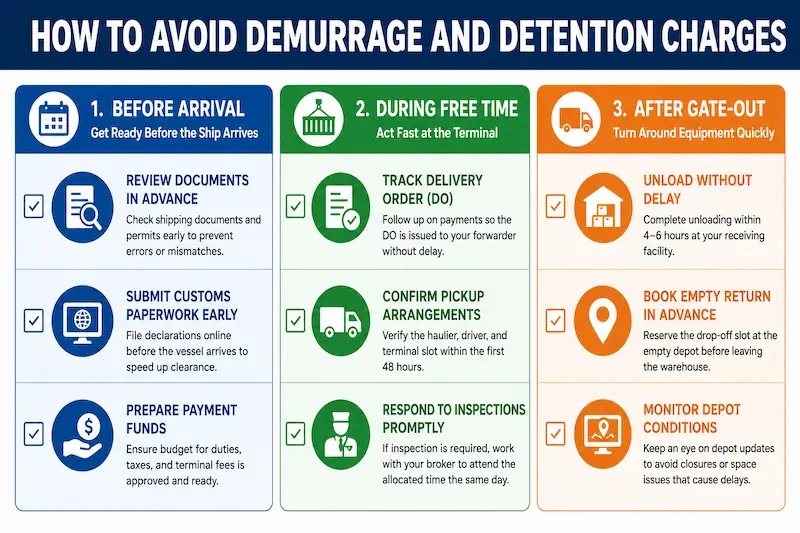
Mitigating demurrage and detention risks requires turning abstract supply chain goals into concrete checklist tasks. By dividing your operational actions into three specific phases, your logistics team can stay ahead of the carrier's billing clock.
Before Arrival Action Items
Effective inbound logistics preparation focuses on eliminating administrative errors before the vessel drops anchor.
Audit Documents Early: Verify the accuracy of the Bill of Lading, commercial invoice, and packing list against your import permits at least 7 days before port arrival to catch discrepancies.
Pre-Lodge Customs Declarations: Submit digital customs documentation to the Royal Malaysian Customs Department via the DagangNet system before the ship berths to trigger early clearance processes.
Secure Finance Allocations: Approve internal funds for customs duties, taxes, and terminal handling charges in advance so local payments can be transferred the moment the invoice is generated.
During Free Time Action Items
Once the container reaches the terminal yard, effective yard management coordination yard management coordination becomes essential for maximizing pickup speed and managing unexpected delays.
Confirm Delivery Order Release: Track your payment clearance with the ocean carrier to ensure the digital Delivery Order (DO) is released to your forwarder immediately upon arrival.
Schedule Daily Haulier Check-ins: Ensure your transportation management workflow confirms the haulier's port pickup slot and assigned driver within the first 48 hours.
Escalate Inspection Delays: If customs flags the container for physical inspection, immediately coordinate with your broker to attend the inspection slot on the same day it is scheduled.
After Gate-Out Action Items
The final phase begins the moment the container leaves the port gate and focuses on rapid equipment turnaround.
Enforce Warehouse Unloading Slots: Set a strict 4 to 6-hour maximum unloading window for the warehouse team once the container arrives at your receiving bay.
Pre-Book the Empty Return Depot: Instruct your haulier to pre-confirm the drop-off slot at the carrier's designated empty depot before the truck even departs your warehouse.
Monitor Depot Status Updates: Check for temporary depot closures or space constraints using real-time vehicle monitoring features to prevent missed deadlines.
How ERP Helps Reduce Demurrage and Detention Risk
Demurrage and detention risks increase when shipment data is scattered across spreadsheets, slowing approvals and container handling. An ERP system centralizes this information and helps teams act before free time expires through the following capabilities:
Integrated ETA Tracking and Alerts: ERP tracks vessel arrivals, calculates free time deadlines, and sends early alerts. This helps logistics teams prepare documents, transportation, and warehouse resources before charges begin.
Faster Document and Finance Approvals: Digital workflows speed up document verification and payments for duties, taxes, and carrier fees. This prevents incomplete documents or pending payments from delaying delivery order release.
Coordinated Warehouse Operations and Reporting: ERP aligns shipment schedules with receiving capacity, utilizing smart load planning tools to streamline unloading. Centralized reports also identify suppliers, carriers, or internal processes that frequently cause delays.
By replacing fragmented manual tracking with an integrated ERP system such as HashMicro, businesses can improve visibility across shipment, approval, and warehouse processes. This coordination helps teams respond earlier to delays and reduce the risk of avoidable demurrage and detention charges.
Conclusion
Demurrage and detention charges reveal where control breaks down across documentation, clearance, pickup, unloading, and empty return. Demurrage indicates delays before gate out, while detention indicates delays afterward, helping businesses identify the source of recurring costs.
Businesses cannot prevent every customs, port, or depot disruption, but they can protect free time through clear ownership, early escalation, and accurate deadline tracking. These controls help teams respond faster and prevent one delayed handover from increasing charges.
To achieve this level of cross departmental coordination, relying on manual spreadsheets is no longer sustainable. Advanced logistics software bridges these information gaps by providing real time tracking, automated approval workflows, and centralized data management. Explore how a tailored system can streamline your supply chain and protect your bottom line by scheduling a free demo today.
FAQ
Demurrage is a penalty charged when a container overstays inside the port terminal yard, whereas detention is a fee applied when the container is kept outside the port beyond the allowed return window.
Free time is the designated grace period provided by ocean carriers and port terminals that allows importers to utilize shipping equipment and storage space without incurring daily penalties.
The importer or consignee typically pays these charges directly to the carrier to secure cargo release, though costs may be recovered later if the delay was caused by a freight forwarder or transporter error.
Demurrage is calculated on a daily, progressive scale after the free time window expires, meaning the per-day fee often increases the longer the container remains inside the terminal.
Yes, these fees can be minimized by utilizing digital tracking tools to monitor carrier deadlines, submitting customs documentation prior to vessel arrival, and establishing pre-booked haulage schedules.
Malaysian importers frequently encounter these expenses due to customs inspection queues at major gateways like Port Klang, haulage driver shortages during peak seasons, and manual internal payment approval bottlenecks.
An ERP system centralizes milestones by triggering automated alerts for expiring free time, accelerating finance workflows for duty payments, and aligning warehouse receiving schedules with real-time container arrivals.