







In today's volatile economic landscape, relying solely on historical financial data is no longer enough to secure a company's future. Finance managers and CFOs are under immense pressure not just to report on what happened yesterday but to accurately predict what will happen tomorrow. This shift from reactive reporting to proactive strategy is driven by Financial Planning and Analysis (FP&A).
As businesses scale, traditional spreadsheet forecasting quickly becomes a major bottleneck. In fact, according to PwC Malaysia, the rapid adoption of automation and data analytics is transforming finance from a basic transactional role into a strategic business partner. This technological shift empowers teams with real time data to drive highly informed corporate decisions.
In this comprehensive guide, we will explore the core pillars of the FP&A process, the essential metrics you need to track, advanced strategies like scenario planning, evaluate a real world financial case study, and understand why transitioning to modern accounting software solutions is a necessity for growing enterprises.
In this comprehensive guide, we will explore the core pillars of the FP&A process, the essential metrics you need to track, advanced strategies like scenario planning, evaluate a real world financial case study, and understand why transitioning to [modern accounting software solutions] is a necessity for growing enterprises.
Key Takeaways
FP&A transforms raw financial data into actionable forward-looking strategies through continuous planning, budgeting, and forecasting.
Unlike traditional accounting, which is historical, FP&A utilizes Scenario Planning and Sensitivity Analysis to prepare for multiple future economic outcomes.
Manual FP&A processes using disjointed spreadsheets often lead to data silos, version control errors, and delayed decision-making for C-level executives.
Manual financial consolidation slows down your strategic planning. Centralizing your financial data empowers your FP&A team to generate accurate forecasts in real-time.

What is Financial Planning and Analysis (FP&A)?
Financial Planning and Analysis is a crucial set of analytical activities that support corporate strategy and financial health. While standard accounting focuses on historical compliance, FP&A acts as the analytical engine of the company.
FP&A professionals evaluate financial data and macroeconomic trends to build predictive forecasts. By answering complex questions about market expansion and supply chain shocks, the team provides executives with the insights required to drive major business decisions.
The 4 Core Pillars of the FP&A Process
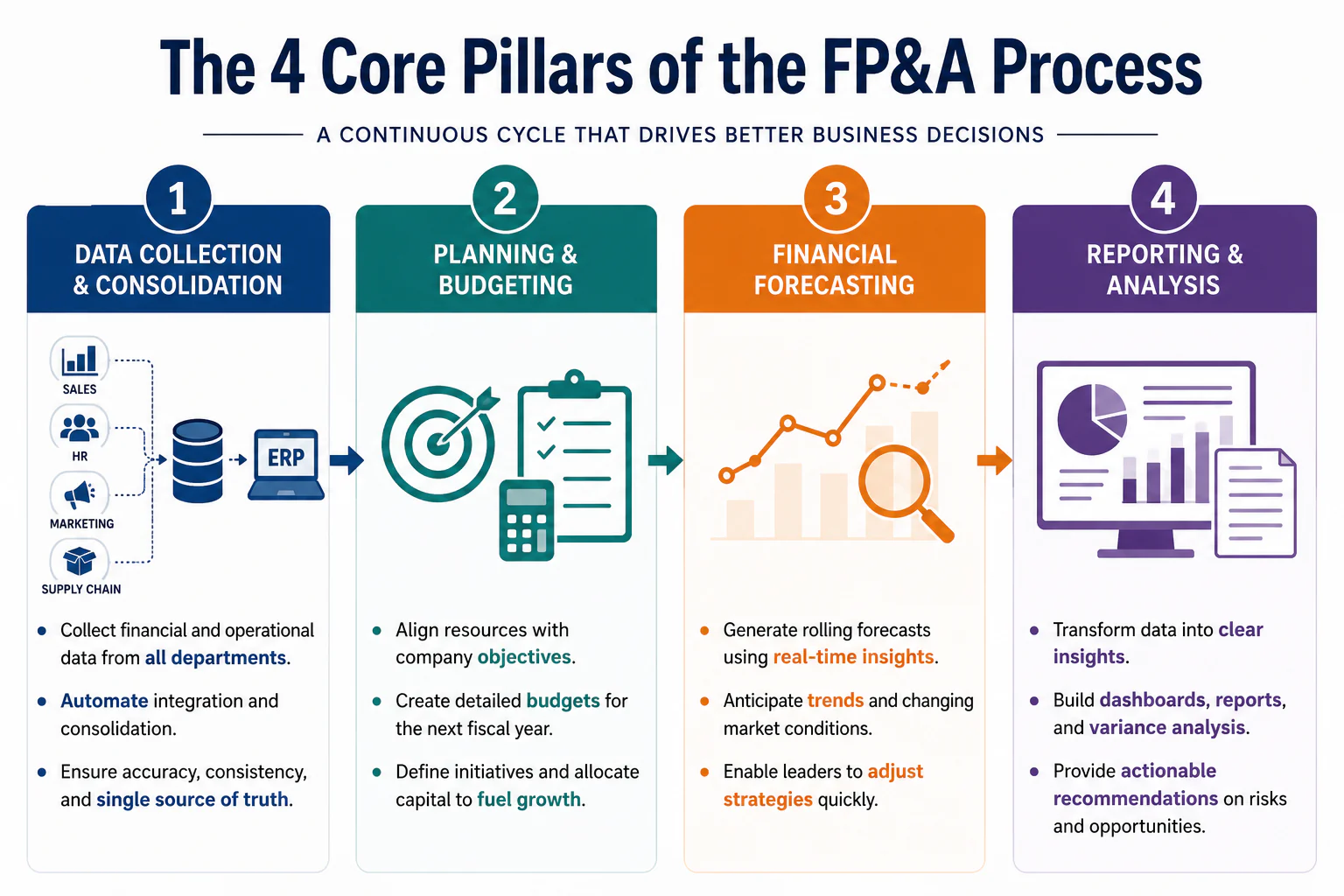
A robust FP&A process is continuous and cyclical. For senior analysts and finance managers, the workflow generally revolves around four primary pillars:
1. Data Collection and Consolidation
Before any analysis can occur, financial and operational data must be gathered from across the entire organization. This includes pulling numbers from sales, HR, marketing, and supply chain departments. In a mature FP&A setup data from modern e invoice Malaysia frameworks is automatically consolidated into an ERP system eliminating manual data entry risks.
2. Planning and Budgeting
Once data is consolidated, the FP&A team aligns the company's financial resources with its strategic goals. Budgeting involves outlining exactly how money will be spent in the upcoming fiscal year. Planning, on the other hand, is the strategic roadmap—determining what initiatives will drive revenue growth and how capital will be allocated to support those initiatives.
3. Financial Forecasting
While a budget is a static document set at the beginning of the year, a forecast is dynamic. FP&A teams use rolling forecasts to predict future performance based on real-time data and changing market conditions. This agility allows executives to pivot their strategies quickly if the company is falling behind its financial targets.
4. Reporting and Analysis
The final pillar is translating complex data into digestible narratives. Equipped with advanced financial reporting software systems FP&A analysts create management reports dashboard visualizations and variance analyses comparing actual performance against the budget to advise the CFO and other stakeholders on potential risks and opportunities.
FP&A vs. Traditional Accounting: What is the Difference?
Many business owners mistakenly assume that their accounting team and their FP&A team perform the same function. While traditional accountants manage day to day ledger entries like tracking long term accumulated depreciation, FP&A professionals look toward future growth.
Many business owners mistakenly assume that their accounting team and their FP&A team perform the same function. While traditional accountants manage day to day ledger entries like [tracking long term accumulated depreciation], FP&A professionals look toward future growth.
Many business owners mistakenly assume that their accounting team and their FP&A team perform the same function. While traditional accountants manage day to day ledger entries like [tracking long term accumulated depreciation], FP&A professionals look toward future growth.
| Criteria | Traditional Accounting | Financial Planning & Analysis (FP&A) |
|---|---|---|
| Primary Focus | Historical data and financial compliance. | Future forecasting and strategic business growth. |
| Core Activities | Bookkeeping, tax filing, payroll, auditing, and preparing financial statements. | Budgeting, financial modeling, variance analysis, and scenario planning. |
| Time Horizon | Past (What happened?) and Present (Where are we now?). | Future (What will happen? What should we do next?). |
| Key Output | Balance sheets, income statements, cash flow statements. | Rolling forecasts, ROI analysis on new projects, management dashboards. |
| Mindset | Detail-oriented, strict adherence to accounting standards. | Analytical, strategic, and business-oriented. |
Building a High-Performing FP&A Team Structure
A common gap in growing companies is assigning FP&A duties to standard accountants who are already overwhelmed with month-end closes. A mature FP&A function requires a dedicated structure:
- Chief Financial Officer (CFO): The ultimate consumer of FP&A data using the insights to shape corporate strategy and communicate vital metrics like the company debt to equity ratio with investors.
- Director of FP&A / Finance Manager: Oversees the FP&A process, ensures alignment with business objectives, and translates raw data into executive presentations.
- Senior FP&A Analysts: Build complex financial models, conduct scenario planning, and work closely with department heads (like Sales or Marketing) to gather operational data.
Top Financial Metrics and KPIs Every FP&A Team Must Track
While accountants track every single ledger entry, FP&A professionals focus on high-level Key Performance Indicators (KPIs) that dictate business health and scalability. A modern FP&A dashboard should automatically track:
- Working Capital Ratio: Measures the company’s operational liquidity and short term financial health which is often optimized through the use of leading accounts receivable software platforms.
- EBITDA (Earnings Before Interest, Taxes, Depreciation, and Amortization): The clearest indicator of core operational profitability stripping out financing accounting decisions and one off events like corporate asset disposal sales.
- Cash Runway & Burn Rate: Critical for rapidly growing or transitioning companies to understand exactly how many months they can operate before needing additional funding.
- Customer Acquisition Cost (CAC) vs. Lifetime Value (LTV): A vital metric that FP&A teams use to advise marketing and sales on budget efficiency and long-term profitability.
Scenario Planning and Sensitivity Analysis: The New Standard
In the past, generating a single "Expected Case" budget was standard practice. Today, market volatility demands that FP&A teams employ scenario planning and sensitivity analysis.
Sensitivity analysis tests how changes in one specific variable (e.g., a 15% spike in shipping costs) affect the bottom line. Scenario planning goes broader, creating full financial models for three distinct futures:
- Base Case: The expected outcome based on current trends.
- Best Case: Optimistic modeling if new products overperform or costs drop.
- Worst Case: Stress-testing the company’s cash reserves against economic downturns or major supply chain failures.
By having these models pre-built, CFOs can execute contingency plans immediately when market conditions shift, rather than scrambling to recalculate budgets mid-crisis.
FP&A Case Study: The Financial Impact of Scenario Planning
To understand the true value of FP&A, let us look at a hypothetical (but highly realistic) case study of a mid-sized electronics distributor in Selangor with an annual revenue of RM 10,000,000.
In Q2, global supply chain disruptions cause a sudden 15% spike in shipping and raw material costs. Let's compare two scenarios: one where the company relies only on static historical accounting, and one where the FP&A team proactively uses sensitivity analysis to mitigate the damage by modeling a slight 5% price increase to customers.
| Financial Metric | Base Case (Original Budget) | Without FP&A Intervention | Proactive FP&A Intervention (5% Price Hike) |
|---|---|---|---|
| Total Revenue | RM 10,000,000 | RM 10,000,000 | RM 10,500,000 |
| COGS (Supply Chain Cost) | RM 6,000,000 | RM 6,900,000 (+15% spike) | RM 6,900,000 (+15% spike) |
| Gross Profit | RM 4,000,000 | RM 3,100,000 | RM 3,600,000 |
| Operating Expenses (OpEx) | RM 2,000,000 | RM 2,000,000 | RM 2,000,000 |
| EBITDA (Profitability) | RM 2,000,000 (20% margin) | RM 1,100,000 (11% margin) | RM 1,600,000 (15.2% margin) |
The Result: Without proactive FP&A, the company's EBITDA margins collapse to 11%. However, because the FP&A team ran a sensitivity analysis before the crisis fully hit the bottom line, the CFO had the data needed to justify a 5% strategic price hike. This single intervention rescued RM 500,000 in EBITDA, proving that a strong FP&A function pays for itself.
Best Practices for Modernizing Your FP&A Function
If you are a finance manager looking to elevate your department, consider these best practices:
- Adopt Rolling Forecasts: Move away from static annual budgets. Implement 12-month rolling forecasts that update monthly, ensuring your strategy is always based on the most current data.
- Foster Cross-Departmental Collaboration: FP&A cannot exist in a vacuum. Analysts must be business partners with Sales, HR, and Operations to understand the qualitative stories behind the quantitative data.
- Standardize Your Data: You cannot run accurate sensitivity analyses if your sales team defines "revenue" differently than your accounting team. Establish a Single Source of Truth (SSOT).
Evaluating Your FP&A Process: The Shift from Spreadsheets to Software
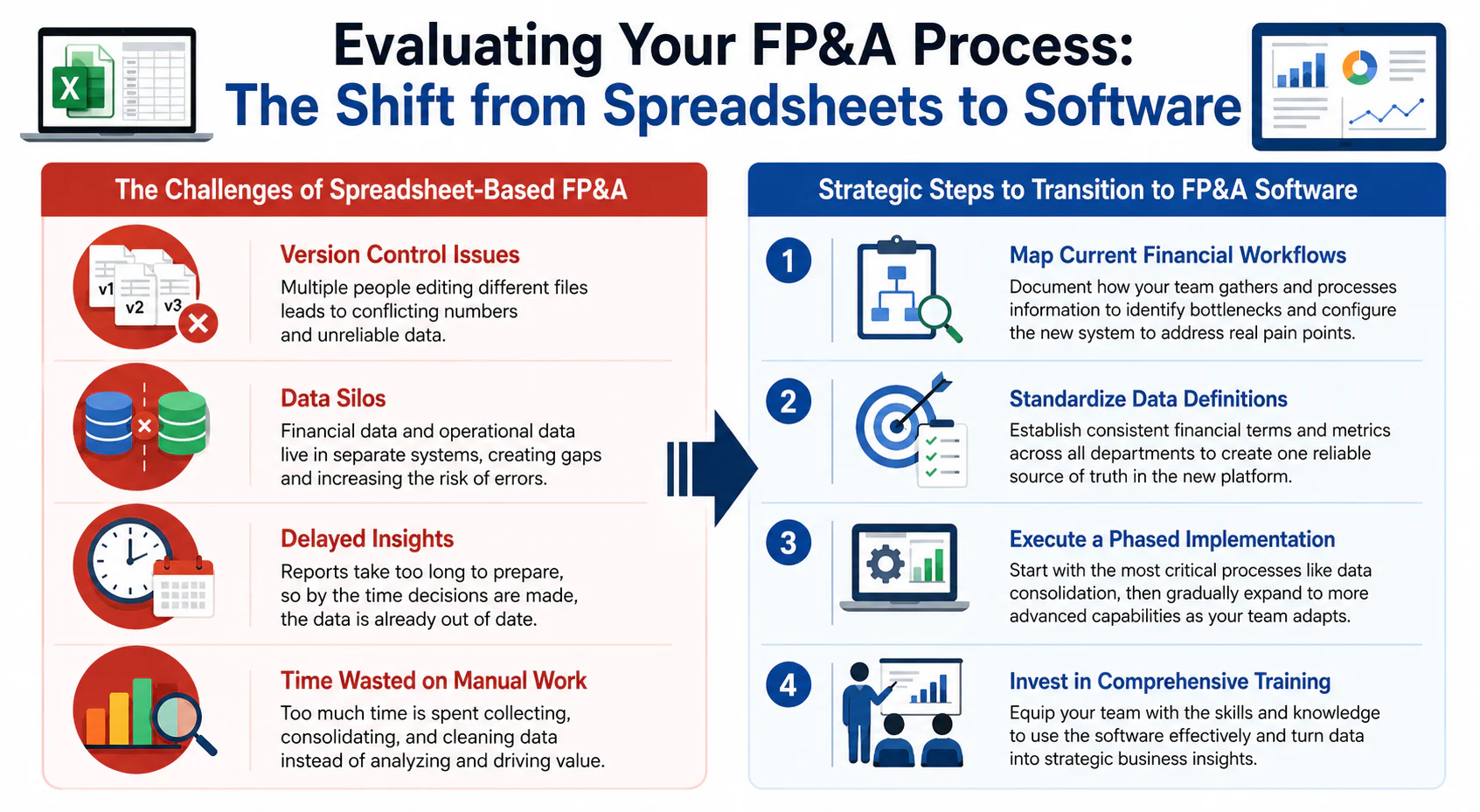
For many growing enterprises, the biggest roadblock to implementing the advanced strategies mentioned above is an over reliance on manual spreadsheets. When a finance team spends the vast majority of their working hours merely collecting, consolidating, and cleaning raw data rather than actually analyzing it, the business operates at a massive strategic disadvantage.
The Problem with Legacy FP&A
When financial planning is heavily dependent on disconnected Excel files, several critical issues arise:
- Version Control Nightmares: Multiple department heads editing different versions of a budget file leads to fragmented and inaccurate data.
- Data Silos: Financial data sits in the accounting software, while operational data sits in a separate CRM. Analysts must manually bridge these gaps, increasing the risk of human error.
- Delayed Insights: By the time a manual variance report is finalized, the data is already weeks old, making it useless for proactive decision making.
Strategic Steps for Software Migration in FP&A
Transitioning away from familiar spreadsheets toward predictive modeling and modern forecasting tools requires a structured migration plan tailored for FP&A teams. To execute this upgrade smoothly while ensuring forecast accuracy and efficiency, enterprise finance automation initiatives play a crucial role in modernizing your financial workflows. Organizations should follow these core implementation steps:
- Map Current FP&A Workflows: Before touching any new software, document exactly how your finance team collects data, builds budget models, and consolidates variance reports. Identifying manual forecasting bottlenecks helps configure the new automated platform to solve specific FP&A pain points.
- Standardize Financial Data Definitions: Automated enterprise planning systems require a single source of truth. Ensure every department aligns on core financial metrics and definitions before migrating historical ledgers and performance models into the new platform.
- Execute a Phased FP&A Implementation: Avoid trying to automate every budgeting template overnight. Begin by migrating core data consolidation and monthly reporting first, then gradually roll out advanced forecasting and scenario planning features once the team adapts.
- Invest in Specialized Analytical Training: Dedicate proper time to train your financial analysts not just on basic system navigation, but on how to leverage advanced data visualization and predictive modeling tools to generate strategic business insights.
Conclusion
Financial Planning and Analysis has evolved far beyond routine budgeting into an essential compass for navigating market volatility. Companies shifting from reactive reporting to forward looking predictive modeling are far better equipped to safeguard their profit margins.
True competitive advantage comes from cultivating a culture where agile forecasting drives corporate decisions. When finance teams escape manual data entry, they actively shape enterprise growth rather than merely report on past results.
Transitioning to modern infrastructure eliminates manual data silos. Explore a free demo to see how automated consolidation gives your CFO the real time insights needed for business success.

Frequently Asked Questions (FAQ)
The main role of Financial Planning and Analysis (FP&A) is to provide corporate executives with the financial analysis and insights they need to make strategic business decisions. This includes budgeting, forecasting future financial performance, and analyzing market trends.
Accounting is retrospective, focusing on recording historical financial transactions, closing the books, and ensuring compliance. FP&A is prospective, using that historical data to create forward-looking forecasts, budgets, and strategic financial models for the future.
Scenario planning is critical because it prepares a business for uncertainty. By modeling Best Case, Base Case, and Worst Case economic scenarios, FP&A teams allow CFOs to have contingency plans ready before a crisis or sudden market shift occurs.
Historically, FP&A professionals relied heavily on manual spreadsheets. Today, mature finance teams use advanced Corporate Performance Management (CPM) tools, integrated Accounting Software, and Enterprise Resource Planning (ERP) systems to automate data collection and improve forecast accuracy.
A great FP&A analyst combines strong financial modeling skills with deep business acumen. They do not just report the numbers; they communicate the story behind the numbers, collaborate across departments, and provide actionable recommendations to senior management.