









 Limited to 100 registrants

When risk is managed separately by each department, small warning signs can quickly turn into bigger business problems. A delayed supplier, system downtime, audit issue, or compliance gap can affect daily operations before management gets a clear picture of what went wrong.
Enterprise risk management (ERM) addresses this by giving businesses a unified framework to identify, assess, and respond to threats across every function, from finance and supply chain to IT and compliance.
For Malaysian businesses, this has moved beyond best practice into a regulatory priority. Securities Commission Malaysia’s Corporate Governance Strategic Priorities 2021–2023 identifies board-level risk oversight as a key focus area, with companies expected to strengthen governance structures and integrate risk considerations into business strategy. For businesses operating under Bursa Malaysia listing requirements or the Companies Act 2016, structured risk visibility directly affects audit readiness and investor confidence.
This article explains what enterprise risk management is, how the ERM framework works, and how businesses can use an ERP system to identify, monitor, and reduce risks before they disrupt growth.
Key Takeaways
ERM connects risk visibility across departments, so management can see risks clearly.
A structured ERM framework helps businesses identify, assess, respond to, and review risks.
Successful ERM needs leadership support, clear governance, documented risks, and accurate reporting.
Managing enterprise risk becomes significantly easier when procurement, finance, and operations data are connected in one system. Decision-makers get a real-time view of where risks are building before they escalate into bigger problems.

What is Enterprise Risk Management (ERM)?
Enterprise Risk Management (ERM) is a company wide approach to identifying and managing risks that can affect business goals. It helps management see risks across finance, operations, compliance, supply chain, cybersecurity, and strategy in one connected view.
ERM also helps businesses decide which risks need action, which can be accepted, and how much risk they can take while pursuing growth. For Malaysian businesses, this supports stronger governance, internal control, and clearer risk reporting.
Types of Enterprise Risk Every Malaysian Business Faces

Understanding each type of risk helps businesses know what to monitor, prevent, and prioritize. For Malaysian businesses, these risks often appear in strategy, operations, finance, compliance, and brand reputation.
1. Strategic Risk
This risk affects long-term business direction. In Malaysia, it can come from new competitors, market shifts, or changes in government policy.
2. Operational Risk
This risk disrupts daily business processes. Common examples include system downtime, manual process errors, production delays, or weak internal workflows.
3. Financial Risk
This risk affects cash flow and financial stability. It may involve Ringgit fluctuations, bad debt, audit issues, or poor budget control.
4. Compliance Risk
This risk happens when a business fails to meet laws or regulatory requirements. In Malaysia, examples include PDPA violations, Bursa disclosure issues, or BNM non-compliance.
5. Reputational Risk
Reputational risk can arise from data breaches, product recalls, poor service, or negative media coverage. Strengthening quality control and product traceability helps avoid product recalls and protect customer trust.
Emerging risks such as ESG compliance and AI adoption are also becoming more important in modern ERM. Since these risks are often connected, one issue can quickly lead to financial loss, compliance problems, and reputational damage at the same time.
The ERM Framework: How It Works Step by Step
Effective risk management works best when businesses follow a clear and repeatable process. This helps every department identify risks early, set priorities, and use resources where they matter most.
Step 1: Risk Identification
This step focuses on finding and listing risks that could affect business goals. Companies can use risk workshops, stakeholder interviews, and internal reviews to spot possible threats. The result is a risk register, which records risks such as supplier delays, raw material price changes, system downtime, or workplace incidents.
Step 2: Risk Assessment
After risks are identified, businesses need to measure how likely they are to happen and how serious the impact could be. Many companies use a risk matrix to decide which risks need immediate action and which ones can be monitored over time.
Step 3: Risk Response
At this stage, businesses decide how to handle each risk. The common options are to avoid the risk, reduce its impact, transfer it through insurance or contracts, or accept it when the cost of action is higher than the possible loss.
Step 4: Control Activities
Control activities help businesses make sure risk policies are followed in daily operations. These can include approval workflows, segregation of duties, access controls, and automated checks through an ERP components to reduce human error.
Step 5: Communication and Reporting
Risks should be reported clearly to the right stakeholders, from department managers to senior leadership. For Malaysian listed companies, regular risk reporting also supports stronger governance and annual disclosure requirements.
Step 6: Monitoring and Review
ERM is not a one-time project. Businesses need to monitor key risk indicators, review changes regularly, and update their risk strategy when there are major shifts such as new regulations, market changes, mergers, or operational changes.
Key Differences Between COSO and ISO 31000
Most businesses align their ERM strategies with international standards to ensure credibility and stronger governance.
| Aspect | COSO ERM Framework | ISO 31000 |
|---|---|---|
| Developed by | Committee of Sponsoring Organizations (COSO) | International Organization for Standardization (ISO) |
| Approach | Structured, component-based framework | Flexible, principles-based standard |
| Core components | Governance & Culture, Strategy, Performance, Review, Information & Communication | Principles, Framework, and Process — customized to business needs |
| Best suited for | Public companies, Bursa-listed companies, MNC subsidiaries | Organizations of all sizes, including Malaysian SMEs |
| Governance focus | Strong emphasis on board-level oversight and enterprise-wide strategy | Emphasis on integration across all functions and organizational levels |
Benefits of Enterprise Risk Management for Your Business
Implementing a strong ERM framework provides far more than just a safety net; it creates a foundation for sustainable growth. Here are the primary benefits for Malaysian organizations:
Holistic Risk Visibility
ERM breaks down departmental silos, allowing leadership to see how a risk in the supply chain might affect financial liquidity or customer reputation. This 360-degree view helps prevent blind spots that can lead to bigger business problems.
Enhanced Operational Resilience
By identifying potential disruptions before they occur, such as IT system failures or logistics bottlenecks, businesses can develop contingency plans that ensure continuity, even during volatile market shifts.
Strategic Capital Allocation
ERM allows management to quantify risks, enabling them to allocate resources and capital more efficiently. Businesses can invest with confidence, knowing which risks have been assessed and prepared for.
Stronger Regulatory Compliance & Governance
For companies regulated by BNM or listed on Bursa Malaysia, ERM helps support alignment with governance and risk management expectations. This protects the organization from compliance issues, legal disputes, and potential operational disruption.
Improved Stakeholder & Investor Confidence
Investors and lenders often value businesses with structured risk management. It demonstrates maturity, transparency, and a commitment to protecting shareholder value, making it easier to secure funding or partnerships.
Proactive Risk-Aware Culture
ERM encourages employees at all levels to identify and report hazards. When risk management becomes part of the daily workflow, the organization becomes more agile and better equipped to handle unexpected challenges.
How to Implement Enterprise Risk Management in Your Organization
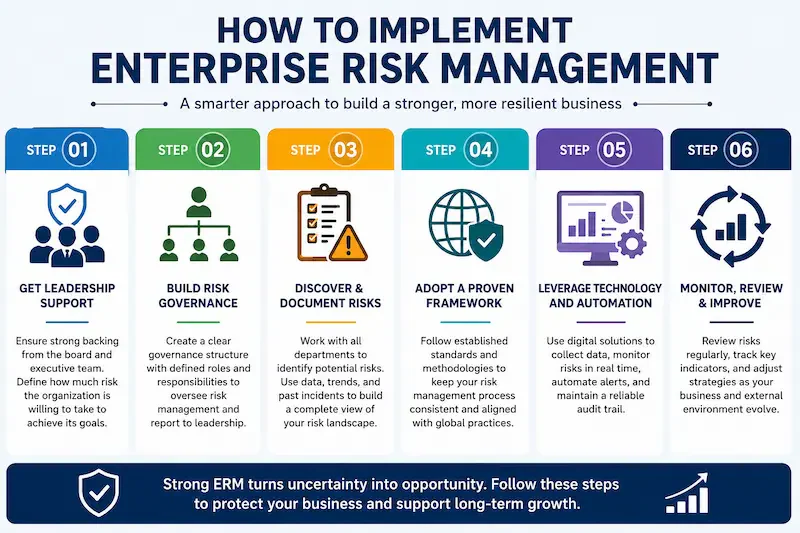
Transitioning from reactive firefighting to a proactive ERM strategy requires a phased approach. Follow these steps to build a resilient framework:
- Secure Executive Buy-In: ERM cannot be a bottom up initiative. It requires clear support from the Board of Directors and the C-suite. Leadership must define the organization’s Risk Appetite, which means how much risk the business is willing to accept while pursuing strategic goals.
- Establish the Risk Governance Structure: Appoint a Chief Risk Officer (CRO) or establish a dedicated Risk Committee. This team is responsible for overseeing the ERM framework, keeping policies updated, and reporting findings to the board.
- Identify and Document Risks (Risk Inventory): Conduct cross-departmental workshops and interviews. Look at historical data, market trends, and internal audits to build a comprehensive Risk Register that covers everything from financial fraud to ESG factors.
- Select a Standardized Framework: Align your process with recognized standards like ISO 31000 or COSO. This ensures your risk management is structured, consistent, and aligned with international best practices, especially for businesses planning regional or global expansion.
- Integrate Technology & Automation: Manual spreadsheets are no longer enough for modern ERM. Implement digital tools or an integrated ERP system to automate data collection, provide real-time alerts, and maintain a digital audit trail of all risk-related decisions.
- Monitor, Review, and Report: ERM is a continuous cycle. Schedule quarterly reviews to reassess existing risks and identify new ones. Regular reporting ensures that the strategy remains relevant as the business environment changes.
How ERP Supports Enterprise Risk Management
Effective ERM requires accurate, real-time data and standardized internal controls. An integrated ERP system can act as the digital backbone of a risk management strategy by embedding controls directly into daily operations. Here is how ERP software supports your ERM journey:
- Automated Internal Controls: ERP software helps reduce human error, which is a common source of operational risk, by enforcing standardized processes. Features like Multi-Level Approval Workflows ensure that high-value transactions or sensitive changes require authorized sign-offs.
- Comprehensive Audit Trails: Every action taken within the system is recorded. This digital footprint is essential for compliance risk management, allowing Malaysian businesses to prepare reports more easily for BNM, Bursa, or external auditors.
- Granular Role-Based Access Control (RBAC): Protect sensitive data and prevent internal fraud by restricting system access based on job roles. This ensures that only authorized personnel can view or edit critical financial and employee information.
- Real-Time Data & Predictive Analytics: Instead of relying on delayed reporting, ERP systems provide live dashboards and Key Risk Indicators (KRIs), allowing management to spot anomalies or financial discrepancies as early as possible.
- Integrated Supply Chain Risk Management: Monitor supplier performance and inventory levels in real-time. By identifying potential shortages or vendor delays early, businesses can trigger mitigation strategies before production is affected.
- Data Security & PDPA Compliance: A secure ERP system can support PDPA compliance through access control, audit trails, and structured data protection processes, helping reduce the risk of data breaches and reputational damage.
With the right ERP setup, businesses can connect risk monitoring, internal controls, reporting, and compliance in one system. This gives leaders clearer visibility and helps them respond faster when potential risks appear.
Conclusion
Businesses without a dedicated ERM strategy often respond to risks only after problems happen. For Malaysian organizations, especially those facing growth, tighter governance expectations, and more complex operations, enterprise risk management helps create clearer visibility, stronger internal controls, and better decision-making.
Building an effective ERM framework also requires the right system to support daily risk monitoring. With features such as audit trails, approval workflows, role-based access, and real-time reporting, ERP software can help businesses manage risks before they disrupt operations.
If your company is planning to improve risk visibility and internal control, a free consultation can help you understand which ERP setup fits your business needs best.
FAQ About Enterprise Risk Management (ERM)
Enterprise risk management should involve senior leadership, department heads, finance teams, operations teams, compliance teams, and IT teams. Each department understands different risks, while management connects those risks to business priorities.
Businesses should review their risk strategy regularly, especially when there are changes in regulations, market conditions, suppliers, systems, or internal processes. A quarterly review is often useful for keeping risk data updated.
Common ERM documents include a risk register, risk assessment matrix, internal control records, audit trails, incident reports, and management review reports. These documents help businesses track risks more clearly and support better reporting.
Common signs include repeated operational issues, unclear approval processes, delayed reporting, compliance gaps, supplier disruptions, and risks that are only noticed after they become serious problems.
Yes. ERM helps businesses assess risks before entering new markets, adding suppliers, launching new products, or expanding operations. This makes growth decisions more controlled and reduces the chance of unexpected disruption.