







Malaysia’s position as one of Southeast Asia’s most important logistics hubs is facing growing pressure. From port congestion at Westports and Port Klang to unpredictable cross-border freight movements along the northern corridor, logistics delays in Malaysia have become a persistent operational challenge. These disruptions are no longer occasional issues but ongoing barriers that businesses must actively manage.
Logistics delays disrupt inventory planning, customer satisfaction, and revenue cycles. According to a New Straits Times report, rerouted shipping may delay Malaysia’s trade movements, making supply chain resilience a priority for FMCG, electronics, and pharmaceutical distributors.
This article explores the key causes of logistics delays in Malaysia and highlights why a strong warehouse management approach is critical for maintaining operational stability.
Key Takeaways
Malaysia’s deep integration in global supply chains makes distributors highly vulnerable to external disruptions, increasing the risk of delays and operational instability.
Malaysian distributors are adapting by diversifying suppliers to reduce risk and improve supply continuity.
Malaysian distributors are adopting data-driven strategies to boost resilience, agility, and long-term competitiveness.

Supply Chain Disruption in Malaysia: A Growing Risk for Distributors
Malaysia’s role in regional trade makes local distributors highly exposed to logistics disruptions, especially when global shipping routes shift or key ports face heavy cargo flow. According to The Edge Malaysia, Port Klang handled a record 14.64 million TEUs in 2024, up from 14.06 million TEUs in 2023, showing how much Malaysia’s supply chain depends on high-volume port movement.
When congestion, rerouted shipping, or inland transport delays occur, the impact can quickly spread to inventory planning, delivery schedules, and customer fulfilment. For distributors in FMCG, electronics, and pharmaceuticals, stronger shipment visibility and warehouse coordination are now essential to keep operations stable.
Logistics Delays and Their Impact on Malaysia’s Supply Chain

What’s Causing Logistics Delays in Malaysia
Port congestion, cross-border complexity, supplier lead time changes, and seasonal flooding are key causes of logistics delays in Malaysia. These issues can disrupt inland transport, inbound shipments, delivery schedules, and last-mile distribution, forcing distributors to improve planning and prepare for fluctuating transit times.
Logistics delays in Malaysia often come from port congestion, border issues, supplier lead time changes, labor shortages, and flooding, affecting shipments and delivery schedules.
| Cause | What Happens | Impact on Distributors |
| Port congestion | Container dwell time increases at major ports like Port Klang. | Delays inland transport, delivery schedules, and stock replenishment. |
| Cross-border complexities | Customs checks and documentation issues vary across Thailand and Singapore borders. | Creates uncertain transit times and shipment clearance delays. |
| Global supply variability | Supplier lead times from markets such as China and Europe become harder to predict. | Affects inbound shipment planning and purchase order fulfilment. |
| Labor shortages | Warehousing and transport teams may face workforce availability issues. | Slows picking, loading, dispatch, and delivery coordination. |
| Environmental disruptions | Flooding and extreme weather affect road freight and delivery routes. | Disrupts last-mile delivery and increases routing costs. |
The Impact on Malaysian Distribution Operations
Logistics delays reduce inventory availability, trigger stockouts or backorders, and make order fulfilment less reliable for Malaysian distributors. To compensate, businesses may increase safety stock, but this raises warehousing costs and ties up cash flow, while unpredictable inbound schedules make labor planning, storage allocation, and customer service harder to manage.
Logistics delays reduce inventory availability, increase fulfilment risks, and make warehouse planning harder for Malaysian distributors. The main operational impacts include:
| Impact | What Happens | Business Effect |
| Lower order fulfilment rates | Backorders increase and delivery targets are missed. | Service reliability declines. |
| Higher inventory costs | Businesses hold more safety stock. | Storage expenses increase. |
| Cash flow pressure | Working capital is tied up in excess inventory. | Less flexibility for other operational needs. |
| Declining customer satisfaction | Delays and product unavailability affect buyers. | Customers may switch to more reliable suppliers. |
| Planning inefficiencies | Labor scheduling and warehouse capacity become harder to manage. | Daily operations become less predictable. |
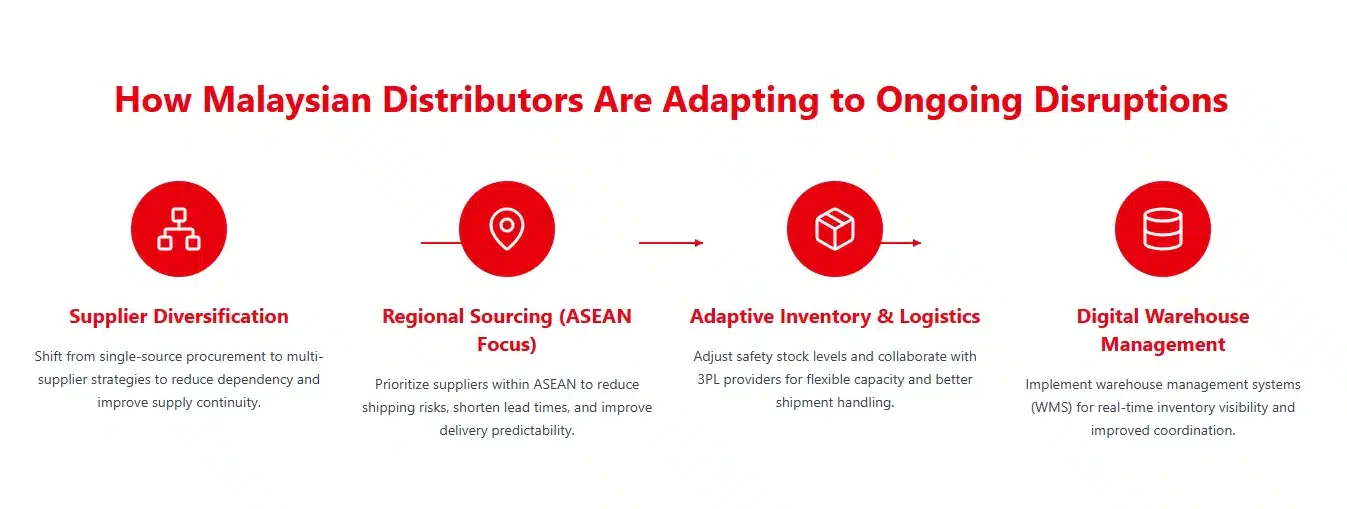
How Malaysian Distributors Are Adapting to Ongoing Disruptions?
Malaysian distributors are actively adjusting their supply chain strategies to reduce exposure to ongoing logistics disruptions. One of the most effective approaches is supplier diversification, shifting away from single-source procurement toward multi-supplier models. This strategy helps reduce dependency on a single region and improves overall supply continuity.
In addition, many businesses are prioritizing regional sourcing within ASEAN to minimize risks linked to global freight instability. Shorter shipping distances and more predictable transit times make regional suppliers a practical alternative in uncertain conditions. This shift also allows distributors to respond faster to demand changes and reduce lead time variability.
At the operational level, inventory and logistics strategies are becoming more adaptive. Safety stock policies are being recalibrated to account for delay risks, while partnerships with 3PL providers offer flexible capacity and improved shipment tracking. At the same time, implementing digital warehouse management systems has become essential for achieving real-time visibility and better coordination across distribution networks.
The Growing Challenge of Managing Inventory Under Uncertainty
Managing inventory becomes increasingly difficult when lead times for the same SKU can range from 14 to 45 days. This variability makes it harder for distributors to maintain optimal stock levels and respond accurately to demand changes. As uncertainty grows, traditional planning approaches often fail to reflect real-time supply chain conditions.
Manual tracking and spreadsheet-based replenishment systems are no longer effective in handling this level of complexity. These methods create visibility gaps, leaving distributors without clear insights into stock availability and warehouse movements. Combined with SKU proliferation, this leads to reactive decision-making and higher operational risk.
Understanding what makes a best-in-class warehouse management system is essential for distributors looking to eliminate these visibility gaps. To better understand the key challenges, here are the main issues distributors face:
- Lead time variability: Unpredictable supplier delivery timelines for the same SKU.
- Limited visibility: Lack of real-time data on stock levels and warehouse locations.
- Manual processes: Heavy reliance on spreadsheets and disconnected systems.
- SKU complexity: Increasing number of products requiring detailed tracking.
- Reactive decision-making: Delayed responses to disruptions and demand changes.
Why WMS Is Becoming Essential in Managing Supply Chain Disruption Malaysia?
A modern warehouse management system (WMS) enables real-time inventory visibility and supports more accurate, data-driven decisions. By tracking every inventory movement through scanning and system updates, distributors can maintain accurate stock records and reduce errors. This helps eliminate the blind spots commonly found in manual systems.
WMS solutions also improve responsiveness by enabling demand-driven replenishment based on current supply conditions rather than historical assumptions. Integration with ERP and logistics platforms allows distributors to anticipate delays, coordinate operations, and communicate more effectively with customers.
To highlight its value, here are the key benefits of implementing a WMS:
| WMS Benefit | What It Does | Impact on Supply Chain Disruption |
|---|---|---|
| Real-time inventory tracking | Shows accurate stock visibility across warehouse locations. | Helps distributors respond faster when shipments are delayed or stock levels change. |
| Automated replenishment | Supports reorder decisions based on current stock and demand conditions. | Reduces stockouts and prevents unnecessary overstocking during uncertain supply periods. |
| System integration | Connects WMS with ERP, transportation, and sales systems. | Improves coordination between warehouse, logistics, and customer-facing teams. |
| Improved accuracy | Reduces manual errors through scanning, automation, and system updates. | Keeps inventory records reliable when operations become more complex. |
| Scalable technology | Supports cloud-based access without heavy upfront infrastructure. | Helps distributors expand warehouse control as shipment volume and disruption risk grow. |
Market Insight: High Demand but Low Engagement in WMS Content
Rising search interest around logistics delays and supply chain disruption in Malaysia highlights a clear shift in how businesses approach operational challenges. However, not all available information provides the depth needed for practical decision-making. The table below outlines the current landscape, key gaps, and the business needs.
| Area | Current Condition in Malaysia | Key Gap | What Businesses Need |
|---|---|---|---|
Search Trends | Rising search volume for logistics delays and supply chain disruption topics | High demand for deeper insights | More practical, operations-focused content |
Content Quality | Most content is still general and surface-level | Lack of actionable guidance for real-world use | Step-by-step strategies and use-case examples |
Operational Relevance | Transportation issues often discussed separately | No clear link to warehouse and inventory impact | Integrated view between logistics and warehouse management |
Buyer Expectations | Increasing awareness of supply chain risks | Limited localized solution insights | Focus on Malaysia-specific needs such as compliance and local operations |
Technology Demand | Growing interest in digital solutions | Features not clearly explained in context | WMS with real-time visibility, automation, and integrations |
Market Education | Businesses are actively researching solutions | Lack of expert-driven, experience-based content | Insightful content that supports decision-making |
Understanding these gaps is essential for businesses aiming to stay competitive in an increasingly complex logistics environment. As expectations continue to evolve, companies that focus on actionable insights and relevant technology will be better positioned to respond to disruption. Aligning content, strategy, and operational tools is now a critical step toward building long-term supply chain resilience.
Advanced Practices for Long-Term Logistics Resilience in Malaysia
As supply chain disruptions continue to evolve, distributors in Malaysia are moving beyond basic mitigation strategies toward more advanced, data-driven approaches. These practices focus not only on reducing risk but also on improving long-term operational agility and competitiveness.
- Predictive analytics for delay forecasting
Leading distributors are using predictive analytics to estimate delay probabilities based on historical port congestion data, shipping patterns, and weather conditions. This allows businesses to anticipate disruptions earlier and make proactive adjustments to inventory planning and distribution schedules. - Collaborative forecasting with customers
By sharing demand forecasts with key customers, distributors can align supply planning with real market needs. This improves demand visibility, reduces uncertainty, and enables more accurate stock positioning closer to end-users. - Regional warehousing network expansion
Expanding to locations like Johor Bahru, Penang, or East Malaysia reduces reliance on one hub. A WMS helps multi-branch FMCG distributors manage stock centrally and fulfil orders from the nearest warehouse when disruptions occur. - Sustainable and regional sourcing strategies
Integrating sustainability into supply chain planning, such as sourcing from ASEAN-based suppliers, helps reduce reliance on long-haul shipping routes. At the same time, it supports ESG goals while lowering exposure to global logistics disruptions.
Adopting these advanced practices enables distributors to build a more resilient and adaptive supply chain in an increasingly uncertain logistics environment. Businesses that invest in these strategies are better positioned to maintain service levels, control costs, and respond effectively to future disruptions.
Conclusion
Logistics delays in Malaysia are no longer temporary issues but an ongoing operational reality. Distributors need to build structural resilience across sourcing, inventory, and distribution to stay competitive. Short-term fixes are no longer enough in a consistently disrupted environment.
Many businesses are responding by diversifying suppliers, adjusting inventory strategies, and investing in digital visibility tools. A warehouse management system (WMS) plays a key role by improving inventory accuracy and enabling faster decision-making. This helps maintain service levels even during supply chain disruptions.
Shifting from reactive responses to proactive strategies allows companies to protect margins and strengthen customer trust. It also creates better readiness for future disruptions and market changes. In the long term, resilience becomes a key driver of sustainable growth in Malaysia’s logistics.
Discover how a modern WMS can help you navigate logistics delays and improve inventory control with request a free demo today to see how it works in your operations.

FAQ about Logistics Delays
Delays increase safety stock carrying costs, trigger penalty clauses for late delivery, and risk the loss of major retail accounts.
Distributors must move to dynamic reorder points and real-time accuracy to manage the uncertainty of arrival times.
A WMS does not remove external delays such as port congestion or shipping reroutes, but it helps businesses respond faster. It gives warehouse teams real-time stock visibility, improves picking and dispatch accuracy, and supports better transfer planning across multiple warehouse locations.
Barcodes are more cost-effective for smaller warehouses with simple scanning needs, while RFID is better for high-volume operations that require faster tracking without direct line of sight. Many Malaysian distributors can use both, with barcodes for daily item scanning and RFID for fast-moving goods, pallets, or multi-location stock tracking.
Current logistics issues in Malaysia include port congestion, cross-border documentation delays, supplier lead time changes, labor constraints, and weather-related disruption. The bigger challenge is that these issues often affect warehouse planning before businesses have enough visibility to react.
The biggest problem is uncertainty. A delay becomes more costly when businesses cannot see stock movement, update fulfilment plans, or adjust warehouse capacity quickly, which can lead to backorders, excess safety stock, and weaker customer trust.