







It is easy for business owners to track their monthly revenue but many cannot answer one critical question. How far can those sales drop before the company starts losing money. Operating without knowing this exact financial cushion leaves you completely exposed to sudden market shifts making the margin of safety an essential survival skill.
For businesses in Malaysia, understanding how far sales can fall before reaching the break-even point is an important part of financial risk management. Whether reviewing pricing, inventory costs, or investment plans, the margin of safety helps measure risk more clearly and supports better business decisions.
More importantly this metric helps you see how much room your business has before profits start to decline. To manage risk better and make smarter financial decisions integrating a modern accounting platform ensures your numbers are always accurate and ready for analysis.
More importantly this metric helps you see how much room your business has before profits start to decline. To manage risk better and make smarter financial decisions integrating a modern accounting platform ensures your numbers are always accurate and ready for analysis.
More importantly this metric helps you see how much room your business has before profits start to decline. To manage risk better and make smarter financial decisions integrating a modern accounting platform ensures your numbers are always accurate and ready for analysis.
Key Takeaways
Margin of safety is the gap between your actual sales and the break even point, showing how much sales can fall before your business starts losing money.
To understand how margin of safety works, you need to look at break even analysis, fixed costs, variable costs, and contribution margin.
A higher margin of safety gives your business more room to stay profitable, respond to pricing changes, and handle market uncertainty with less risk.
You can strengthen your margin of safety through cost control, better planning, smarter execution, and industry specific strategies that fit your business model.
To keep financial records accurate and daily processes more organized, many businesses now rely on integrated accounting software.

What is the Margin of Safety in Accounting and Finance?
The term margin of safety carries two specific meanings depending on your focus. In managerial accounting and corporate finance it represents the exact difference between your current sales and your break even point. In simple terms it shows exactly how much your revenue can drop before the business begins to lose money. A narrow safety buffer means your operations are highly vulnerable to slight cost increases or unexpected sales dips.
In the world of value investing the concept refers to the gap between the true intrinsic value of an asset and its current market price. Since finding the true worth of a company relies heavily on estimates investors use this buffer to minimize risks from market volatility and unpredictable industry disruptions.
"The function of the margin of safety is, in essence, that of rendering unnecessary an accurate estimate of the future."
The Core Components of Break Even Analysis

To fully grasp the margin of safety you first need to understand cost behavior. This financial buffer relies heavily on the relationship between several core accounting components.
- Fixed costs: These are expenses that remain constant regardless of your production or sales volume such as rent salaries insurance and equipment depreciation. The higher your fixed costs the more pressure you put on your break even point.
- Variable costs: These expenses change directly with your sales volume and include raw materials direct labor and shipping fees. To improve cost control mastering the calculation of your direct manufacturing expenses is essential since errors in this area will distort your entire break even analysis.
- Contribution margin: This figure represents the interaction between your selling price and variable costs showing exactly how much revenue from each sale remains available to cover fixed costs. A stronger contribution margin helps you reach your break even threshold faster and widens your margin of safety.
How to Read and Apply the Margin of Safety Formula
Calculating the margin of safety is a straightforward process, as long as your cost data is accurate and updated. Financial professionals typically express the margin of safety in three ways: in absolute dollar amounts, in physical units, or as a percentage of total sales. Each format provides a different view of your business risk.
1. Margin of Safety in Dollars or Local Currency
This is the most direct way to calculate the safety buffer, representing the exact amount of revenue that can be lost before you start facing an operating loss.
Formula: Margin of Safety (RM) = Total Actual or Projected Sales − Break Even Sales
2. Margin of Safety in Units
For manufacturing companies or retailers dealing with physical products, expressing the safety margin in units is often more intuitive for production managers and inventory planners.
Formula: Margin of Safety (Units) = Actual or Projected Sales Volume − Break Even Sales Volume
3. Margin of Safety Percentage Ratio
The percentage format is arguably the most useful metric for comparative analysis. It allows you to compare the risk levels of different product lines, departments, or even competing companies, regardless of their absolute size.
Formula: Margin of Safety (%) = [(Actual Sales − Break Even Sales) / Actual Sales] × 100
To illustrate these formulas in action, consider this example. Imagine a specialized bicycle manufacturing company called Apex Cycles. Apex Cycles produces high end mountain bikes that sell for RM2,000 each. The company’s accounting department has determined that the variable cost to produce one bicycle, including raw materials, direct labor, and variable overhead, is RM1,200.
Furthermore, the company incurs total fixed costs, including factory rent, administrative salaries, and insurance, of RM400,000 per month. To find the break even point, you first calculate the contribution margin per unit. The contribution margin per unit is RM2,000 minus RM1,200, which equals RM800.
The break even point in units is RM400,000 divided by RM800, which equals 500 bicycles. The break even point in sales ringgit is 500 units multiplied by RM2,000, resulting in RM1,000,000.
Now, let us assume that Apex Cycles currently sells 800 bicycles per month, generating total actual sales of RM1,600,000. Using these formulas, you can calculate the company’s margin of safety:
Margin of Safety in Units = 800 Actual Units − 500 Break Even Units = 300 bicycles
Margin of Safety in Ringgit = RM1,600,000 − RM1,000,000 = RM600,000
Margin of Safety Percentage = (RM600,000 / RM1,600,000) × 100 = 37.5%
What does this 37.5% figure actually mean? It indicates that the company’s sales revenue can decline by up to 37.5% from its current level before the business stops making a profit and begins to lose money, it serves as a warning before a business becomes insolvent. That is a healthy buffer, giving you more room to invest in marketing, product development, or operational improvements without feeling too exposed to short term market changes.
Why the Margin of Safety is Critical for Business Survival
The margin of safety works as a financial cushion for your business. In unpredictable markets knowing exactly how much pressure your business can take before losing money is essential. This metric gives management an early warning helping them spot risks before they turn into cash flow problems.
When leadership clearly understands their safety buffer they can make much smarter choices about budgets and expansion. Operating with a wide margin allows a company to take calculated risks without putting daily business in danger. Here are several reasons why keeping this financial cushion is critical for survival
Protects core cash flow: A healthy buffer ensures that even during slow months you generate enough revenue to cover essential expenses like rent and payroll without draining your cash reserves.
Guides expansion safely: Before opening a new branch or launching a new product line management can use this metric to see if the core business is stable enough to support new investments.
Absorbs economic shocks: When inflation hits raw materials or a recession reduces consumer spending companies with a wide safety margin can absorb the damage without resorting to immediate layoffs or desperate price cuts.
Ultimately a strong margin of safety gives your business the flexibility to navigate market uncertainty and creates room to pursue growth without taking unnecessary risks.
How Margin of Safety Influences Profitability
There is a direct relationship between the margin of safety and the overall profitability of your company. Once a business generates enough revenue to cross its break even point every additional sale drops directly into operating income. A wider safety buffer generally means stronger profit potential because a larger portion of your total sales is free from the burden of fixed costs.
Financial analysts and investors pay close attention to this balance. They look at business health by analyzing profitability ratios to see if the returns are actually worth the risk. A business with high profits but a very thin safety margin becomes a risky investment when the economy slows down. To keep growing safely you need to manage your costs well. Here is how this metric directly shapes your profit outcomes
Accelerates net income: Because fixed costs are already fully covered by the break even volume the profit from every subsequent sale consists entirely of your contribution margin which quickly boosts your bottom line.
Improves pricing flexibility: When your safety buffer is wide you can afford to run temporary discounts or promotional campaigns to win market share without accidentally pushing your business into a loss.
Reduces dependence on high volume: A business with a strong margin of safety does not need to rely on record breaking sales every single month just to stay profitable creating a much more relaxed and strategic operating environment.
This is exactly why business leaders need to balance their fixed costs carefully. Pushing for extreme efficiency by taking on massive fixed overhead might increase capacity but it will also shrink your safety margin and threaten your long term profitability if sales suddenly slow down.
How Pricing Strategy Affects Your Safety Buffer
Pricing is one of the most powerful ways to shape your margin of safety. Because price changes alter your contribution margin, they directly move your break even point. Here is how different pricing choices impact your financial buffer:
Raising Prices to Widen Your Buffer
When you raise prices while keeping variable costs steady, your per-unit contribution margin increases. This means you need fewer sales to cover fixed costs, widening your safety buffer as long as volume holds.
Balancing Price Sensitivity and Demand
Higher prices can backfire if your customers are price sensitive. A sharp drop in sales volume will lower your total contribution margin and shrink your buffer. Always study competitor pricing and market demand while understanding your profit margin so volume drops do not ruin net income.
Lowering Prices for High Volume Growth
Some businesses lower prices to capture market share. While this reduces per-unit profit and raises your break even point, a massive surge in sales volume can still expand your overall safety margin, which is why high volume models thrive on thin margins.
Practical Ways to Strengthen Your Margin of Safety
If a financial analysis reveals that your company’s margin of safety is uncomfortably tight, you need to act quickly. Improving this metric comes down to three core moves: increasing sales revenue, lowering fixed costs, or reducing variable costs. Here are several practical ways to widen your financial safety buffer.
1. Reduce Fixed Operating Costs
Since fixed costs determine the height of the break even hurdle, lowering them is often the most direct way to improve the margin of safety. Start with a careful review of overhead costs. Are there underused office spaces that can be cut or sublet? Can expensive short term debt be refinanced into lower interest long term loans?
Can non core functions such as payroll or basic IT support be outsourced at a lower monthly cost? Even small savings from insurance, utilities, or facility expenses can reduce the break even point and give your business more breathing room.
2. Optimize Variable Costs and Supply Chain Efficiency
Lowering variable costs directly increases the contribution margin, allowing the company to reach profitability faster. You can improve this through better sourcing and tighter supply chain control. Procurement teams should negotiate better supplier terms, while manufacturers can reduce waste through lean methods and smarter inventory planning.
Better labor efficiency also helps. Cross training employees, improving workflows, and reducing material waste can lower the variable cost per unit and strengthen the margin of safety.
3. Improve Product Mix and Focus on High Margin Offerings
Most companies sell more than one product or service, and each offering has a different contribution margin. One effective way to improve the margin of safety is to sell more items with stronger margins. Sales and marketing teams can focus more on premium products, add on services, or subscription based offerings instead of low margin options.
When more revenue comes from higher margin products, the overall contribution margin improves and the break even point becomes easier to reach.
4. Use Value Based Pricing Carefully
As discussed earlier, raising prices can be a powerful strategy, but it needs careful execution. Instead of applying broad price increases, focus on value based pricing. This means improving perceived value through stronger branding, better service, or more useful product features so customers are more willing to pay a premium.
Bundled offers or tiered pricing can also increase average order value without putting too much pressure on demand. This helps improve the margin of safety while keeping pricing decisions more strategic.
5. Diversify Revenue Streams
Relying too much on one product line, one market, or a few major clients creates serious risk. If one source of revenue weakens, your safety buffer can disappear very quickly. Businesses can reduce that risk by diversifying where revenue comes from.
How Different Industries Use Margin of Safety
While the fundamental formulas for calculating the margin of safety remain universal, the practical use and strategic meaning of this metric can vary across industries. That is why you need to read it based on your business model, cost structure, and day to day risk exposure.
Manufacturing and Heavy Industry
In the manufacturing sector, companies often deal with high fixed costs, including factory leases, machinery depreciation, and labor commitments. Because these costs stay in place regardless of output, the break even point is usually high. In this setting, the margin of safety helps management decide whether extra orders are worth taking, even at lower margins.
If the margin of safety is wide enough, accepting discounted bulk orders during slower periods may still help cover overhead and keep production running. But if the buffer is too thin, management may need to limit raw material purchases and focus on tighter inventory control to protect cash flow.
Software as a Service and Technology
The SaaS model works differently because it usually starts with high fixed costs, such as product development and server infrastructure, but much lower variable costs for each new user. That is why the margin of safety in SaaS is closely tied to recurring revenue and customer churn.
Finance teams often track how many subscribers the business can lose before recurring revenue falls below its fixed burn rate. When the safety buffer is healthy, SaaS companies usually have more room to invest in customer acquisition and product development without taking on too much short term risk.
Retail and E commerce
Retail and e commerce businesses operate in a fast moving environment shaped by demand shifts, seasonality, and changing consumer behavior. In this industry, the margin of safety helps you set pricing and discount limits more carefully.
During major sales periods, retailers need to know how far they can reduce prices before higher sales volume no longer covers the weaker contribution margin. With a clear view of the margin of safety by product category, you can clear slow moving stock more confidently without pushing overall profitability into danger.
How to Put Margin of Safety Into Practice
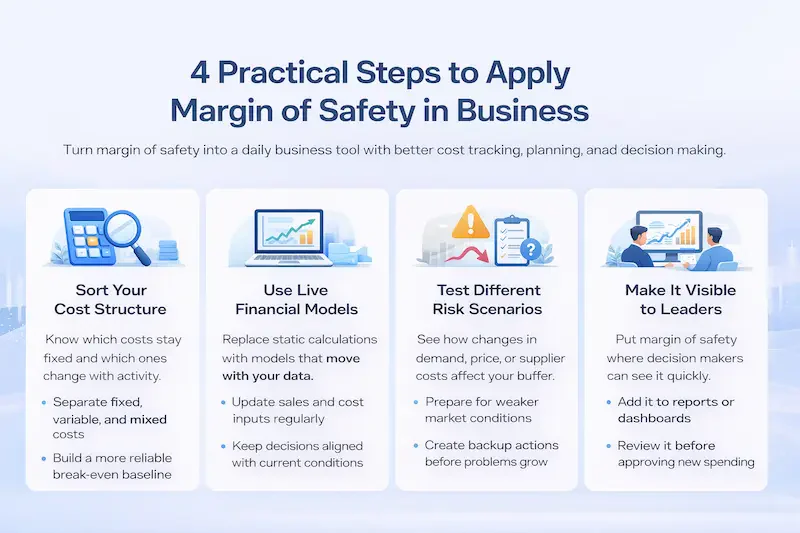
Transitioning the margin of safety from a theoretical concept into a practical business tool requires a structured approach. To make it useful, your team needs clear calculations, relevant data, and regular review.
Step 1: Rigorous Cost Classification
The foundation of any accurate margin of safety calculation is the precise separation of fixed and variable costs. Management must audit the general ledger to categorize expenses carefully. You also need to review mixed costs, such as utilities, because they often include both fixed and variable elements.
Methods like the high low method or regression analysis can help split these costs more accurately. This step matters because the break even point will only be reliable if the cost base is correct.
Step 2: Dynamic Break Even Modeling
Once costs are accurately classified, businesses should build dynamic break even models instead of relying on static spreadsheets. With the right FP and A tools, you can update the break even point and margin of safety automatically as sales data changes.
This gives management a more current view of risk and helps prevent decisions based on outdated numbers.
Step 3: Scenario Planning and Stress Testing
A calculated margin of safety becomes more valuable when tested under pressure. Companies should run what if scenarios to see how changes in cost, pricing, or demand could affect the business. For example, you can test what happens if supplier costs rise or market prices fall.
This helps leadership prepare backup plans early instead of waiting until the pressure becomes a real problem.
Step 4: Integration into Executive Dashboards
The margin of safety should not be buried in a quarterly financial report. It should be visible enough to support faster and better decisions. Integrating this metric into executive dashboards helps leadership stay aware of the company’s current risk buffer.
When a new spending proposal comes up, the real question is whether it strengthens your growth plan or puts more pressure on your margin of safety.
Common Mistakes in Margin of Safety Analysis
Despite its usefulness, the margin of safety can still create a false sense of security if the analysis behind it is inaccurate. That is why you cannot rely on this metric without checking the assumptions that support it.
- Misclassifying Step Fixed Costs: Many businesses treat step fixed costs as fully fixed, even though these costs can rise once capacity passes a certain point. This can make your margin of safety look wider than it really is. If sales fall slightly, you may not be able to remove that added cost right away, which puts more pressure on profit.
- Ignoring the Sales Mix: For businesses selling multiple products, the margin of safety also depends on the sales mix because each product has a different contribution margin. This becomes risky when you assume customers will keep buying the same product mix during a slowdown. In reality, they may switch to lower margin products, which can weaken your safety buffer even if total sales volume does not change much.
- Relying on Static Pricing Assumptions: Margin of safety calculations often assume that selling prices will stay the same when sales begin to decline. But in reality, weaker demand often pushes businesses to offer discounts or promotions. This lowers the contribution margin, raises the break even point, and can shrink the safety buffer faster than expected.
"A margin of safety is only as reliable as the assumptions behind it. If your cost structure, sales mix, or pricing outlook is off, the buffer can quickly look stronger than it really is."
Advanced Practices in Margin of Safety Analysis
For organizations looking to strengthen financial risk management, basic break even analysis is only the starting point. To get deeper insight, you need a more detailed approach that shows where your risk really comes from.
1. Multi Product Margin of Safety and Weighted Averages
Instead of relying on one blended margin of safety, advanced FP and A teams often calculate it by product, region, or sales channel. This helps you see which areas support profitability and which ones put more pressure on the business. By using a Weighted Average Contribution Margin, companies can make more focused decisions on cost control or marketing spend.
2. Integrating Probabilistic Models
Traditional margin of safety calculations usually produce one result based on fixed assumptions. More advanced analysis adds probability to the picture. By testing changes in costs, labor, or demand across many possible outcomes, you can estimate how likely your safety buffer is to stay at a healthy level instead of relying on one fixed forecast.
3. Margin of Safety in Capital Budgeting
The margin of safety is also useful in capital budgeting and project evaluation. When a company reviews a major investment, such as opening a new location or acquiring another business, it needs to know how much projected cash flow can fall before the project stops being financially attractive.
This kind of buffer helps you choose projects that can still hold up when execution is weaker than expected or market conditions become less favorable.
Conclusion
Margin of safety is more than just a financial formula. It helps you understand how much pressure your business can take before profitability starts to weaken. By looking at the gap between actual sales and the break even point, you can assess risk more clearly and make decisions with a stronger financial foundation.
This metric also becomes more useful when you connect it with cost structure, pricing strategy, profitability, and business planning. Whether you are reviewing product performance, testing growth scenarios, or preparing for market uncertainty, margin of safety gives you a more practical way to measure stability and respond before problems become harder to manage.
If you want to improve how your business tracks costs, evaluates profitability, and makes better financial decisions, this is the right time to take the next step. You can start by reviewing your current financial processes and identifying where better visibility can strengthen your margin of safety. For a more tailored approach, consider a free consultation to explore the right strategy for your business needs.

FAQ About Margin of Safety
Margin of safety is important because it shows how much your sales can decline before your business starts losing money. This helps you measure risk more clearly, especially when demand changes, fixed costs rise, or pricing pressure increases. It also supports better budgeting, planning, and profitability management.
There is no single benchmark for a good margin of safety because it depends on your industry, cost structure, and demand conditions. In general, a higher margin of safety is considered healthier because it gives your business more room to stay profitable during weaker market periods.
Yes, margin of safety can be misleading if the assumptions behind the calculation are inaccurate. Misclassified costs, changes in sales mix, or unexpected price discounts can make the safety buffer look stronger than it really is. That is why it should always be reviewed alongside updated data and realistic business assumptions.
Margin of safety is the difference between actual sales and break-even sales, showing how much sales can drop before a business starts losing money. Break-even point (BEP), on the other hand, is the exact level of sales needed to cover total costs with no profit or loss. In simple terms, BEP tells you the minimum sales target to avoid losses, while margin of safety shows how far your current sales are above that point.
A company can improve its margin of safety by increasing sales, lowering fixed costs, reducing variable costs, improving product mix, and applying pricing strategies more carefully. Better cost control and scenario planning can also help protect profitability when market conditions change.