












Is inventory better owned upfront, paid only after it sells, or managed under a shared agreement with suppliers? Should stock be available on-site without immediate financial commitment?
For operations managers, finance teams, and business owners overseeing stock movement, this arrangement often shows up in daily coordination with suppliers. It supports floor availability while keeping working capital flexible and under control.
When inventory visibility, accountability, and cash efficiency need to move together, this model fits naturally into modern supply chains. This is why consignment inventory is well known among businesspeople.
Key Takeaways
|
What Is Consignment Inventory?
Consignment inventory is a supply chain model in which a supplier places goods with a retailer without an upfront payment. Ownership remains with the supplier until the goods are sold to the end customer.
This arrangement involves two main parties: the consignor, who supplies the finished stocks, and the consignee, who sells them. They share responsibility for ensuring the products reach the market effectively.
1. Definition of consignment inventory
Consignment inventory refers to a supply chain model where goods are held and sold by a retailer (the consignee) on behalf of a supplier (the consignor). Crucially, the consignor maintains ownership of the inventory until it is purchased by an end customer. Upon sale, the consignee pays the consignor for the item, retaining a percentage of the sales revenue as their commission. This arrangement effectively allows the retailer to stock their shelves without any initial investment in inventory, thereby freeing up cash flow and significantly reducing the financial risk of carrying slow-moving or obsolete products.
2. Key differences from traditional inventory models
The primary distinction between consignment and traditional inventory models lies in ownership, risk, and payment timing. In a traditional model, the retailer purchases goods directly from the supplier, immediately taking ownership and assuming all associated risks, including storage costs and potential losses from unsold stock. Payment is typically made to the supplier under agreed credit terms, regardless of whether the goods have been sold. In contrast, the consignment model retains ownership and risk with the supplier until the point of sale, and payment is triggered only by an actual transaction with a customer, creating a more flexible, less capital-intensive system for the retailer.
3. Parties involved: Consignor and Consignee
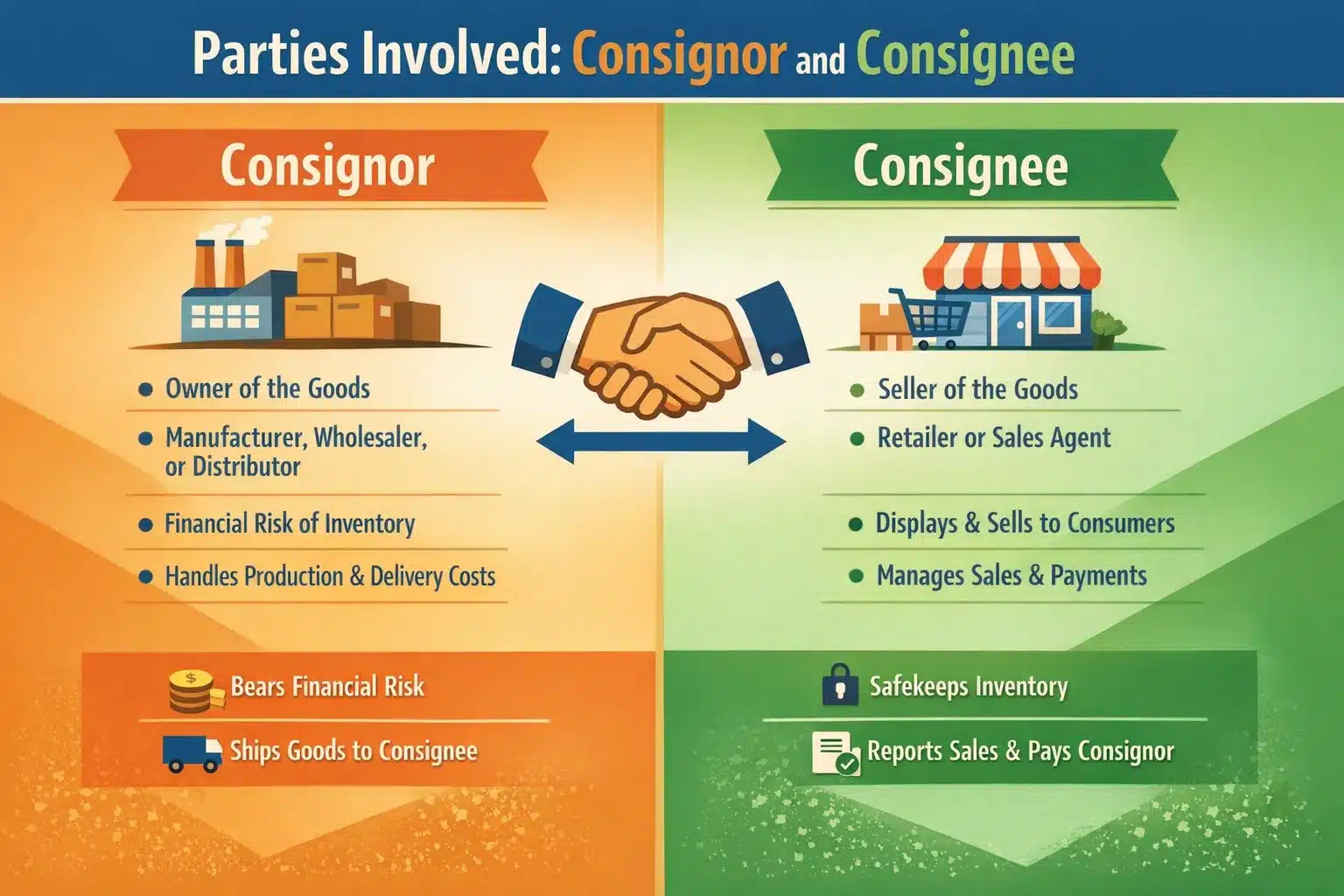
Every consignment transaction involves two key parties, each with a clearly defined role. The Consignor is the owner of the goods—typically a manufacturer, wholesaler, or distributor—who provides the products to be sold. They bear the financial risk of the inventory and are responsible for its production and initial delivery costs. The Consignee is the seller—usually a retailer or an agent—who receives the goods, provides the physical or digital space to display them, and facilitates the sale to the final consumer. The consignee is responsible for the safekeeping of the goods, accurate sales tracking, and timely reporting and payment to the consignor.
To have a better understanding, check out this infographic.
How Does the Consignment Inventory Process Work?
Implementing this model requires a clear understanding of the workflow from agreement to payment. Here are the specific steps involved in the process.
- Drafting the agreement: Both parties sign a contract detailing terms such as commission rates and payment schedules. This document serves as the legal foundation for the entire partnership.
- Shipping the goods: The consignor sends the inventory to the retailer while retaining legal ownership. The retailer receives the stock and prepares it for display without paying upfront, supported by real-time inventory management to keep quantities and movements accurate.
- Selling to customers: The retailer actively markets and sells the products to the final consumer. Once a sale occurs, the ownership transfers to the buyer instantly.
- Reconciliation and payment: The retailer generates a sales report detailing sold items and calculates the amount due. Payment is then remitted to the consignor minus the agreed commission.
Benefits of the Consignment Inventory Model for Businesses
This model creates a symbiotic relationship that offers distinct advantages for both sides. Below are the specific benefits for suppliers and retailers.
1. For Suppliers (Consignors)
- Suppliers can place products in new locations without investing in their own stores.
- It allows manufacturers to test new items with minimal financial risk.
- Suppliers can increase brand visibility by leveraging the retailer’s existing foot traffic.
2. For Retailers (Consignees)
- Retailers stock shelves without incurring upfront capital costs for inventory purchases.
- They can return unsold goods to the supplier, avoiding obsolescence-related losses.
- Retailers can offer a wider variety of products to their customers risk-free.
Challenges in Consignment Inventory and How to Overcome Them
While beneficial, this model comes with specific hurdles that need careful management. Here are the risks and how to handle them effectively.
1. Risks for Suppliers (Consignors)
- Delayed revenue: Cash flow can be tight since payments only arrive after sales are made. Suppliers should negotiate shorter payment terms to mitigate this financial strain.
- Inventory loss: Goods located off-site are harder to monitor and protect from theft. Implementing strict tracking protocols helps reduce the risk of shrinkage.
2. Risks for Retailers (Consignees)
- Tracking complexity: Separating consigned stock from owned inventory can be confusing manually. Using automated systems ensures accurate segregation and reporting.
- Space management: Storing slow-moving items can waste valuable retail floor space. Retailers must regularly review sales data to optimize shelf allocation.
Key Elements in a Strong Consignment Agreement

A solid contract prevents disputes and ensures smooth operations between partners. These are the essential elements to include.
- Ownership terms: The contract must state that the consignor retains title until the point of sale. This protects the supplier’s assets in the event of a retailer’s bankruptcy.
- Payment terms: Clearly define when and how the consignee must remit payments to the consignor. For example, payments might be scheduled monthly based on sales reports.
- Liability clauses: Specify who is responsible for insurance and damages while goods are in the store. This clarifies who pays if inventory is stolen or destroyed.
- Termination policy: Include procedures for ending the agreement and returning unsold goods. This ensures a clean exit strategy for both parties if the partnership ends.
Managing Consignment Inventory Effectively with Technology
Manual tracking is prone to error, making technology indispensable for efficiency. Here is how digital tools streamline the operation.
- Real-time tracking: Systems monitor stock levels in real time across multiple locations. This allows suppliers to see exactly what is on the shelf at any moment.
- Automated invoicing: Software, for example, invoice-generation software, generates bills immediately based on sales data entered at the POS. This removes the need for manual calculations and speeds up payments.
- Data integration: Platforms connect inventory data directly with accounting records. This ensures that financial statements always reflect the current stock status.
KPI Metrics for Consignment Inventory
Measuring performance is vital to determine if the consignment strategy is working. These metrics provide the necessary insights.
- Inventory turnover: This measures how frequently the consigned stock is sold and replaced. A high ratio indicates efficient sales and good product demand, and it also supports data-driven demand planning.
- Sell-through rate: This compares the amount of inventory sold against the amount received. It helps identify which products are performing best in specific locations.
- Days’ sales of inventory: This metric calculates the average number of days it takes to sell stock. It highlights slow-moving items that may need to be discounted or removed.
Singapore Regulations Section
Operating a consignment arrangement in Singapore requires more than commercial alignment between parties, as it is shaped by clear regulatory and legal frameworks. Understanding how local tax, registration, and contract rules apply helps businesses structure consignment transactions with confidence and compliance.
1. GST Treatment
In a consignment arrangement, the standard 9% GST treatment generally applies when the goods are sold to the final customer, not when they are merely delivered to the consignee. Since the consignee executes the sale, they are responsible for collecting and remitting GST to IRAS, with options such as self-billing available, while overseas consignors may fall under the Overseas Vendor Registration (OVR) regime for certain B2C transactions.
2. ACRA & Business Registration
Both the consignor and consignee should be registered with ACRA and hold a valid UEN, as this is the official identifier used for invoices, contracts, and regulatory filings. For higher-value consignment transactions, a Private Limited Company (Pte Ltd) structure is often preferred for clearer governance, while companies must also meet ongoing requirements, such as annual returns and the appointment of a company secretary.
3. Consignment Agreement Requirements
Singapore follows a common law system rooted in English contract law, making clear, well-drafted agreements especially important for consignment arrangements. Key clauses typically cover ownership, risk of loss, governing law, and dispute resolution. Where a sale occurs, the transaction may also be governed by the Sale of Goods Act (Cap. 393).
How Abbott Optimize Their Consignment Inventory with Inventory App
Managing consignment inventory across healthcare environments requires precise visibility and disciplined tracking to avoid stock gaps or excess. This is where Abbott, a pharmaceutical company, leverages an integrated inventory app to maintain control over supplier-owned stock placed at customer sites while keeping operations efficient and compliant.
- Keeps consigned diagnostic supplies visible at hospital and lab sites
Abbott can track supplier-owned reagents and consumables stored at customer locations, so both sides know what’s available for daily testing without relying on manual checks. - Supports faster intake and movement tracking to reduce admin work
Instead of logging every item in spreadsheets, Abbott can use an inventory app to capture receiving and stock movements more consistently, helping prevent “lost” consignment stock. - Prevents stockouts that could interrupt testing workflows
By monitoring usage patterns and minimum levels, Abbott can replenish critical supplies before a lab runs short, helping customers keep testing operations running smoothly. - Flags expiry and slow-moving items early
Since many healthcare items have strict shelf-life rules, early alerts help Abbott rotate inventory sooner and reduce waste from expired consigned stock. - Makes replenishment more accurate by using real consumption data
Consignment works best when refill decisions follow actual usage, and an app helps Abbott plan restocking based on what was consumed, not estimates. - Standardizes consignment control across multiple customer locations
When Abbott supports large hospital groups with several sites, one system helps keep processes consistent, from stock rules to reporting and replenishment.
Conclusion
Consignment inventory offers a flexible way to expand business reach while minimizing financial risk. It aligns the interests of suppliers and retailers toward shared growth.
Are you interested in taking the next step to optimize the management of consignment inventory? Consult with our experts to align your business needs, gain clearer control over consigned goods, and improve inventory visibility and stock management with your operational goals.
FAQ About Consignment Inventory
-
What is the main difference between consignment inventory and Vendor-Managed Inventory (VMI)?
The key difference is ownership. In consignment, the supplier owns the goods until they are sold. In VMI, the customer (retailer) usually takes ownership upon receipt, but the supplier is responsible for monitoring and replenishing stock levels.
-
Who typically bears the shipping costs in a consignment model?
This is negotiable and must be clearly defined in the consignment agreement. Often, the consignor covers the initial shipping cost to the consignee’s location, while costs for returning unsold goods may be shared or negotiated.
-
What happens to unsold consignment goods?
Unsold goods from a specified period are typically returned to the supplier (consignor). The procedures, timing, and cost responsibilities for these returns must be detailed in the agreement to prevent disputes.
-
Is the consignment model suitable for all industries?
Not always. It is most effective for products with uncertain demand, luxury items, products with a short lifecycle (like seasonal goods), or when introducing new products. Industries like retail, furniture, and electronics often benefit greatly from this model.
-
How are taxes (like VAT) handled in consignment transactions?
Tax rules can vary, but generally, Value Added Tax (VAT) is due when ownership transfers, i.e., at the point of sale to the end customer. The consignee is usually responsible for collecting and remitting the tax, and it’s crucial to consult a tax professional to ensure compliance.