







 Limited to 100 registrants

The business landscape of 2026 demands unparalleled speed and precision. Modern commercial teams face complex purchasing cycles and buyers who expect instant, highly personalized responses at every single touchpoint.
It is no longer enough to simply react to customer requests; businesses must anticipate needs before the client even realizes they have them. In response, enterprises are moving away from manual data entry and disjointed software platforms. They are fully embracing sophisticated digital infrastructures that can scale dynamically alongside their expanding business operations.
Managing this level of complexity requires a fundamental change in how retail and B2B businesses approach their backend processes. The sheer volume of data generated by modern consumers is practically impossible to process efficiently without automated systems. As global competition increases and profit margins tighten, businesses must find ways to optimize every single interaction.
This necessity has sparked a rapid evolution in how companies manage their sales pipelines, forcing a transition toward highly integrated technological solutions that completely redefine commercial workflows.
Key Takeaways
AI business software qualifies inbound leads, answers early questions, and routes high-value prospects, so reps spend their time on negotiation rather than admin.
Machine learning turns revenue forecasting into a data-driven process by reading historical deals, engagement signals, and pipeline trends to flag stalled work early.
Connecting sales data to inventory, logistics, and finance removes manual reconciliation and keeps delivery promises accurate across every location.

Automating Customer Engagement
"Every enquiry now gets a response within minutes, not the next business day. The software handles the first round of questions and passes the serious buyers straight to us, so our reps walk into conversations that are already halfway qualified."
To maintain a competitive edge, modern sales teams are adopting specialized digital tools designed to streamline the entire customer acquisition process. A major component of this shift involves utilizing an AI inbound agent to handle initial inquiries.
This specific sales tech application operates autonomously to qualify leads, answer preliminary questions, and route high-value prospects directly to human representatives. Managing the frontlines of customer interaction ensures that no inquiry goes unanswered while significantly reducing the administrative burden on the core sales team.
This shift toward intelligent automation allows businesses to scale their operations without proportionally increasing their administrative overhead.
When software handles the initial stages of consumer interaction, human agents are freed up to handle complex negotiations and bespoke customer service requests.
This strategic allocation of resources drastically shortens the overall sales cycle and significantly improves conversion rates. The result is a leaner, far more agile sales force capable of handling high transaction volumes with exceptional precision and speed.
Once sales, supply chain, and finance sit on the same data, the next gain comes from being able to ask that data a question. Hashy, HashMicro's AI Coworker, reads those connected records through the Company Nexus, so a manager can check stock, margin, or branch performance without waiting on a report.






Enhancing Forecasting and Pipeline Visibility
The integration of machine learning into CRM platforms is fundamentally changing how commercial leaders predict revenue. Rather than relying on gut feelings or static spreadsheets, modern software analyzes historical deal data, engagement signals, and pipeline trends to provide highly accurate forecasts.
For managers looking to optimize pipeline efficiency, this level of real-time visibility is absolutely critical. Predictive analytics can highlight risks early, flagging stalled deals before they become permanent losses.
Analytical approaches ensure that resources are allocated exactly where they will have the highest impact. Teams can view momentum scores and instantly understand the health of their active deals.
Furthermore, these platforms can recommend the next best action for representatives to take, ensuring that every follow-up is timed perfectly to maximize engagement. This level of granular visibility transforms revenue forecasting from a chaotic guessing game into a reliable, data-driven science.
Integrating Operations Across Multiple Locations
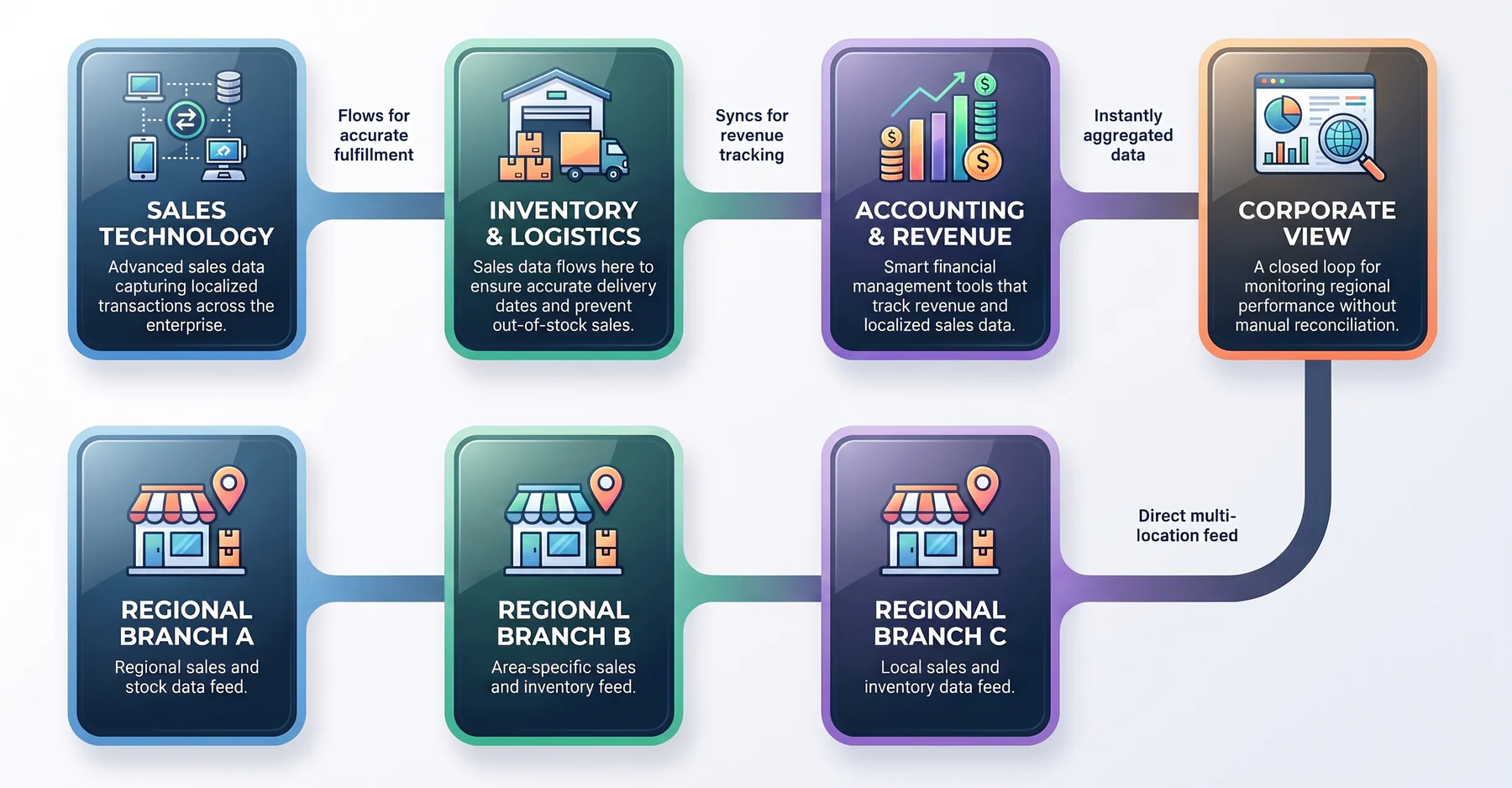
Advanced sales technology does not operate in a vacuum. It must connect seamlessly with broader enterprise operations to be truly effective.
For businesses managing complex supply chains and physical inventory, understanding the core distribution definition is just the beginning. Sales data must flow directly into inventory and logistics platforms to ensure that promised delivery dates are accurate and achievable. This prevents representatives from selling products that are out of stock, protecting the brand reputation and ensuring smooth fulfillment.
This interconnectivity extends directly into accounting and revenue tracking. Integrating sales pipelines with tools designed for smart financial management for multi-location business structures ensures that localized sales data is instantly aggregated at the corporate level.
A unified ecosystem creates a closed loop of data, allowing executives to monitor performance across various regional offices without manual reconciliation. By breaking down the silos between sales, supply chain, and finance, companies can operate with unprecedented agility.
The Changing Role of the Human Representative
The rapid advancement of these platforms frequently sparks debate about the future of human sales roles.
However, industry experts often discuss why your next top sales performer might actually be a digital assistant rather than a replacement. The technology acts as a force multiplier. It provides representatives with real-time insights, automated follow-up scheduling, and personalized outreach templates based on behavioral data.
The adoption of comprehensive sales automation does not eliminate the need for human empathy or complex problem-solving.
Instead, it removes the friction of manual research and data entry. This allows representatives to spend the majority of their time actually speaking with clients and building genuine relationships. The human element becomes more valuable, not less, as the surrounding technology handles the mundane administrative tasks.
Sustaining Commercial Growth

The shift toward intelligent business software is becoming a critical step for businesses that want to scale effectively. From automating early lead qualification to improving revenue forecasting, modern platforms give businesses the visibility and efficiency they need to make better decisions and respond faster to market changes.
Investing in smarter digital tools is a practical choice for companies looking to improve their operations while delivering more relevant experiences for customers.
Businesses that continue relying on outdated systems risk falling behind competitors that can adapt faster, forecast with greater accuracy, and respond more effectively to customer needs.
The commercial leaders of the next decade will be those that treat technology as more than a support function and make it a central part of their growth strategy.
Conclusion
AI business software earns its place by removing friction rather than removing people. Automated lead qualification, predictive forecasting, and connected inventory and finance data give commercial teams a clearer view of the pipeline and faster answers for customers.
The businesses that pull ahead will treat these platforms as part of how they grow, not as a support function bolted on the side. Start with the workflow costing your team the most hours, prove the gain, then expand. To see how connected sales, inventory, and finance data could work across your business, book a free consultation with HashMicro.

Frequently Asked Questions
AI business software uses machine learning to handle commercial tasks that once needed manual effort, such as qualifying inbound leads, forecasting revenue, and updating records. It reads live business data rather than working from static reports, so its output reflects what is actually happening. Most platforms sit across sales, inventory, and finance rather than in one department alone.
Common examples include AI inbound agents that qualify leads and book meetings, predictive forecasting tools inside CRM platforms, automated invoice and document processing, and demand planning for inventory. Many businesses also use AI layers built into their ERP so sales, stock, and finance data feed the same system. The right mix depends on which workflow currently costs the most manual hours.
Pricing depends on deployment type, user count, required modules, and how much integration work the rollout needs. Standalone tools often charge per user each month, while connected suites price around the modules a business uses. Ask for a quote based on your actual team size and workflow rather than the advertised entry price.
Yes, and the connection is where most of the value sits. Sales data needs to reach inventory and logistics so delivery dates stay accurate, and it needs to reach accounting so revenue tracking stays current without manual reconciliation. Confirm which connectors ship as standard and which need custom development before you commit.
No, it removes the manual research and data entry that fill a rep day rather than the judgement they bring. Automated tools handle early qualification and follow-up scheduling, so representatives spend more time in live conversations and complex negotiations. Most businesses use it to lift capacity per rep instead of reducing headcount.