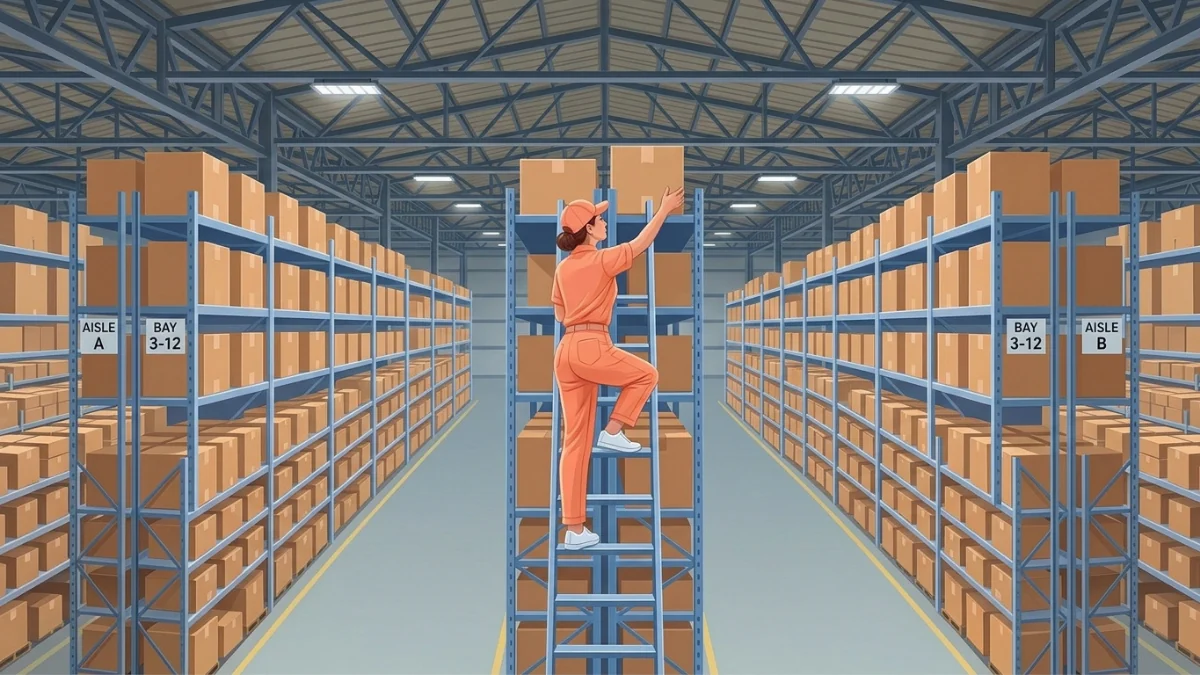







Have you ever felt frustrated to see products just sitting on your shelves, gathering dust and tying up funds that could be used elsewhere? Dead stock is not only a nuisance but also a silent profit killer, inflating storage costs and even rendering your inventory obsolete.
Effective management of dead stock is essential for maintaining financial health and optimizing operational space. Identifying the root causes of unsold inventory and using targeted strategies to convert it into revenue helps prevent the costly cycle of overstocking. Read on to find methods to revitalize your inventory management and boost profitability!
Key Takeaways
Deadstock refers to unsold inventory that remains on shelves, tying up capital and occupying valuable space that could be used for more profitable products.
Employing strategies such as using advanced inventory management tools, engaging in strategic discounting, and repurposing products can help businesses convert dead stock into profit.
Implementing systems is crucial for monitoring stock levels and reducing the occurrence of dead stock, ultimately improving business profitability
What is Dead Stock?
 Deadstock refers to unsold inventory that remains on shelves well past its expected selling period, posing a risk of never being sold. Additionally, this type of stock can include various items, whether locally produced or sourced from suppliers, tying up valuable capital.
The ongoing presence of deadstock isn’t just about space; it locks in capital that could be used for more profitable ventures or improving operational efficiency. Furthermore, without proper inventory management systems, deadstock accumulation often goes unnoticed, quietly draining finances and affecting cash flow.
Businesses without robust systems may struggle to identify dead stock, turning potential assets into hidden financial burdens. As a result, cash flow and operational agility are severely impacted, hindering overall growth and efficiency.
Why is Dead Stock Bad for Businesses?
Dead stock is a significant concern for businesses because unsold inventory symbolizes missed opportunities and misallocated resources.
Here are five critical ways dead stock negatively impacts businesses:
- Capital Tie-Up: Deadstock represents a substantial financial burden as it ties up capital that could otherwise be allocated to developing new products or expanding business operations.
- Increased Storage Costs: Holding onto unsold items for an extended period increases storage and maintenance costs.
- Lost Opportunity for Sales: Space taken up by dead stock can be better utilized to display new, trending items that draw in more customers and boost sales.
- Risk of Obsolescence: Products that remain in inventory for too long may become obsolete, especially in fast-moving industries like technology and fashion.
- Damage to Brand Reputation: Excessive amounts of dead stock can indicate poor management and inefficiency, potentially damaging a business’s reputation among suppliers and customers.
Effectively managing dead stock with advanced inventory systems helps businesses optimize inventory levels and improve cash flow. Moreover, it enhances overall operational efficiency by ensuring better resource allocation and smoother workflows.
What are the Causes of Dead Stock?

Understanding the root causes of dead stock is crucial for businesses as it helps develop strategies to prevent inventory stagnation and financial loss.
Here are the primary causes of dead stock:
- Poor Demand Forecasting: Incorrect predictions about customer demand can lead to overstocking certain items with a buffer stock. When predictions fail to align with actual consumer behavior, the surplus stock becomes dead stock.
- Market Trends Shift: Rapid changes in market trends can make products obsolete or unfashionable before you sell them. Businesses that fail to respond quickly to these shifts risk accumulating dead stock.
- Excessive Bulk Purchases: Purchasing large quantities of items to secure a lower price often results in an excess stock that remains unsold for an extended period, particularly when you overestimate product demand.
- Inadequate Market Research: Not understanding the target market deeply can lead to stocking products that do not meet the needs or preferences of potential customers, leading to prolonged shelf life and eventually, dead stock.
- Lack of Product Variety and Differentiation: Offering products that are too similar to each other or to those offered by competitors can dilute customer interest and reduce sales, increasing the chances of items becoming dead stock.
To address these challenges effectively, businesses should adopt proactive measures like conducting regular market research and using advanced forecasting techniques. Additionally, being cautious with bulk purchases helps prevent overstocking and reduces potential dead stock.
The Impact of Dead Stock on Filipino Businesses
Deadstock is one of the biggest hurdles for Filipino businesses. Without you knowing it, it will drain your cash flow as those goods sit in storage for months, if not years. This reduces liquidity, limiting a company’s ability to invest in faster-moving inventory, marketing, or even day-to-day operations. For Filipino businesses that need to stay flexible amid changing customer demand, this can create serious pressure on both profitability and working capital.
Deadstock takes away money, but also space. It occupies valuable warehouse and retail space that businesses could use for profitable items. Thus, storage costs increase as they have to spend more on storage, handling, insurance, and stock monitoring. As deadstock ages, it can become obsolete, damaged, or expired. Not only that, but crowded warehouses also slow inventory tasks, reduce stock visibility, and increase the risk of poor replenishment decisions.
Common Causes of Dead Stock in the Philippines
Filipino Businesses can prevent deadstock more effectively when they understand what creates it. In the Philippines, deadstock often is the result of planning gaps, weak stock visibility, and fast-changing local demand. These issues can hurt retailers, pharmacies, groceries, and distributors that rely on limited storage space and tight working capital.
Here are the common causes of deadstock in the Philippines:
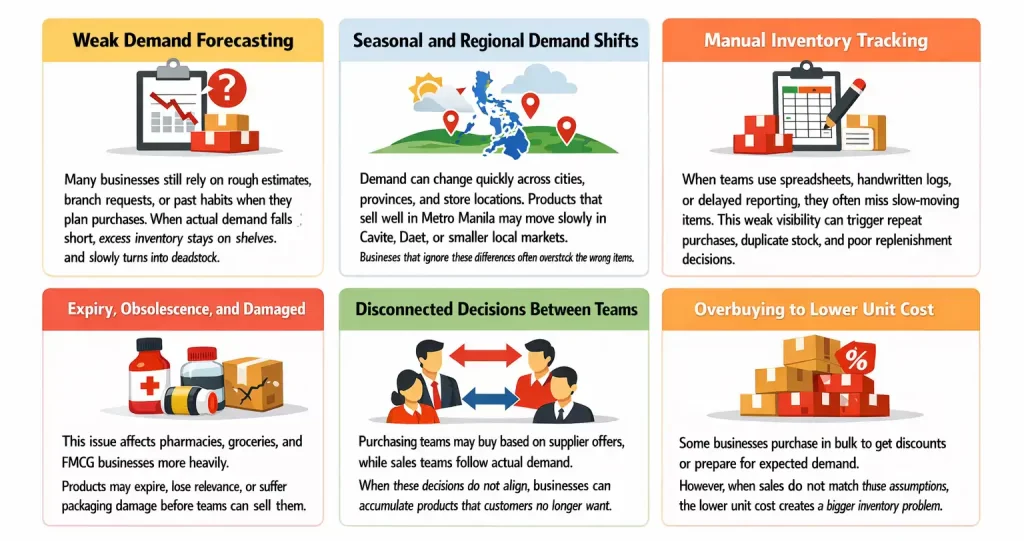
To identify these problems before it becomes big, Filipino businesses should do an annual self-diagnosis. Modern inventory tools can help you make the task of finding deficiencies easier and faster.
Solution for Filipino Businesses
Proactive inventory management helps businesses prevent deadstock and protect profits. Companies should improve stock visibility to identify slow-moving items, monitor turnover, and make better purchasing decisions. They should also strengthen forecasting by using historical sales data, seasonal trends, and real-time inventory reports. This approach helps businesses match stock levels with actual demand and avoid tying up capital in products with weak sales potential.
Regular inventory reviews help businesses spot risks before items become unsellable. Identifying problems earlier, like aging stock, turnover rates, and product performance will give teams the chance to act earlier through promotions, bundling, reorder adjustments, or stock clearance. An inventory management system makes this process faster and more accurate. With real-time tracking and automated planning, businesses can reduce deadstock, improve warehouse efficiency, and focus on more profitable products.
Real Life Examples in the Philippines
Now that you know the common problems and solutions to deadstock for Filipino businesses, it’s time to see real case studies to see how these common problems can be solved realistically.
A 2024 study on 50 small-scale pharmacies in Cavite showed how Filipino businesses manage the risk of deadstock effectively. Many pharmacies use EOQ for purchase planning, FSN analysis to identify fast, slow, and non-moving items, and FEFO to handle products with expiry risk. These practices helped businesses monitor stock movement more closely and reduce overstock exposure.
A 2021 study on 150 MSM grocery stores in Daet, Camarines Norte, showed that many retailers had no assigned inventory personnel. The research also found that many stores still relied on manual physical counting instead of real-time stock recording. These gaps can make it harder to spot slow-moving items early, which increases the risk of excess stock and deadstock. This shows that there is a need for modernization by using an inventory system paired with the right POS system to transition to automated counting.
How to Turn Dead Stock into Profit

Transforming deadstock into profit is a crucial strategy for Filipino businesses looking to improve their bottom line. By proactively addressing the causes of deadstock, businesses can not only recoup their investments but also enhance their operational efficiency.
Here are five practical approaches that can help turn unsold inventory into profit:
- Product Repurposing: Repurpose deadstock by redesigning or repackaging items. This can align with current market trends and appeal to different customer segments.
- Strategic Discounting: Use targeted discount strategies like flash sales or exclusive offers to loyal customers. Making deadstock more attractive while preserving profit margins.
- Bundling Products: Bundle deadstock with best-selling items to increase the overall purchase value and clear out unsold inventory without heavy discounting.
- Online Marketplaces and Pop-up Sales: Use online platforms or pop-up sales to reach a wider audience. Reviving interest in deadstock through novelty and limited-time offers.
- Incentivize Bulk Purchases: Encourage bulk purchases by offering discounts or added benefits, appealing to resellers or businesses that can absorb larger stock quantities.
To effectively implement these strategies, the use of sophisticated inventory management tools becomes essential. By leveraging technology, businesses can ensure that current inventory issues are addressed and that future accumulation of unsold products is prevented.
Manage Dead Stock with a Cloud Inventory System
A cloud inventory system helps businesses manage dead stock more effectively by giving teams real-time access to inventory data. It gives better visibility across warehouses, branches, and sales channels. With it, companies can track stock movement faster, reduce excess inventory, and make better purchasing decisions before slow-moving items turn into dead stock. For that reason, it is advisable for you to find the right cloud inventory software that can integrate with your system and operations well.
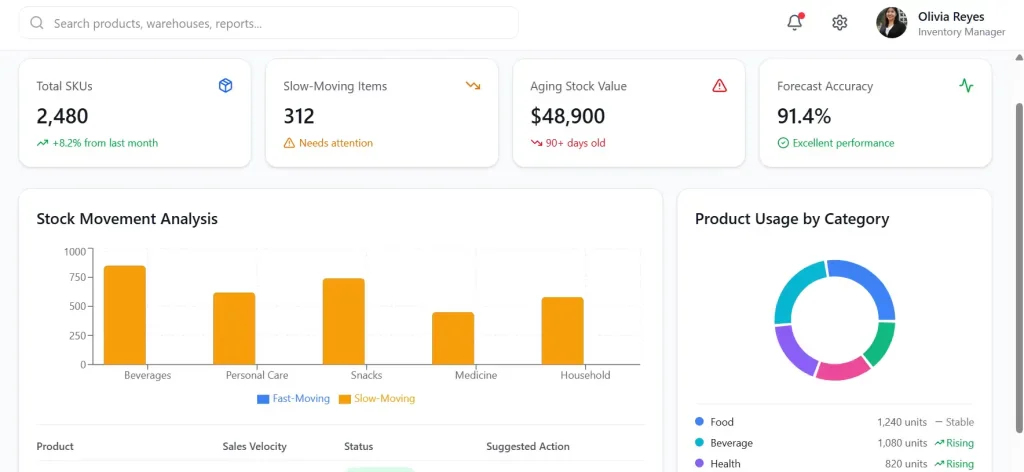
Features that help minimize dead stock:
- Fast-Moving and Slow-Moving Stock Analysis: A cloud inventory system can track sales velocity and identify products that move too slowly. This helps businesses take action early through promotions, stock transfers, or purchasing adjustments.
- Stock Aging Reports: This feature shows how long items have remained in storage. Businesses can quickly detect aging products and prevent them from becoming obsolete, expired, or harder to sell.
- Warehouse Stock Optimization: A cloud-based system helps businesses monitor stock levels across multiple warehouse locations in one platform. This makes it easier to avoid overstocking in low-demand locations and distribute stock more efficiently.
- Product Usage and Category Tracking: The system records how often products sell and groups them based on movement trends. As a result, businesses can identify low-performing items and focus on products with stronger turnover.
- Demand Forecasting Tools: Cloud inventory systems can use historical sales data and demand patterns to support more accurate forecasting. This helps businesses plan stock levels more carefully and reduce the risk of overbuying.
When businesses combine these features with a structured approach like FEFO, they can move at-risk stock faster and reduce waste from aging inventory. As a result, a cloud inventory system can improve inventory turnover, strengthen stock control, and support healthier profitability.
Conclusion
Managing deadstock is a prevalent challenge for retailers in the Philippines. By grasping the full implications of deadstock and adopting effective strategies, businesses can significantly reduce their negative impact. For retailers looking to optimize their inventory management and turn potential losses into gains, trying out the best system can be a pivotal first step. Those inventory systems provide essential tools that enhance inventory management, decrease deadstock, and boost profitability.
FAQ for Dead Stock
Deadstock generally accumulates when products don’t sell, often due to overestimating demand or changing market trends. Consequently, this leads to unsold inventory, which can negatively affect profitability and storage space.
Businesses usually identify dead stock by monitoring inventory that remains unsold for a designated period. Moreover, using inventory management systems ensures more accurate tracking and timely identification of such items.
Eliminating dead stock frees up storage space and capital, allowing you to use these resources for more profitable items. Furthermore, this process enhances overall business efficiency by optimizing resources for better returns.
Common deadstock items include expired food and beverages, outdated electronics, seasonal products, old fashion inventory, damaged goods, and slow-moving FMCG items. Businesses also often find deadstock in products with low demand, discontinued models, or items purchased in excess.>
Businesses usually record deadstock by identifying unsold or non-moving items in their inventory system, then tagging them as slow-moving, obsolete, expired, or unsellable. They should update the item status, note the quantity, record its current value, and document the reason it became deadstock for reporting and decision-making.>